
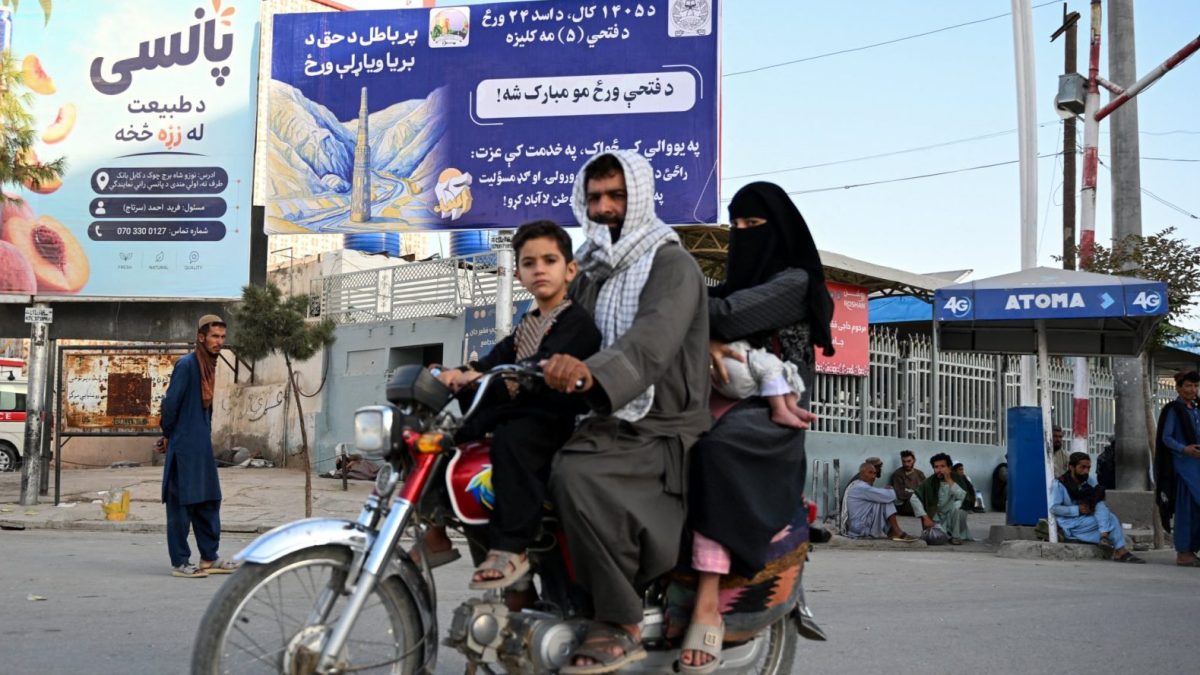
Five years after the Taliban swept back into power in Afghanistan, life is still getting worse for women and girls, who can barely leave their homes. The regime has now issued about 200 decrees restricting freedom for the female population, including prohibiting girls over 12 from attending school, barring women from university and nearly all forms of employment and forbidding them from leaving the house without being completely covered and accompanied by a male guardian. One of the Taliban’s latest decrees permits men to beat their wives, provided they do not break any bones or leave visible, lasting wounds. Another makes it far harder for a woman to leave a marriage, while preserving men’s right to divorce, and implicitly permits child marriage. Half of Afghan women now leave home only once or twice a month because of the severe restrictions on their movement and access to public spaces, according to UN Women. “As a woman, we can’t easily go out to buy something for ourselves and bring it back,” Prima, 23, told The i Paper. “For example, shopping for groceries, whatever we need, that responsibility falls on our husbands. He is the one who has to go and get things for the house.” Afghan girls are no longer educated beyond primary school (Photo: AFP) Prima was recently forced to return to Afghanistan after eight years living in Iran with her family and working as an embroiderer. They now live in a compound with collapsed ceilings. “All our possessions, whatever we had, we spent on travel expenses to return to Afghanistan,” she told The i Paper. “We have nothing to eat, nothing to wear.” Prima’s husband is unemployed, and she cannot work because of the Taliban’s ban. “I’m an embroiderer, so I could work from home, if I had a machine” she said. “It’s within my ability. With that work I could at least cover my household’s daily expenses from the skill that I have.” Farzana, a 40-year-old woman living in western Afghanistan, was also forcibly deported from Iran in early March after living there for more than two decades. “My daughters cannot go to school,” she told The i Paper. “We cannot work or move freely. “There are thousands, millions of women like me. We have no freedom, no work, no future … We are all wondering what will become of our lives.” Shorts Gissou Nia, a human rights lawyer and legal adviser to the End Gender Apartheid campaign, said the situation had triggered a mental health crisis. “Sadly our team receives reports of women and girls attempting self harm, of feeling despair at the lack of options for their future,” she said. The campaign is calling for the classification of gender apartheid – a term also used during the first Taliban takeover of Afghanistan in the late 1990s – as a crime against humanity. Saturday will mark half a decade since the Taliban came back into power and its drastic rollback of rights for women and girls has almost completely erased them from public life. Some women still protest inside the country, despite the risks, and those in exile are putting pressure on the international community to do more to hold the Taliban to account as relations gradually normalise. The European Union sparked anger when it held talks with the Taliban in Brussels in June on deporting failed asylum seekers. Supporters of the Taliban regime celebrate the fourth anniversary of their takeover of Afghanistan, near the Kabul Polytechnic University, last year (Photo: Wakil Kohsar/AFP) Metra Mehran, an Afghan women’s rights activist, said: “It hurts me that the Taliban are getting normalised. There is diplomatic engagement. Europe is inviting them [for talks], so I think that also creates legal obligations for other states on how they then engage and interact with the Taliban regime.” Mehran said the campaign to have gender apartheid made a crime against humanity will help to prevent other repressive regimes around the world from pursing similar policies. On 3 June, the first round of formal proposals for amendments to the UN Crimes Against Humanity treaty was released and seven countries included gender apartheid in their submissions. Fourteen countries have publically expressed support for the codification of gender apartheid in the crimes against humanity treaty – not including the UK. Afghans attempt to flee the country at Kabul airport on 16 August, 2021, after Taliban forces captured the capital as US troops withdrew (Photo: Wakil Kohsar/AFP) Mehran said the campaign has been “a powerful mobilising force for women in Afghanistan”. She said that a woman in the country had recently told her that “womanhood itself is being criminalised by the Taliban”. A severe humanitarian and economic crisis is now deepening in Afghanistan, with the UN estimating that 28 million people were living in poverty in 2025, and nearly three in four people were unable to have their basic needs met. This has been exacerbated by mass population returns, drought and cuts to foreign aid and assistance. Catholic aid agency Cafod has called for action from the UK government. “It’s increasingly difficult for aid workers to provide vital support due to a restricted operating environment, regional conflicts, and reduced funding globally,” said Grace How, Cafod country representative for Afghanistan. “We urge the UK government to not only respond to the humanitarian crisis but provide long-term aid to increase the resilience of rural communities. Advocating for marginalised groups, such as women and girls, is vital. As it stands, there is a generation of girls who do not know what it’s like to be free.” Nia describes the situation for Afghan women and girls in the country right now as bleak. She said women were “pushing back on their oppressors and what they want is for the international community to support them in that fight and not appease the Taliban”. As UN Women warned on Wednesday, an “unparalleled crisis of women’s and girls’ rights is at risk of being forgotten by the world”.
The country where men can now legally beat their wives – and marry children
Full Article
Original Source
Read the full article at Inews →KhanList aggregates and links to publicly available news content. We do not host full articles from third-party sources. Always verify important information with original sources.