
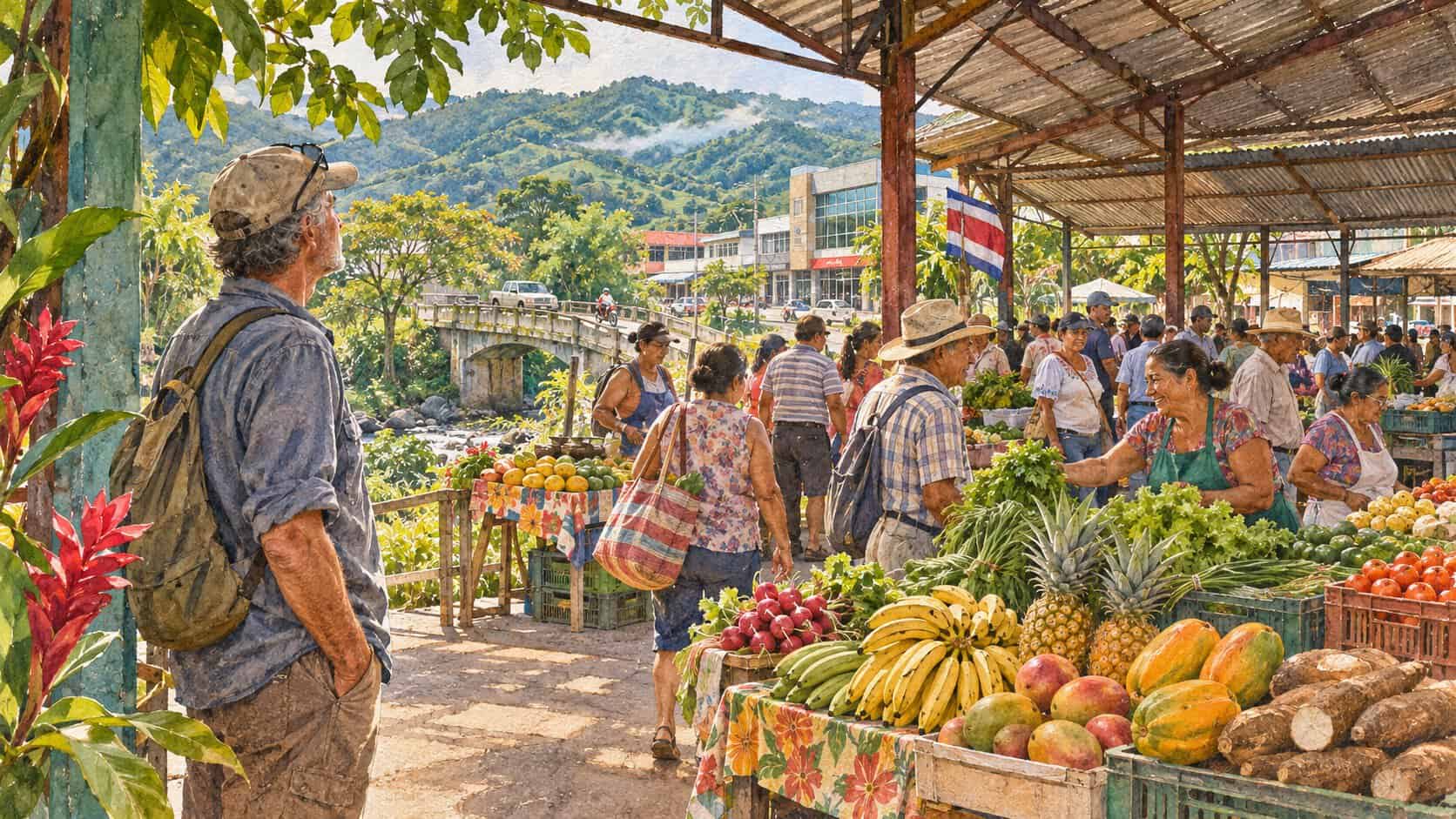
I like going to the weekly feria in Perez Zeledon. Unlike much of the Costa Rica I know, it is largely unchanged over the past thirty years. Same location, same set up, same rows and rows of vendors selling fresh fruits, veggies, and assorted other agriculture and artisanal products. I once had a booth there, selling my homemade breads and cookies. I can stand at the spot where I had a booth and look out and see the same scenes I saw thirty years ago. There is a comfort in that kind of familiarity. As time passes, not everything stays the same. Change is inevitable. Things that once were fade into distant memory. While I can stand in that spot at the feria and remember being there thirty years prior, once I step outside, I am in a Costa Rica where much has changed. There have been major changes– in infrastructure, with new highways and bypasses, and in construction, with thousands of new houses, and a San Jose skyline that features dozens of high rises that have sprung up in that time span. But there are also smaller changes, more subtle, less noticeable at first, that have occurred. Here is my own list of 20 random changes I have seen in Costa Rica: The disappearance of the Lada Niva. The Russian made 4×4, cheapest on the market, could be classified as a vanishing species. I personally can’t remember the last time I saw one on the road. The machete wielding landscapers have been replaced by gas powered weedwhackers. We traded the rhythmic whinging of the machete for the incessant drone of the machine. Whatever happened to the amateur blood pressure takers? They once roamed the cantinas and public areas, dressed in medical garb, blood pressure measurement devices in hand. For a small fee they would let you know how serious your hypertension, though the accuracy of their units was always in doubt. Informal, front of the house bars were once fairly common. Up front, a small bar with uncomfortable wood block chairs, with a door that separated the bar from the living area. It was always a bit odd when the door opened and you would see a family sitting around in their living room while at the bar, borrachos sang along with a ranchero tune. While on the topic of bars, many will remember the days of a free boca with every drink order. You could get a full meal with 3 or 4 beers. Some bars kept it basic with only ‘sustancia’, others offered small portions of meat, chicken or fish. Now virtually extinct. In a good change for taller people like myself, the 6-foot high doorways have been universally adjusted. I banged the top of my head more than once in older Tico houses and cantinas. Likewise, most buses have more legroom than previous, thanks to a new generation of larger Ticos. Speaking of which, large doesn’t always mean tall. My first years in Costa Rica, I marveled at the overall fitness of the country. Everybody looked like a soccer player or a cowboy. Today the country deals with the health issues brought on by poor diets and lack of exercise. Obesity rates are up everywhere in the world, so Costa Rica is hardly alone. I remember a time when people looked ahead as they walked down the street. They are still around but the number of distracted walkers is astronomical compared to the pre-cell phone epoch. For every person you saw back then who was reading a book or newspaper as they walked down the street, today there are ten staring into their phones. At least. Cooking con leña – The wood fired cooking of meat, The Cocina con Leña, was once as common as fried chicken, but is now more artisanal, offered up in higher-end restaurants. The masses eat it fried, skin and all. My barrio in San Isidro de el General has paved streets, I remember when it didn’t. But I’m not complaining. We still have one-lane bridges. Relics of simpler days. Medical care was once incredibly cheap. People come here because it still is a good deal. How’s this for a good deal?: In 1991 my son was born in a private clinic in San Jose, the doctor an accomplished Costa Rican who had worked in well known US hospitals. An anesthesiologist was called in as my son was delivered by caesarian. His mother spent four nights, and a 24-hour nurse on call. The total bill was $1,100. Here’s another: In 1992, I had emergency surgery to remove an ulcerating parasite from my intestines. I spent 10 nights in the hospital after surgery. Had daily doctor visits and nurses always around. The cost was $800. Adjusted for inflation, $2,700 and $2,000. Still astounding. The rest of the list is what I call the Virtually Extinct list: I overstayed my visa for a year. The fine was $2 per month. And at immigration you could wait half the day, or pay ten bucks in colons to a gavilan, as they were called, who had inside connections and could get it taken care of in half an hour or less. Pay phones. Remember them? You can still find the outside bays in some places, a modern day ruin, with the phones long gone. Video Rental Stores– Hello Netflix, goodbye video rentals. Most everywhere, not just here. Bankbooks– My first account, in the long defunct Banco Anglo, came with a pocket sized bankbook, with all entries handwritten. The Airport Exit Tax Stop– The first place you were directed toward upon entering. The San Jose airport was efficient. There were always eight or ten collectors seated in open kiosks. If every arm of the Tico bureaucracy had a “How quickly can you move the line along?”contest, this group would blow the rest away. There was never a wait. You could once buy individual cigarettes in bars, pulperias, from the mobile street vendors. Those days went up in smoke. Those mobile street vendors also sold the daily newspaper. The three or four most popular were stacked high, and sold out. And these vendors were on most downtown corners, in every city and town. With the dollar continuing to plummet versus the colon, it is fun to remember a time when money changers lined the downtown San Jose streets, always buying dollars at a few colons more than the bank was paying. They called “dolares, dolares!’ and ranged from honest hustlers to grifters who would try to short change you or switcheroo your hundred dollar bill and pull out an obviously fake Benjamin and claim it was yours. Blocking of public roads as a form of protest was a time-honored tradition, respected as a legitimate form of leverage by many Ticos, and is currently illegal. There was nothing like missing a flight, or appointment or just having your day disrupted. I hated it as a form of protest. I used to tell them if they went to the capital and blocked the streets there, I’d be on their side. Do not be surprised if some day, this form of protest returns from extinction.
The Costa Rica I Remember and the Changes I Have Seen
Full Article
Original Source
Read the full article at Ticotimes →KhanList aggregates and links to publicly available news content. We do not host full articles from third-party sources. Always verify important information with original sources.