
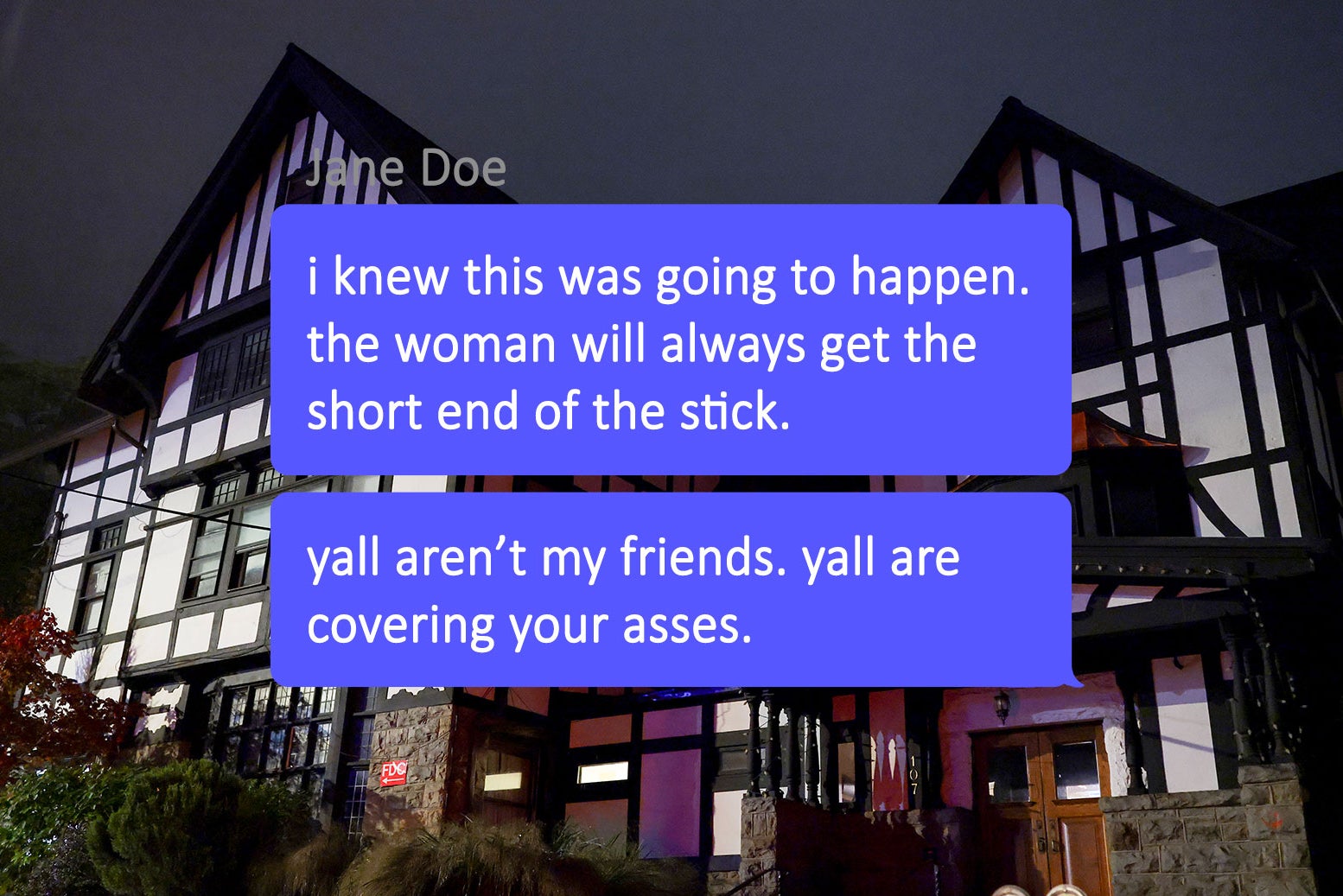
Life It Took a Week and a Half for Jane Doe to Understand What Had Happened to Her. That’s Textbook. A new cache of messages between Jane Doe and the “Cornell Seven” is going to ignite a debate. It shouldn’t. By Enter your email to receive alerts for this author. Sign in or create an account to better manage your email preferences. Unsubscribe from email alerts Are you sure you want to unsubscribe from email alerts for Scaachi Koul? Nov 09, 20263:07 PM Photo illustration by Slate. Photo by Anna Moneymaker/Getty Images. Sign up for the Slatest to get the most insightful analysis, criticism, and advice out there, delivered to your inbox daily. The new cache of texts around Jane Doe’s sexual assault at Cornell University likely won’t change anyone’s mind. Published over the weekend by the New York Times, the texts span just over a month, between Jane Doe, other Delta Delta Delta sorority members, and the men of Chi Phi who famously offered Doe up as “free pussy” to the rest of their fraternity house Snapchat group in October 2024. The texts among the frat members and Jane Doe have long been picked apart, but this new interpretation of them won’t make anyone decide, suddenly, that Doe or her alleged assailants were lying. The messages have been designed by the Times to give you the feeling of being in these group chats yourself, watching Doe and accused attacker Matthew Ingalls talk about what happened at the party that night in October. What’s laid out is a more detailed version of a story Doe has been telling for years, and that the Cornell Seven have denied: She went to a frat party to hang out with her friends, she was too intoxicated and high to consent to a sexual encounter, and, without her knowledge, the guys of the frat were talking about her as if she were up for grabs. “Like you can walk in and whip it out rn,” Ingalls wrote to the Snapchat group. Three days later, he texted her to comfort her when she became the subject of Cornell gossip, and after she said she may have gotten a UTI from what had happened to her in the Chi Phi house: “This sucks dude, but we’ve both been through worse, right?” The texts end suddenly and predictably when Ingalls asks Gillio Lopes, a member of the accused seven, who his lawyer is. You could venture a fair guess that said lawyer told all of them to stop putting so much evidence into their devices. There is a strangeness to not just what the Times has published, but its format. The texts are designed as such, and so reading them becomes a personal experience. Here you are, holding your phone and looking at messages as if this were your own inbox, and your own group chats. Are we supposed to be Jane Doe or one of the guys? If you were already primed to be on Doe’s side, it’s easy to identify with her in these texts. It’s unbearably relatable, a young woman checking in on all these men to make sure they were all in it together. She’s trying to be on their side before it’s made clear this is an experience that she was, somehow, alone in. She’s scared, anxious, and slowly being isolated, all for something that she remembers only piecemeal. She didn’t know who was in the room with her, and then had no idea who was gossiping about her around campus. But if you’re primed to believe the guys, then you’re ready to believe that this is a woman who got mad because she felt shamed for a consensual act. One read of the texts is that once talk about her swirled around her classmates, and she felt exposed by the guys who didn’t seem to be protecting her reputation, she started to sour on them entirely. By Oct. 30—10 days after the Chi Phi party—the frat president called her to disinvite her from their upcoming Halloween party. “I knew this was going to happen. the woman will always get the short end of the stick,” Doe wrote to Ingalls after she was cut out. “Yall arent my friends. yall are covering your asses.” From there, it’s true that Doe becomes more terse with Ingalls, unwilling to chat with him on the phone, and unwilling to play nice through emojis or friendly texts. These texts will merely affirm the beliefs of those who think Doe filed suit against the boys only because she was socially ostracized, and not necessarily because she didn’t consent to group sex with the fraternity members. The day after the party, Doe told Jonathan Newell that she “really liked being w [him] and matt [Ingalls],” and maybe she wanted to. That doesn’t account for the other five guys in the room, and it’s a story Doe was obviously putting together in real time—that’s how unable to consent she was. It took about a week and a half for Doe to understand what had happened to her. That’s a reasonable amount of time for a young woman who drank at a few parties and was then given an indeterminate amount of ketamine, only to spend the next few days finding out who her friends actually were. The aftermath of sexual assault often runs through a similar cycle, starting with an acute phase and into what’s called the outward adjustment phase. This is when survivors of assault try to cope: They might minimize what happened or turn it into a joke or run away from it entirely. These texts are hardly a gotcha of Doe’s reaction; they’re just textbook. Heartening, at least, is that this record shows her sorority sisters standing up for her and perhaps helping her understand the full gravity of what had happened to her. “It’s disgusting that people think this is funny to talk about when it would be rape if it were to happen,” her big sister texted a classmate. “Per usual people love to blame women for being abuse victims or make them out to be sluts. always blaming the victim not the rapist.” Did girls in her sorority turn her against the boys in that room, or did they just see the situation with more clarity? The case of the Cornell Seven has reignited a fallacy that to accurately name your sexual assault or your rape is to do it immediately. The only way to be unimpeachable in your description of what happened to you is to have been sober, to have fought back, and to have spent no time considering what happened. Doe’s time spent retracing her steps, finding out who was in the room, and ostensibly talking to her Tri Delta sisters is a mark against her. By Nov. 3, she’s able to name it. “Let’s be clear that 90% of what happened that night was not consensual,” she texted Newell. “I was given more key than i can remember and i know that i told u i felt uncomfortable and i didn’t know anyone in the room. All i remember after that was u giving me ket to do off your dick in front of everyone like a sex doll/worker.” What the texts actually show isn’t someone dragging their heels but finding words for what happened to her with remarkable speed. In just a few weeks, she realizes that her campus isn’t safe, that there were more men in the room having sex with her than she ever anticipated, and that her friends at the fraternity weren’t really her friends. That’s a lot to download just a few weeks into a new year at college. Doe’s texts go from friendly and acquiescent the day after the party, to icy in her clarity. Her transition, even over a handful of texts, into a more unyielding force is a righteous journey to witness. “I think im done talking to you,” she said to Ingalls three weeks after the party. “I know you lied.” In response, he asked her to call him. Finally, she got to say no. College Rape Sexual Assault Women
The Cornell Jane Doe Texts Prove Something Crucial About Sexual Assault
Full Article
Original Source
Read the full article at Slate →KhanList aggregates and links to publicly available news content. We do not host full articles from third-party sources. Always verify important information with original sources.