
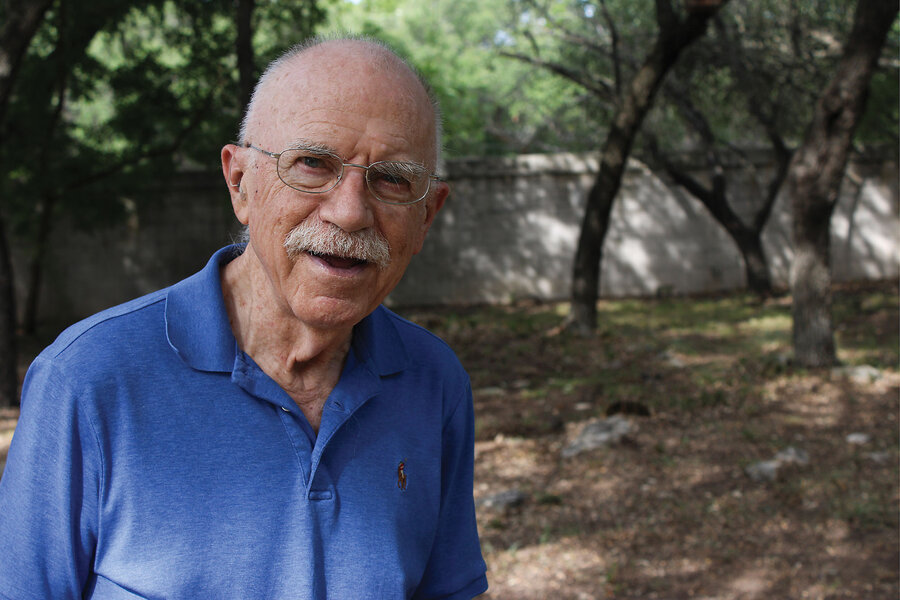
Austin, Texas | Nov. 10, 2026, 11:04 a.m. ET | 5 min read Merlin Tuttle recalls entering his first bat cave almost seven decades ago, as a teenager living in Tennessee. Leaving behind a beautiful spring afternoon, he went into the cold, dark chamber and soon noticed small movements. He turned his light in that direction, and a colony of gray bats suddenly awakened, flapping their wings and squeaking.He barely flinched. “It just never occurred to me to be frightened,” he says.That teenager became Dr. Tuttle, one of the world’s leading voices for bat conservation. Born in Hawaii and raised west of Knoxville, he has traveled the world studying and advocating for the maligned mammals. Forty years ago, he chose Austin, Texas, as his home – and the headquarters for his nonprofit work – after he discovered that a colony of bats had roosted there, too.Debunking fearsAustin is a living tribute to how a city can learn to love bats. Thanks in large part to Dr. Tuttle’s efforts, the city overcame its fear of the furry, fanged flyers and is now home to the largest urban bat colony in North America. Courtesy Of ©MerlinTuttle.orgMike Ryan (left) and Merlin Tuttle work with an Egyptian fruit bat in Kenya in 1984. In 1980, the Texas Department of Transportation renovated the Congress Avenue bridge in the city’s downtown. The project addedconcrete beams that, it transpired, are an ideal artificial habitat for Mexican free-tailed bats. Within a few years, tens of thousands of the animals were roosting under the bridge during the summer months. Initially, Austinites were not very welcoming.“Bat colonies sink teeth into city,” read one local newspaper headline in 1984.In a television report two years earlier, the city’s health director had said little to ease residents’ concerns. “How much rabies there would be in this bat population, I don’t know,” the official said. “It’s something we have to look into.”Dr. Tuttle has devoted his career to debunking the fears popularly associated with bats.He points out that bats can carry rabies, but only a small percentage of wild bats are infected. (The incidence of rabies in bats is lower than in other mammals, such as raccoons, foxes, cats, and dogs.)On the positive side, bats serve as natural pest control by eating vast quantities of insects. They also pollinate plants and crops, and enrich soil with their droppings, known as guano. Melanie Stetson Freeman/Staff/FileA bat hangs from the roof of a concession stand inside Kruger National Park in northeastern South Africa in 2002. Dr. Tuttle’s challenge is that the bad press about bats has had a long head start on the good press.As early as 1897, Bram Stoker’s fictional vampire Dracula could transform into a bat. The image of bloodthirsty nocturnal flyers beating their leathery wings has been a constant in popular culture ever since. The fact that bats typically nest in dark, out-of-the-way places doesn’t help, either. Photographs of bats often show them in gloved hands, or flying through dark skies, fangs bared. Thus, one of the most potent tools in Dr. Tuttle’s long conservation career has been his photography. He has spent decades perfecting how to find, observe, and handle bats in a way that makes them look both beautiful and nonthreatening in photographs.“Back in the ’80s, you looked at every single picture of a bat, [and] all you saw was teeth,” says Bert Grantges, a friend of Dr. Tuttle’s who has accompanied him on research trips around the world. “In Merlin’s photos ... they weren’t scary.”Photography, he adds, has been “a critical piece to [Dr. Tuttle] creating a relatable story to an unrelatable animal.” Henry Gass/The Christian Science MonitorMexican free-tailed bats fly out from under the Ann W. Richards Congress Avenue Bridge at sunset in downtown Austin, Texas. A source of prideDr. Tuttle had developed an interest in small mammals years before he entered the bat cave as a teen.Before he graduated from high school, he had presented research to the Smithsonian Institution about the migratory patterns of the bats near his house. Before he received a bachelor’s degree in zoology from Andrews University in Michigan, the Smithsonian had offered him the opportunity to co-direct an expedition to Venezuela to study mammals in the Amazon. He went on to obtain his master’s degree and Ph.D. from the University of Kansas, before settling into a job as a curator at a museum in Milwaukee.By 1986, he had brought his newly formed nonprofit, Bat Conservation International (BCI), to Austin, where the bats under the Congress Avenue bridge were being threatened with nets, blowtorches, and even cyanide gas. Henry Gass/The Christian Science MonitorOnlookers try to capture images of bats flying out from under the Congress Avenue bridge in downtown Austin. The bridge is home to the largest urban bat colony in North America. Over the years, however, Austinites have come to view the colony of bats under the bridge with pride instead of alarm. The bats there now number about 1.5 million. Every summer, tourists flock to the bridge at dusk to watch bats pour out from under the bridge for their nightly insect hunt. The spectacle attracts 140,000 people – and about $10 million – to the city every year, according to the Texas Parks and Wildlife Department. The bats also save the state’s agriculture industry about $1.4 billion each year in pest control costs.On one warm August evening in Austin, almost 200 people are gathered at the Congress Avenue bridge. The city’s glass skyline has turned orange against the setting sun, and the rustling and squeaking of bats are audible.At the front of the crowd, Natalie and Steve Keene – visiting from the United Kingdom – are back for the second night in a row. The previous evening, 45% of the colony had emerged, an app had told them.“I’d never seen anything like that before in the world,” says Mrs. Keene.A few minutes later, under a darkening sky, a gasp ripples through the crowd. Bats pour out from the bridge, carving a black “S” into the air. The crowd looks up, smiling in awe.“An incredible advocate”Under Dr. Tuttle’s leadership, BCI bought land surrounding a bat cave north of San Antonio. Bracken Cave, as it’s known, is now home to the world’s largest bat colony, housing more than 15 million Mexican free-tailed bats during the summer. In the ’90s, Dr. Tuttle also helped design an artificial bat cave on a private preserve west of Austin that is now home to more than 200,000 Mexican free-tailed bats, according to Texas Parks and Wildlife. He left BCI in 2009 to start a new organization, Merlin Tuttle’s Bat Conservation. Courtesy Of ©MerlinTuttle.orgBrazilian free-tailed bats roost in the main room of an artificial bat cave constructed of reinforced steel rods on the Bamberger Ranch Preserve in Texas in 2016. “He’s an incredible advocate,” says Gary McCracken, a bat researcher and professor emeritus at the University of Tennessee, Knoxville, who first met Dr. Tuttle in 1978. Bat colonies are now “seen as a public attribute, and Merlin deserves a huge amount of credit for that.” Deepen your worldviewwith Monitor Highlights.Politics with respectGet political stories with respectful analysis.There‘s a world of new ideas in everyBooks newsletter.There‘s more to life, enrich yours withCulture & Learning weekly.Follow humanity‘s discoveries withScience & Nature stories in your inbox.Gain a spiritual perspectivefrom the stories in your inbox.Want to understand the deeper impact of critical events? Learn the Monitor‘s insight.Already a subscriber? Log in to hide ads. Still, 53% of bat species in North America are at moderate to very high risk of extinction over the next 15 years, according to a 2024 study. The major threats, the study says, include changes in weather patterns and land development, and the spread of a disease known as white-nose syndrome.“We fear most what we understand least, and bats are easily misunderstood,” says Dr. Tuttle. “Until we educate people to value bats, they’re not going to protect them.” ALREADY A SUBSCRIBER? LoginReal news can be honest, hopeful, credible, constructive.The Christian Science Monitor was founded in 1908 to lift the standard of journalism and uplift humanity. We aim to “speak the truth in love.” Our goal is not to tell you what to think, but to give you the essential knowledge and understanding to come to your own intelligent conclusions. Join us in this mission by subscribing.
The conservationist who’s building bridges between bats and people
Full Article
Original Source
Read the full article at Csmonitor →KhanList aggregates and links to publicly available news content. We do not host full articles from third-party sources. Always verify important information with original sources.