
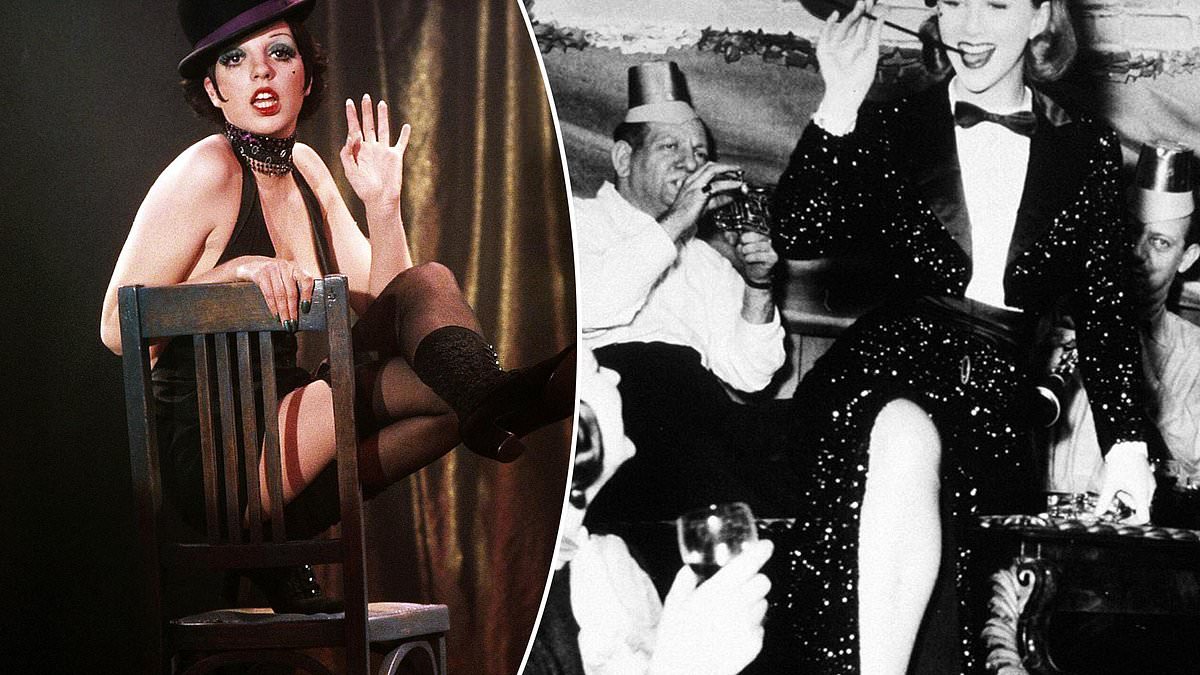
In the Academy Award-laden 1972 film of Cabaret, Liza Minnelli, in black fishnet stockings and false eyelashes, is ‘every inch Judy Garland’s daughter’ in the brazen way she plays flapper Sally Bowles in this sleazy story about ‘indulging in wine and song and sex’ while Germany is poisoned by the Nazis. Liza Minelli and Joel Grey in Cabaret (1972)Bob Fosse’s film – also notable for the electrifying Joel Grey as the Emcee – was based on the Harold Prince Broadway and West End musical, which in 1968 had been a vehicle for Judi Dench, who gave Sally her trademark croaky voice.The non-musical version of the material was I Am A Camera, put on screen in 1955 with Anton Diffring, Shelley Winters and (as Sally) Julie Harris. The studios had wanted Marilyn Monroe as Sally, which would have been a brilliant choice. The film received an X certificate, owing to the line, ‘What shall we do first, have a drink or go to bed?’All these adaptations derived from Christopher Isherwood’s semi-autobiographical novels, Mr Norris Changes Trains (1935) and Goodbye To Berlin (1939), brought together as The Berlin Stories (1945). There have been dozens of paperback reprints. Beryl Cook provided illustrations for the Folio edition – big-busted women in suspenders wielding whips etc.In 1929, Isherwood, who was from Cheshire gentry, had been drawn to Germany’s Weimar decadence, atonal music, Expressionist painting and male brothels. Berlin was ‘a city with no virgins’, where gents dressed in kimonos and burned incense. In cellar bars clogged with smoke, showgirls would rip off their wigs, ‘exposing them as men’. Cheadle this was not.Known as Herr Ishyvoo, Isherwood shared a rented apartment with the 19-year-old girl who’d shortly become the inspiration for Sally Bowles, ‘an apathetic gold-digger and dupe’, whose ambitions to appear in cabaret outstripped her talents. As Isherwood reported, ‘She sang badly, without any expression, her hands hanging down at her sides – yet her performance was, in its own way, effective because of her startling appearance and her air of not caring a curse of what people thought of her.’The original of Sally was named Jean Ross, whose ‘face was long and thin, powdered dead white’. She’d say things like, ‘I didn’t sleep a wink last night. I’ve got a marvellous new lover.’ Apparently, she took more than 200 lovers while in Berlin, and poet Stephen Spender (later Barry Humphries’ father-in-law) commented, ironically and favourably, ‘I think she’s absolutely repulsive.’ Author Christopher Isherwood Jean was born in Egypt in 1911 and educated in Switzerland. She turned up in Germany hoping to work as a translator for the film industry. Despite her small talent – she couldn’t carry a tune – and her refusal to make her own bed or ever to stop talking and chain-smoking, Jean, a dark-eyed beauty, mesmerised everybody.Beyond her Berlin days, which culminated in a botched abortion, back in London, Jean had a relationship with Eric Maschwitz. He composed These Foolish Things (Remind Me Of You) with Jean in mind and had earned £1.2 million in royalties by 1957. Jean had an affair with journalist Claud Cockburn and became a communist. She went as a reporter to cover the Spanish Civil War and met Hemingway.Then she disappeared, only to be tracked down by this newspaper in the wake of Cabaret the musical. ‘Are you the real Sally Bowles?’ Jean was asked. ‘Yes, and now go away,’ she replied. She died in 1973 of cervical cancer.Isherwood’s other great inspiration was Gerald Hamilton, who became Arthur Norris, who changed trains. In the novel he is a confidence trickster and soldier of fortune, a comic figure in an ill- fitting toupée. The actuality, according to Brian Fairbanks, was equally as bizarre.Employed for some reason in a Chinese bank, Hamilton converted to Catholicism, squandered a family inheritance, dabbled in black magic, wore a turban with a red bicycle reflector affixed to it, and loved dancing and bridge. Hamilton was, said Isherwood, an ‘icy cynic’ who ‘took it for granted everybody would grab and cheat if they dared’.Hamilton sold rifles to Indian rebels, cheated at roulette, and tried to learn Dutch. During the war he spied on the British for the Germans and on the Germans for the British. He had an affair with a black nightclub singer who was killed when a bomb fell on London’s Café de Paris. Disguised as a nun, Hamilton slipped away to Ireland to meet Vatican emissaries at the German embassy in Dublin. Imprisoned as a traitor, Hamilton shared a cell with Oswald Mosley, who thought him a joke and a bore.After the war, Hamilton befriended the elderly Lord Alfred Douglas and had an association of some kind with Guy Burgess, the defector. Obese and stooped, he claimed his body was copied by sculptors when they were doing likenesses of Winston Churchill. He died bankrupt in 1970, though it is possible he faked his demise ‘to evade creditors’. Life is a Cabaret is available now Though they shot it in Belfast not Berlin, in the worth-repeating television biopic Christopher And His Kind (2011), Hamilton is played by Toby Jones, the scrumptious Imogen Poots is Jean Ross, and Isherwood himself is Matt Smith.All highly diverting and farcical. Yet when Isherwood had stated of his writing style, ‘I am a camera with the shutter open’, this was hardly the case, as editing was extensive, blind spots shocking. In the Berlin novels there is little sense of the economic crisis, or of the anti-Semitism and police-state invasiveness.Fairbanks, therefore, rightly fills us in on the historical background, the faltering democracy, the street violence perpetrated by the Nazis, as they rose to power, the persecution of the Jews, whose businesses and shops were confiscated, who were removed from jobs, banned from the civil service, and from driving motor cars or attending concerts. Unworthy of citizenship, soon enough Jews were rounded up for torture, slave labour hewing and hauling rocks, and death.In the early 1930s, when Isherwood was there having fun, Hitler’s belief that rebuilding the army would lead to Germany’s resurgence had already meant the suspension of freedom of speech and of the press, and of the ending of due process for criminal proceedings.Excellent though Fairbanks is describing the fuller, necessary context behind the Cabaret high-jinks, he’s an atrocious writer: ‘debaucherous’, ‘frenemies’, ‘gaydar’, ‘wannabe’, ‘strategize’ and ‘guilted’ are all here, among other instances of clumsiness.
The communist chain-smoker who slept with over 200 men inspired Cabaret's Sally Bowles
Full Article
Original Source
Read the full article at Dailymail →KhanList aggregates and links to publicly available news content. We do not host full articles from third-party sources. Always verify important information with original sources.