
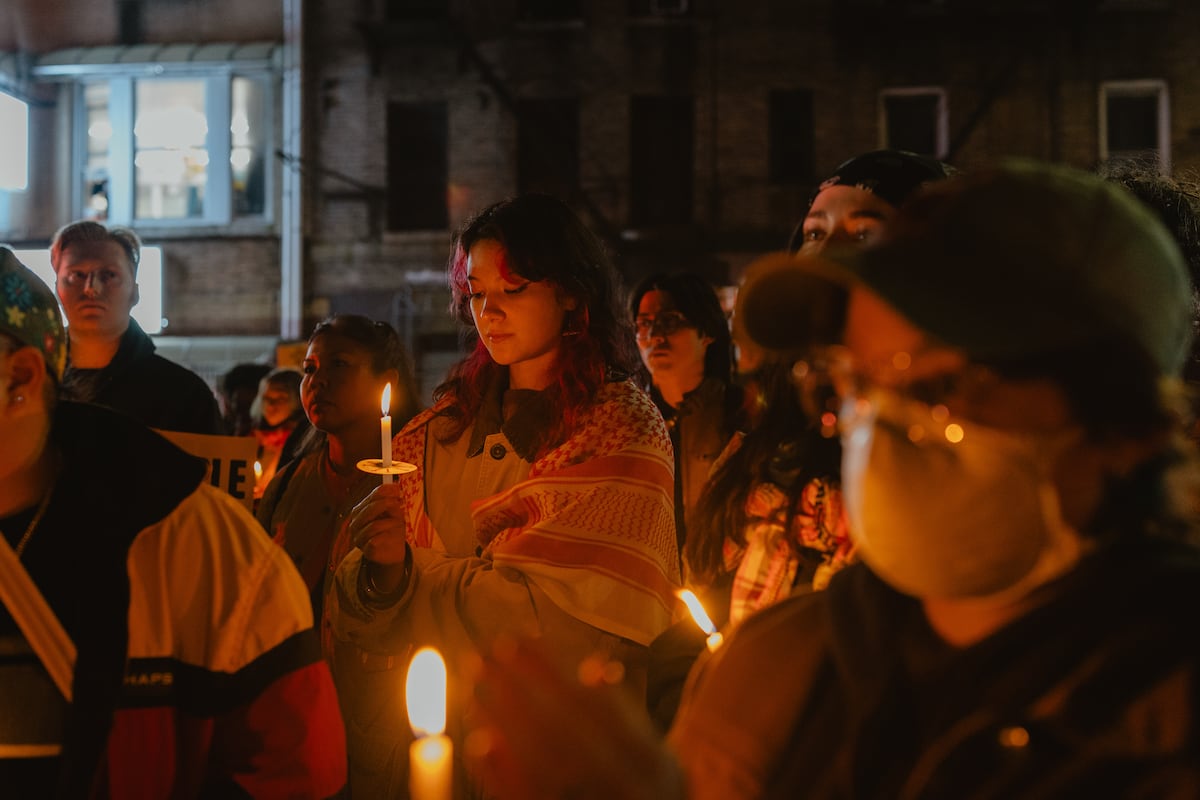
Mr. Michael has rolled up in his wheelchair to the intersection of Flatbush and Bedford, two hectic, bustling avenues lined with restaurants and beauty salons, a place far removed from New York’s glamour. There is trash on the corners, potholes in the streets, cracks in the houses.Mr. Michael switches on a speaker and searches on his phone for The Jets so that the sweet, velvety voice of Elizabeth Wolfgramm would fill the air. “I don’t know what I can do,” he says, “I can only play music.” Then he points to an empty, fenced-off space, a blind spot in the middle of Flatbush. A stranger would never imagine what once stood there, but a local resident understands the absence: the neighborhood is missing building number 1321. It took eight lives with it when it collapsed, laying bare the cracks in a city.After a week of fire trucks coming and going, of workers in blue hard hats clearing away debris, of politicians stopping by to tick the visit off their schedules, and of curious or disbelieving neighbors gathering at the scene, Flatbush has reverted to its usual rhythm: congested traffic, people smoking halfway down the sidewalk, and music drifting out from clothing stores and takeout joints.At first glance, there is a sense of normality. Beneath the surface, however, lies a simmering frustration that nothing seems able to ease. Residents say they have spent years complaining about cracked walls in their buildings, missing smoke detectors, leaks and dampness. But it took the deaths of eight people for the city to begin paying attention to their grievances.Now the neighborhood has assembled a makeshift memorial with candles, photographs and a card bearing the names of the victims of the collapse of building 1321, which came crashing down on the afternoon of November 11 onto an adjacent lot where several construction workers were on the job.In handwritten lettering, the kind that is rarely seen anymore, someone sought to preserve the names of the victims. There was Nicole Daniela Salvada Rodríguez, the nine-year-old Colombian girl whom her teachers described as “brilliant”; her cousin, Kevin Santiago Reyes González, 10, who was being raised by his father alone on the building’s second floor; and Juan Daniel Salvada Guzmán, 31, Nicole’s father.The memorial also bears the name of José Luis Caguana, a 26-year-old Ecuadorian and father of a four-year-old boy, who had been expecting the birth of his second child this week. Then there is Gabriel Siguencia, a 22-year-old Ecuadorian carpenter who had a four-year-old son and plans to marry soon. Also on the list are Barry Mamadou, 21, who had arrived from Guinea about five years ago, and his cousin Ndiaye Mamadou, 31, with whom he shared an apartment on the building’s second floor.The name of Edgar Sapón, a 26-year-old Guatemalan described as a “quiet” man, appears as well. A few days ago, his wife, Brenda Vázquez, had to tell their six-year-old son, Eduardo: “Your dad isn’t coming back. Your dad died.”On Wednesday, young Eduardo arrived dressed in a black suit and white shirt at Las Rosas Funeral Home, a modest funeral parlor, one of the most affordable in the city and a place frequently used by immigrants.The funeral home’s manager, a young Ecuadorian man, said business had been especially busy lately: “People are out of control. There are a lot of accidents, a lot of people with drug problems.”But his most recent clients were different. He had been watching news reports about a building collapse in Brooklyn when his boss called to say they would be holding wakes for some of the victims there. One of them was Edgar Sapón, Eduardo’s father. The boy wandered from room to room and ran around with other children, not fully understanding what was unfolding around him.A few days earlier, when he noticed his father was not coming home and that his mother seemed different, he wanted to know what was going on. “What happened to my dad?” the boy asked. “Nothing, my love, your dad is working, you know he works late,” Vázquez told him. On Wednesday, November 11, Sapón had left home early to work at a construction site on a vacant lot at 2625 Bedford Avenue. Around midday, as she often did, Vázquez sent him a message: “My love, I’m heading out. What about you?”Sapón did not reply. That afternoon, when she finished work, she called him, but no one answered. When she got home, the news was already reporting on the tragedy that had gripped New York: a building collapse. At that stage, no one yet knew how many lives it had claimed or who the victims were. In the footage, Vázquez spotted a survivor wearing a shirt emblazoned with Elite Concrete, the name of the contracting company her husband worked for.“I said, ‘This can’t be,’” Vázquez recalls through tears, a few steps from Sapón’s coffin. “I said, ‘Let my husband be OK, God, take care of my husband.’”She rushed to the emergency room at Kings County Hospital Center, where victims were being taken, but she did not recognize Sapón among the injured. “I looked and looked and couldn’t find him.” She showed a photo to firefighters and paramedics, but no one had seen him. She returned at night to the disaster site. Workers kept digging through the rubble as the hours dragged on. “Around 5 a.m. they started pulling out bodies. One body came out, then another 20 minutes later, and another.” At 7 a.m., they told her her husband was one of the fatalities, but she did not believe it. “They made a mistake,” she said. Later, at the morgue, the photograph of Sapón matched one of the victims of a collapse that exposed not only shattered concrete but also a long history of residents’ complaints, building-code violations, fines and neglect by property owners.When building 1321 came down, it killed migrant construction workers. It killed other migrants who could afford to live only in a cracked building with nearly 100 maintenance complaints. It displaced residents who are now living in temporary hotel accommodation. And it left an entire neighborhood demanding that New York authorities pay attention to the places that almost no one pays attention to.A collapse turned into a symbolAmid an angry crowd gathering on Wednesday evening, holding signs condemning the property owners and demanding justice for the victims of the collapse, a young woman took hold of a megaphone and asked to be heard. “In New York there are two kinds of people,” she said. “Those who have the life they dreamed of, and those who end up dying under the rubble.” People shouted. They looked angry. These are the residents of a neighborhood of low-rise buildings, the brick structures with narrow windows that are so characteristic of the city. According to Anil K. Agrawal, professor and chair of the Department of Civil Engineering at The City College of New York, many of these buildings are nearly a century old. “New York is an old city. It has many very old buildings that are not always in good condition, many built of masonry that do not have great structural strength,” he says. These are the buildings that began to rise across the city in the late 19th and early 20th centuries, as successive waves of immigrants, particularly from Ireland, Italy and Germany, arrived in New York. Today, the real estate industry has set its sights on many of these properties, replacing them with developments that can command higher rents.“Some of these new buildings offer 100% market-rate housing, while others take advantage of tax incentives and reserve 20% of units for lower-income people, with affordable, regulated rents,” explains George M. Janes, an urban planner and consultant in New York. He says very few buildings dedicate 100% of their units to affordable housing. That is another of the major housing issues that the Brooklyn collapse has brought back into focus. Robert Fischman, the owner of the construction site, who had already been fined twice for violating restrictions imposed by the New York City Department of Buildings (DOB), planned to build a nine-story structure with 64 residential units, which would then be rented at prices that many Flatbush residents could scarcely afford.Attention has also turned to Olufemi Falade, the owner of the collapsed building. He once spent 12 days in jail for refusing to remedy more than a thousand violations across several of his properties.On Monday, Dengane Omari Jack, a musician who lived in the building, filed a complaint in Brooklyn Supreme Court saying he had photographed cracks in the structure and that in October he informed the owner about the building’s condition. Falade, however, responded that “it wasn’t his fault” and that “it couldn’t be fixed.” A few days ago, Jack stood looking at his vinyl records scattered across the rubble, after a warning that no one had heeded.The tragedy of building 1321 has ultimately become a symbol of an entire neighborhood’s grievances. “I think it’s a sign of what’s happening,” says Angelina, a local resident who has helped lead efforts to collect supplies for displaced families and who, together with other neighbors, is raising a $130,000 fund to support the affected families. “It’s a sign of what happens when people try to defend their rights and their lives but are not listened to and are ignored. It’s a symbol of our future if we don’t make a change right now.”After making their way along Flatbush Avenue, past Jamaican takeout joints, a Mexican taco stand, hair salons advertising Afro hairstyles and all the bustle of Little Caribbean, the assembled residents arrived at the makeshift memorial and shouted at the top of their lungs: “Housing is a human right!”They demanded justice for the residents of building 1321 and held up signs asking: “How many lives must be lost before tenant protection is prioritized over profits?” Then they fell silent. A call for justiceJust over three miles away, mourners were arriving at Las Rosas Funeral Home. That Wednesday, several women in traditional huipiles were handing out hot coffee and chicken tamales, while a group of men stood nearby, heads bowed, stunned by what had happened. They were construction workers. They had worked alongside the deceased and had only escaped their fate because they had been assigned to different job sites that day.“When they returned to work on Monday, the atmosphere was tense, sad,” says Ecuadorian worker Víctor López. “I only ask God to watch over us, because construction is very hard, very risky work.” Construction is also one of the industries that employs the largest number of Latino workers and one of the best-paying, with wages of around $35 an hour.Walter Sinche, who instructed José Luis Caguana in an OSHA training course — the federal agency that oversees worker safety and health standards in the United States — teaches his students a fundamental lesson. “When you work, put life and work on a scale and see which way you want it to tip,” he tells them. “Some choose life, but other bosses force them to work or fire them if they complain.” As he speaks, Sinche slowly shakes his head, visibly affected by what happened to one of his own. What everyone wants now is an answer: what actually happened in the Flatbush collapse? Was it caused by the excavation work underway next door, or was it related to the condition of the building itself? The Department of Buildings and city authorities say the investigation is ongoing.Vázquez knows nothing will bring her husband back, but she wants justice. “The city should have supervised better, the engineer should have made proper plans and ensured they were followed, the contractors know the risks the work entails,” Sapón’s wife says angrily. “I want justice for my husband’s life. My son was left without his father because someone didn’t do their job.”Luis Siguencia also arrived at the funeral home. Dressed all in black, he approached Vázquez to offer his condolences. Two days earlier, he had held a wake in the same place for his son Gabriel, whose body had been repatriated to Quito and would be buried in the parish of Ingapirca, in Cantón Cañar. The body of fellow Ecuadorian José Luis Caguana had also been flown back home.Little by little, they were making the journey back, in a way they had never planned. They wanted to save money, to buy land in their hometowns. Now, in their hometowns, they were being welcomed with flowers, prayers and funeral rites, the farewell that New York would never have given them.Sign up for our weekly newsletter to get more English-language news coverage from EL PAÍS USA Edition
The collapse of building 1321, the tragedy that exposed New York’s cracks
Full Article
Original Source
Read the full article at English →KhanList aggregates and links to publicly available news content. We do not host full articles from third-party sources. Always verify important information with original sources.