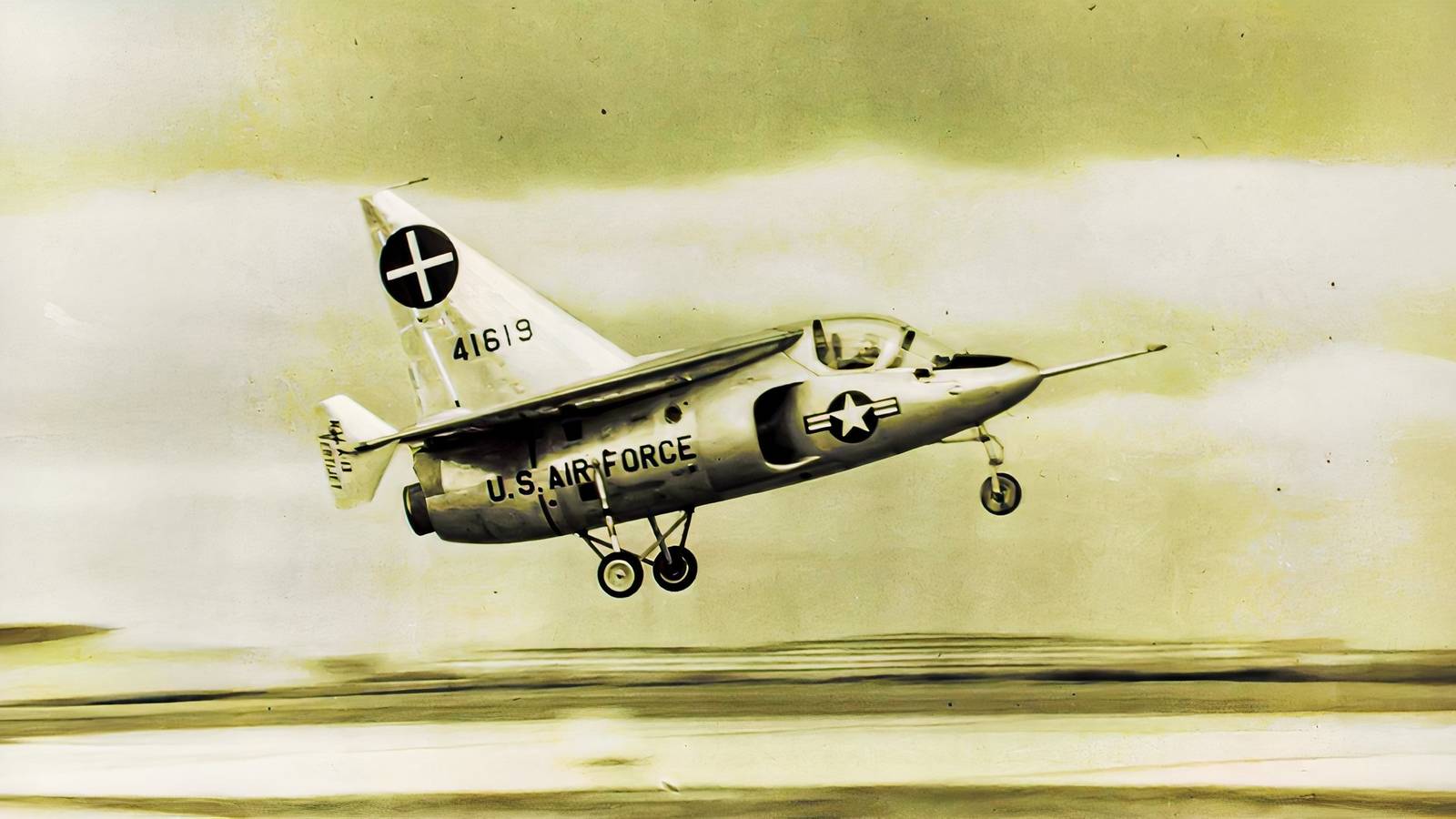
Credit: Picryl | Simple Flying Published Aug 18, 2026, 1:00 PM EDT Chris earned a Master’s degree in Defense and Strategic Studies (Highest Honors) from the University of Texas at El Paso. His graduate work concentrated on Global and National Security, Low-Intensity Conflict, Modern Warfare, and US grand strategy. He also undertook extensive regional studies, analyzing how key regions integrate into the broader US security architecture. This rigorous program provided him with a comprehensive understanding of U.S. military operations, global strategy, and weapons systems. Additionally, he gained a strong appreciation for great power competition.—an increasingly central force shaping international relations and conflict for the foreseeable future. Sign in to your Simple Flying account The Ryan X-13 demonstrated that jet-powered vertical takeoff and landing (VTOL) flight was indeed possible, yet its unique cable landing technique would ultimately prove to be its undoing, despite compiling a remarkably successful test flight record. While the aircraft itself never entered service, the lessons learned from its development helped shape the future of military VTOL aircraft for decades to come. For global militaries that have the ability to operate them, vertical takeoff and landing aircraft offer unique capabilities. These aircraft do not require the extensive infrastructure that conventional takeoff and landing fighters need to make an operational impact. Specifically, the latter depend on well-established airbases with long, secure runways to undertake a mission, while VTOL aircraft simply need a field, road, or the deck of an amphibious assault ship. This is precisely the reason the United States Marine Corps (USMC) has been a key operator of such aircraft, beginning with the AV-8A Harrier and now the Lockheed Martin F-35B Lightning II. While these aircraft provide key tactical air support organically from within the USMC's Amphibious Ready Groups, they have a deep history dating back to just after World War II. During that timeframe, although the Axis powers had been vanquished, the Soviet Union emerged as the new threat, first to Western Europe and then directly to the United States. The Soviets possessed an enormous military, and if a conventional war had ensued, they could have rapidly targeted and attacked US and allied airbases, attriting or denying airpower to American and allied forces. It was for those reasons that the Navy, first, and then the Air Force, took a keen interest in aircraft capable of taking off and landing vertically. If deployed, reliance on vulnerable airbases would be reduced; the United States Navy (USN) sought a tactical advantage at sea, while the United States Air Force (USAF) later sought greater diversity in its tactical strike capability. The promising beginning of the jet-powered VTOL age took shape with the Navy and the Ryan X-13 program. The Ryan X-13 Proved Jet-Powered VTOL Was Possible In the 21st century, VTOL has become a given in aviation, something that seems to have always been there. The first operational aircraft of this type was the Hawker Siddeley Harrier, and its operational success, beginning in 1969, has maintained a solid grip on military tactical doctrine through to the 21st century with the F-35B. While these aircraft are or were revolutionary for the operational effectiveness of their respective operators, the road to jet-powered VTOL flight began in 1947 with the USN and Ryan Aeronautical Company. At that time, the USN was interested in turbine-powered VTOL aircraft for operations at sea, thereby reducing reliance on airfields seen as vulnerable to Soviet attack. Had such a compact aircraft entered service, it would theoretically have been able to operate from submarines and small vessels, providing an organic combat capability to support amphibious forces ashore or attack nearby enemy ships. Such an aircraft also promised greater operational flexibility, allowing combat aviation to be dispersed across a wider range of locations rather than concentrated at fixed bases. For six years, the USN and Ryan made steady progress on the X-13 concept, using ground-based vertical test equipment, with a focused effort on VTOL low-speed flight controls. Despite the effort, no manned flights were conducted during this period. By the summer of 1953, following the Korean War, Navy research and development funding was cut, and the X-13 project ran out of funds. However, coming to the project's rescue, the USAF—then the military's newest branch—had gained interest in the concept prior to the depletion of its naval funding, assumed ownership, and kept the project alive with a fresh monetary injection. Once in charge, Ryan produced two X-13 prototypes, which were assigned the USAF serial numbers 54-1619 and 54-1620. The aircraft were 23.5 feet (7.16 meters) long, had a 21-foot (6.40 meters) wingspan, and had a maximum takeoff weight of approximately 7,200 to 7,300 pounds (3,266 to 3,311 kilograms). Flight testing with No. 54-1619 began on Saturday, December 10, 1955, with Ryan Chief Test Pilot Peter F. Girard at the controls. The seven-minute flight was intended to assess the aircraft's conventional flight characteristics, and the results pointed to the need for further improvement and testing. Successful Flight Tests Couldn't Overcome The Tailsitter's Practical Limitations Credit: US Air Force By the spring of 1956, the second of the two X-13 test aircraft (No. 54-1620) arrived at Edwards Air Force Base and underwent preparations for flight testing. Following numerous preliminary flights, which involved connecting to the vertical stowage platform via its under-nose hook, the aircraft was finally deemed ready for its full transitional flight demonstration. This event took place on November 28, 1956, with Girard in the cockpit, marking the culmination of years of development and bringing the experimental aircraft one step closer to proving the viability of jet-powered VTOL flight. With the aircraft running, he ascended to 6,000 feet (1,829 meters) and gently rotated it from horizontal flight into a vertical attitude until it was hovering. Finally, Girard maneuvered the aircraft back to a horizontal position and regained flight speed, making the first VTOL transition of a jet-powered aircraft. Months later, in April 1957, the aircraft performed the same transitional maneuvers. This time, however, all aspects of the aircraft's capabilities were brought together when it landed vertically on its storage trailer via its hook without incident. The years of development and testing culminated in a public display intended to gain the support of the US military's top brass. In late July 1957, the X-13 was flown to Washington National Airport, at which point Girard took off, made a dramatic flight over the Potomac River, then transitioned the aircraft into a hover before recovering it onto its trailer outside the Pentagon. This successfully demonstrated the aircraft's unique vertical landing capability before an assembled audience of more than 3,000 military officers, Pentagon staff, and members of the press. While the demonstration impressed those in attendance and made for impressive headlines, ultimately the jet's modest range of 192 miles (307 kilometers) and comparatively slow speed of 350 miles per hour (563 kilometers per hour) did not speak well for the aircraft. Further, despite the aircraft's 1.48 thrust-to-weight ratio and the 10,000 pounds (4,536 kg) of thrust provided by the Rolls-Royce Avon turbojet engine, which made the X-13's aeronautical feats possible, the cable-and-hook recovery method proved to be the program's greatest challenge. While mechanically and operationally sound, it demanded a blind rearward descent that was unlikely to be reliable under tense and dangerous combat conditions. In the end, the impressive performance did not convince the USAF to invest in production, and the July demonstration would prove to be its final public appearance. The X-13 made its final flight on September 30, 1957, then the program quietly came to an end. Although the aircraft never entered operational service, the data gathered throughout its development helped validate the feasibility of jet-powered VTOL flight and provided valuable insights that would influence the design philosophy of future vertical flight aircraft. The X-13's Legacy Lives On In Modern VTOL Aircraft Credit: US Air Force Although the X-13 never progressed beyond the prototype stage, its influence on the future of vertical flight reached well beyond its brief flight-test program. By successfully demonstrating that a jet-powered aircraft could take off vertically, transition to conventional flight, and recover vertically, the aircraft made clear that a pure-jet VTOL was not merely an engineering concept but a reality. In doing so, however, it also laid bare the operational limitations that would ultimately shape every successful VTOL aircraft that followed. Rather than revealing shortcomings in the aircraft's performance, the X-13 highlighted the challenges the pilot faced. While the cable-and-hook recovery system functioned as designed throughout testing, recovering the aircraft required a blind rearward descent onto a suspended cable. Although the maneuver could be undertaken by an experienced test pilot under tightly controlled conditions, it was ultimately considered too demanding and impractical for routine military operations, particularly in the uncertainty of combat. The lessons learned from the X-13 influenced the direction of later VTOL development. Instead of pursuing the tailsitter concept, designers later focused on configurations that allowed pilots to remain seated upright, providing enhanced forward visibility during takeoff and landing. This philosophy was reflected in aircraft such as the Harrier, which achieved vertical flight through vectored thrust, and later in the Lockheed Martin F-35B Lightning II, which combined a shaft-driven lift fan with a swiveling exhaust nozzle to perform short takeoffs and vertical landings. While the X-13 itself quietly faded into aeronautical history after just two prototypes and a handful of successful demonstrations, its greatest contribution was not becoming an operational aircraft. Rather, it provided engineers with a clear understanding of both the possibilities and the practical limitations of jet-powered VTOL flight, which helped shape a design philosophy that continues to influence modern military and civilian VTOL aircraft.
The Cold War Jet That Proved Vertical Takeoff Works Then Got Canceled Anyway
Full Article
Original Source
Read the full article at Simpleflying →KhanList aggregates and links to publicly available news content. We do not host full articles from third-party sources. Always verify important information with original sources.