
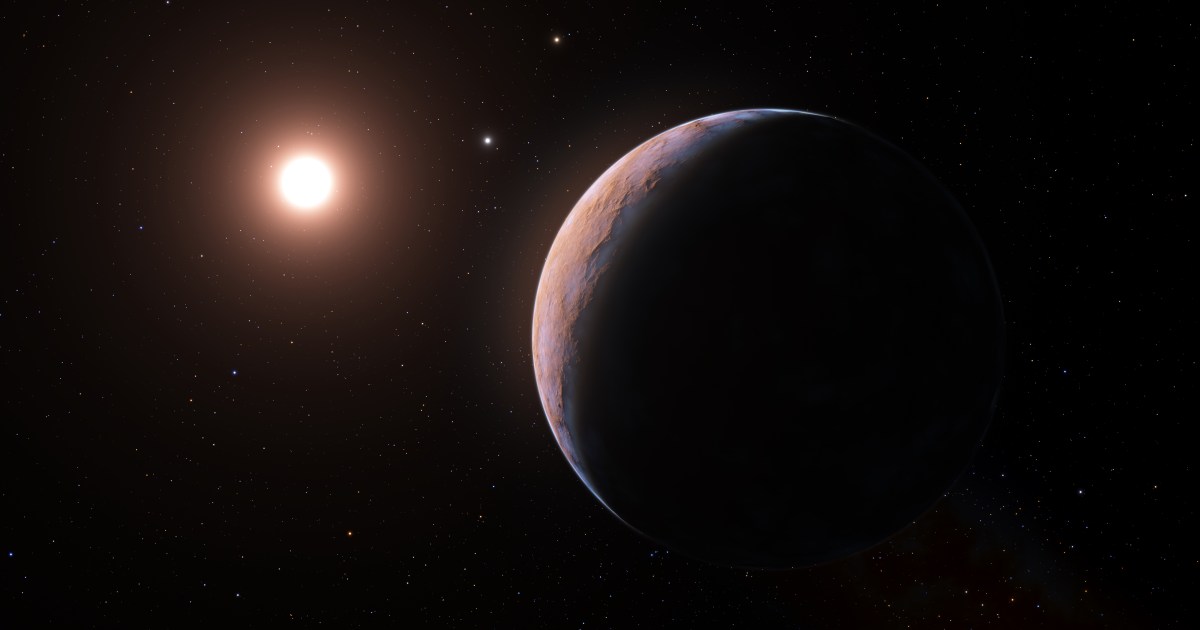
Rocky exoplanet Proxima d looms large in the foreground as it orbits its red dwarf sun, Proxima Centauri, in an artist’s rendering. Researchers have recently found strong evidence that Proxima d may have a magnetic field, protecting its surface from stellar flares. In the distance, to the right and upper right of the star, are planets Proxima b and c, the latter of which has not yet been fully confirmed. Credit: ESO/L. Calçada In all the universe, Earth is the only planet known to have life. A big part of the reason life is possible here is our planet’s magnetic field. It acts like a shield, deflecting harmful energy from our Sun as well as cosmic rays from deep space that could otherwise erode Earth’s atmosphere and irradiate the surface, a death sentence for evolving life-forms. But Earth is far from the only planet we know of. As of this writing, there are more than 6,300 confirmed exoplanets on the roster, with more added by the day. Scientists have discovered stars with as many planets as our own Sun hosts. In other systems, planets as big as Jupiter whip around their sun in only a few days’ time. Astronomers have even discovered planets that orbit multiple stars at once, and they recently caught a glimpse of a possible atmosphere around a rocky, Earth-sized world in its star’s habitable zone. But until 2026, they had no compelling evidence that any terrestrial exoplanets had magnetic fields of their own. Beyond the solar system Because of their protective role, magnetic fields have major implications in the search for life beyond Earth. Astronomers have long suspected that part of the reason Mars now appears dead is that its magnetic field fizzled out billions of years ago. This let the solar wind strip the water and other volatile compounds from its atmosphere, leaving it cold and barren. Beyond the solar system, in 2019 researchers reported “indirect detections of exoplanetary magnetic fields” in four hot Jupiters. Then, a 2021 study found a strong signature of a magnetic field around HAT-P-11 b, a Neptune-like planet. Two years later, a pair of studies detected possible signs of a magnetic field around YZ Ceti b — this time, a rocky, Earth-like planet roughly the same size as, and only a bit less massive than our own. But this find has not yet been confirmed. In July 2026, a study published in Astronomy & Astrophysics found possible evidence of magnetic fields around two rocky exoplanets. Not just any exoplanets, either — Proxima Centauri b and d, the closest confirmed planets beyond our solar system, orbiting the red dwarf Proxima Centauri 4.2 light-years away. Proxima b, roughly Earth’s mass and size, orbits every 11.1 days. Proxima d, likely a quarter to a third of our planet’s mass and 70% its size, orbits closer in with a period of 5.1 days. Because Proxima Centauri is smaller and less massive than our Sun, Proxima b is inside the habitable zone, where temperatures allow liquid surface water. A third planet, Proxima c, was tentatively detected in 2019 but is still unconfirmed. Astronomers don’t yet know if any of these worlds host atmospheres. Timing flares The new study, led by María Rosa Zapatero Osorio of the Centro de Astrobiología in Madrid, Spain, used 117 separate observations made with the Echelle SPectrograph for Rocky Exoplanets and Stable Spectroscopic Observations (ESPRESSO) instrument on the Very Large Telescope atop Cerro Paranal in Chile. The research followed up on previous studies conducted with ESPRESSO in 2020 and 2022, which focused on confirming the presence of planets around Proxima Centauri. Zapatero Osorio and her collaborators used the data to identify a peculiar correlation between the timing of flares emitted from Proxima Centauri and the orbital periods of its planets. “We detected low-energy flares occurring with a characteristic period of about 5.1 days,” Zapatero Osorio says. “This is very close to Proxima d’s orbital period.” But flares did not occur during every orbit of Proxima d, so the team ran statistical analyses to determine whether the flares were preferentially occurring at particular phases of the planet’s orbit. They found strong statistical evidence “that the occurrence of the flares is not randomly distributed over the planet’s orbital period,” Zapatero Osorio says. “Instead, a significant number of flares tend to occur at particular times in Proxima d’s orbit.” This is a possible indication that Proxima d could be interacting magnetically with its parent star, which would be likely to happen if the planet has a strong magnetic field of its own. Using a model adapted from the physics of solar flares, Zapatero Osorio’s team calculated that Proxima d could have a magnetic field anywhere from 8 to 230 gauss in strength, with the best median estimate limited to around 16 gauss. This is about 27 times more powerful than Earth’s magnetic field (0.6 gauss), which protects life on Earth from the worst of the Sun’s energy. Their model assumes that the star and planet are magnetically connected, Zapatero Osorio says. Each sustains its own magnetic field, and these fields are interconnected. As a result of this connection, stress builds up on the stellar surface. From time to time, this stress is released in the form of low-energy flares, whose period is closely tied to the planet’s orbital period. Although there was not as strong a correlation between Proxima b’s orbital period and the stellar flares, the team did find that Proxima b could also be interacting with the star, albeit in a lesser capacity. This suggests that although the finding is less sure, Proxima b may also sustain a magnetic field. There are alternative explanations for the findings. One possibility is that there could be intrinsic, long-lived active regions on Proxima Centauri itself that account for the peculiar timing of the flares. Another explanation is that gravitational interactions between the planets and Proxima Centauri could induce disturbances on the star without requiring a strong planetary magnetosphere, although the team suggests this is less likely. It’s also possible that when Proxima’s stellar wind reaches the planets, it interacts with them in a way that mimics the effects of a planetary magnetic field without requiring one. Why Proxima matters Like most red dwarfs, Proxima is a highly active star, regularly belching out intense flares that would be hazardous to any fledgling life-forms on the worlds in close orbit. Because Proxima is so close to Earth and has at least one rocky planet in its habitable zone, it makes a perfect testbed for studying how stellar flares could affect habitability around red dwarfs — the most common stars in the universe. Astronomers looking for habitable worlds around these stars must contend with the likelihood that any planets would be effectively sterilized by the intense radiation in the flares constantly washing over them. Now, though, there is a glimmer of hope. If Proxima b and d do have magnetic fields, as this research suggests, they could act much like Earth’s own protective magnetic shield, deflecting enough harmful stellar radiation that life might just be able to take hold. “Earth’s magnetic field plays an important role in protecting life and supporting human progress,” says Zapatero Osorio. “It shields our planet from the solar wind and energetic particles, and it has also played an important role in navigation.” Unfortunately, Proxima d is so close to its host star that it is likely too hot to sustain life as we know it. Proxima b, however, lies within the habitable zone. “Based on the results of our study, both Proxima d and b may have magnetospheres capable of providing some protection against their host star’s activity,” Zapatero Osorio says. The importance of this find goes deeper than simply a pair of neighboring planets. In the last few years, evidence has emerged that gas giant exoplanets similar to Jupiter and Saturn host magnetic fields. These are the easiest types of planets to detect and study, but while magnetic fields around such worlds are certainly fascinating, the implications for planetary habitability are limited. But as the number of known planets continues to swell, so, too, does our sample of Earth-like worlds. And if the two closest rocky planets beyond our solar system do indeed have magnetic fields, then perhaps these features are common. If true, it increases the chances that rocky worlds across the galaxy could be habitable — at least, for life-forms as we understand them. And the more planets capable of hosting life, the more likely it is that we might someday discover we are not alone. Nick Oakes is a science writer for NASA’s Heliophysics Education Activation Team at Goddard Space Flight Center in Greenbelt, Maryland.
The closest exoplanets may host magnetic fields
Full Article
Original Source
Read the full article at Astronomy →KhanList aggregates and links to publicly available news content. We do not host full articles from third-party sources. Always verify important information with original sources.