
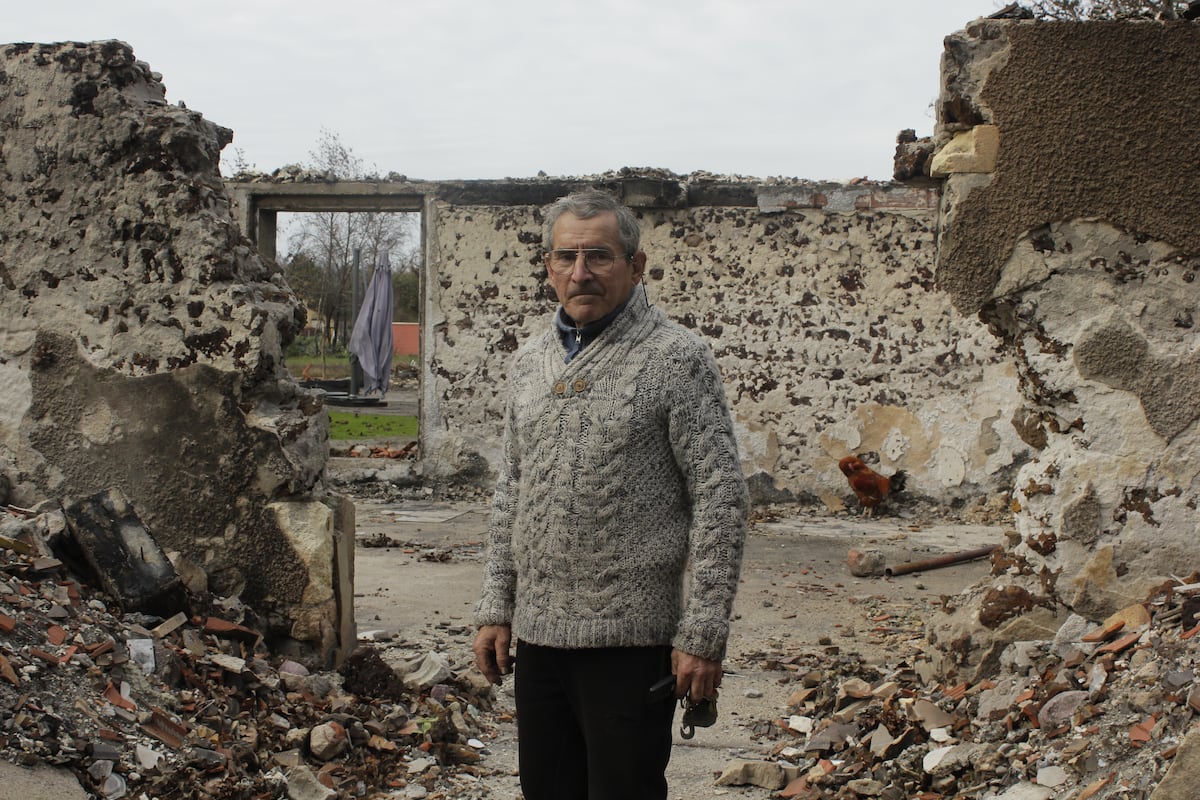
Philippe Verdier walks purposefully across the field, a set of keys in his hand, toward the four stone walls that still stand in the middle of the countryside, like a host about to open his home to a guest. He begins the tour in the kitchen: “There were tall cupboards over there for the dishes, and along this wall there was an oven.”He then moves into the main room: “This was the living room. There was a fireplace on that wall, and here I had a large wooden table and a television... Upstairs there were two bedrooms,” continues the 74-year-old, looking up at the sky.Verdier lives alone and is a resident of Le Porge, a small town of 3,400 people at the epicentre of the wildfires that ravaged southern France this summer.As he speaks, he retrieves a colorful tile from the rubble. He places it on top of a wall, as though that simple gesture could help rebuild the home where he lived for 40 years. Now, all that remains is debris and a few charred walls. “It’s a catastrophe,” he says despairingly. The fires in the department of Gironde were the largest recorded in France since the Second World War. They burned through 42,000 hectares in just one week and forced more than 220,000 people to evacuate. And France is far from an isolated case. More than 700,000 hectares have burned across the European Union so far this year, including 300,000 in Spain, according to official figures.Europe has experienced a succession of extreme weather events this year. Devastating wildfires have been compounded by severe droughts that caused billions in losses. In some stretches, the Danube, Europe’s second-longest river, fell to its lowest levels in decades. After a series of increasingly frequent and intense heatwaves, this became the hottest summer on record in Spain, France, the United Kingdom, the Netherlands, Belgium and Austria, according to the European Earth observation program Copernicus.The suffocating temperatures are estimated to have caused more than 50,300 deaths across Europe in 2026, with 65% of them attributable to climate change, according to a study by Imperial College London and the London School of Hygiene & Tropical Medicine.The climate emergency has ceased to be an abstract threat and has arrived on people’s doorsteps across Europe and around the world. Last year, disasters triggered nearly 30 million forced displacements globally, according to the Internal Displacement Monitoring Center (IDMC). Although the European Union remains the least affected region, with around 125,000 population movements in 2025, the figures for 2026 are expected to be significantly higher when accounting for the more than 250,000 people evacuated during the wildfires in southern France alone, as well as nearly 75,000 others in Spain.“Forced displacement is a persistent and silent tragedy, a crisis that goes largely unrecognized,” says Paula Gaviria, the United Nations Special Rapporteur on the human rights of internally displaced persons.There is no consensus on what to call the exodus of people caused by environmental disasters. The term “climate-displaced people” is commonly used when such movements take place within national borders, while “environmental migrants” describes the movement of people who leave their countries driven by disasters in their surroundings, among other factors.The term “climate refugees” is gaining traction among those who argue that there is a political and legal responsibility towards those affected. However, it remains a subject of debate among experts, since international law does not recognize the climate emergency as grounds for persecution.“The problem we have is that we think these terms apply only to people from the Global South and not to us, Europeans,” says François Gemmene, a professor at HEC Paris Business School and a specialist in migration and environmental geopolitics. “However, what we’re seeing in Spain, France, and other parts of the continent is that more and more people are being forced to leave their homes, whether due to climate-related events or simply because it is no longer convenient or comfortable to live where they chose to,” he adds via video call.“Are they climate refugees?” asks Martial Zaninetti, the mayor of Le Porge. “That is the question we are asking ourselves, because we are experiencing situations we have never encountered before, and we were not prepared to deal with such a catastrophe.” The authorities have set up a scheme to provide temporary accommodation for those affected — around 250 families — until their homes can be rebuilt. “It is something that will take years,” Zaninetti acknowledges from his office.“Of course we’re victims of climate change, because the government is failing to act on a problem that’s been obvious for a long time,” says Ludivine Daurignac, 42, one of those affected in Le Porge. “We left in five minutes thinking we’d be back in a couple of days, but we never did. You never think you won’t return home.” She still remembers the first time she returned to the village, in early August. “The first thing I heard were the screams of the neighbors when they saw what was left of their homes,” she says. After being in the media spotlight during the disaster, the village now feels abandoned.According to the IDMC, wildfires account for nine out of every 10 disaster-related displacements in the European Union. Xiao Fen Hernan, an analyst at the center, points to two factors behind the rising number of people displaced by wildfires: fire seasons are lasting longer, and fires are occurring increasingly close to cities.Climate change is also altering storms and floods. “It’s important to understand that more and more countries in Europe will face a wider range of disasters than they are accustomed to,” she notes. “The responses can’t be the same as they were before.”More than 1,000 miles from Le Porge, the threat is not fire but the sea. Eamann Cahill gazes at the horizon as the tide rises behind his home in Portrane, a coastal village in Ireland with a population of just over 1,200. “I have a love-hate relationship with the sea,” admits the 81-year-old priest.His fascination with the beach brought him here in the 1980s. Four decades later, the power of the waves and storms threatens to destroy his home. Cahill lives at ground zero in one of the areas hardest hit by coastal erosion, a phenomenon that is putting hundreds of structures at risk of being swallowed by the sea in the coming years.Father Cahill has never met or even seen Mr. Verdier, but, like him, he clings to places on his property that have become part of his memories: vegetable gardens that are gone, trees that have had to be removed, and a greenhouse that he has had to relocate farther inland. “I’ve lost about 120 or 130 square meters of my garden,” he says.Erosion is a natural cycle, but the process has accelerated in recent decades due to human activity and climate change. The Climate Ireland platform estimates that 20% of Ireland’s land area is at risk of erosion. After being largely ignored for decades, the issue has become an increasingly pressing concern for a country with nearly 5,000 miles of coastline, where 40% of the population — around two million people — live within three miles of the sea. Across Europe, 25% of coastlines are experiencing erosion, according to a report published by the Council of Europe in October.Iris Möller, director of the School of Geography at Trinity College Dublin, says the phenomenon offers real-time evidence of how rising sea levels and increasingly intense and frequent storms are leaving their mark on the planet. “Portrane is teaching us lessons that apply to so many other places,” the academic notes. “In a way, we are to blame for these homes falling into the sea because they should never have been built there in the first place, and because we are responsible for the climate change that is making it increasingly difficult to live in these areas.”A similar debate is unfolding in the wake of the wildfires in France. “We are going to have to move away from the forest. We need to change our mindset. We can’t live the way we used to, because if we do, it will mean we haven’t learned anything, and in 10 or 20 years, our children will suffer the same fate,” says Mayor Zaninetti. The impact goes far beyond that, Gemenne warns: “The change we are going to see in Europe is that more and more people will take climate and environmental risks into account when buying a home.”At the Burrow, Portrane’s largest beach, the coastline has retreated 20 meters inland compared with its position in the mid-20th century, leaving several homes literally teetering on the edge of a cliff, according to a 2020 study by consulting firm RPS.The threat is a ticking time bomb. If sea levels rise by half a meter, more than 200 homes will be at risk by 2050, and nearly 250 by 2100. Raymond Brett, president of the Burrow Residents’ Association, has spent nearly two decades searching for a solution and admits that he is constantly thinking about moving away. “If nothing is done, we’ll be practically underwater in 20 years. We’re talking about 200 to 300 families being displaced,” he says.“We’ve watched houses disappear before our eyes,” says Marion Lynders, a 66-year-old tour guide. The lack of a national strategy and the absence of compensation mechanisms for people who lose their homes to erosion have sparked debates about intergenerational justice. Some built their homes by the beach decades ago, without anyone warning them that those homes might have an expiration date. Then there are the younger generations, who may never again get to enjoy the area the way their parents and grandparents did.As she walks along the beach, Lynders takes stock of everything that has been tried to tackle the problem. The barriers erected by residents still stand along the shoreline, including metal fences and cages filled with stacked rocks. Hundreds of concrete honeycomb blocks — large hexagonal structures designed to form an enormous line of defense — have become part of the landscape. There are also sandbags, arranged like a massive trench, and this year, rock revetments have been installed as an emergency measure.Möller believes that Portrane’s battle against the sea is unwinnable. Rather than focusing on building artificial barriers to prevent erosion, she argues, the community should consider planned retreat, a strategy that has been implemented for more than 1,000 homes along the French coast, as well as dozens more in the United Kingdom. “It’s inevitable,” she declares.For Father Cahill, leaving is not an option. “This is my home, not just where I live,” the priest says emphatically. “I’ll leave, but in a coffin.”Residents of Le Porge are facing the same dilemma: whether to leave or stay. In the coming days, they will be informed whether they can rebuild their homes in the same locations. A hundred or so affected residents are demanding answers and have filed a lawsuit seeking to establish the cause of the fire, how the authorities handled the crisis, and whether the state bears any responsibility.Amid the landscape carpeted with dry branches and debris, Daurignac embraces Verdier, who has taken refuge in a prefabricated house and a mobile home that have been their home for the past five months. Despite everything, both are hoping to stay. “Look at the ground, the grass is already growing,” he says, with a hint of hope.Artículo elaborado en el marco del proyecto ChatEurope, financiado por la Comisión EuropeaSign up for our weekly newsletter to get more English-language news coverage from EL PAÍS USA Edition
The climate crisis is forcing thousands of Europeans from their homes
Full Article
Original Source
Read the full article at English →KhanList aggregates and links to publicly available news content. We do not host full articles from third-party sources. Always verify important information with original sources.