
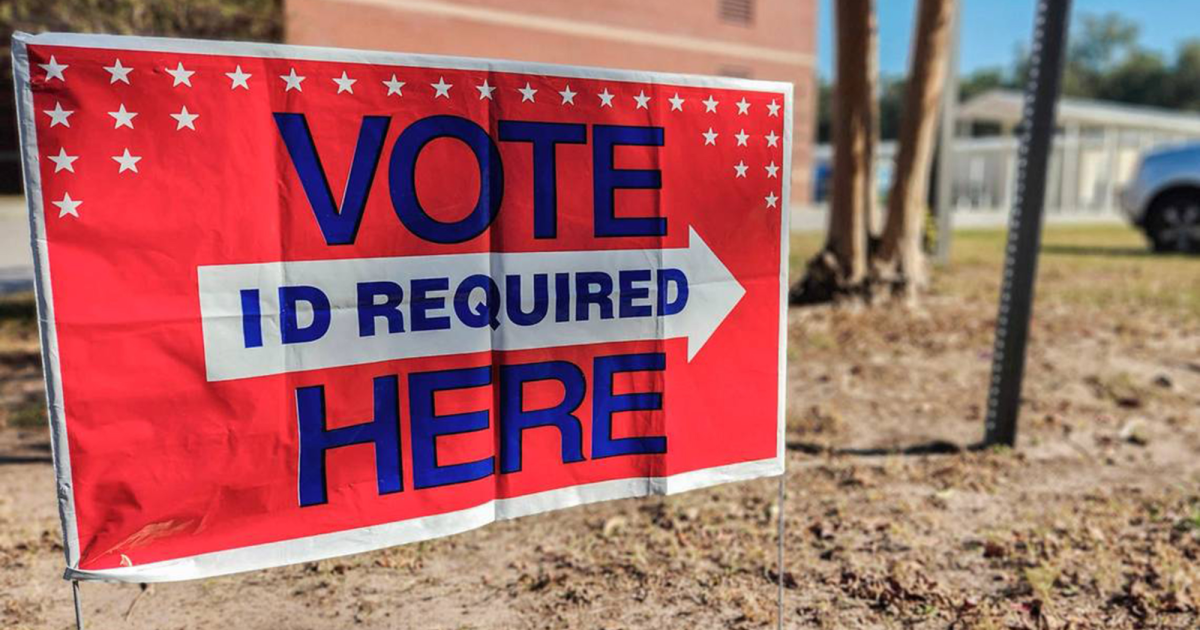
A polling station requiring Photo ID during the 2024 elections.Drew Martin/The Island Packet/ZUMA Get your news from a source that’s not owned and controlled by oligarchs. Sign up for the free Mother Jones Daily. When I sat down with Mike for an interview at a homeless shelter in Northern Virginia, he shook his head and chuckled. “The staff told me someone was coming here to ask about voting, thought you might be someone from ICE,” he said. “Your mind runs wild, and you start thinking, ‘Well, this administration is interested in voter fraud.’” Mike (not his real name) is 58 years old and for the last seven months, he and his family have been staying at a local shelter, the result of a complicated mixture of medical and domestic issues, and soaring rental prices in Northern Virginia that led to the loss of their home in Fairfax County and their inability to find another place to live (he preferred not to be specific about his family’s circumstances). Born and raised in Virginia and a registered voter, Mike rattles off party breakdowns of obscure local districts and ballot measures he once voted for (and against) more than 10 years ago—he even remembers who he voted for in his first election when he turned 18. “Voting is important. I’ve voted for Republicans, Democrats, and Independents,” he tells me, “but I’ve always thought it’s important.” Now in temporary housing, Mike feels lucky they have beds, three free meals a day, a case manager, storage for medical and identifying documents, and Wi-Fi. “A place like this,” he said, referring to the shelter in the Virginia suburbs, “can save someone.” But now he wonders what this will mean on Election Day. “How do you vote if you don’t have a place [to live]?” he asked, with the midterms only a week away. He’s also unsure about where to cast his ballot, even though he had registered to vote when he still had a home. “I literally am trying to think of where the nearest polling place to vote is,” he said. “I’m trying to think where the nearest school is around here.” Mike’s situation is better than many who are unhoused or are experiencing unstable housing. In Virginia, an estimated 7,141 people are homeless on a given night, and Street Sense Media estimates that number is on the rise. But even with resources like Wi-Fi and a case manager, navigating the voting process without permanent housing for people throughout the country can feel downright impossible, especially for a demographic that receives so little outreach. “We hear a lot about voting these days, but we don’t hear enough about the impact on people who are experiencing homelessness.” “We hear a lot about voting these days, but we don’t hear enough about the impact on people who are experiencing homelessness,” said Marcy Thompson, vice president for programs and policy at the National Alliance to End Homelessness. In a country where less than 10 percent of the 745,652 unhoused people typically cast a ballot in any given election year, Thompson said “losing your home should not equal losing your voice.” Nationwide, people experiencing homelessness face a gauntlet of barriers when trying to exercise their right to vote, from strict voter registration guidelines and ID laws, to maintaining correct and up-to-date documentation, to just physically getting to the polling site. Some states, like California, Washington, Vermont, and New Jersey, are actively trying to make voting more accessible. But in others—Florida, Kansas, and Mississippi, for example—casting a ballot if unhoused is nearly insurmountable. A state like Virginia, where I spoke to Mike, with its blend of expansive and restrictive voting laws, often sows further confusion and uncertainty. In the lead-up to the 2026 midterm elections, the Trump administration and Congressional Republicans have attempted to limit voting access. The controversial Republican-led Safeguard American Voter Eligibility (SAVE) Act would have required eligible voters to present a passport or birth certificate at the time of registration. And while that bill has stalled in Congress, Arizona, New Hampshire, Louisiana, South Dakota, Utah, and Wyoming have already enacted their own “show your papers” laws that implement the same ID requirements, even though millions of Americans lack easy access to documents proving citizenship. Research from the Brennan Center for Justice has found that more states have passed expansive voter laws than restrictive ones since the start of 2026, but the federal government’s attempts to usurp states’ constitutional control could undermine these laws as well as public confidence in elections. As Donald Whitehead, executive director of the National Coalition for the Homeless, explained, “The stricter the requirement, the more likely they are screening out people experiencing homelessness, and the people who are the most disenfranchised. It prevents people from being able to exercise their right to vote.” Virginia’s voting laws are complicated. When Mother Jones ran a piece about unhoused voters in 2019, the state had some of the strictest voting laws in the country after a coalition of Republican legislators passed reforms to keep the state red. But in the last two years with a Democratic statehouse, Virginia has enacted eight new voting laws that include a statewide ban on immigration enforcement activities within 500 yards of a polling place. There are also added protections from racial discrimination and erroneously canceled voter registration. The state also offers a 45-day early voting period and same day voter registration. At the same time, Virginia is one of 38 states that require voter identification, a hurdle that can turn a small technicality for voters with fixed addresses into an impossibility for someone experiencing homelessness. Voter ID laws in states like Alabama and Indiana are much stricter than those in Virginia, requiring a driver’s license, passport, or military ID. Virginia offers voters the option to use non-government documents like a utility bill or bank statement—documents often inaccessible to someone experiencing homelessness. People living in unstable housing, such as encampments or tents, might be more vulnerable to theft, street sweeps, and encampment closures, all of which, Thompson said, adds up to “more lost documents.” The challenge of maintaining documentation while unhoused is a “circle of doom. The more unstable [someone’s] housing is, the more likely they are to lose those documents.” Pam Pearson, director and general counsel of VoteRiders’ ID Assistance, a nonpartisan, nonprofit organization that focuses on voter education and voter ID assistance, calls the challenge of maintaining documentation while unhoused a “circle of doom. The more unstable [someone’s] housing is, the more likely they are to lose those documents.” She works with eligible voters directly to help them get essential documents like birth certificates and drivers’ licenses. “My birth certificate and social security card are in a little lockbox,” she said, “I don’t carry them with me.” But for someone who is unhoused, “they’re in situations where they have to carry everything with them.” Once at the polls, those in Virginia who lack an acceptable form of ID or a fixed address do have an option: they can sign an affidavit that affirms identity and then cast a ballot. The state allows people experiencing homelessness to identify a place they usually sleep as their residence for voting registration, which, in Mike’s case, can be the family shelter. In other cases, it can be a cross-street or an intersection. These locations can similarly be used when voting by mail, but people experiencing homelessness may struggle to receive their mail, potentially missing out on crucial voter education materials like ballot initiatives or information about the candidates, not to mention simply receiving their ballots. When we meet, Mike is still uncertain. “This is not a place of residence,” he said, “so I think you vote at your last residence?” The shelter in which he is staying requested that it not be named, but an assistant programs director said their clients “can use the shelter’s address as long as they remain here, until there’s a change in location status.” No matter what the jurisdiction, unhoused voters can face an additional series of obstacles that compound their difficulties in exercising their franchise. Whitehead, from the National Coalition for the Homeless, noted “Sometimes these voting locations are in remote areas and not easily accessible to someone who has to rely on public transportation or walking.” Should someone have all the paperwork and arrive at a polling station ready to vote, “there’s discrimination against people who may not look the part, especially if they’re living on the street,” Whitehead said. “There can be issues with clothing or hygiene. But if you’re living in the street and don’t have access to a public shower, it becomes quite a burden.” Taking steps to facilitate voter comfort, like recruiting poll workers who are known within the homeless community, Whitehead’s organization states, can go a long way to encourage successful voting. Adding to the challenges for marginalized voters is the Trump administration’s scrutiny over election integrity and voter fraud. Despite overwhelming evidence that US elections are secure, Trump has waged unsubstantiated attacks on voting equipment, mail-in ballots, and the citizenship of voters. In an act of unprecedented overreach, the Department of Justice has demanded access to state voting rolls and, in May, even charged a woman in Los Angeles with paying people, “including homeless individuals,” to register to vote. Online mis- and disinformation have also pushed claims that unhoused people in LA were being bribed to vote for now-Mayor Karen Bass, to which the LA County Registrar replied on X, “Fact Check: NO Evidence ‘Skid Row’ Woman Voted for Karen Bass for $5.” “Misinformation about people experiencing homelessness being paid to vote make good headlines, [but] they’re always proven to be false narratives,” said Whitehead. “What it really demonstrates is that we already have very strict voting laws, and there’s this push to make them even more restrictive.” As Trump has unleashed and expanded federal and local law enforcement since assuming office, culminating in deadly ICE raids and the National Guard’s ongoing deployment in Washington, DC, Whitehead said a culture of fear is developing around voting, particularly for those who are unhoused. “With excess law enforcement, you see a level of fear. People are scared,” he told me. He said people experiencing homelessness in DC sometimes will travel to Virginia to sleep to avoid the National Guard troops deployed to the city by the Trump administration. “They’re going to other locations so they won’t be rousted in DC, so their belongings—medical devices, identification, family heirlooms—won’t be taken.” VoteRiders’ CEO Lauren Kunis noted that sowing confusion is one of the tactics in the broader agenda of voter suppression. “These voters don’t want to get in trouble. They don’t want to show up with the wrong things. They just want to cast their vote, and it’s really confusing,” she said. “The confusion is the enemy of the voter because it’s going to deter a lot of people from actually voting, and that’s not fair to them.” In the end, Mike doesn’t really think that his vote as a person in unstable housing matters. “I don’t think there’s enough homeless people to be a voting block,” he told me—and he’s not wrong, since they are such a dispersed population. Indeed, among the people with whom he lives who are just managing to survive, politics is not top of mind. “Not one person here has said anything about the election.”
The “Circle of Doom” Keeping Unhoused Americans From the Polls
Full Article
Original Source
Read the full article at Motherjones →KhanList aggregates and links to publicly available news content. We do not host full articles from third-party sources. Always verify important information with original sources.