
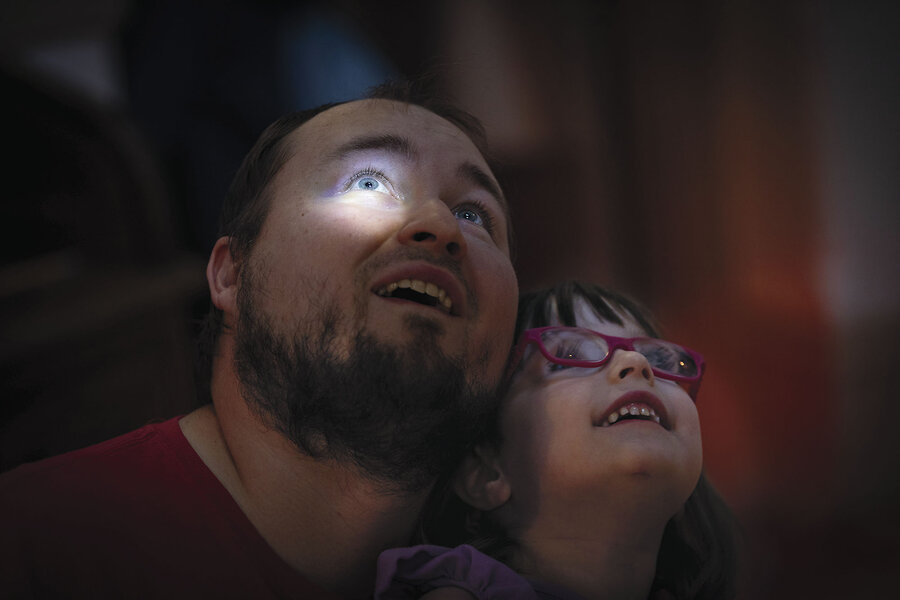
Cincinnati | Nov. 12, 2026, 11:51 a.m. ET | 2 min read The Cincinnati Observatory is filled one evening with 16 squirmy scientists eager to learn about the moon.It’s an exciting time for space scientists, given the ongoing Artemis space missions aimed at establishing a long-term human presence on the moon and crewed missions to Mars. Some people in this room – many still in elementary school – could well be on future Artemis missions.“Who knows something about the moon?” asks their guide, Nicole Capella, program manager for the observatory. Every single hand rises.Call it the Artemis effect. As with the Apollo and Challenger missions before, NASA captured the imaginations of a new generation of children fascinated by the prospect of making the stuff of science fiction into reality. NASA says its live broadcast feed of the Artemis II launch last April set new streaming records, registering more than 149 million views of the launch, the flyby of the moon, and the splashdown. This success built on the launches of Artemis I in 2022 and the James Webb Space Telescope in 2021. Melanie Stetson Freeman/Staff’SCOPING FOR THE BEST: The Cincinnati Observatory, which touts itself as the “birthplace of American astronomy,” includes the Merz and Mahler telescope. The Cincinnati Observatory touts itself as the “birthplace of American astronomy.” Former President John Quincy Adams – an ardent advocate of public astronomy – spoke at the groundbreaking on Nov. 9, 1843. When the 11-inch Merz and Mahler refractor telescope arrived from Bavaria in 1845, it was the largest refractor in the Western Hemisphere and third largest in the world.While the U.S. Naval Observatory in Washington was created to assist in mapmaking and navigation, the goal of the “people’s observatory” in Cincinnati is educational. During the young scientists’ visit, children listen to a collection of fun facts, and then get their hands dirty: They bathe black construction paper with glue sticks, pour a dusting of flour, and drop rocks from above to mimic the impact of asteroids. William Messer, a third grader, tells his father that he is “very interested in going to the moon and to Mars.”Mike Messer is supportive. “When I was your age, I thought that I would get to see people on Mars, but that might have to be your generation that does it,” he says. Deepen your worldviewwith Monitor Highlights.Politics with respectGet political stories with respectful analysis.There‘s a world of new ideas in everyBooks newsletter.There‘s more to life, enrich yours withCulture & Learning weekly.Follow humanity‘s discoveries withScience & Nature stories in your inbox.Gain a spiritual perspectivefrom the stories in your inbox.Want to understand the deeper impact of critical events? Learn the Monitor‘s insight.Already a subscriber? Log in to hide ads. Ms. Capella guides the visitors into the telescope room and pulls a rope to open the roof for the Merz and Mahler refractor telescope. All the young scientists gasp. The energy in the room bears some resemblance to the hum of the cosmos. Some of the kids raise their hands and answer questions like waist-high Carl Sagans.Asher Myers, a second grader, takes his turn to look through the telescope eyepiece and declares, “I love space.” Melanie Stetson Freeman/StaffSTAR PUPIL: William Messer, with his dad, Mike, raises his hand to answer a question about the moon at the observatory. Melanie Stetson Freeman/StaffSTARRY-EYED: Jens and Megan Sutmoller and their sons Hugo (left) and Augie look into the Clark Telescope. Melanie Stetson Freeman/StaffSTELLAR REPUTATION: The observatory’s domed Herget Building is a National Historic Landmark. Melanie Stetson Freeman/StaffAMAZING STARGAZING: Program manager Nicole Capella poses by the Clark Telescope, which is used for public education and graduate research. Melanie Stetson Freeman/StaffNIGHT READING: Kids’ books on the solar system are available on family night. ALREADY A SUBSCRIBER? LoginReal news can be honest, hopeful, credible, constructive.The Christian Science Monitor was founded in 1908 to lift the standard of journalism and uplift humanity. We aim to “speak the truth in love.” Our goal is not to tell you what to think, but to give you the essential knowledge and understanding to come to your own intelligent conclusions. Join us in this mission by subscribing.
The Cincinnati Observatory sends young visitors over the moon
Full Article
Original Source
Read the full article at Csmonitor →KhanList aggregates and links to publicly available news content. We do not host full articles from third-party sources. Always verify important information with original sources.