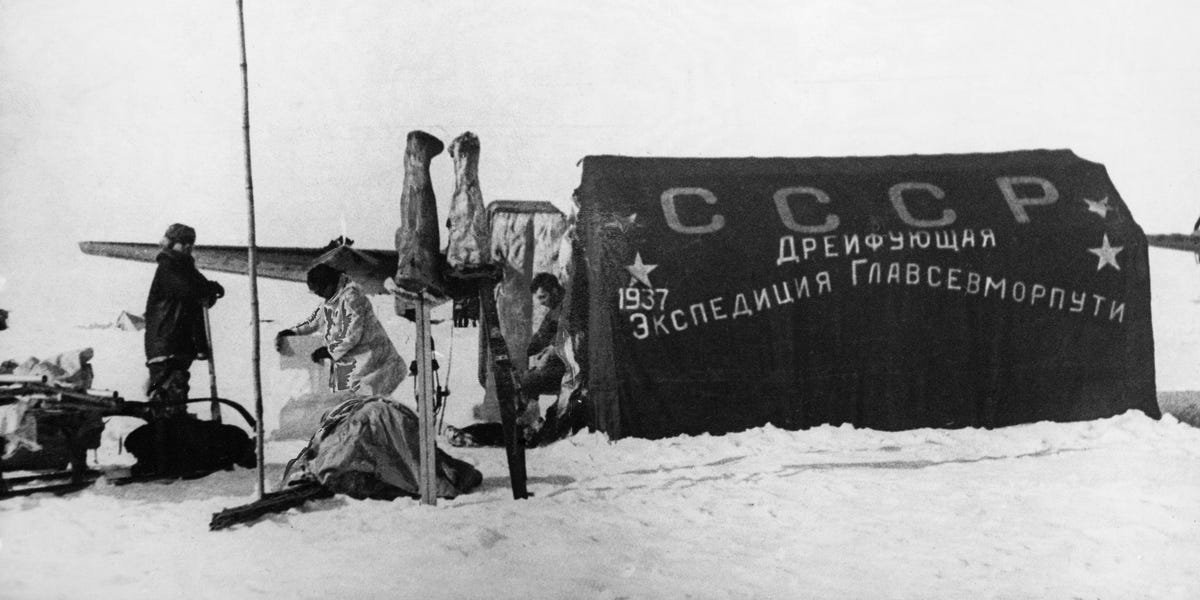
6 min readIn 1961, the CIA discovered an abandoned Soviet drift station frozen deep in the Arctic, but extracting its intelligence seemed impossible.Three years earlier, inventor Robert Fulton developed the Skyhook aerial retrieval system, which used a balloon-lifted cable to pluck people from the ground into a passing aircraft.During Project Coldfeet, the CIA successfully used Fulton’s untested Skyhook technology to extract two operatives and 150 pounds of Soviet research materials from the abandoned station.In the 2008 blockbuster The Dark Knight, there’s a moment where Bruce Wayne asks his engineer Lucius Fox about a way to get aboard an airplane “without it landing.” With a smirk, Fox tells him, “The CIA had a program back in the ’60s for getting their people out of hotspots called Skyhook. We could look into that.”Here at Popular Mechanics, we looked into that claim, and it turns out that it’s true: in the 1960s, the CIA really did develop a way to get people aboard planes without the plane ever landing, and they really did call it Skyhook. And with all due respect to Batman, the story of what the CIA did with the tech is even more impressive than extraditing a man back to Gotham City.Operation Coldfeet1961 was a particularly fraught year in the Cold War. It saw the botched Bay of Pigs Invasion, the construction of the Berlin Wall, the contentious Vienna Summit, and a standoff between Soviet and U.S. tanks at Checkpoint Charlie. It felt as though the balance of power might shift at any given moment, and that made any advantage the U.S. could gain—no matter how slight or how difficult to obtain—feel like a matter of survival.In May 1961, a naval aircraft spotted something remarkable in the Arctic during a routine aeromagnetic survey flight: a Soviet drift station, fully abandoned. The U.S. employed similar ice stations to keep tabs on Soviet submarine movement, and being able to see how the Soviets equipped their own drift stations—including the tech they employed and any research they left behind—would be invaluable intelligence. It was almost too good to be true. So, why was it just sitting there, seemingly ripe for the taking?Only a few days after the U.S. made the discovery, the USSR confirmed the findings. Their drift station, known as Station NP9, had indeed been abandoned. The reason? The ice runway the Soviets had been using to receive restocks of supplies had been demolished by a pressure ridge, making it impossible for any more incoming flights to reach the station. The Soviets were forced to abandon their station, confident that, with no way on or off the drift station, all their secrets would eventually be consumed by the Arctic.It was a reasonable assumption to make. A CIA history notes that Station NP9 “was far too deep into the icepack to be reached by an icebreaker, and it was out of helicopter range.” You would need a way to get men onto and off of the station without ever landing the plane. It seemed impossible.Fortunately, Robert Fulton wanted to do the impossible.Robert Fulton’s Flying MachinesRobert Edison Fulton Jr., son of the president of the Mack Truck Company, had already lived quite a life before he came to the attention of the CIA. Born in New York in 1909, and given a middle name in honor of his grandfather’s good friend Thomas Edison, Fulton had studied architecture in Vienna, visited King Tut’s tomb in 1923, spent 17 months on a “motorcycle adventure” across 32 countries, and turned a fascination with photography into a job with Pan Am “taking pictures for the development of the trans-Pacific air route.” His continued to innovate in the aviation space during World War II, dveeloping a simulator called the “Gunairstructor” that used film to train gunners in aerial combat.In London after the war, Fulton saw a demonstration of the All American System—an adaptation of the British aerial mail pickup system developed by All American Aviation. Utilizing steel poles and cables, an aircraft could gently glide at 90 mph without touching down and snatch a pouch of mail up into the air. Fulton felt that a similar system could be developed that wasn’t limited to extracting inanimate objects.Eventually, in 1958, he introduced the Fulton aerial retrieval system, otherwise known as Skyhook. The system utilized a harness that was attached to a 500-foot braided nylon line. When it was time for pickup, a portable helium bottle would inflate a balloon, which lifted the line to a height where it could be easily hooked by the pickup plane’s angled steel “horns.”Fulton successfully tested the system—first on dummies, and then on a pig who “arrived onboard undamaged but in a disoriented state.” Human tests conducted in the summer of 1958 found that the system actually delivered less shock than a soldier experienced during a parachute opening, equating the sensation to “a kick in the pants.”So, when the challenge of how to reach Station NP 9 arose in 1961, Captain John Cadwalader determined that Fulton’s Skyhook was the only solution for what would be called Project Coldfeet.Top brass, however, needed to be convinced.As the operation would be a collaboration between the CIA, the Defense Intelligence Agency, and the Office of Naval Research, the Navy needed to approve the plan. And since the Skyhook had never actually been used in the field before, high-ranking officials were slow to approve it. The Navy feared the system would not only fail, but potentially kill the men sent on the mission in the process (a fear exacerbated by the fact that one of the men selected for the mission, Antarctic geophysicist Lieutenant Leonard A. LeSchack, had no prior jump qualification and needed to be rushed through the training process). By the time Cadwalader got his approval, NP9 had drifted too far away to be reached.Then, in March of 1962, a breakthrough came. The Soviets had abandoned another drift station—the more up-to-date NP8. Better yet, NP8 was even easier to reach than NP 9 would have been, as it was positioned only 600 miles from Resolute Bay, a Royal Canadian Air Force base.The Fateful FlightOn May 28, 1962, a Boeing B-17 Flying Fortress took off from Intermountain Aviation (a company secretly owned by the CIA) carrying Lt. LeSchack and Major James Smith (a paratrooper and Russian language expert) from the Air Force. A first attempt two days earlier had failed when the crew couldn’t locate NP8. But this time, they found the station, and the two men parachuted down onto the ice. Once Major Smith radioed a positive report, the B-17 returned to base, where crews affixed the equipment needed for Fulton’s Skyhook to—hopefully—retrieve the men. LeSchack and Smith had 72 hours to search the drift station.Pickup was supposed to occur on May 31, but worsening weather conditions delayed the efforts by several days. When the team was finally able to fly out on June 2, it wasn’t because the weather had suddenly turned ideal. They were simply running out of time.If anything, conditions seemed designed to push Fulton’s system to its absolute limits. The skies gave the ice a “gray hue” that challenged visibility. The wind surged at a speed of 30 knots, which introduced the risk that the hooked cargo could blow away during extraction. LeSchack and Smith had collected nearly 150 pounds of Soviet operational materials, including “exposed film, documents, and equipment samples.” When the B-17 flew over for extraction, the men needed to grip tightly onto the canvas bag containing thier prize for fear it would be blown away.The materials they brought back revealed that the Soviets were developing advanced Arctic anti-submarine warfare technology, meaning that the USSR was far more advanced in its polar and oceanographic research than the U.S. was. Captain Cadwalader remarked that the findings demonstrated the Soviets’ “long experience in this field and the great importance that their government attaches to it.”For Cadwalader, however, the real success of Project Coldfeet was the operational demonstration of the Fulton Skyhook, which proved “the practicality of paradrop and aeroretriever recovery to conduct investigations in otherwise inaccessible areas.” The U.S. would continue to use the Skyhook technology (later abbreviated as STAR for “surface-to-air-recovery”) for human extraction until a special forces team member was killed during the 1982 Flintlock exercises. The system remained in use for non-human extractions until the mid-90s, when newer long-range helicopters capable of aerial refueling rendered the technology obsolete.Outside of its military applications, the Skyhook found itself a second life in Hollywood. The technology made its big screen debut just three years after Project Coldfeet, rescuing James Bond in the final moments of 1965’s Thunderball. In 1968—at the same time the real Skyhook was being deployed in the Vietnam War—it appeared in the film The Green Berets.Skyhook’s inventor, Robert E. Fulton Jr., died in 2004 at the age of 95, and he’s remembered as much for his many travelogues a he is for the invention of the Skyhook. But just four years after his passing, the balance shifted, and Fulton’s retired flight technology returned to the public consciousness. It appeared in a film about a fictional figure whose wealthy and well-traveled background, as well as his love of tinkering, matched Fulton’s own: The Dark Knight.Michale Natale is a News Editor for the Hearst Enthusiast Group. As a writer and researcher, he has produced written and audio-visual content for more than fifteen years, spanning historical periods from the dawn of early man to the Golden Age of Hollywood. His stories for the Enthusiast Group have involved coordinating with organizations like the National Parks Service and the Secret Service, and travelling to notable historical sites and archaeological digs, from excavations of America’ earliest colonies to the former homes of Edgar Allan Poe.
The CIA Found a Soviet Ghost Station Full of Cold War Secrets. To Steal Them, the U.S. Had to Do the Impossible.
Full Article
Original Source
Read the full article at Popularmechanics →KhanList aggregates and links to publicly available news content. We do not host full articles from third-party sources. Always verify important information with original sources.