
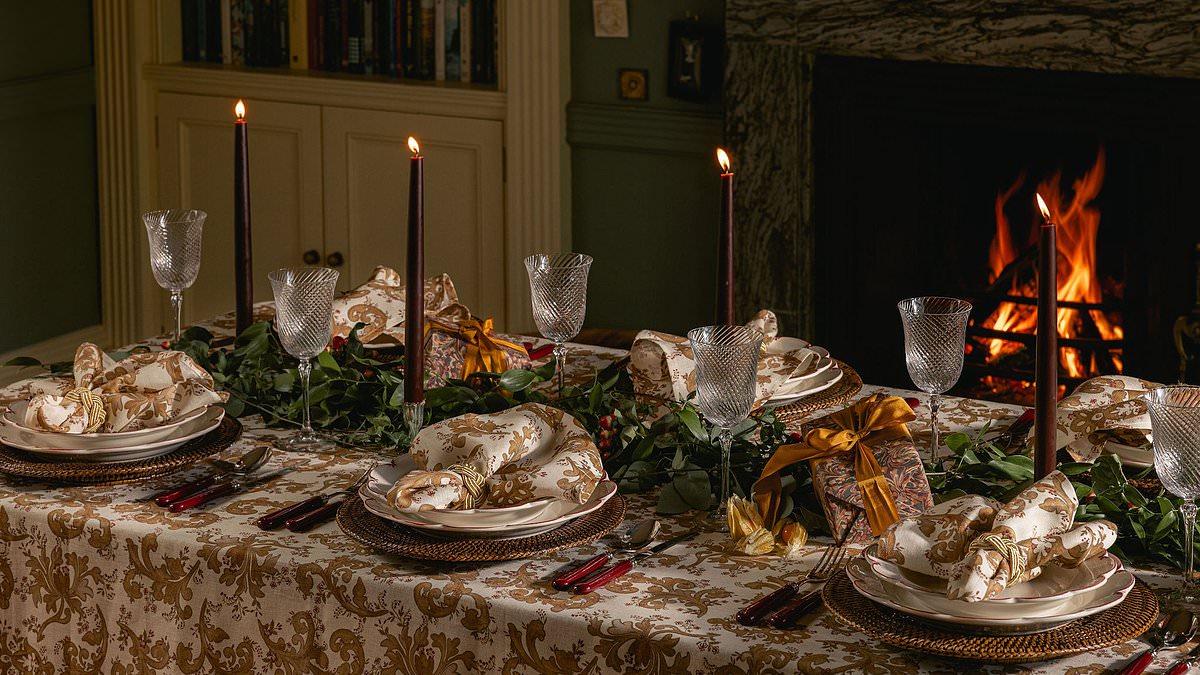
Daily Mail journalists select and curate the products that feature on our site. If you make a purchase via links on this page we will earn commission - learn moreChristmas lunch is one of the few occasions when more really is more. We’re talking extra serving platters, the good crockery, enough candles to rival a church and, of course, a tablecloth that has probably been tucked away in the airing cupboard since last December. But while dressing the table is all part of the festive fun, there’s a fine line between a beautifully considered setting and one that looks as though Father Christmas has emptied his entire sack of decorations across it.So, how do you get it right? According to Rebecca Udall, founder of the eponymous British homeware and linen brand, the secret is to embrace abundance without getting too caught up in perfection. Think layers of beautiful linens, carefully chosen colours, plenty of candlelight and personal touches that make guests feel welcome.And, perhaps most importantly, don’t be tempted to save your favourite pieces for another occasion. Here, Udall shares her dos and don’ts for dressing a Christmas table that looks just as good as the food tastes.1. DO embrace a little festive excessIf there’s ever a time to get everything out of the cupboards, it’s Christmas. While we’re usually told to keep things simple, the festive season is an excuse to bring out all those beautiful serving platters, favourite crockery and glassware that might not make an appearance during an ordinary Sunday lunch.Udall’s biggest piece of advice is to embrace the abundance. Layer your favourite table linens with beautiful crockery, glassware and serving pieces, and don’t be afraid to mix different styles together.‘Christmas is a rare point in the calendar when you need all the serving platters, plenty of candlelight and a full table setting, so I love to really lean into that.’The trick is to make it feel generous and welcoming rather than overly styled. After all, nobody wants to feel nervous about putting their wine glass down in case they disturb the carefully curated arrangement.2. DON’T turn your dining table into a Christmas grottoThere’s festive, and then there’s festive. While it’s tempting to buy everything from novelty napkin rings to Christmas tree-shaped salt and pepper shakers, Udall believes the most timeless tables are those that don’t scream December 25 at every opportunity.Instead, she recommends choosing pieces that can be used throughout the year, from patterned linens and woven placemats to hand-painted crockery.‘Personally, I think the most beautiful and timeless settings aren’t too on-the-nose festive.’Traditional golds, deep reds and earthy greens are all lovely seasonal colours, but you don’t need to invest in an entirely separate set of Christmas tableware. A few thoughtful finishing touches will do the job without making your dining room look like the Christmas department at a garden centre.3. DO let your tablecloth do the talkingStarting with a completely bare table can feel a little daunting, but Udall has a simple solution: begin with the linens.A tablecloth is the foundation of your entire setting, so choosing this first will help determine the colours, textures and overall mood of everything that follows. Whether you opt for a bold print, a classic white linen or something in a rich festive shade, it will immediately give your table a more considered feel.A tablecloth is the foundation of your entire setting, says Udall.In fact, there’s one traditional rule Udall refuses to abandon: ‘The one rule I would never break though is setting the table for Christmas lunch without a tablecloth.’Consider that your permission to get the good linen out.4. DON’T go completely colour blindYou don’t need to stick to a rigid colour scheme, but equally, throwing every shade of the rainbow onto your table isn’t necessarily going to create the effect you’re after.Udall’s trick is to work with three key colours and one accent shade, making sure each appears at least twice throughout the setting. This creates a sense of cohesion without everything looking too perfectly coordinated.You can also play with different intensities of the same colour. For example, introduce a dusty burgundy through your table linen, a deeper shade through your candles and a rich burgundy ribbon tied around your napkins.And don’t underestimate the power of an unexpected pop of colour. ‘That slight clash brings another layer of interest and character,’ she explains. Think tortoiseshell cutlery against a traditional festive palette or a flash of something bright in your hand-painted plates.5. DO mix your patterns – just don’t lose the plotMatching everything is easy, but it can also make a table feel a little flat. Udall is a big believer in mixing patterns, materials and textures, provided there’s something tying them together.A common colour, a similar print or a shared design detail can help different pieces feel as though they belong together, even if they weren’t originally bought as a set.Texture is equally important. Think weighty cutlery, soft linens, woven placemats and beautifully detailed crockery. These different finishes add depth and make the table feel richer without needing to pile on the decorations.As Udall puts it, ‘things don’t have to match, but they do need to be cohesive.’6. DON’T let your centrepiece steal the show (or the gravy boat)A dramatic floral arrangement might look wonderful in photographs, but there’s one rather significant problem with an oversized centrepiece: your guests won’t be able to see each other.And when you’re hosting a family Christmas lunch, conversation is arguably more important than having an Instagram-worthy arrangement of flowers.Udall prefers a more relaxed approach, suggesting seasonal foliage running down the centre of the table, dotted with berries and seasonal fruit for colour. Alternatively, a collection of little bud vases arranged along the length of the table creates a pretty effect without taking up too much room.The same goes for height. Before guests arrive, try sitting in each seat to check that nothing obstructs the view of the person opposite you. Nobody wants to spend Christmas lunch talking to the back of a floral arrangement.7. DO take your candle game seriouslyNothing transforms a dining table quite like candlelight. Even the simplest setting feels instantly more special with a warm, flickering glow, so this is one area where Udall encourages a little extravagance.Her suggestion is to have one taper candle per place setting, although there’s no need to arrange them in perfectly regimented rows. Vary the spacing and group two or three together at different heights to create a more relaxed, natural look.And don’t restrict your candles to the dining table. If you have a sideboard or spare surfaces nearby, add a few tealights and tapers to extend that lovely warm glow throughout the room.Just remember to keep candles safely away from foliage, decorations and anything else that might catch fire. Festive ambience is one thing; an unexpected visit from the fire brigade is quite another.8. DON’T assume luxury has to mean expensiveYou don’t need to spend a fortune on new decorations to make your table feel special. In fact, some of the most effective finishing touches can be found in your fruit bowl.Udall recommends using seasonal fruits such as figs, pomegranates, clementines and grapes to bring colour, natural texture and interest to the table. Arrange them amongst your foliage or scatter a few along the centre for an effortlessly festive feel. Better still, they can double up as an after-dinner snack. Use seasonal fruits to bring colour, natural texture and interest to the table.Another lovely idea is to wrap a small gift for each guest. Udall does this every year, using beautiful wrapping paper and velvet ribbon to create an extra detail at each place setting.It doesn’t have to be anything extravagant, either. A little treat, personalised decoration or something homemade will make guests feel thought of before they’ve even sat down.9. DO embrace mismatched place settings (within reason)Do all your plates, glasses and napkins need to match? Not necessarily. While Udall admits that she tends to use matching place settings for Christmas lunch – ‘as the founder of a homeware brand, I don’t have much excuse not to have matching sets!’ – she is all for mixing things up when the occasion calls for it.If you’re short on matching crockery or have a few extra guests joining at the last minute, her advice is to distribute the different styles evenly across the table. That way, no one or two settings look noticeably out of place.Vintage crockery is another opportunity to embrace an eclectic look, with different patterns and designs adding personality. The key, once again, is making sure the overall combination feels intentional.10. DON’T get bossy with the place cardsPlace cards can be a lovely finishing touch, particularly if you’re hosting a larger gathering, but they’re not essential for every Christmas lunch.If everyone around the table is family or close friends, Udall thinks they can sometimes feel unnecessarily formal. Instead, she has a much sweeter suggestion: get the children involved.‘What I love to do, though, is recruit the children in the family to make them.’Not only is it a lovely festive activity to keep little ones occupied, but it also adds a personal, playful touch to the table. And even if the handwriting is a little wonky, that’s rather the point.11. DO prioritise atmosphere over perfectionUltimately, the most important thing to remember is that a Christmas table is there to be enjoyed, not simply admired. It’s easy to become so preoccupied with getting every detail right that you forget the reason you’re hosting in the first place.Udall encourages hosts to think about how they want their guests to feel, rather than focusing solely on the aesthetics. A beautiful setting should still be comfortable, practical and inviting.‘Hosting for any occasion is about building a welcoming, relaxing and celebratory ambience,’ she says.Udall’s golden rule? Work at three heights and create interest at each layer. Her golden rules are to think about height and texture, working across three levels: start with the tablecloth and placemats, add crockery, charger plates, foliage and tealights, then introduce height with taper candles, stemmed glassware and flowers.But above all, use the things you love. Bring together your favourite linens, crockery, glassware and serving pieces, and add a few seasonal touches. The most interesting tables, she believes, are those with a sense of personality.12. SHORT ON TIME? Light the candles and fake the restOf course, even the most organised host can find themselves with half an hour to go before the doorbell rings and a completely undressed dining table. Don’t panic: there’s still time to make an impression.Udall recommends starting with the tablecloth, then prioritising candles and any foliage or bud vases before laying out the place settings. These simple additions will immediately create atmosphere, even if the finer details aren’t quite finished.‘Candlelight adds immediate charm and atmosphere.’And if the napkins aren’t perfectly folded or the place settings aren’t quite symmetrical? Don’t worry. You can finish adding the essentials while chatting to your guests with a glass in hand.After all, the best Christmas tables aren’t necessarily the most perfect ones. They’re the ones where everyone wants to linger a little longer.
The Christmas table mistakes to avoid (and the styling tricks that make all the difference), according to a homeware expert
Full Article
Original Source
Read the full article at Dailymail →KhanList aggregates and links to publicly available news content. We do not host full articles from third-party sources. Always verify important information with original sources.