
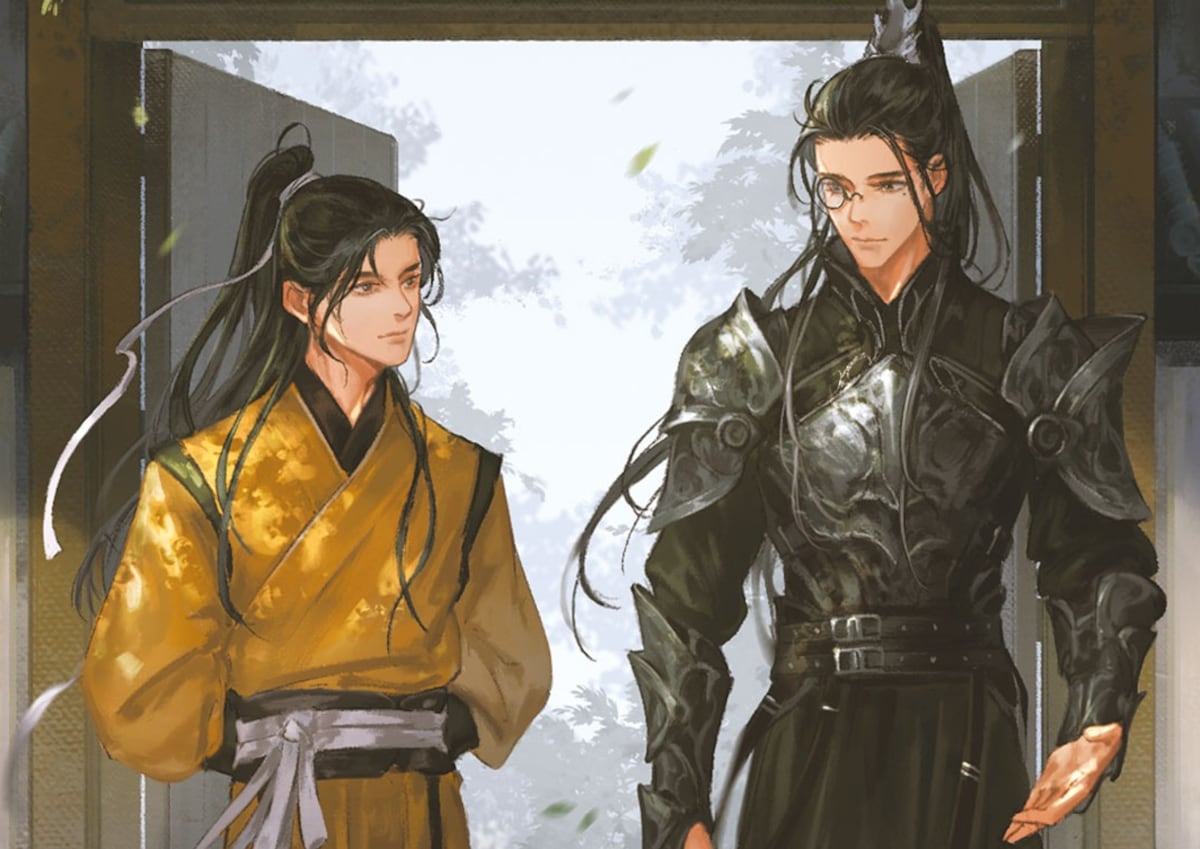
In China, stories about romantic relationships between two men are written and consumed primarily by women. Their popularity has grown steadily, extending well beyond China to Europe and the United States. The literary genre known as danmei (roughly, “addicted to beauty”) has flourished over the past decade on the country’s digital platforms and has fueled a thriving industry of screen adaptations.It has also attracted the attention of censors. Authorities have detained and fined authors, most of whom publish under pseudonyms. Even so, these novels have found readers abroad, first through fan translations circulated online and later through commercial editions.“To explain it, I usually say they are very diverse novels whose common denominator is a romance between two men,” says Ona Pujol, who heads the dedicated danmei imprint launched by Spanish publisher Norma in 2024. The publisher now releases two new titles a month.The roots of danmei can be traced to manga about romantic relationships between male characters that Japanese women began publishing for teenage girls in the 1970s. Those stories helped give rise to what is now known as the Boys’ Love (BL) genre. Its spread to China in the 1990s, following the country’s period of economic opening, and the subsequent expansion of the internet enabled local fans to begin writing and sharing stories of their own.Xu Ren, a 25-year-old author who prefers to use a pseudonym, began as a reader of fan fiction centered on South Korean K-pop idols. When she reached university, she decided to try her hand at writing her own novel, “one of those fairly clichéd toxic-love stories,” she admits. But it was enough to secure a contract with an online platform and start earning some money, which in turn gave her the freedom to experiment with more original plots.In China, danmei has absorbed the worlds and conventions of popular domestic literature: martial-arts adventures, intrigues set in imperial courts, and Taoist-inspired fantasy, where characters seek immortality through practices of spiritual cultivation. But the genre also encompasses crime fiction and stories set in schools.“It spans every genre,” says Pujol. “And many formats. They often start as long novel sagas, but have begun to be adapted into manhua, the Chinese manga, into animated or live-action series, and even into audio dramas, with CDs that offer extra chapters.” Norma’s own catalogue illustrates that diversity: contemporary adult thrillers such as Silent Reading by Priest; slice-of-life stories such as Antidote by Wu Zhe; or the historical fantasy drama Grandmaster of Demonic Cultivation by Mo Xiang Tong Xiu, the bestselling author whose work, according to Pujol, helped put the phenomenon on the global map.Readers, most of them women between 18 and 40 years old, can find everything from explicit sex scenes to more understated romances, stories driven by humor or melancholy, and books that are often produced with great care, in keeping with the idea of “indulgence in beauty.” Pujol, however, points to one important difference: “It’s not like the romance fiction we’re used to. There’s a lot of yearning — that is, a long build-up. The two end up together, but first they go through a whole journey to get there.”The serialized nature of publication has fostered a close relationship between authors and readers. Yu, a 26-year-old fan, participates in a community on Weibo (similar to X, which is censored in China) dedicated to one particular writer: members discuss plotlines, share illustrations and fan fiction based on the original work, and celebrate when a story performs well in the platform’s rankings. “We think [the author] is very capable and we’d like to be like her,” she says.Yu has watched danmei evolve over the 13 years she has been reading it. She recalls that the stories she consumed as a teenager “were very melodramatic,” marked by forbidden love and the suffering of their protagonists. Although same-sex marriage is not legal in China and the authorities have tightened restrictions on LGBTQ+ activism and support networks, Yu believes homosexuality is becoming more accepted among younger generations. In her view, that shift has also influenced these novels: “Many works have become stories in which the two protagonists simply happen to be men. Their relationship develops in a healthy way, and the most important thing is that the plot is compelling.”Qi Zhang, an academic specializing in danmei and its reader communities, argues that the genre “is necessarily rooted in female imagination and female reading practices,” although it also includes male authors and readers. At the same time, anonymity makes it impossible to know with certainty who is really behind most of the names that appear on book covers. The situation is even less transparent given that publishers such as Norma have no direct relationship with the authors themselves, managing their releases through a Taiwanese rights agency. The partnership began when another editor at the Spanish publishing house, Óscar Valiente, got in touch years ago, acting on a hunch: “This is going to be huge.”Qi also challenges the common assumption that danmei readers are predominantly heterosexual women. “Queer people make up a fairly significant sector of the danmei reading community,” she notes.The researcher also disputes the idea that the genre exists solely as a realm of fantasy and escapism. Instead, she sees “a very strong desire to engage with real-life issues.” “Given that China does not have a solid tradition of queer writing, many danmei works have deliberately taken on the task of realistically portraying the difficulties faced by this community,” she adds.For novelist Xu Ren, writing danmei over the years has raised questions about the place of women in her stories. “I wondered whether I was somehow giving up my right to write about women,” she says. She recalls an episode in which readers criticized her for giving an unusually prominent role to a female character, one who competed with the protagonists and faced prejudice against women athletes. Looking back, Xu believes that conflict interrupted the sense of escapism her readers were seeking. She understands their reaction, though she is uncomfortable with the idea that authors must justify their creative choices.“If we turn everything into an ideological issue and start labeling and condemning authors, I think we could end up harming women’s literary creativity even more,” she argues.Censorship has also shaped the evolution of the genre. Qi Zhang points to the government’s 2014 anti-pornography campaign as a turning point. The platform Jinjiang renamed its danmei section chun’ai (“pure love”) and restricted sexual content. According to the researcher, these revised versions and new labels have made the works easier to circulate.Yet the pressure has not disappeared. In 2024, more than 50 people publishing on Haitang, an erotic-fiction platform hosted in Taiwan, were detained or fined by police, according to reports from their lawyers at the time. The most high-profile case was that of Yun Jian, who was sentenced to four and a half years in prison for publishing works deemed obscene. She had earned about 1.85 million yuan ($274,700) from 37 novels.In 2025, Reuters documented another wave of arrests of dozens of writers who used the same platform. The operations were carried out under regulations prohibiting the production and distribution of material deemed obscene; some of those investigated had earned only a few thousand yuan.The reports have led Xu to avoid printing and selling her work through unofficial channels and to reconsider where she publishes. She hopes to pursue a career in education and fears that if her identity as an author were exposed (the pseudonym she uses for this interview is not the one she publishes under), her professional future could be jeopardized. She currently lives outside China and has even considered not returning if that connection were ever established.“I’m very worried that my activity as a writer could destabilize and bring down the order I’ve built in my personal life,” she admits. That mistrust extends even to her relationships with other creators: “We all have some fear that someone could betray us.”Sign up for our weekly newsletter to get more English-language news coverage from EL PAÍS USA Edition
The Chinese women writing gay love stories: How ‘danmei’ became a global phenomenon despite censorship
Full Article
Original Source
Read the full article at English →KhanList aggregates and links to publicly available news content. We do not host full articles from third-party sources. Always verify important information with original sources.