
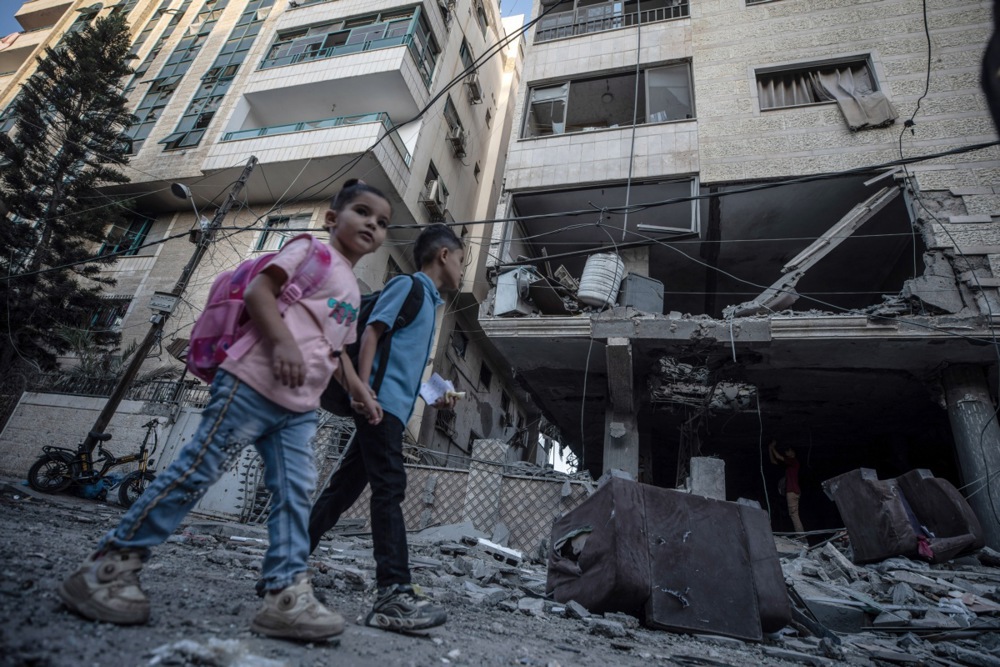
Every day, children are killed in Israel’s genocidal war on Gaza. Where are the outraged headlines? The number of children killed in Gaza since Israel started its onslaught, following the Hamas attack on 7 October, 2023, is estimated at more than 21,600. The UN Children’s Fund (UNICEF) says that since the so-called Israel-Hamas ceasefire, an average of “at least” one child a day – 300 children over 300 days – has been killed in the enclave. Children, toddlers, and babies are being killed in their homes, schools, hospitals, shelters, and on roads marked by displacement. They are also dying because the basic structures that should protect them – family, healthcare, education, food, water, and refuge – have been systematically destroyed. Where are the urgent statements from EU and world leaders? EU governments continue to authorise arms transfers to Israel despite rules which require governments to deny licences where there is a risk that military equipment will be used for serious violations of international humanitarian law. Every EU member state is also bound by the UN Convention on the Rights of the Child and the EU’s own treaty, which requires the union to promote children’s rights. Why are these international rules and domestic commitments not being applied to the children of Gaza? Mourners light candles during a mass funeral and vigil for 105 Palestinians near the rubble of the Al Tajj building in Gaza City on 30 September 2026 (Source: EPA/MOHAMMED SABER) Children rights beyond Ukraine The EU does care for children. In Ukraine, the EU treats children as individuals rather than statistics: it convenes coalitions, compiles names, traces families, imposes sanctions, creates mechanisms for return and makes the fate of children a central diplomatic demand. In her State of the Union address last month, European Commission President Ursula von der Leyen – a proud mother and grandmother – introduced and praised the courage of Sasha, a six-year-old Ukrainian girl who lost a leg in a Russian missile strike in Ukraine but has now returned to her beloved gymnastics. Von der Leyen quite rightly made the suffering of Ukrainian children intimate and personal. It is more than time she did the same for Palestinian children. But let’s not only blame political leaders for their indifference, their lack of historical knowledge of Palestine’s occupation and their limited understanding of Palestinian calls for justice. Parts of the legacy media must also own up to their responsibility in normalising the abhorrent. Powerful mainstream media have preferred to “repeat Israeli propaganda and sometimes simply cut and paste IDF press releases” rather than accept the analysis of Palestinian journalists, writers and scholars, writes Bhakti Shringarpure. Her criticism reflects a wider ongoing discussion on the sourcing and framing of Gaza coverage, with studies spotlighting how Western media has described Israeli suffering by using emotive language around 11 times more often than Palestinian suffering. References to Israel’s “right to defend itself” appear roughly five times as frequently as references to Palestinian rights. Also, as the immediate shock of the bombardment recedes - but the killing continues - Gaza has dropped down the news cycle. Assal Rad, author of “Don’t Say Palestine: How the Media Manufactured Consent for Genocide”, describes the logic: “The façade of a ceasefire has created the space to cover it less. In reality, the conditions on the ground for Palestinians in Gaza have not changed.” It is also less politically costly for leaders and media to focus on settler violence and settlement in the occupied West Bank, since it can be described as the work of “extremists” rather than of the Israeli government. EU silence Our lack of a strong reaction to what is happening is Gaza is also the story of how bystander societies can watch, absorb, and rationalise horrors - and move on. Additionally, the killing of Palestinian children is preceded by their political “unchilding”, a process which Palestinian scholar Nadera Shalhoub-Kevorkian says begins before the missile falls, when Palestinian children are imagined not as children with futures but as demographic threats, future militants, or extensions of an armed group. Their age, instead of guaranteeing greater protection, becomes entangled with suspicion. Even amid such savage violence, some people are not giving up. Their bosses may still look the other way, but EU Staff for Peace, which holds vigils in front of the European Commission and the EU Council every Thursday, has held gatherings to read out the names of children killed in Gaza, thereby according individuality to children whom the political and media systems have reduced to numbers. As one EU staffer told me: “We only have a time slot of three hours and the last time we only managed to read out the names of children up to three years old. It took us one hour to read out the names of Palestinian babies under one-year old.” Hind Rajab, who was five, was killed on 29 January 2024 by Israeli fire on the car in which she was trapped. Her body was found 12 days later alongside the bodies of members of her family and two paramedics who had gone to rescue her. Israel has acknowledged firing on the car but has not admitted that her killing was unlawful, citing an ongoing investigation. In other words, there has been no accountability. The obscenity is not only that Hind was killed, but that by now the killing of children in Gaza has become a familiar event. The shame is that so many of us have constructed a hierarchy in which some children summon the world’s full moral and political force, while others are ignored. Omar El Akkad, in his seminal book says that “One Day, Everyone Will Have Always Been Against This.” Given the cowardice on display over the last three years, I sometimes wonder if there will ever really be a true global moral reckoning.
The children of Gaza are being killed every day. Where are the headlines?
Full Article
Original Source
Read the full article at Euobserver →KhanList aggregates and links to publicly available news content. We do not host full articles from third-party sources. Always verify important information with original sources.