
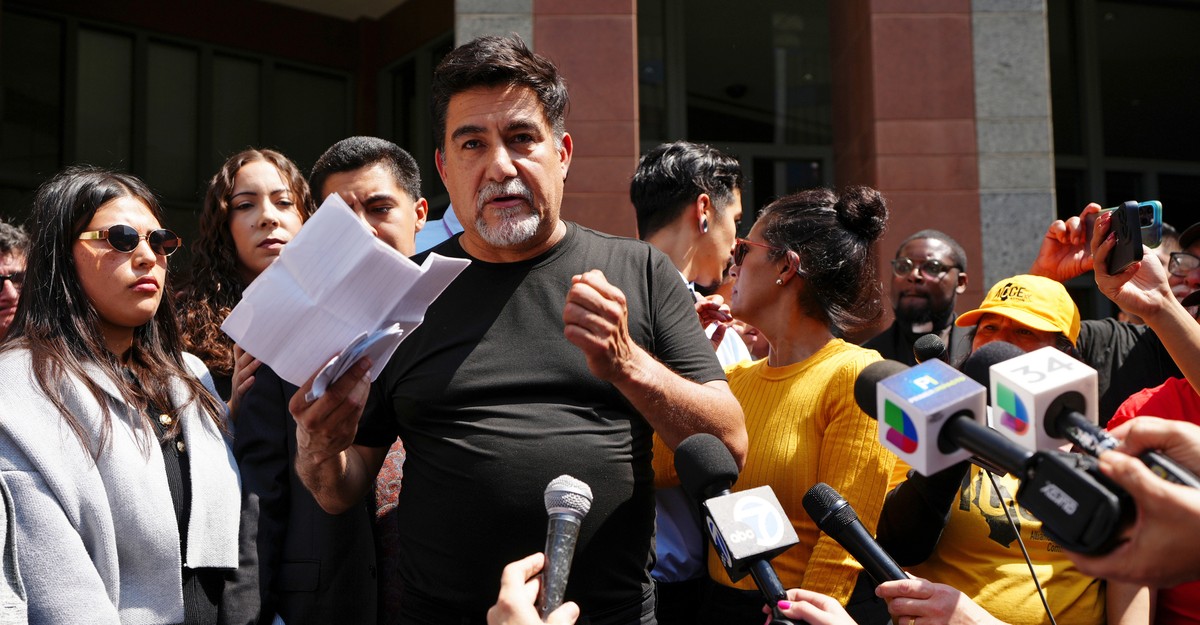
David Huerta sat on a steel bed too small for his burly frame in a Los Angeles jail last summer and looked out a small rectangular window at Dodger Stadium, where he’d once spent evenings with his two boys. He was the kid who’d made good, although it hadn’t been easy. His mother died from breast cancer when he was 4. He was raised in southeast L.A. by his dad, a veteran of the Korean War turned Teamster, who paid the bills by loading and unloading cargo—and, when he was out of work, took his sons with him to the hiring hall. Huerta steered clear of gangs and instead went to college, became a union organizer, and worked his way up to become president of the largest labor union in the state, the Service Employees International Union of California.Yet here he was.He was sure that he hadn’t done anything illegal. He had screamed at masked federal agents as they executed search warrants at a downtown apparel business that was suspected of hiring undocumented immigrants. He had been angry, no question—especially at President Trump. He had flipped his middle fingers at the masked federal officers. At one point, he sat down in front of the business’s gate; later, he encouraged other protesters to form a picket circle in front of it. When an officer warned him he might be arrested, he replied, “I can’t hear you through your fucking mask.” And when a police van tried to enter, he stood with his hands on his hips nearby. He considered all of that well within the bounds of his First Amendment rights. But he couldn’t stop second-guessing his decision to show up at such a volatile scene alone.Huerta wondered how his wife and sons, his niece and nephew, and his other family members would react to seeing videos of his arrest. He wondered if he had somehow jeopardized the safety of his union’s hundreds of thousands of members by drawing unwanted headlines. He wondered if his arrest would make others more fearful of opposing this administration’s actions. He wondered when he would be released—or if he would be. He wondered if he could survive prison, should it come to that. And he wondered what his late dad would’ve thought of him sitting on a thin, stained mattress as his cellmate on the top bunk managed a comedown from drugs. Would he have been ashamed, or proud?Trump’s top federal prosecutor in Los Angeles charged Huerta with conspiracy to impede a federal officer—a felony, under a Civil War–era statute that had rarely been used before last year. If convicted, Huerta faced up to six years in prison. But months later, prosecutors lessened the charges to a misdemeanor count of obstructing, resisting, or opposing a federal officer. This July, the Justice Department said it would drop the charges altogether, adding it to the growing list of federal prosecutions that have fallen apart before going to trial.Although those dismissals have been celebrated as victories, the cases have taken a financial and psychological toll on the defendants. For Huerta, the past 15 months have been filled with anxiety. He has endured sleepless nights and grown emotionally distant from his wife of 30 years. The public attention continues to make it more difficult to do his job. And despite his pride in standing for what he believed in, he struggles with the shame of being jailed and appearing in court in shackles—an image he worries that his two sons and niece and nephew (whom he has raised as his own) will never forget. As we spoke inside a coffee shop in his neighborhood of Highland Park one recent afternoon, Huerta’s voice rose in anger and indignation while he recounted and, at times, reenacted the minutes before he was shoved to the ground by a federal officer. He teared up.“The president of the union just got fucking arrested,” he said. “If they can do this to me, imagine what they’re doing to other people.”On the morning of June 6, 2025, the phones at the SEIU office were ringing with reported sightings of immigration-enforcement operations in and around downtown L.A. Huerta and his team—along with other labor leaders, Democrats, and social-justice groups—had been preparing for a moment like this ever since Trump was elected to a second term. The administration was trying to detain and deport as many immigrants as possible. Workplaces were being targeted, and even American-born Latinos were getting caught up in immigration dragnets. Huerta and his team would later learn that this day was the opening of a monthslong operation in the L.A. area overseen by then–Border Patrol Commander Gregory Bovino. It aimed to not just increase arrest numbers but also intimidate immigrant communities.Read: A U.S. citizen detained by ICE for three days tells his storyThe union’s rapid-response network was designed to help employees during moments like this. “Shit’s happening,” Huerta recalled thinking that morning, “and we’re now in the fight.” He heard a report of an immigration raid in the apparel district, so he scrapped his plans and headed there.Federal agents were swarming an industrial complex. A woman stood outside the facility’s gate, prosecutors later claimed in charging documents, filming officers and telling someone by phone what was happening. A federal agent later said that Huerta seemed to be communicating with that woman and other protesters “in a concerted effort to disrupt” the operation.As the crowd grew, people screamed expletives at the officers, and someone yelled, “I want you to kill yourself,” according to the accounts of federal agents contained in court filings. The agents described Huerta joining in the taunting, urging protesters to “walk in circles and picket,” and pacing in front of the gate, “effectively preventing law enforcement vehicles from entering or exiting.”Huerta told me that he had never acted quite like this at a protest, but that he had snapped when he saw how the officers were treating a young girl who was crying about her dad, who she said was inside the building. “They were so dismissive of her,” he said. He screamed at the agents, asking how targeting workers was making the city safer, and telling them that they were “taking orders from a fucking monster.”When a federal agent ordered Huerta to move away from the gate, he remained in place, confident that the vehicles had plenty of room. An officer then began to move Huerta out of the way. He recalls not fighting back and keeping his hands on his hips—just as he was trained. But he was still pushed to the ground. A video shows Huerta falling on his back, his head hitting the curb. He told me that he was rolled onto his stomach, sprayed with a chemical irritant, cuffed, and taken to the hospital, where he spent several hours before being transferred to a federal detention center.His wife, Lucía Aguayo-Huerta, learned of his arrest while at the doctor. His oldest son, Ismael, heard from a cousin, who was crying hysterically. He jumped on Instagram and typed in his father’s name. Huerta had a bum shoulder from an old skiing injury. His other son, Camilo, watched as Huerta’s arm was pulled behind his back in one of the videos. “I was almost on the verge of tears,” he told me. “Almost screaming at my phone, like, You’re fucking with his shoulder!”Huerta didn’t sleep that first night in jail, and when he arrived at breakfast, he squirreled away packaged food in case it would become valuable in the days ahead. He’d been fingerprinted for detention on a Friday night but had not been fully processed and so had no way to call his family, although he’d briefly called his wife, Lucía, while he was at the hospital.Protests had erupted in parts of downtown Los Angeles as word of the raids spread. Outside the detention facility, people were showing up in large numbers, clashing at times with police. Inside, news of those protests streamed on a TV. At one point, an inmate looked back and forth from the TV to Huerta, and asked Huerta if that was him on-screen. “That’s me, bro,” Huerta replied. He said the man asked, You’re the fucking union president? What the fuck are you doing here? His title, and years spent helping workers, made his life over the next 48 hours easier. Another inmate gave him toilet paper, a cup, and toothpaste, the holy trinity of jail provisions. Word spread, Huerta told me, and soon 100 or so men had gathered to applaud him.It was a demonstration of support that Huerta hadn’t realized he needed. The sense of community he felt in that moment reminded him of his own union and the solidarity shown by his dad’s old Teamster buddies, who’d rallied around their family after his mom died, bringing them money and bags of food. He spent the rest of that day learning about the other men and the circumstances that had landed them in jail, in hopes of helping them after his release.The hardest part of all, Huerta said, was when his wife and kids showed up for his arraignment and bail hearing and he had to look them in the eye. He wore a black T-shirt, black jeans, cuffs, and shackles. From his perspective, it was humiliating. From theirs, it was honorable. His sons told me that their dad had held his head high, his shoulders back, and his chest straight.Listen: When Border Patrol comes to townDozens of other union leaders and workers packed the courtroom to support Huerta, along with Democratic Senator Adam Schiff. Los Angeles Mayor Karen Bass wrote a letter to the judge, urging her to take into account his ties and contributions to the community as she decided bail. Huerta was charged with conspiracy, released on $50,000 bond, and dropped outside without his shoes. Facing a throng of supporters, he defended his actions and spoke of the men he had met who were still stuck inside. “We will have our time for justice,” he told the crowd, “but we must do it in a way that we demonstrate the power of working people.” That night, though, after a long shower and dinner from his favorite taco truck, Huerta lay awake in his bed thinking about a new, terrifying phrase: “conspiracy to impede.”The psychological stress was, Huerta later realized, his worst punishment. He wanted to get back to work, but he didn’t want his presence at the office to draw negative attention to the union. For a time, he worked remotely. Lucía and the boys worried about his health. He had grown moody and snippy, often wanting to be left alone after work. Other family members worried that Huerta’s critics might try to physically harm him.Three attorneys and their teams from Los Angeles and Washington, D.C., represented him pro bono, and nonprofits helped pay other expenses. But Huerta was still stressed about the many hundreds of hours that his case was consuming. All of the time he was spending on his legal fight was time lost organizing laborers, he said. Senator Alex Padilla of California, a Democrat, told me he figured that the federal government’s case against Huerta, a friend, would fail, but he knew it had to be taken seriously. “It was clear to me that it was weighing on him,” Padilla said. But Huerta also understood, the senator said, that his members were “looking to him for how to handle the chaos that was going on and the pain that was being inflicted.”“Free David Huerta” rallies popped up around the state; supporters carried posters featuring his stenciled portrait and wore T-shirts emblazoned with his name. “An injury to one,” the AFL-CIO wrote on Facebook, “is an injury to all.” Huerta attended two rallies to protest Trump’s immigration policies, but kept his appearances short, he told me. He left one as people marched toward a detention facility; he didn’t want to violate the terms of his bond that required he stay at least 100 yards away from federal-law-enforcement agents or operations. One day, while at home with Lucía, he paced the house and imagined how much worse things could get, feeling out of control. “Hey, calm down, you’re okay,” his wife told him. He later realized that he had suffered an anxiety attack. He was raised in a culture in which seeking treatment for mental health carries a stigma, but he knew he needed help. He began to see a therapist for the first time.In October, his charge was downgraded to a misdemeanor. Prosecutors needed to establish that he had planned to interfere with federal officers that day—but his actions were unplanned, his attorneys said. His team tried to get prosecutors to dismiss the case entirely.The lesser charges brought some relief, but his character and reputation were still under attack. “Those anxieties of uncertainty,” he said, “they kept creeping up.” The case continued to weigh heavily on his marriage. Then, in July, prosecutors gave up. Late last month, the charge was dismissed with prejudice. He got back his passport and phone, two items that symbolize his freedom and his work. He did not celebrate. “I was detained—and fortunately, that’s all that happened,” he told me. Others—in Minneapolis, Houston, Maine—had been shot dead while interacting with immigration officers. Bill Essayli, the top federal prosecutor in Los Angeles, said on X that Huerta, since his arrest, had complied with conditions to not interfere with federal agents and operations, but “should he unlawfully interfere with any federal agent engaged in their duties, we will not hesitate to arrest and charge him again.” His office declined further comment.Read: Another fatal ICE shootingIf the point was to try to make an example out of him, a conviction wasn’t necessary. The case against Huerta signaled to the labor and immigrant communities that no one could protest immigration raids without real risk, he and other labor leaders told me. Some union members grew afraid of speaking out, they said. But many others were moved to show their disapproval of the immigration crackdown by protesting peacefully because of how they saw officers treat Huerta, Arnulfo De La Cruz, who took over in April as president of SEIU California, told me. “In a lot of ways, he was the embodiment of a transition from fear to We’re not gonna back down.”Huerta doesn’t know when—or even if—he will show up at another immigration-enforcement protest, he said. His experience has made him think hard about how he tries to achieve his goals. “I’m not leaving the work,” he told me. “But I would be a liar to say that it’s not in the back of my head that I could find myself in the same situation.” On the day I saw him, he had just pulled into town from Big Bear, a rare escape. He spoke not of the views or the lake, but of the workers powering the restaurants and hotels.
The Charges Were Dropped, but the Damage Was Already Done
Full Article
Original Source
Read the full article at Theatlantic →KhanList aggregates and links to publicly available news content. We do not host full articles from third-party sources. Always verify important information with original sources.