
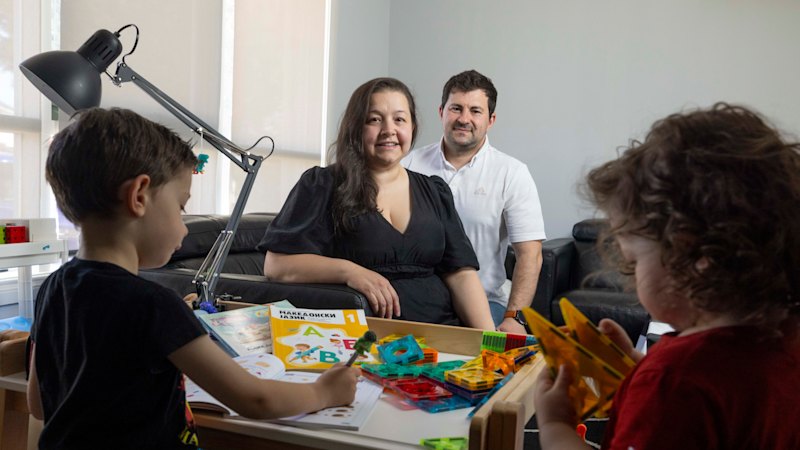
November 24, 2026 — 7:00pmBuilding more select-entry schools and scrapping payroll tax are among the changes Victorians could see in education after the state election.While both major parties are committed to explicit teaching and improving literacy and numeracy results, other policies set them apart.Victoria Petrevska and Nikola Breshovski, pictured with their children, are watching what the parties are promising for bilingual education.Wayne TaylorThe Liberal/National coalition has announced a string of changes that will impact students and schools, including a curriculum review, while Labor has focused primarily on expanding existing programs and upgrading schools.Minor parties have also pitched major changes, with the Greens promising to scrap voluntary fees in public schools and One Nation proposing a ban on the burqa and niqab on campuses.With such a wide suite of promises, we asked three education experts to weigh in on what the parties were offering to win your vote.Monash University Dean of Education Mary Ryan, University of Melbourne Professor in Educational Leadership Pasi Sahlberg and Deakin University PhD candidate Tom Mahoney give their verdict.The CoalitionScrap the payroll tax High-fee private schools have claimed annual fee increases, as high as 15.1 per cent, are a consequence of Labor’s decision to strip them of their long-held payroll tax exemption in 2024.The tax, which was projected to deliver an estimated $101.8 million to the state budget last year, applies to schools with annual fees of $16,397 or more and is due to continue until January 1, 2029.But the Coalition has promised to free all schools of the tax burden, under the assumption private schools will pass on the savings to parents.Mahoney said fewer than 10 per cent of private schools, all high-fee, would benefit from this policy, with savings unlikely to flow through to parents.“There’s only 60 non-government schools out of about 700 that are currently paying the payroll tax, and those schools are the ones charging the highest fees to parents,” he said.Mahoney said non-government schools had been raising fees year-on-year well before the payroll tax was introduced and there was no evidence to suggest they’d raise them less if it were scrapped.“There are plenty of other ways that I would say non-government schools can reduce their fees, such as reducing their building projects,” he said.Sahlberg said scrapping the schools payroll tax was “an ineffective promise” and he’d much rather see the Coalition commit to fully fund all public schools by 2030.“Surely, fixing that should come first.”Literacy and Numeracy GuaranteeMonash University Dean of Education Mary Ryan.Ryan said setting targets was useful, but the policy lacked detail and focused on the overall result, rather than lifting proficiency among children who performed poorly on NAPLAN – including those from remote and low-socioeconomic communities.“For a start, we probably need to know what the target applies to: is it year level? Is it overall?“What are we going to do to lift those particular cohorts? Because if we lift those cohorts, that will make a huge difference,” she said.Ryan said it was also unclear how the Coalition would review the curriculum while reducing teacher workloads.“A review of the curriculum is going to be a lot of work for teachers,” she said.Build three new select-entry high schools and transition six existing public schools to select or partial select-entryVictoria currently has four select-entry schools, and competition for places has become so fierce there are more than six applications for every spot offered.The Coalition wants to buy land in Melbourne’s three fastest-growing regions – the west, north and outer south-east – for three new select-entry schools.Ryan said the problem with select-entry schools was the impact on non-selective schools of plucking out their brightest students.“It changes the whole demographic of those schools ... it changes the resourcing; it sometimes changes the expectations [of students],” she said.Sahlberg said research showed selective schools tended to attract students from more advantaged backgrounds.“So, rather than making [the] Victorian education system fairer, this could actually make the gaps between public schools even wider,” he said.“If we have $150 million extra public dollars to invest in education, I would put that into schools serving Victoria’s most disadvantaged communities, where better teaching, additional support and stronger learning opportunities could benefit many more children. That would be a much better investment in our state’s future.”Shadow education minister Brad Rowswell introduced Successful School Starters at The Age education summit.Turbo360Deakin University education expert Tom Mahoney.“It’s a bit short-sighted in that it’s assuming that the diagnosis is what is needed to be able to support these students,” Mahoney said.Establish 10 new technical colleges statewideProviding alternative pathways for students who don’t want to attend university has been a focus for both major parties.Under the Coalition’s plan, about 5000 students would enrol in industry training focused on construction and engineering in 10 specialised colleges while completing their VCE at a cost of $222 million over eight years.Ryan said providing alternative pathways for students was important, but she was concerned it could limit the options for students if they changed their mind on pursuing a trade.“Some of the trades now, they need to be learning skills that are similar to a mechanical engineering degree.”Ryan said Australia was also seeing fewer students going into trades, and while this seemed to be a case of “build it, and they will come”, she wasn’t convinced.Student and teacher leadership councilsThe Coalition has promised to give students and teachers a direct pathway to the education minister by establishing student and teacher councils in every electorate.Local MPs would chair the councils with the aim of having classroom experiences heard by decision makers.LaborFree kinderLabor began providing free kinder for three- and four-year-olds statewide from 2023, after a staged rollout starting in regional Victoria in 2020.Under its plan, free kindergarten for four-year-olds would double from the current 15 hours a week to 30 hours statewide by 2036, while three-year-old kinder would scale up to 15 hours a week by 2029.Education Minister Gabrielle Williams.Justin McManusWhile vowing free kinder is here to stay, the Coalition has pledged to undertake a review of the early learning sector to improve accessibility and quality, “and examine how Labor’s regulatory changes have affected childcare”.Free kinder is one of several existing policies Labor has promised to expand, including broadening its free dental check-ups in schools program to include kinders.School upgrades Since being in power, Labor has prioritised new school builds, with 121 new public schools opened since 2017.As part of its election promises, Labor has pledged $1.17 billion to upgrade 228 public schools and $500 million to upgrade independent schools.New selective and independent schoolsBuilding on the John Monash Science School model, Labor has promised to establish more specialist selective schools, starting with a new maths and science school in Melbourne’s north.A re-elected Labor government would invest $135 million to establish the public school for up to 650 students from years 9 to 12 at La Trobe University’s Bundoora campus.It will also spend $15 million to build Victoria’s first Sikh school, teaching the curriculum alongside Sikh religious, cultural and language traditions.Two new TAFE campusesThe building of two new TAFE campuses in Melbourne’s outer north and west are on the agenda with further upgrades of campuses in Bendigo, Wonthaggi and Dandenong, for a combined $170 million.Smart glassesLabor has promised to expand the ban on mobile devices in all schools to include a ban on smart glasses and wearable devices.LanguagesOne new initiative is a $43 million pledge to increase the languages available to students in VCE, through the Victorian School of Languages (VSL).VSL currently offers 17 VCE languages through remote learning. Labor would expand that to all 44 modern VCE languages from 2028.Macedonian-Australian Victoria Petrevska said the language program’s expansion would mean she could send her son to any nearby secondary school, confident he could continue his language studies.Petrevska said her son was currently building foundation language skills at the Macedonian bilingual primary school in Lalor.“We’re really thankful for any kind of program that helps bilingual students access bilingual education,” Petrevska said.University of Melbourne professor Pasi Sahlberg.NineMahoney said his concern with the policy was that it assumed there was high enough demand for the work required to implement it.Asked to give an overall assessment on Labor’s track record on education, Sahlberg said they deserved credit for some positive developments in Victorian schools.He highlighted improvements in foundation literacy, progress in keeping students engaged in secondary education and Victoria achieving the country’s strongest overall NAPLAN results.“My concern is that, despite these achievements, Labor’s approach to education remains rather conservative, focusing more on improving schools as we have known them than reinventing schooling for a rapidly changing world,” he said.“Good NAPLAN results bring some political comfort for sure, but they don’t tell us everything about the quality of education. And when enrolments in non-government schools are growing faster than those in public schools, we should be asking why more families are looking elsewhere for their children’s education.”Sahlberg said the most difficult question for Labor was on funding.“After more than a decade in government, why hasn’t Labor made free public education by fully funding every Victorian public school by 2030 its central election promise?”One NationWarren Pickering’s team is focusing on streamlining the curriculum and lifting standards and discipline.In addition to replacing the “overcrowded curriculum”, One Nation would allow schools greater flexibility to offer programs that reflect their community, such as agriculture, trades, sport, music, technology or the arts.The party has vowed to make it easier for parents and communities to establish new independent, specialist and alternative schools.It would also introduce a voucher system that would give funding directly to parents for them to spend on the school of their choice.Asked to summarise, Sahlberg said One Nation’s policy to give schools more flexibility to offer programs that reflect local needs and its policy to expand trade schools were “sensible”.“But overall, I find their education agenda disappointing,” he said.“There is practically nothing here to fix the chronic underfunding of public schools, tackle growing inequalities in educational outcomes, or prepare young people for a world shaped by artificial intelligence, changing work and an increasingly unstable planet.”One Nation’s Victorian leader Warren Pickering.Luis Enrique AscuiSahlberg said their promises would introduce more political control over schools.“I am particularly concerned about their proposals for school vouchers and expanding independent and alternative schools,” he said.“Instead of building a stronger and fairer public education system, we risk creating more competition and division between schools.”Ryan said voucher systems were problematic because families don’t have equal access to the school of their choice.“Vouchers are not going to work for every family, and schools might then be competing for students rather than lifting outcomes for all students and meeting the needs of communities.”She said a voucher system would also be very difficult to implement.Ryan said banning burqas and niqabs in schools was potentially contravening equal opportunity, human rights and discrimination legislation.“For me, that raises serious educational, ethical, and legal concerns,” she said.Ryan said there was no evidence that religious dress was a barrier to integration.“Those two particular issues really stand out as problematic, and it would be very unlikely that they could be implemented in Australia,” she said.Greens leader Ellen Sandell.AAPThe GreensThe minor party isn’t short on ideas for our public education system, publishing 30 education “principles”, and 66 “aims” under eight categories, including improved conditions for educators and funding and infrastructure.Mahoney said Ellen Sandell’s team showed a strong commitment to fully funding public schools, which he saw as a top priority.However, he said making school completely free by banning parent contributions was flawed.“Schools rely on parent contributions and fundraising to get the basics, and it shouldn’t be that way, but we can’t ignore the reality that it is,” he said.Mahoney said he also had a problem with the Greens’ push to mandate domestic, family and sexual violence education for students in years 10 to 12.“[It] disregards what’s already done through the Respectful Relationships curriculum,” he said.More:EducationFor subscribersNAPLANMelbourneVictorian electionFrom our partners
The changes to expect at your child’s school – no matter who wins the election
Full Article
Original Source
Read the full article at Smh →KhanList aggregates and links to publicly available news content. We do not host full articles from third-party sources. Always verify important information with original sources.