
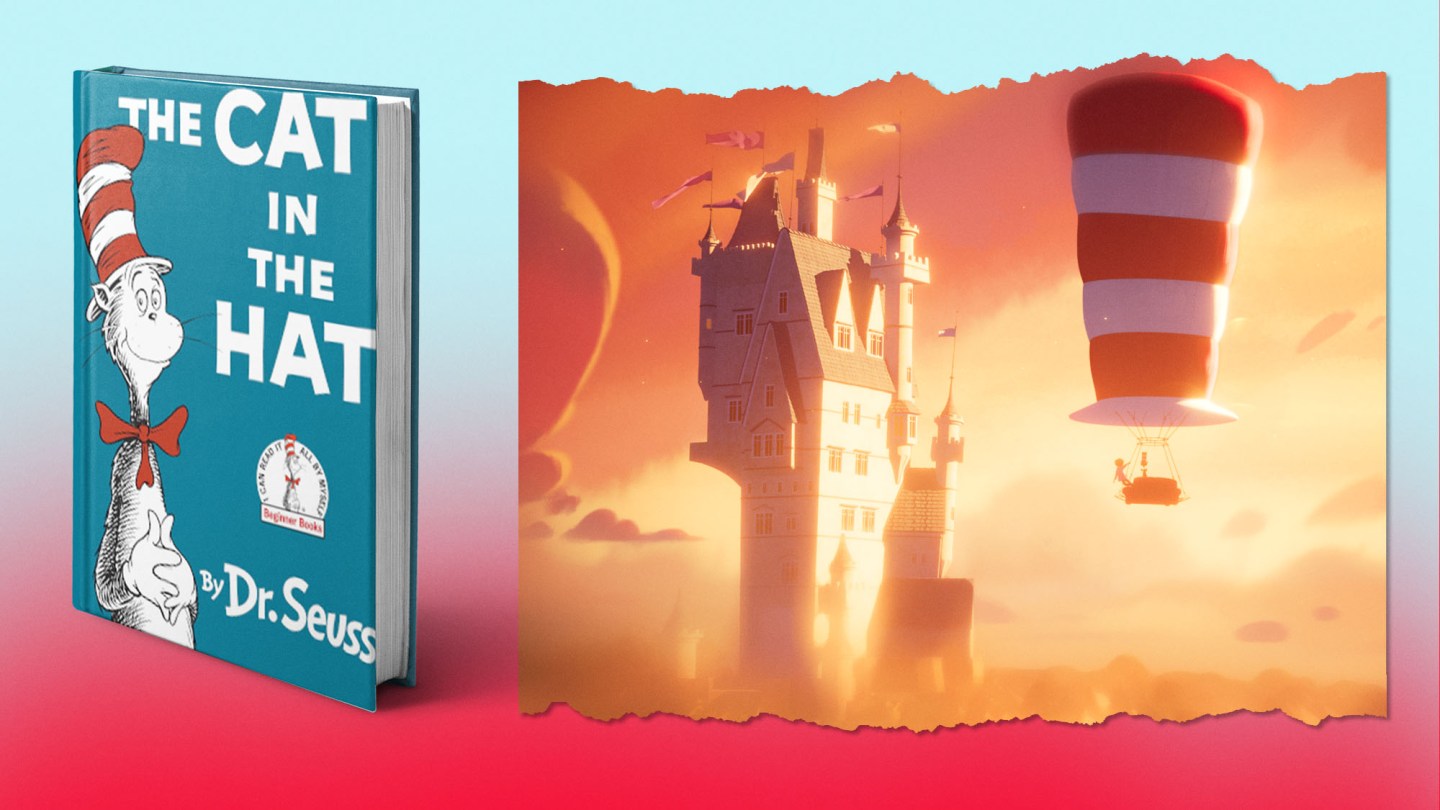
Some stories refuse to stay on the page. The Hollywood Reporter’s Beyond the Book column explores what happens when books make the leap to screen and beyond — unpacking what stayed, changed, how it was done and why it matters with the creatives who made it. *** In 1957, Theodor Seuss Geisel wrote The Cat in the Hat, a black, white, red, and blue tale about a six-foot whiskered agent of chaos. It disrupted the world of children’s publishing. “Before there was this very orderly world with our children’s books,” says Susan Brandt, president and CEO of Dr. Seuss Enterprises. “There were Dick and Jane books, and the kids were just impeccable. The Cat disrupted all of that, both in terms of children’s literature and in the story itself. They’re sitting pretty in that window, and he’s like, ‘It’s fun to have fun. You have to know how.’ He challenged us to push boundaries, and to remember that kids are kids.” In the nearly four decades since Geisel’s passing, the Cat has become the spokesperson of the late author’s library and legacy, despite being published a full 20 years after his first children’s book and debuting the same year as another classic, How the Grinch Stole Christmas. With the theatrical arrival of Warner Bros. Pictures Animation’s upcoming The Cat in the Hat on Nov. 6 — the first feature-length animated movie starring the titular character — he has the chance to be a disruptor once again. “Starting with live-action, we have a history of that. Our very first film was the 2000 Jim Carrey How the Grinch Stole Christmas, and that was an incredible success,” says Brandt. “Then Chris Meledandri at Illumination came to us and said, ‘I want to do the Grinch.’ I was thinking, we did it. It’s really successful and continues to play well. But he said, ‘I think I can bring a new audience, a new style, a slightly different story.’” The success of Meledandri‘s animated Grinch film proved to the Dr. Seuss Enterprises head “there was room in the market, and there was room in this story to explore the Cat in a slightly different way,” she tells The Hollywood Reporter. After conversations around town with every major studio, the company chose Warner Bros. Pictures Animation to launch the Cat’s animated feature outing as part of a three-film deal. At the end of September, while presenting to an eager crowd of animation students as part of the SCAD AnimationFest‘s 10th anniversary, writer-directors Erica Rivinoja and Alessandro Carloni joined head of story Ryan Gaffney and art director Amos Sussigan at the school’s Atlanta campus to tease their new vision of Cat. “I was so impressed by Dr. Seuss Enterprises and Warner Bros. with how much they let us be irreverent,” says Rivinoja. “We were honoring The Cat in the Hat, but we were also having fun with him and his history.” While gathered on the highest floor of the FORTY residence hall, one of the school’s intimate and colorful private event spaces, the team shared elements of the film’s visual production process as they discussed how they’re expanding Geisel’s famous feline in a touching ode to childhood ahead of the story’s 70th anniversary. “One of the lines in the movie that I love the most is, ‘Childhood is messy.’ I think that’s what the Cat embodies,” Brandt tells The Hollywood Reporter. “Childhood is not sitting pretty. It’s messy, and he creates a safe space for that. I think it’s a beautiful interpretation of the book.” “And Then Something Went Bump! How That Bump Made Us Jump!” “Childhood is not sitting pretty. It’s messy, and he creates a safe space for that. I think it’s a beautiful interpretation of the book,“ says Susan Brandt, president and CEO of Dr. Seuss Enterprises. Warner Bros. Since his creation, the Cat has become “a character that’s unlike any other,” says Brandt. For his preschool and kindergarten audience, he’s an approachable figure representing childhood and literacy. Among parents and grandparents, a trusted memory they want to pass on to their children and grandchildren. As the company spokesperson, Cat can be corporate, but also a “chaotic, unexpected, unpredictable ”pop culture figure.” “This relationship to each demographic is authentic to who he is,” she explains. “They’re all him. So you can take whatever aspect of his personality and see an opportunity. It’s just asking: who are we targeting, and what side of our Cat would we focus on here?” The film attempted to tap into these multitudes, taking that 60-page book and turning it into a music- and comedy-infused 107-minute adventure that asks “what happens before and after that one location, one day, one tiny set of characters,” according to Rivinoja. “In the book, it looks like an agent of chaos comes in,” Carloni adds. “But by the time the Cat leaves, they do seem to sit up straighter and appear to be a little more confident. Something changed from when he came in to when he left, and that was enough to make us wonder: Could it be that Cat in the Hat is not just a crazy clown? That he doesn’t only want to have a good time? That maybe he’s someone who’s actually able to find out what a child needs and can give it to them?” The film’s answer is something not seen in seven decades: an origin story in full color. In Seuss’ black and white, hatch marked version of the real world, readers enter the home of two children when Cat arrives at their front door with two Things in tow. The upcoming movie expands that premise without betraying it, interweaving three animation styles to pay homage to and expand Seuss’ established universe. Set in that same real world, The Cat in the Hat follows tween Gabby (Xochitl Gomez) and her younger brother Sebastian (Tiago Martinez) after they are left with their goldfish Waffles (Matt Berry) when their mother, Carmen (America Ferrera), has to leave for work. Stuck in their new apartment amid a sea of barely touched moving boxes, Cat (Bill Hader) emerges from a mouse-sized hole in the wall in all his striped-hatted glory to turn the day around. In the book, his arrival at the children’s door is inexplicable and spontaneous, but in the film it’s part of a mission to save his job as an agent of entertainment and fun at the I.I.I.I. (Institute for the Institution of Imagination and Inspiration, LLC). “His boss tells him, like we are told often, that he is making a mess, and it’s costing the company too much. If he commits one more mess, he’ll be fired,” Carloni explains. Adds Rivinoja: “The red and white hat is how we know the Cat in the Hat. That’s his entire identity. So if he loses that hat, he’s just a regular old cat. That was really a good way of understanding what the stakes are.” From there, Cat embarks with the kids on an interdimensional journey, moving between the worlds of the apartment and moving boxes as they face down the literal and figurative messes of coming of age. “While we were in their apartment, we also needed to go somewhere. We had a film to fill,” says Brandt. “In terms of traditional childhood, appliances came in big boxes, and those boxes became portals for us. The filmmakers picked that up while still being true to this book.” The film playfully winks at the Things potential to win over audiences. Warner Bros. “It Is Fun to Have Fun, But You Have to Know How“ Before building universes with moving boxes, the team used the book to set a visual tone authentic to and distinct from other Seuss projects for both its real and Seussian worlds. “The real world is more grounded and tangible, but starts changing once the Cat comes,” says Brandt. “That was deliberate and specific. We spent a lot of time talking about how his very presence brings a Seussian feel and things start to warp a little bit.” Audiences see that as early as the opening sequence, which features the titular character arriving at a familiar house on a rainy afternoon. “It was really important to pay homage to that because it’s the source material,” explains Rivinoja. “[Geisel] was an amazing artist and made such innovative choices in his line work. And once the Cat fully gets the children’s attention, we use color to open up the world.” Speaking on last month’s SCAD AnimationFest panel, Sussigan expressed that “pitching a studio that you’re going to have an animated movie starting in black and white was a little tough at the beginning.” But “the first few minutes of the movie are to remind the audience where we start and where we go,” Carloni told THR after the panel. “Those colors, it’s the same reason why Superman is red and blue. There was a limitation, especially for the cost at the time. But [Seuss] found this beautiful way to navigate that.” From left: Amos Sussigan, Ryan Gaffney, Erica Rivinoja and Alessandro Carloni speak onstage at the Cat in the Hat: Sneak Peek panel during SCAD AnimationFest 2026 at SCADshow on Sept. 23 in Atlanta, Georgia. Derek White/Getty Images for SCAD After coloring in the lives of his latest assignment, the agent of fun travels back to the I.I.I.I., a place Carloni likens to Santa’s North Pole. Visual signatures of Geisel’s style, like negative space and wacky camera angles, abound, with color “oversaturated and your line weights different — a distinct and new look for us,” according to Brandt. Through the Institute, the film reveals that Cat is one of many animal employees, each donning their own red and white-striped accessory. “The most fun that the story crew had early on was just: who are these coworkers?” Gaffney said about dreaming up Cat’s colleagues. “Could it be a raccoon with a spoon? Gopher with loafers? It was populating his little office world and seeing him interact with them.” With the Institute, the creative team establishes Cat as more than some unwieldy agent of chaos, but a generation-spanning agent of change. “Something that we talked about early on is that chaos is not comedy. It’s not necessarily funny to have someone coming in making a giant mess,” says Rivinoja. “There’s Santa Claus; there is the Tooth Fairy. We created a mythology where The Cat in the Hat is a character that comes to you in a moment of need in your childhood,” adds Carloni. “A whole institution does this, so if you’re bored one day, you can get Rat with a Bat. Or you can get the best of all because he throws the book out.” As part of its larger ode to Geisel, the movie also uses the late author’s signature meter, anapestic tetrameter, to create a sort of corporate speak for the whimsical and wacky Institution, while the rest of the film operates in natural dialogue, preserving the voice actors’ styles. “Every time they read some HR documents, it’s in the same metric rhyming,” Carloni explains. “When the boss brings up what Cat has done, he opens up hundreds of Cat in the Hat books we never knew existed, and those are all the same metric rhyming.” “Ted Geisel wrote The Cat in the Hat in response to an article in LIFE magazine that asked, ‘Why can’t Johnny read?’ The answer was primers were boring, so why wouldn’t someone like Walt Disney or Dr. Seuss write one?” notes Brandt. “Ted accepted the challenge. There were 250 words that were approved for primers. He used 236 when he wrote The Cat in the Hat. That’s our roots.” From left: Sussigan, Gaffney, Rivinoja and Carloni speak onstage with Abbey White at the Cat in the Hat: Sneak Peek panel during SCAD AnimationFest 2026. Derek White/Getty Images for SCAD “Then, Fast as a Fox, the Cat in the Hat Came Back in With a Box” Cat’s Institute and the kids’ real-world styles combine modern animation with original Geisel sensibilities. But the movie’s moving box style invites the visual language to evolve. “From Ted’s first book to 1957 with Cat and Grinch to his last book in 1990, there are variations in style. We have a licensee that does our fine art, and they have traced Ted’s travels to influences on his art. This evolution gives us freedom and flexibility,” says Brandt. “We’ve never done multiple animation styles before in a film, but it’s brilliant because there’s not one style of Seuss. This film embraces that.” “We’ve all seen Spider-Verse. We’ve seen Nimona. We’ve seen the Ninja Turtles. A lot of those movies ask, ‘What if it looked like this?’” Carloni said during the SCAD panel. “But in our movie, we had the opportunity to follow the narrative — from one world we enter into another. We use styles to let viewers know what world we’re navigating between.” Within those moving boxes, “it’s the idea of what it’s like in a child’s memory and the nostalgia,” says Rivinoja. Color — specifically the book’s classic red and blue — serves as the through line between characters and their growing or thinning emotional connections. Starting in blues, the Cat’s influence seeps in, turning things “more red, but never fully red. For Seb, we go to orange. In Gabby’s, we go all the way to fuchsia,” says Sussigan. “The red and white hat is how we know the Cat in the Hat. That’s his entire identity. So if he loses that hat, he’s just a regular old cat,“ says Erica Rivinoja. Warner Bros. “This is a story about connection and disconnection and everything that’s in between, so we leaned into that when we went into the boxes,” he adds. “It was about understanding how different people understand colors. In Sebastian’s box, we wanted to use colors that were very pure, almost like if he just used a box of 12 crayons. When you go to Gabby’s box, our emotions are a little bit more complex, and so the colors are less pure.” In the journey between those boxes, a few new Things arrive. “What was so fun was when we decided they don’t all have to look alike,” Rivinoja explains. “Maybe One and Two are just twins, and then we have more. Seuss [Enterprises]was totally on board with that.” That should come as no surprise, as the Things “are actually one of [Dr. Seuss Enterprises’] biggest merchandise sales,” the writer-director told THR. According to Brandt, the company is already poised to launch their new Things “in market with merchandise,” allowing fans to quickly embrace the Cat’s (in)famous silly sidekicks. “We [focused on] keeping them deadpan, with no crazy grins, bouncing off each other, with their own way of communicating,” Gaffney says. “We wanted to stay away from Minions territory, but asked what we could do with percussion. The way it happens in the movie, it was so fun to play out their communication in these action set pieces.” The film playfully winks at the Things potential to win over audiences, and back in 2020, a Thing One and Thing Two film was announced as part of the deal with Warner Bros. Pictures Animation. Its potential plot could possibly be hidden within Cat’s film, but everyone is remaining cautiously optimistic — and vague — about where the Things go next. “What we’re doing, we’ll see. It is something that we’ll have to sit down with the filmmakers and Bill [Damaschke, president of Warner Bros. Pictures Animation] to say: Is there room for a full movie? I don’t know yet because the storyline hasn’t been established,” says Brandt. “But I think everyone feels it. Let’s learn more about our Things. Why not? I think it could be really fun, and I do think that the Things steal the show a little bit.” “I was so impressed by Dr. Seuss Enterprises and Warner Bros. with how much they let us be irreverent,” says Rivinoja. “We were honoring The Cat in the Hat, but we were also having fun with him and his history.” Warner Bros. “I Know Some New Tricks … I Will Show Them to You” Since 1993, Dr. Seuss Enterprises has used Cat across its ventures, from entertainment experiences through Universal’s Islands of Adventure, Broadway, and Carnival Cruise Line to the literacy-focused free book campaigns with First Book and recent publication of the newly uncovered Seuss title Sing the 50 United States! He’s also led aspects of the company’s expansion from publishing and physical spaces into the digital realm, with mobile apps like the recently launched Dr. Seuss: Learn & Play, YouTube-based Dr. Seuss Babies preschool content, and social media-driven live-action DJ Cat. (The latter has already seen Cat collaborate with Elmo, meme Connor Storrie, dramatically read Pitbull lyrics, and meet his adoring fans on both sides of the DJ table in the most New York way possible.) Now, with the release of the feature-length animated The Cat in the Hat, the company kicks off an anticipated three-film slate and a year-long celebration of Geisel’s seven decades of influence. “There’s a little bit of an Easter Egg at the end of the film, a nod to what we are calling the 2027 Year of Genius,” says Brandt. The 2027 Year of Genius will start around March 2, as part of an annual celebration of Seuss’ birthday: “We will see Cat on the floor with our books. You’ll see our merchandise.“ Abbey White That celebration will start around March 2, as part of an annual celebration of Seuss’ birthday. “We will see Cat on the floor with our books. You’ll see our merchandise. You should see a nice burst of a campaign talking about our Genius Year,” the CEO explains. “Seuss is all about celebrating the uniqueness and possibilities within each one of us. We want to acknowledge the genius that was Ted, the genius that are these characters, and the genius that’s within each of us.” That will be followed by several activations “where we pop up in what we think are genius ways and moments with partners,” Brandt tells THR. During the 70th anniversary summer, the company will bring together two of its icons — Cat and the Grinch — for the first time in the company’s history. The fourth quarter will focus on the Grinch, with something in between that the company can’t yet reveal. Alongside the new film slate and Year of Genius celebration, the company is working to expand its location-based experiences. “We work with a group, WildBrain CPLG, that helps us think through more theme park opportunities,” says Brandt. “The LBE space for Cat and our other characters — whether it’s Lorax, Green Eggs and Ham, Horton, or our Fish — that’s a really interesting area that we’re exploring. There are conversations and partnerships, you can hear it in my smile, that we are on the cusp of announcing.” All of this will help launch the next era of a global entertainment empire built on books. It’s a chapter that will feature the upcoming Jon M. Chu-directed Oh, the Places You’ll Go!, a film Brandt describes as “definitely a musical” where the soundtrack is going “to be emotional, important” and at the “forefront of the storytelling” — versus The Cat in the Hat, where a marching band version of Taylor Swift’s “Shake It Off” and a new track from Hilary Duff “serve as a vehicle to take you someplace with your emotions,” she says. With the release of The Cat in the Hat, the iconic character is primed to help the company continue to honor its literary roots and spirit of expansion for the next generation. “Ted did the first stage show for The 500 Hats of Bartholomew Cubbins. He did a film, The 5,000 Fingers of Dr. T. He did merchandise. He had the Grinch Christmas television show, which he himself, even then, had to take and give backstory and breath,” says Brandt. “If you’re going to take these beautiful books, their characters and messages, and create other projects with them, you have to allow some freedom and flexibility, and I see permission to do so from Ted Geisel himself.” *** The Cat in the Hat releases in theaters on Nov. 6.
‘The Cat in the Hat’ Is Back: How the Seuss Icon’s First Animated Feature Will Kick Off a New Era
Full Article
Original Source
Read the full article at Hollywoodreporter →KhanList aggregates and links to publicly available news content. We do not host full articles from third-party sources. Always verify important information with original sources.