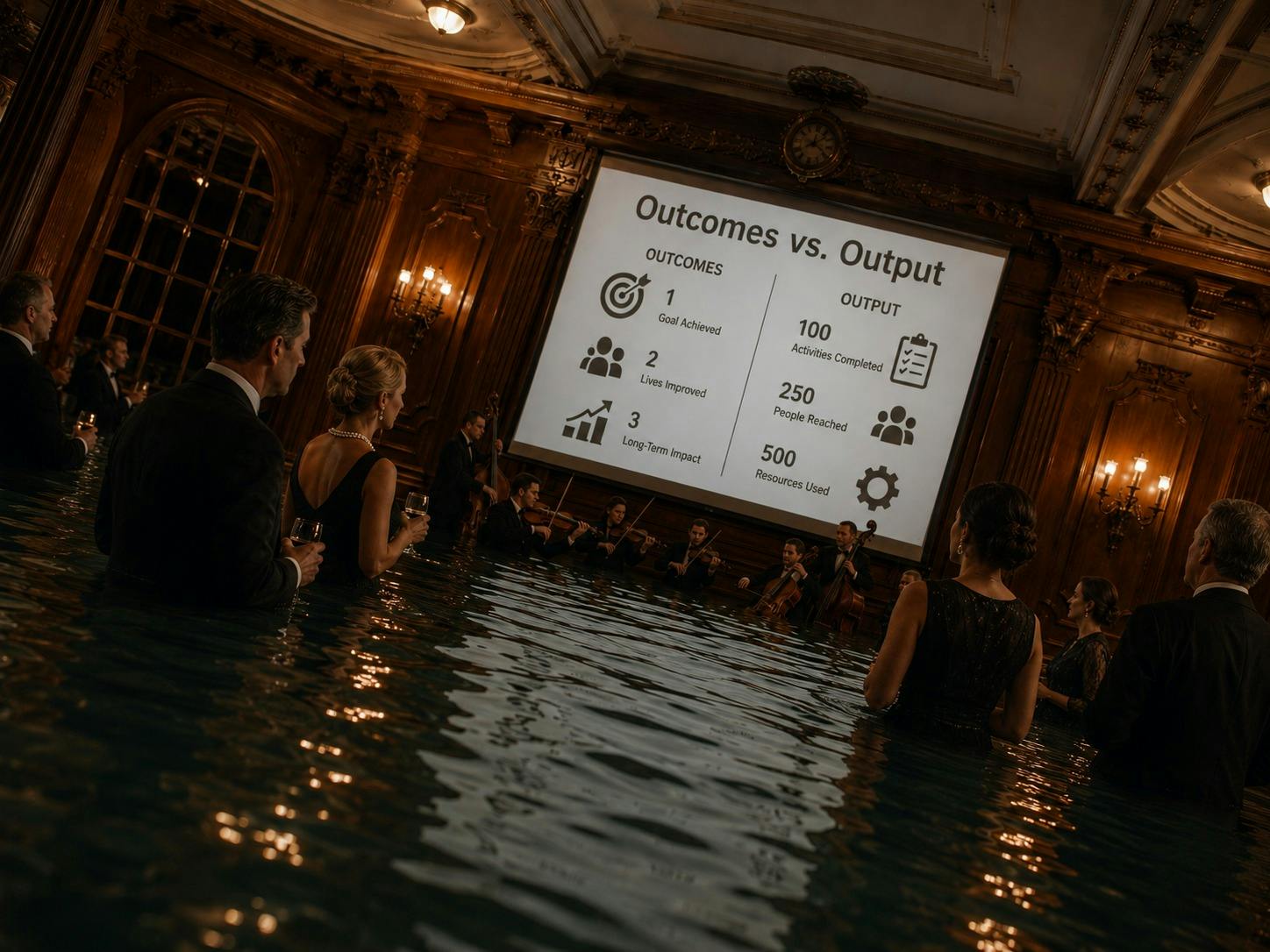
In Capitalism, Creativity, and Creative Destruction, Professor Michael Dearing replays a familiar movie: The Fast-paced and the Serious: I get very worried when I see people come with a shopping list, and they’re saying, ‘Okay, I need 32 ounces of front-end developer, and I need a pound of iOS backend.’ (Dearing, M,. Greylock, 2015, 53:29) This colorful scene is a reminder of how we act in the workplace, wearing black-and-white suits and powered by professional methods. Consider the history of Objectives and Key Results, OKR. The original idea was Management by Objectives, by Peter Drucker, the father of modern management. Andy Grove (who served as CEO of Intel from 1987 to 1998) organized these ideas to help Intel reinvent itself. According to The OKR Origin Story, “under Grove, Intel increased revenues from $1.9 billion to $26 billion. None of this would have been possible without OKRs.” After Grove’s teachings, grasshopper John Doer introduced the philosophy at Google, and the rest is history. Google became Google and OKR was set free. There is nothing wrong with OKR, like with a beautiful iceberg that took many many years to float. On the other hand, we keep on sailing around with OKR, because under the name of productivity the corporate tour must go on. The waltz never stops, and the captain is the last to jump. Because this article is a conscious trip that honors OKR, our goal must be clear. Goal: How to approach the subject of Objectives and Key Results more responsibly? To close this gap, consider the following three key stops: Key stop 1: Let’s consider why outcome-based key results emerged in response to the careless use of output-based key results. Key stop 2: Let’s test how our flawed principles can also be used to manipulate outcome-based key results. Final stop: Let’s consider why the father of OKR focused so much on outputs as key results. 1. The battle of outcome vs. output At some point in time, with the widespread of OKR, prescriptions like the following started showing up: Key Results need to be outcomes, not outputs. That statement reveals a battle. But that is not a battle of practitioners taking sides. In real life, the struggle happens inside the boat, as we sail around with OKRs. Key Results need to be outcomes, not outputs. If you make a key result “launch this feature” and halfway through the quarter you discover it won’t move the number you hoped it would, you’re stuck. (Wodtke, 2022) The practitioners who raised that flag had a strong reason to do so: a syndrome. In, Are You Sure You Want to Use OKRs?, Christina Wodtke calls it “the Drift,” when the process drifts away from the original goal. Trying to shove the OKR process into a dysfunctional org is like Cinderella’s sisters cutting off toes to fit into the glass slippers. It hurts and it doesn’t fool anyone. (Wodtke, 2022) Fundamentally, they are worried about us focusing on effort (activities) with no regard (whatsoever) to how things get better, the big picture and how things change. They care when we just don’t care about the impact from our actions. In “To Write Better OKRs, use Outcomes,” practitioner Josh Seiden also prescribed outcomes as key results. And again, the advice wants from us to look at the big picture: For example, a leader may want to reduce cost. That's an impact. An execution team may understand that support costs are high because customers call tech support at a high rate. That's the outcome. They think they can reduce tech support costs by fixing confusing product features. That's the output. (Seiden, 2019) The moral is: make me care. That is why Josh asks, “Are people’s behaviors changing?” Essentially, practitioners promoting outcomes simply want us to be responsible. In alignment with this conscious view, consider the following advice about how to come up with outcomes when we don’t know exactly what matters: Often people ask me, how do I know what key result to set? How do I know how much it should improve? I say ‘Go ahead and guess.’ I read once a long time ago that predictions and estimates are a skill. You start by guessing, but as time goes one you develop an instinct. I have found that to be true. You don’t have to get your OKRs perfect because you are building an intuition, not because you’ll be held accountable for getting it “right.” (Wodtke, 2022) 2. What you see is what you get Since our theme is “The Drift,” let us use this section to test doers under certain conditions. Consider a well-trained who has followed these good principles of the outcome-driven advice. She is not radical, and she is interested in developing intuition from action. Now, let us give her a different mission: You should use output key results The same doer, and the same honesty settings. But now the key results should be defined around outputs. Let us see what the folks from Measure What Matters have to say about output-based key results: Output key results are the identified milestones that should be met in the process of reaching the objective. (Head, n.d.) This statement aligns well with the principles, she concludes. Furthermore, she may now think that, in the land of outputs things must be connected as well. And if she is the kind of person who also wonders, "What if my outputs don’t make a difference?”, that makes her the right audience for these output-driven practictioners: Although an output in many cases can serve as a measurement, outputs don't necessarily lead to outcomes. In the name of productivity, it is quite easy for teams and leaders to lose sight of their overall objective and instead shift focus to their outputs. However, outputs must clearly communicate what will change. In other words, they must make a difference. (Head, n.d.) Perhaps she would also conclude that, whether it is an outcome or an output, there is always the good, the bad, and the ugly version. The Upside-Down Test Now, if the experiment suggests the possibility of doing good with outputs, it follows that we must check how far we can go by doing bad with outcomes. To do that, however, we must turn her-the-conscious-doer into a he-the-radical-doer and place him in the Upside Down world. Then give him the reverse mission: give up output and stick with outcomes as key results. To be fair, from the manager’s seat, we should agree that an outcome orientation sets the stick towards impact. And because things are indeed connected, naturally an outcome orientation produces results closer to what we want, assuming the spectrum consists of Activity, Output, Outcome, and Impact. Fair enough, if we track this doer, we would know precisely whether his actions changed behaviors, for example more users, more clicks, fewer calls to support, you name it. A key complication, however, one that can be seen from a rigorous managerial seat, is that, for all things closer to impact there may be a price to pay. This price can be seen the more we look at what is unseen. In other words, the more we focus on outcomes as key results the more we hide the activities from view. Of course, a natural question that follows is: What is the problem of hiding the activities if all that matters is the outcome achieved? The short and conscious answer would be: Is it? A longer one might be: Well, it may appear to not be a problem, initially, except when we don’t know what to set as an outcome. For example, when outcomes are guesses. Furthermore, the real price we pay is that implicitly we are hiding things, therefore reducing shared understanding. In other words, by following the dynamics of this upside-down world, we reinforce a culture that sets key results around expectations, wishes and demands, not around learning. To some extent, it becomes a culture where learning happens in retrospect (if anything at all was recorded after what was done.) Conversely, this culture weakens the humble mindset which is necessary to develop intuition. 3. Why output matters In Leadership is not about your good intentions, Johnathan Nightingale talks about a big idea, that junior people we evaluate on effort, seniors on outcomes. It is lovely to see how experienced managers talk about getting things done: We evaluate junior folks on their efforts and their intentions. If they did hard, diligent work on a doomed project, it's hard to make it dooming their fault. (Nightingale, 2017) Now, take aside the human character from these personas, the junior and the senior. A junior entity, one that deserves the right to advance from the effort. And the senior entity, one that knows what to measure because it already knows where to go. Leadership is not about your good intentions is not a catchy title, it’s a reminder about how teams make mistakes and how “good” we can be to create bad outcomes too. Plus, it’s also about how our senior entities keep demanding outcomes from our junior entities: When you are new, it's hard to know the difference between a bad idea, a good idea with the wrong team and a good team with a bad plan. [To ask them to behave as if they knew the outcome] It encourages people to be hard trigger and awful to each other as a way to seem smart. (Nightingale, 2017) If I had to make that call, to pick a side, if I had to pick between outcomes or outputs as key results, I would go now with outputs because it increases the chance for collaboration, as it exposes what was done in connection with the expected objectives. The KR is now on the line. As for when we are in doubt, it is worth remembering Jeff Bezos and his view about how good people are to come up with numbers: Jeff Bezos had a very strong point of view that, as the CEO, [that] every one of his direct reports has a bias toward wanting to please him. Therefore, the analysis and the metrics they show are going to try to demonstrate that they’re doing a great job. (Greylock, 2017, 14:54) When we suggest doers to find ways, to solve at any cost, we pay a price in the long run. When we use key results that hide what is being done, OKR don’t enable the shared conversation. We are essentially narrowing our views. The whole point is to say, out loud, and as clear as possible. Before we wrap things up, I wanted to go back to what OKR say about communication. In “The Magic of OKR,” Michael Dearing, organized well how OKR depends on clear communication: Writing down a goal increases chance of achieving it. Your team craves clarity on priorities and connection with the larger purpose. Tracking progress as you go motivates everyone. None of this is to say that we should know upfront the right outputs that close the gap. But it is also not about accepting guesses. OKR wants clarity about what we want to do and why that matters. With that, we can share the conversation, learn, and improve our intuition. To close, I ask what would a serious manager do about the fact, the problem, that we always had goals (around outcomes) but need a better system to track how to achieve them? Andy Grove, the father of OKR, wanted us to share the conversation about the what, how, and why we do the things we do. References Greylock. (2015). Blitzscaling 03: Michael Dearing on capitalism, creativity, and creative destruction [Video]. YouTube. Pines, G. (2025, April 4). The OKR origin story. What Matters. Wodtke, C. (2022, February 5). Are you sure you want to use OKRs? Seiden, J. (2019, July 16). To write better OKRs, use outcomes. Medium. Medium. Head, K. (n.d.). Output vs. outcome with OKRs. What Matters. Nightingale, J. (2017, March 6). Leadership is not about your good intentions. BetaKit. Greylock. (2017, June 20). The job of a CFO at a scaling company with Sarah Friar and Jason Child | The Scaleup Offsite 2017 [Video]. YouTube. Harrison Metal. (2020). The magic of OKRs [Video].
The Case Against Treating Outcomes as the Only Good Key Results
Full Article
Original Source
Read the full article at Hackernoon →KhanList aggregates and links to publicly available news content. We do not host full articles from third-party sources. Always verify important information with original sources.