
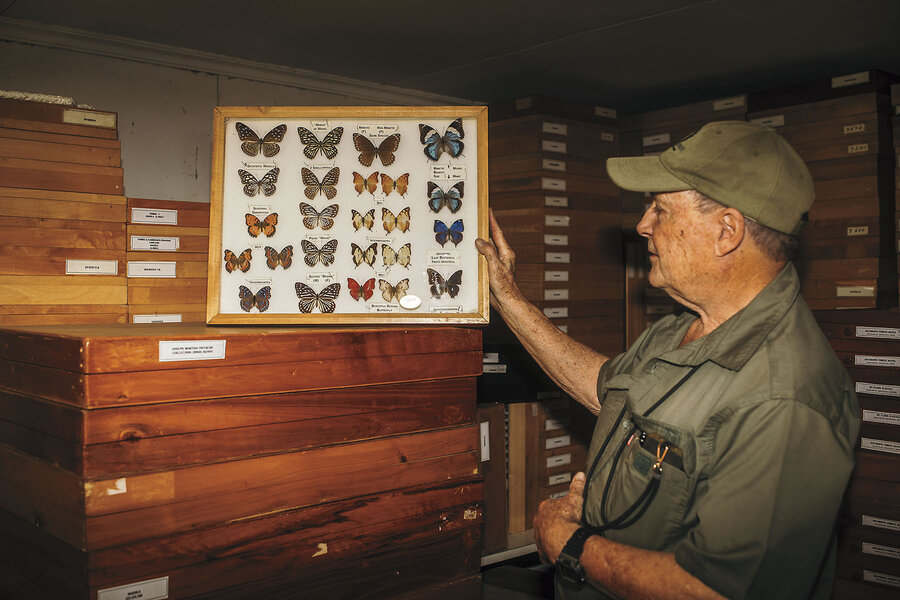
Nairobi, Kenya | Oct. 05, 2026, 11:00 a.m. ET | 4 min read Steve Collins reaches up and pulls out one of the tens of thousands of thin wooden boxes that line the shelves in a garden shed outside his home on the outskirts of Nairobi. Carefully, he opens the lid to reveal a dark brown butterfly pinned to a board behind a sheet of glass. The insect’s torn wings are dotted in blue and orange. Cramped writing on the accompanying label says that the insect was captured in 1960. Mr. Collins caught it as a boy growing up in western Kenya. This Charaxes castor specimen is one of 4.2 million butterflies in the collection that has been his life’s endeavor. It includes insects thought to be extinct, from environments long since destroyed. And it is, Mr. Collins says, the largest collection of African butterflies in the world. Now retired, Mr. Collins is desperately seeking a permanent home for these butterflies. Collections like his are increasingly a thing of the past. Today, butterfly enthusiasts are encouraged to photograph, rather than pin, specimens. “We will become extinct before the butterflies become extinct,” Mr. Collins says of old-school lepidopterists like himself. Kang-Chun Cheng/Special to The Christian Science MonitorMr. Collins holds a Charaxes candiope specimen caught that morning in a trap at the African Butterfly Research Institute. Kang-Chun Cheng/Special to The Christian Science MonitorEdgar Emojong, standing near a butterfly trap at the African Butterfly Research Institute, has helped care for the collection for 22 years. Transfixed by insectsMr. Collins was raised on a coffee farm near the peak of Mount Elgon, surrounded by verdant slopes. He and his brother kept antelopes as pets and collected guinea fowl eggs to hatch among the family chickens. “We didn’t have much in the way of dogs,” Mr. Collins quips.When he was about 6 years old, his parents traveled to what was then the Belgian Congo, where a friend gifted them a knotted wooden butterfly net. When they returned home, the whole family became amateur collectors, racing through farmland and the forest to capture butterflies. For Mr. Collins, the interest stuck. Transfixed by plants and animals, he studied zoology in London and embarked on a decades-long career as an agronomist developing genetically modified crops. On the weekends, Mr. Collins kept catching butterflies or paid other hobbyists to do the same and to give him the specimens. As a result, he says, the collection is not just a symbol of his own devotion but represents the work of as many as 40 people. Following butterflies across Africa, Mr. Collins recalls, led to many adventures. He once sailed with seven other students in a rubber dinghy from Ethiopia to Sudan to hunt for specimens. While he scaled a mountain in the Comoros islands with his then-teenage son, their passports and plane tickets were stolen from a rental car. Thinking fast, he went on the radio to make a passionate appeal for the return of his possessions. “The next morning, sitting on the wall of the hotel were our tickets and our passports,” Mr. Collins says, laughing. Kang-Chun Cheng/Special to The Christian Science MonitorMr. Emojong pinned this Papilio nireus lyaeus, or green-banded swallowtail. Kang-Chun Cheng/Special to The Christian Science MonitorMr. Collins’ vast archive contains a butterfly pinning room. Nature lover’s paradoxAbout 1.2 million butterflies, amassed over some seven decades, line rows and rows of shelves inside Mr. Collins’ garden shed. The aisles are tight and claustrophobic, like those in a basement vault. Dust mites swirl in the sun-streaked air before settling on books and papers. Inside their drab boxes made from jacaranda wood, the butterflies glimmer in a riot of color: blue, orange, purple, and white. The room houses a fraction of what Mr. Collins has collected. Three million other butterflies are stored in envelopes in the back. Out in the garden, living butterflies flutter among orchids and flowering shrubs, some landing in butterfly traps hanging from the trees. These ones, Mr. Collins says, will be released as part of a butterfly restoration program. Danish journalist Emil Leth Beiter, who has been interviewing Mr. Collins for a book on various collectors, acknowledges the paradox of pinning butterflies. “Collecting natural history necessarily means that you are destroying what you love,” Mr. Leth Beiter says. At the same time, the scientific value of Mr. Collins’ vast archive is “priceless,” says Kenyan entomologist Dino J. Martins, who collaborated with Mr. Collins on the field guide “Butterflies of East Africa.” The continent is thought to have some 4,000 butterfly species, but many face habitat destruction as a result of urbanization and a rapidly warming planet. A number of the species that Mr. Collins has collected have not been seen in the wild for 50 years and are thought to be extinct. “It is an incredible resource for understanding the diversity, the evolution, the conservation of butterflies in Africa,” Dr. Martins says. Kang-Chun Cheng/Special to The Christian Science Monitor“Anyone who wants to work on African butterflies has to come to ABRI.” – Steve Collins, referring to the African Butterfly Research Institute, which he operates A legacy in jeopardyMr. Collins would like to give his collection to a university so that the next generation of scientists can benefit from it. He notes that over the years, researchers from around the world have flocked to his archive, known as the African Butterfly Research Institute, and continue to study with him. “Anyone who wants to work on African butterflies has to come to ABRI,” he says. The center hosted school visits until 2003, when a dispute with the revenue authority here closed its doors to the general public.A collection of this size would take at least two truckloads to move and potentially need new buildings to house it, Mr. Collins says. So far, no donors have come forward to help. “He’s given his life to the butterflies,” says Dr. Martins. “It would be nice to see something come through in terms of securing this and making it a legacy.” Deepen your worldviewwith Monitor Highlights.Politics with respectGet political stories with respectful analysis.There‘s a world of new ideas in everyBooks newsletter.There‘s more to life, enrich yours withCulture & Learning weekly.Follow humanity‘s discoveries withScience & Nature stories in your inbox.Gain a spiritual perspectivefrom the stories in your inbox.Want to understand the deeper impact of critical events? Learn the Monitor‘s insight.Already a subscriber? Log in to hide ads. Mr. Collins has already created many butterfly fanatics. He trained his assistant Edgar Emojong, who has helped to care for the collection for 22 years. Whatever happens with the collection, Mr. Emojong wants to help maintain it.Sitting on his veranda, Mr. Collins surveys his garden perfumed by Stachytarpheta and lantana flowers, both known to attract butterflies, as he reflects on his life’s undertaking. Birds chirp in the tree branches above, and a large yellow butterfly alights on a leaf before flapping away into the sloping sunshine. ALREADY A SUBSCRIBER? LoginReal news can be honest, hopeful, credible, constructive.The Christian Science Monitor was founded in 1908 to lift the standard of journalism and uplift humanity. We aim to “speak the truth in love.” Our goal is not to tell you what to think, but to give you the essential knowledge and understanding to come to your own intelligent conclusions. Join us in this mission by subscribing.
The butterfly monarch: A Kenyan lepidopterist’s collection archives a kingdom
Full Article
Original Source
Read the full article at Csmonitor →KhanList aggregates and links to publicly available news content. We do not host full articles from third-party sources. Always verify important information with original sources.