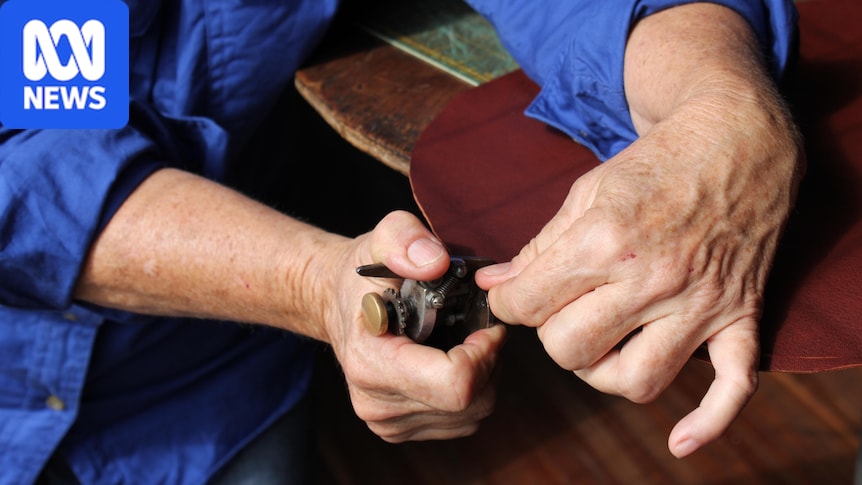
On a warm winter's day, sunlight spills through the tall timber doorframes of the memorial hall where Bill Webb is gently folding one strand of kangaroo leather over another.Dust dances in the beams of light as five women carefully follow his practised movements, cutting, braiding and conditioning at workstations dotted around the hall.Conversation ebbs and flows as they laugh about husbands, children and the joys found living in rural north Queensland.The room smells faintly of kangaroo hide and fresh country air.There is no rush.For the next three days, they have traded family and farm for sharp knives, leather gauges and sheets of finely cut kangaroo skin.The master leather plaiter is teaching them to make one of Australia's most iconic bush tools — the stock whip. Bill Webb hopes to keep the art of leather plaiting alive through workshops.()Softly spoken and quick to laugh, Bill roams from one student to the next, quietly correcting a hand position here, tightening a braid there."Lean on it with your body," he reminds them.It is advice repeated dozens of times throughout the workshop.Not because leather is difficult, but because patience is.While few Australians may know the name Bill Webb, plenty know the man who taught him about craftsmanship and legacy.Keeping RM's dream aliveThose immersed in the world of leather plaiting regard Bill as one of the country's finest craftsmen, whose work has travelled to Brazil, England, Italy and the United States.He has won multiple Dame Mary Durack Awards for Outback Crafts, which Bill describes as "the Melbourne Cup" of leatherwork. Bill favours kangaroo skin for making whips because of its strength and durability.(ABC Tropical North: Aimee Mitchell) Working with leather requires patience and time. (ABC Tropical North: Aimee Mitchell) Tools of the trade used by Bill and his workshop attendees to craft leather into different designs.(ABC Tropical North: Aimee Mitchell)But ask him what he is proudest of, he does not mention the awards.He talks about teaching."My mission in life is to try and keep the art form of leather plaiting alive," he says."That was RM's dream and I'm trying to do the same."'Boy'Long before Bill became the teacher, he was simply "Boy" to legendary bushman Reginald Murray Williams, now famously known as RM Williams.The pair first met when Bill was a teenager spending school holidays mustering on neighbouring properties.His payment was not money — it was two weeks learning beside the man whose name would become synonymous with craftsmanship and Australian bush culture. RM Williams affectionately nicknamed a young Bill Webb "Boy." (Supplied: Bill Webb) RM Williams (left holding hat) took Bill Webb under his wing when he was a young man at Rockybar station. (Supplied: Bill Webb) Bill Webb grew up on cattle properties where bushcraft was part of everyday life. (Supplied: Bill Webb)"He was such a generous man," Bill says."If you were fair dinkum, he'd give you the shirt off his back."RM also demanded perfection.A piece that looked finished to everyone else often wasn't finished to him."He'd say, 'You can do better than that. Start again,'" Bill recalls. Bill's leather plaiting skills were passed on to him by the famous RM Williams when he was just a boy.(ABC Tropical North: Aimee Mitchell) Catherine McNamara learns the skills to continue the trade long after the workshop has finished.(ABC Tropical North: Aimee Mitchell) Bill trims the conditioned kangaroo leather so it is ready for plaiting.(ABC Tropical North: Aimee Mitchell) Rhonda Walton patiently braids the thin strands of kangaroo leather for the body of her stock whip.(ABC Tropical North: Aimee Mitchell)More than half a century later, Bill still hears RM's words every time he starts a new piece."He was always just saying, 'Try and make the next one better than the last one and be the best that you can be,'" he said.At the Bloomsbury Soldiers Memorial Hall, about 90 kilometres north of Mackay, the ladies are starting to understand why.Making a whip involves focus and steady movements to perfect not just what is seen on the outside, but also to establish the foundations and finally the finishings on the inside too.Bill tells them 70 per cent of the job happens before the first strand is ever plaited. Raelene Miller conditions her hand-cut leather strands before she begins the plaiting process.(ABC Tropical North: Aimee Mitchell)"Each strip must be cut to exactly the right width," he says."Every strand stretched. Trimmed. Bevelled. Prepared. Only then can the leather start to take shape.""Look after it, and a good whip can last a lifetime … or two."Saving the tradeFor Jane Henley, the journey to Bloomsbury started more than a decade ago.The hairdresser from Tully first met Bill at a Lost Trades Fair in Victoria, which is dedicated to showcasing artisans who practise lost arts, rare trades and forgotten crafts. Tully farmer Jane Henley has been waiting years for Bill Webb to host a leather plaiting workshop in north Queensland.(ABC Tropical North: Aimee Mitchell)When she found out Bill was heading north for a workshop, she packed the car and convinced three girlfriends, Catherine, Rhonda and Raelene, to come too."We've been stalking Bill Webb for years," she laughs.Her handmade whip is destined for her husband, who still uses one while mustering cattle on their small property near Tully.Jane had never worked with leather before, but now she'll have the knowledge to make another.That, Bill says, is exactly the point.He says for generations, leather workers closely guarded their techniques, but now he believes the great risk is that nobody learns at all."They wouldn't show you because you're going to take business away from them," he says. The work starts with the right piece of leather. (ABC Rural: Aimee Mitchell)"Now … we're trying to tell everyone as much as we can so we can keep it alive."Workshop organiser Kimberly Carey grew up surrounded by horses, dogs and stockwhips on a cattle property near Clermont in central Queensland.She worries practical bush skills are slowly disappearing beneath screens and keyboards. Kimberly Carey tests her newly made stockwhip in her backyard.(ABC Tropical North: Aimee Mitchell)"If we don't keep any of these old skills alive, they're going to be gone," she said"It builds character, it builds patience, and unreal craft."Spreading the craftBy the final afternoon, everyone has a finished whip.Some are a little tighter than others, some braids are more even, but none of that matters much to Bill.He knows they have learned enough to make another or to teach someone else. Kimberly Carey's whip collection now includes her own handmade addition.(ABC Tropical North: Aimee Mitchell) Some of the many uniquely handmade leather products crafted by Bill Webb.(ABC Tropical North: Aimee Mitchell) The fine strands of Kangaroo leather tightly plaited show the intricate work needed to make the butt of a stockwhip handle.(ABC Tropical North: Aimee Mitchell) Bill travels to crafts markets to sell his work and meet others people who appreciate bush craftsmanship.(ABC Tropical North: Aimee Mitchell)Kimberly turns her whip over in her hands."It's pretty awesome," she says."I didn't realise how much was involved in building one.It will take pride of place in her home, the first of many she intends to make. Raelene Miler, Jane Henley, Rhonda Walton, Catherine McNamara and Kimberly Carey with their handmade stockwhips and teacher Bill Webb (centre).(Supplied)For Bill, her confidence to try more is the greatest compliment a teacher can receive.When asked what Bill would like his legacy to be, he pauses for a moment."I'd like my legacy to be that people know I've tried to pass the trade and the skills on to everybody else that wants to learn," he says.
The bush artisan saving craftmanship one stockwhip at a time
Full Article
Original Source
Read the full article at Abc →KhanList aggregates and links to publicly available news content. We do not host full articles from third-party sources. Always verify important information with original sources.