
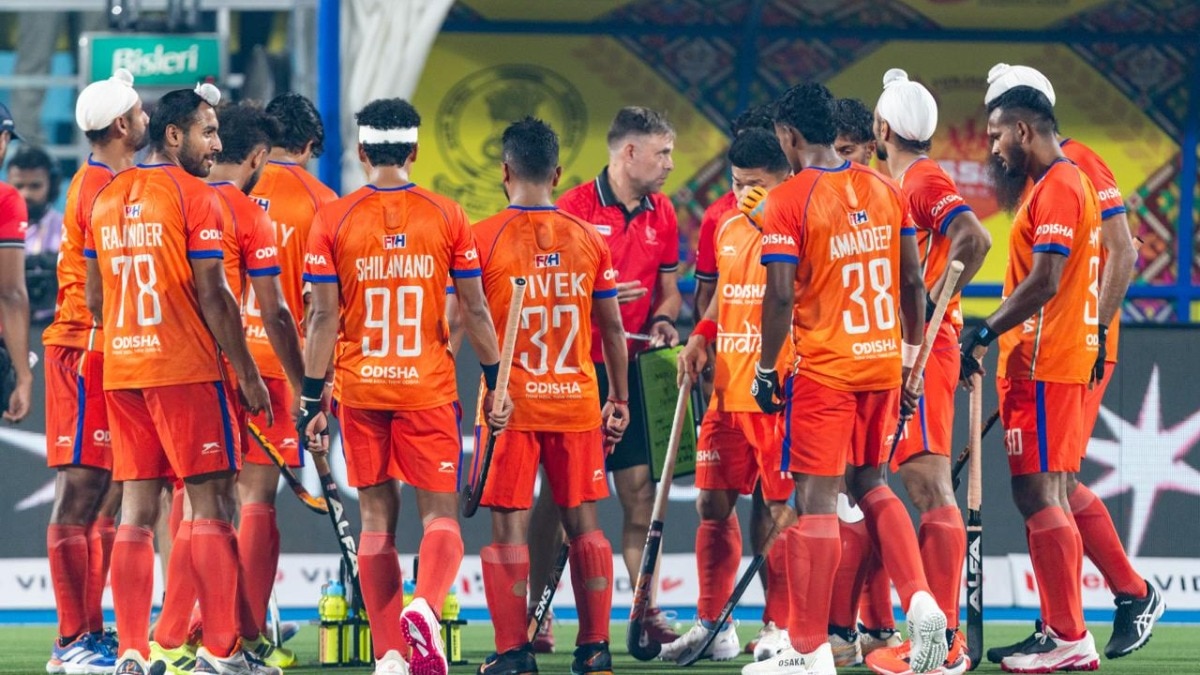
Every evening at Tokyo’s Platform 1, the Shinkansen glides into the station. It is a marvel of human engineering - sleek, aerodynamically shaped, fast, and utterly predictable. The first time you see it, your pulse quickens. By the tenth time, it is merely background noise. By the end of the month, it is a blur. Noticeable but not registering anymore.Field hockey has reached its bullet train moment. Or maybe, it’s just a clash of eras. Of the passage of time and data squeezing the joy out of sport to leave it to robotic elements.Hockey is not alone in this trap. Modern sport is littered with games that increased their pace only to lose their eloquence. Sport has an expression and like so many other things in life, we are killing that too. We saw it on the Formula 1 grid, where raw, instinctive racing turned into clinical data management.Rugby Union descended into an unwatchable whistle-fest to basketball’s obsession with three-pointers led to the death of the midrange game; the story is the same. In chasing hyper-efficiency, sport has sacrificed happiness and joy that fans felt was humanly achievable. But hockey’s identity crisis is particularly acute, it has become as fast as an F1 pit stop, structurally closed as squash, and as hit-and-run or probably more than basketball. The spectator feels he is stranded somewhere in the middle. In today’s modern game, if a team rotates the ball – the midfield and the defence trying to slow down the game to gain some control - the fan also exhales.There is no doubt that a decade after the International Hockey Federation (FIH) dismantled the traditional 35-minute halves and introduced four 15-minute quarters, the sport is undeniably faster, leaner, and relentlessly athletic, like a group of sprinters given a stick and told to go hell for leather. Look toward football, and you understand why teams like Barcelona, Real Madrid, and Pep Guardiola’s Manchester City avatar are revered. Artistry keeps you hooked; the suspense hanging over the pitch ensures you are glued to your seat.Eight sprinters combining in a robotized motion gives us breathless hockey, but after a point, it becomes predictable. Six consecutive penalty corners to one team may stem from great defensive work, but in the stands, they all seem the same. Without a pause, the theatre on the pitch feels overdramatized.The changes to hockey worked, for a while. But after the initial rush of the quarter system cooled off, an uncomfortable truth emerged: hockey had accelerated itself into a 60-minute frenzy - a Chuck Norris film in fast-forward. It is impressive in its evolution, but increasingly difficult to feel.Hockey will not die out. The Olympic franchise is thriving, and player conditioning is at an all-time high. Yet the idea that sport, with all its unpredictability and individual artistry, is self-strangulating under the weight of non-stop pace remains real.Until a decade back, time was hockey’s biggest asset. For decades, the midfielder was the conductor - patient and precise as a surgeon, dictating tempo and shifts in speed. Today, players hardly settle down. Unlimited interchanges and compressed bursts have transformed the pitch from a beehive of diverse problem-solving minds into a treadmill of runners following rigid tactical templates.Former Indian captain and coach V Baskaran believes:"Once the off-side rule went, hockey changed rapidly. Now the sport is too much coach and analyst-driven. Individual skill has taken a back seat; the days of Balbir Sr., Ajit Pal Singh, Mohammed Shahid, Shahbaz Ahmed, Teun de Nooijer, and Pol Amat are over. Also understand that the reason for fewer crowds in Asia is that hockey has lost its artistry and charm. It’s all drawings on a board. Players, except for a few, don’t think anymore."When a game loses its ability to slow down, it has lost its set-up quality that finished in a screaming peak. Without a quiet build-up, the sudden sprint into an attack loses its contrast. Everything is fast, which paradoxically means nothing feels fast anymore.Compounding this is a rulebook that alienates the mind. No major global sport asks its spectators to decipher as many obscure, constantly shifting micro-interpretations. What constitutes a dangerous ball? Was the stick above the shoulder? Did the ball hit the foot, or did the foot seek the ball?Was the defender five meters away on a self-pass, or four-and-a-half? Even standing on the turf, players and coaches frequently exchange bewildered looks as the whistle blows. Video referrals interrupt fluid play, leaving fans staring at slow-motion replays. The sport is testing the players, but more so the fans.Yet perspectives vary. Olympian and former Indian midfielder Arjun Halappa doesn’t buy the argument that pace entirely diminishes skill.“You can’t see it like that alone,” he says. “Even in the recent World Cup, players from Argentina, the Netherlands, and India were very good on the ball. A coach might cut down on holding the ball too long, but that is tactical. I think it is up to the player to balance speed and skill.”Indian women’s coach Sjoerd Marijne echoes a balanced view:“Fans do appreciate the pace, and in clean structures, you do get to see exceptional action. In terms of athleticism, teams are so much better. But if I were to choose between that era of Shahbaz Ahmed, Pol Amat, de Nooijer, I would love watching Stephen Veen and Pol Amat. That was exciting hockey.”On video referrals, Marijne defends them as a tool for honesty that often resolves in under ten seconds. However, Arjun points out that the rulebook itself needs simplification rather than annual tweaking.“Has cricket, volleyball, or football changed rules on an annual basis? No. Simple rules lead to better commercialisation.”Arjun also targets the penalty shoot-out:“It was brought in for artistry, but now everyone turns and has their back to the goalkeeper. A front-facing approach involves far more skill.”Today's Hero Shootout Thrill features this exciting semi-final match between France and Pakistan at the FIH Hockey Men's Nations Cup 2024/25. Download https://t.co/71D0pOpuZ8 to avail discounts and watch the #FIHNationsCup final. #hockey https://t.co/SSCwTDfrSn— International Hockey Federation (@FIH_Hockey) June 21, 2025Nowhere is this technical jamboree more pronounced than in the penalty corner routine. What was once a pure test of drag-flicking power and defensive bravery along with brilliant goalkeeping has mutated into a minefield of microscopic scrutiny - body positioning, runner trajectories, and knee-high ball heights are dissected with crime scene intensity. The circle is no longer an arena of just pure instinct; it is a space hedged in by technical jargon the paranoia for which is set up in the dressing room.From the dugout, modern international hockey is driven by GPS metrics, heart-rate tracking, rotation schedules, and video analysis. Yet a fundamental question remains: in hyper-analysing every metric, have we become risk-averse to a fault? Has the coach-analyst’s structural compliance replaced the on pitch spontaneous genius? From the dugout, hockey is now driven by GPS metrics, heart-rate tracking and more (Credit: Hockey India) Bhaskaran kind of stands in neutral territory here. He agrees that the narrative is set by the coach after studying what the opponent can create.“The coach is understanding the flow from outside and sometimes sees things that the players can’t. But there are players who take the initiative like Ajit Pal used to do as a midfielder or Dhanraj who would change the script if not entirely but as a player decide a different method if he believed things were not going to plan. I did have issues at the time when I coached the Sydney 2000 Olympic Games, but in the end a coach needs to trust the players’ instinct too.”But let’s speak plain before most modern technical talk becomes another jargon blog. Players like Australia’s legendary Jamie Dwyer, a maestro who could sashay across the turf as if balanced and screwed to an inbuilt steel ball, lower body powered by a motor with an incredible hockey visionary mind, didn’t just play the game; they solved it in real-time. Dwyer was the ultimate thinker, a player who possessed the rare gift of slowing time down inside his own head while the rest of the world scrambled at breakneck speed.Yet modern coaching metrics and dressing room tactical spreadsheets are systematically squeezing out players of that mould. Even today, when we watch exceptional contemporary minds like India’s Hardik Singh, the Netherlands’ Jorrit Croon, Belgium’s Victor Wegnez, or Argentina’s Maico Casella, seasoned orchestrators trying to carve out magic, you see them constantly fighting against the grain.By forcing athletes into rigid, pre-determined tactical boxes and prescribing every single movement by data-driven templates, the sport is starving out its intuitive geniuses. The pitch cannot become an assembly line of high-speed sprinters, the sport also needs a bit of breathing room for flair, individual expression, and on-the-spot brilliance to take root. Hockey cannot come pre-packaged. Some bit of it needs to be cooked on the pitch.Field hockey does not need another cosmetic adjustment. The sport urgently requires a return to narrative balance. If the sport is to reignite the imagination of a global audience, it must make its rules intelligible, allow its matches space to breathe, and permit its players to be artists once more.- Ends
The bullet train dilemma: Has field hockey traded its artistry for athleticism?
Full Article
Original Source
Read the full article at Indiatoday →KhanList aggregates and links to publicly available news content. We do not host full articles from third-party sources. Always verify important information with original sources.