
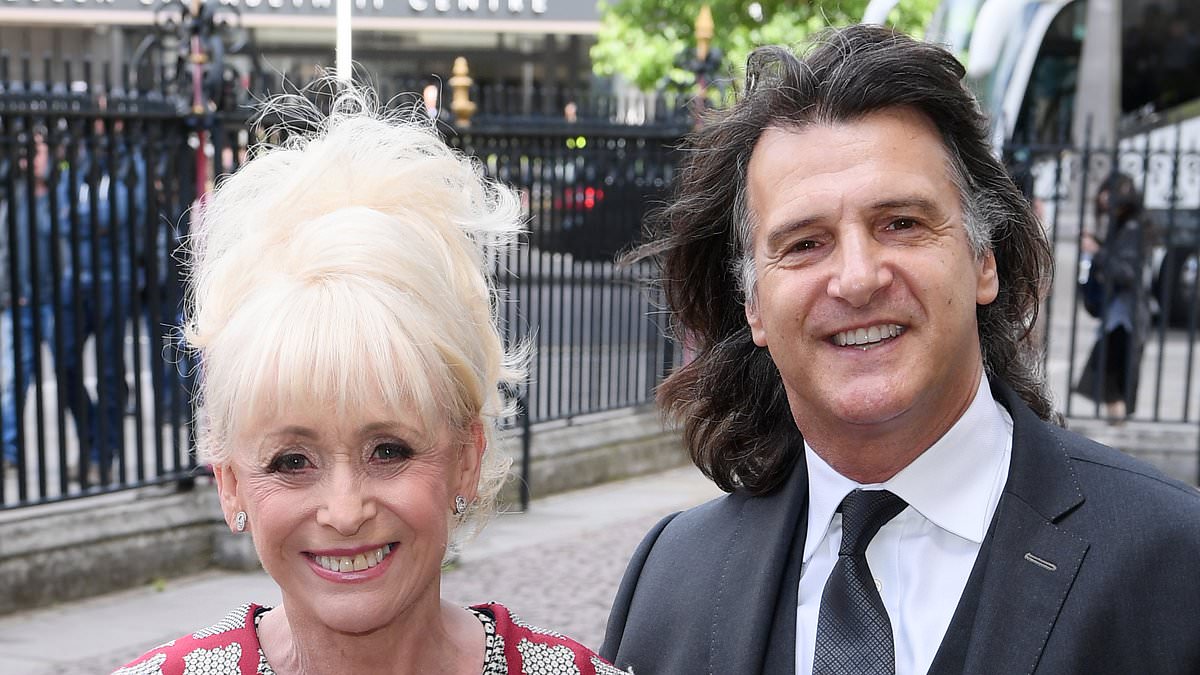
Scott Mitchell was helping his wife, TV legend Dame Barbara Windsor, out of the bath when she said the words he had most feared.‘Who are you?’ she asked, her eyes wide in terror, scanning his face.Barbara, who graced our screens for more than 50 years – 22 of them playing pub landlady Peggy Mitchell in EastEnders – had been diagnosed with Alzheimer’s disease two years earlier.‘The diagnosis, in 2014, was a terrible shock, for both of us,’ recalls Scott. ‘So, a week later, I made an appointment to see her neurologist alone to ask questions she might have found upsetting.‘I couldn’t talk for crying at first, and he asked me what it was I most feared. I told him that it was her looking at me, one day, and not knowing who I am.’It was two years later, in 2016, by which time Scott’s relationship with Barbara had begun to morph from husband into carer, that this fear was realised. The late Dame Barbara Windsor, who died of Alzheimer’s in 2020, with her husband Scott Mitchell in 2017Barbara graced our screens for more than half a decade and played pub landlady Peggy Mitchell in EastEnders for 22 years ‘Having my wife of 20 years look into my eyes and not recognise me was indescribably painful,’ recalls Scott. ‘But I could see how scared she was, so I composed myself and said: “It’s me, Scott, your husband. You’re OK. You’re safe with me.”‘She quickly snapped out of it and got very emotional, realising what she had done.’Sadly, as is common with dementia, over the next four years, until her death in December 2020, aged 83, the times during which Barbara was unable to recognise Scott, the man she met and fell in love with in 1993, became increasingly frequent.Since Barbara’s death, Scott, 63, a talent agent, has worked tirelessly raising awareness about Alzheimer’s, as well as money for research into the disease.In 2019, a year before Barbara died, they were both appointed ambassadors for Alzheimer’s Society, and this month Scott attended the first pilot class, held in Hornchurch, east London, for a new, much-needed, national support network, Dementia Carers Together. It will be launched, and available to carers across the UK, in January.The Daily Mail has teamed up with Alzheimer’s Society to raise money to help fund this network, providing a lifeline to those caring for loved ones with dementia, a disease affecting almost one million people in the UK, where it claims 76,000 lives per year. Scott speaks to other carers at the pilot session of the Dementia Carers course in Hornchurch, east LondonDementia Carers Together consists of six standalone sessions, each lasting two hours, during which trusted advice will be given on navigating both the practical and financial matters that come with supporting someone diagnosed with this cruel disease.Carers can attend all, or select, sessions and will also have the opportunity to connect with others whose days are spent tending to dementia sufferers, helping reduce the loneliness and isolation that fulfilling this role so often brings. Highlighting that dementia is the nation’s biggest killer, Michelle Dyson, Alzheimer’s Society chief executive, says Dementia Carers Together will fill a gaping hole in providing assistance for those carrying the burden of care, helping them feel more informed, connected and supported.This, in turn, will improve the well-being, and strengthen the resilience, of those at the dementia care coalface – 2.5 million people in the UK provide some form of care for loved ones with the disease.‘Too many carers are facing loneliness, exhaustion and overwhelming responsibilities without the support they need and, often, without the knowledge about what is available to them,’ says Michelle. ‘Dementia carers are often left to shoulder the huge emotional, practical and financial burden of care alone.‘Many have little access to local support and are unaware of the help they’re entitled to. Dementia Carers Together will play a vital role in their lives.’Given the demands, which can include washing, dressing, feeding, administering medication, dealing with health and social care providers, as well as keeping loved ones safe – all while having the same, forgotten conversations on repeat – it is little surprise that four in five unpaid dementia carers report having reached ‘crisis point’ at least once.More than two-thirds – 70 per cent – say their mental or physical health has suffered. Meanwhile, compounding what is already a hugely challenging situation, one in seven carers don’t know what support is available, while almost half are unaware they may be entitled to carer’s allowance, attendance allowance and free prescriptions.While guidance given around this will be invaluable to those with little time and energy to spare beyond caring for those in the grips of this terrible disease, connecting with others who really ‘get it’ will be priceless – as I discovered while chatting to carers at the pilot event.One son, Steve, who tells the group that his mother is convinced he and her doctors are trying to kill her, is advised by Alzheimer’s Society staff to seek a medication review for his mum.However, it is when Scott is able to offer support by drawing on his own experience that Steve visibly relaxes.‘I went through that a lot,’ Scott says, as Steve’s shoulders drop, hearing the resonance. ‘When I gave Barbara her medication at night, she’d say: “I don’t take medication at night. You’re trying to kill me.” It’s really, really difficult.’Others in the room share accounts of how questioning a loved one’s confused perception can lead to a great deal of distress.‘What I learnt to do is enter Barbara’s reality – I wasn’t always good at it at first, and I think we have to forgive ourselves when we get it wrong,’ Scott says.‘When she would say to me things that made absolutely no sense like: “Is my mummy coming to see me tonight?”, instead of reminding her that her mum was no longer with us, I’d say: “She might be, but I know she’s been busy today,” and distract her, asking: “What’s that on the television?” ’This poignant glimpse into Scott and Barbara’s final years together leads to a chorus of people wondering whether he, like others sipping tea around the table, felt guilty about ‘lying’ to his loved one. ‘Sometimes,’ reflects Scott. ‘But it felt kinder to tell a little white lie than to tell her the harsh reality and for her to ask: “Why am I thinking that? Oh, I’m not well,” because that causes even more stress and anxiety, for them and for you.’It is clear there can be no therapeutic substitute quite like trading ‘war stories’ with others who have first-hand experience of the unique challenges that come with caring for someone with dementia.Another attendee, Ann Burkin, 67, who has cared for her 77-year-old husband since his diagnosis of Alzheimer’s four years ago, relates, all too painfully, to Scott’s experience. ‘The hardest thing for me is that the man I’ve spent the past 50 years with no longer recognises me,’ she shares, tearfully. ‘I’m not sure I’ll ever come to terms with that.‘He’s always telling me he wants “to go home”, and he means where he lived in London before we got married. He seems to have no memory of our 50 years together.’Ann is keen to keep her husband in the family home for as long as possible, despite the unrelenting demands of meeting his every need, all the time aware she is a stranger to him.She also, sometimes, has to contend with his anger, which she knows is borne of frustration.‘He will stand and talk to cushions, and that’s fine, but he gets really angry with me because I don’t join in the conversations,’ says Ann. ‘But he can’t actually have conversations – I can’t understand what he’s trying to say – which makes it really difficult for me to engage.’Ann feels fortunate to have three adult daughters who, although they no longer live at home, she can call for emotional support at the end of challenging days.However, she has little time to herself and was only able to attend the Dementia Carers Together meeting because it fell on a day when her husband was at a local authority-run day centre.And she is very glad she made the time, having found great solace in speaking to others living with the demands, frustrations and sadness of their caring roles.Advice covered during this first session was around arranging Lasting Power of Attorney and transferring legal rights to carers when dementia sufferers no longer have capacity to manage their own affairs.Subjects covered at future sessions will include navigating health and social care and what benefits carers may be entitled to, including council tax discounts, blue badges, grants and support with energy costs. Information about latest research and clinical trials will also be provided.Some sessions will be delivered online, to ensure greater accessibility for carers who cannot attend in person.Ghanshyam Patel, 74, came along to the first pilot session with his wife, Mrudula, 75, who was diagnosed with vascular dementia earlier this year. Although matters being discussed seemed, at times, confusing to her, as her full-time carer, Ghanshyam didn’t have anyone to leave her at home with.(Unfortunately, it won’t be possible to bring dementia sufferers to the courses when they are fully launched next year.)He is worried about his wife’s lack of appetite, a common symptom of dementia, as damage to parts of the brain disrupts natural signals for hunger, thirst and fullness.‘She has breakfast and, after that, she doesn’t eat anything,’ Ghanshyam tells the group. ‘When I ask her to eat, she says: “I’m not hungry.” ’The advice from the Alzheimer’s Society team and those who are familiar with this challenge is to leave a ‘grazing board’ close to where Mrudula sits, as ‘muscle memory’ may encourage her to reflexively reach for food.As his wife is in the early stages of the disease, Ghanshyam appreciates hearing from other, more experienced, carers as well as listening to the talk from an Alzheimer’s Society adviser on Lasting Power of Attorney.As often happens when he encounters other carers, Scott is reminded of his final years with Barbara.Despite their 26-year age gap – Barbara was 55 and Scott was 29 when they were first introduced by Scott’s mum, who had gone to dance school with the Carry On star – they, like the Patels, had, he says, ‘a very happy marriage’.Even after Barbara’s diagnosis, which the couple kept to themselves until 2018, they were both regular fixtures at glamorous showbiz parties and premieres. While Barbara came to terms with her condition, she continued filming EastEnders until 2016, as the couple were eager for things to stay as ‘normal’ as possible.December 10 will be the sixth anniversary of Barbara’s death and one of her great legacies is the Dame Barbara Windsor Dementia Goals programme, a UK government-backed initiative set up in 2022 with Scott’s support to accelerate dementia research, early diagnosis and the delivery of new treatments.It has since received over £100million in public and private funds to support research.‘Treatments are really developing, but you have to catch it early,’ says Scott. ‘I’m honoured to be a part of the process of helping improve outcomes and often joke that the Goals Programme means that Barbara will now be remembered for more than that iconic scene of her bra flying off in Carry On Camping.’As Scott prepares for the sixth anniversary of her death, he recalls how the fifth anniversary was especially challenging, sending him ‘into a bit of a dip’, last December.‘You’re still in deep grieving for the first couple of years. In fact, I don’t think the grieving ever truly goes away, but the fifth anniversary felt like completing a cycle and it hit me much harder than I anticipated,’ says Scott, who went on to date Barbara’s EastEnders co-star, Tanya Franks, for three years until April.‘It was lovely, but not to be,’ he says now of the relationship. ‘So at the moment, I’m beautifully single. I’ve got a lot of friends, I’m always out, always busy, either with work or socially.‘Barbara always said to me: “Please, when I go, be upset, be hurt for a little bit, but promise me you will live life to the full again.” She lived ten lives compared to the rest of us – and so I do.’Although speaking about what he and Barbara went through can still, at times, trigger an outpouring of grief, sharing his experience with other carers has, he says, been one of the most fulfilling parts of his life over the past six years.‘Being able to say: “I know what you’re going through, I’ve been where you are, and you will be OK,” is incredibly cathartic,’ says Scott. ‘Feeling understood and supported when you’re caring for someone is so important.‘Which is why I know that Daily Mail readers will give whatever they can to ensure this wonderful Dementia Carers Togethers programme is available to those who need it.’ Dementia Carers TogetherDementia Carers Together is raising money to fund new courses across the UK to give tens of thousands of struggling unpaid dementia carers vital emotional and practical support. For further information, visit dailymail.com/dementiaHow you can donateOnline: Click here.By Text: To donate £10, text CARER to 70115. To donate £20, text LOVE to 70115. To donate £30, text HEART to 70115. Texts will cost your donation amount plus your network charge.By phone: Call 0300 1234577. Standard charges may apply.By cheque: Send cheques made payable to Mail Force Charity to:Dementia Carers Together, 42 Phoenix Court, Hawkins Road, Colchester CO2 8JY READ MORE: As the Mail launches landmark campaign for dementia carers, TV news veteran and sufferer Alastair Stewart says: 'I'm at the point where I wonder if life is worth living... I only exist because of Sal' Iceland food chain backs dementia campaign with a cool £50,000 donation SARAH VINE: It was a blessed relief when my dementia stricken father finally died Help us back UK's dementia carers: Daily Mail launches major appeal to fund vital new support network 'The despair in her eyes was unbelievable': In heartbreaking detail, a husband recounts how his wife's Alzheimer's diagnosis devastated both of their livesDementia carers' postcode lottery: As Mail launches landmark fundraising appeal, heartbreaking figures reveal how looking after loved ones hits families' quality of life differently around the UK
The brutal truth of Barbara Windsor's mental decline and why her widower is backing a new national carers' network funded by the generosity of Daily Mail readers
Full Article
Original Source
Read the full article at Dailymail →KhanList aggregates and links to publicly available news content. We do not host full articles from third-party sources. Always verify important information with original sources.