
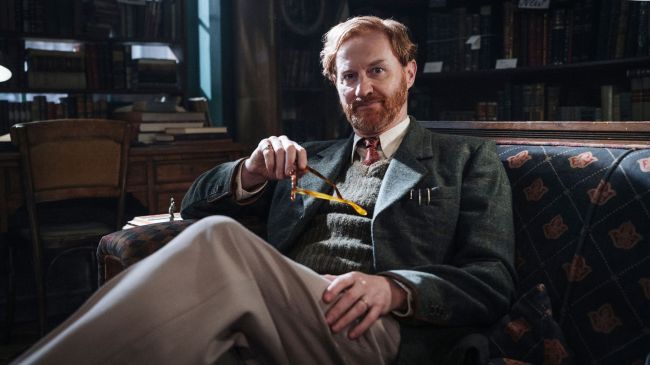
“I get it, because I love invoking that nostalgia, but I think that term also implies a certain ease,” Mark Gatiss recently explained to Variety his apprehension at the “cozy crime” label being applied to his latest labor of love. “And doesn’t have to be just wallpaper; it can have teeth.” As much a meditation on navigating sexuality in the immediate aftermath of World War II as a period procedural, Gatiss’ PBS series “Bookish” certainly has plenty to chew on. In fact, alongside “Ludwig” and “Death Valley,” it’s leading the British charge to subvert a sub-genre widely dismissed as undemanding background fodder. Indeed, once the domain of Hallmark Channel, whose twee franchises (“Curious Caterer,” “Crossword Mysteries”) are as formulaic as their tradwife propaganda romances, the cozy crime drama is undergoing something of a commercial and creative renaissance of late. According to a recent study, 75 percent of 18-29 year-olds, a generation embracing everything ASMR to knitting to drown out the noise, consider themselves fans. At the opposite end of the spectrum, the rapid growth in streaming audiences among boomers explains why Acorn TV, whose catalog is dominated by the stuff, are witnessing a boom in subscribers. And while tried and tested favorites such as “Death in Paradise” (which has even spawned its own Marvel-esque mini-universe), “Father Brown,” and “Midsomer Murders” are continuing to pull in the numbers, audiences are also gravitating toward shows proving that gentle doesn’t necessarily mean shallow. “Bookish” centers on Gatiss’ Gabriel Book, a secondhand bookseller in post-war London who — thanks to a mysterious letter signed by Winston Churchill — is entrusted to apply his encyclopedic knowledge with the Met Police. Yet while its 1940s setting, killing methods (poisoned bonbons) and great British fondness for the cuppa (“Without tea, I am merely reconstructed dust,” Book declares) may be the stuff of Agatha Christie, its themes are unusually progressive. For Book is also in a lavender marriage with Polly Walker’s strong independent woman Trottie, explaining why beyond his remarkable sleuthing abilities, he remains something of a buttoned-up enigma. Laced with an air of melancholy, the series quietly but effectively delves into the hardships of staying in the closet at a time when homosexuality was still 20 years away from decriminalization, while also exploring the concept of platonic love, the disillusionment of women forced to retreat from the workplace, and the PTSD suffered by returning soldiers. A Lacey Chabert vehicle this is not. ‘Ludwig‘CREDIT LINE:BBC/Big Talk Studios/Colin Hutton As its Best Comedy win at the International Emmys would suggest, fellow two-season wonder “Ludwig” is slightly more jovial. In fact, it compels far more as a tragic-comic character study than a murder-mystery, its tendency to withhold vital information until the last-minute ensuring it’s practically impossible for armchair detectives to play along. As the corduroy-clad, socially-awkward puzzle maker, David Mitchell essentially plays David Mitchell; no bad thing, of course, as his hilarious victory on “LOL UK” proved. Much of the BritBox show’s joys derive from watching a bumbling introvert, who poses as his detective twin brother to investigate his disappearance only to become the force’s secret weapon, struggling to adapt to center stage and the complexities of modern life. From his inability to make small talk to his near-pathological dislike of all mod-cons, Ludwig is a reluctant hero and, at times, an impenetrable one, too. (“Whichever one didn’t do it knows that the other one did and is protecting her. While the one that did do it knows we can’t prove that the one who didn’t do it, didn’t do it”) However, as with “Bookish,” creator Mark Brotherhood balances Ludwig’s quips and idiosyncrasies with a genuine sense of longing, not only for his missing sibling, but for the dad who abandoned them as youngsters as well as the sister-in-law he obviously holds a torch for. Come for the cryptic capers, stay for the complex family dynamics and post-millennial tensions. Also returning to BritBox for its second season this month (out November 17), “Death Valley” is undeniably the most meta of the three, fully leaning into all the tropes — amateur sleuths unfathomably allowed to permeate crime scenes carte blanche, picture-perfect visuals which double up as tourist board ads (in this instance, the scenic Vale of Glamorgan), a distinct lack of blood, cursing or anything that shatters the illusion of a stiff-upper-lip utopia — while simultaneously skewering them in a blatant case of “have your cake and eat it.” ‘Death Valley’BBC/BBC Studios. Photographer: S Here, BAFTA nominee Timothy Spall plays John Chapel, a curmudgeonly reclusive “thespian with a capital T” best known for starring in a long-running cozy crime drama, Caesar, and his uber-corny catchphrase, “Crime waits for no man.” Brought out of hibernation when “scintillatingly irritating” fangirl DS Janie Mallowan (Gwyneth Keyworth) knocks on his door while investigating a nearby murder, he subsequently ingratiates himself into the inquiry, drawing upon his fictional experiences and celebrity ego to forge an unlikely — and often reluctant — buddy duo. There are inevitable parallels with “Only Murders in the Building” where Steve Martin’s Charles, the similarly jaded star of a classic detective show, also finds a new lease of life by teaming up with a younger woman to solve very real crimes. Instead of an overarching mystery rooted within a swanky high rise in Manhattan’s Upper West Side, though. “Death Valley” is a case-of-the-week affair grounded in the humdrum of rural South Wales: murder scenes include a rugby club, fish and chip shop, and community service litter-picking session. Furthermore, the forays into showbiz are hardly dripping with glamour. Chapel briefly returns to his old day job not in a prestige reboot of his biggest hit, but a local amateur dramatic staging of “Hamlet.” Meanwhile, the fantasy series he infiltrates while investigating the death of a production runner looks hokier than a Syfy original. Of course, the dichotomy between Chapel’s overinflated sense of self and the humbling situations he finds himself in provides much of the comedy. Despite admitting that cozy crime isn’t his bag, Spall is clearly having a ball as a luvvie prone to grand soliloquies about his craft and unwarranted pats on the back about his “revelatory Tartuffe at the Almeida.” Perhaps sensing the response from hardened critics scoffing at the absence of tortured souls and gritty visuals that leave you reaching for your remote’s contrast button, writer Paul Doolan also beats them to the punch with a string of self-knowing lines, whether Janie describing her partner’s performance as “hammy” or a prime suspect’s assertion that their whodunit reveal was “needlessly theatrical.” “Death Valley” is undeniably ‘played to the rafters.’ However, its smart self-deprecation and popculture-spoofing ensures that, like its counterparts, it rises above what Chapel himself calls “the current level of banality in most mainstream TV drama.” Isn’t that better than cozy?
The Brits Are (Finally) Subverting the Cozy Crime Craze
Full Article
Original Source
Read the full article at Indiewire →KhanList aggregates and links to publicly available news content. We do not host full articles from third-party sources. Always verify important information with original sources.