
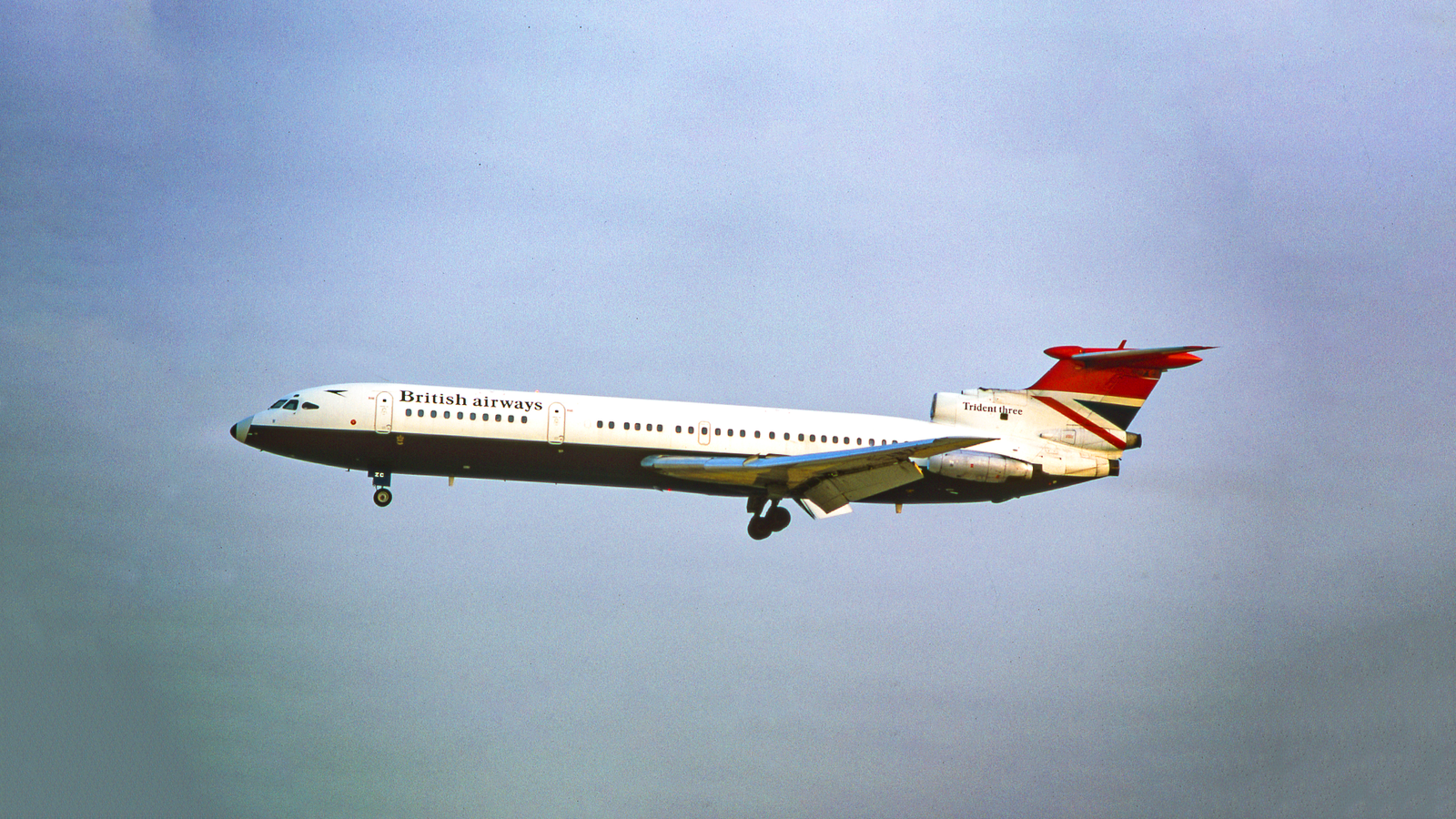
Published Sep 25, 2026, 6:00 PM EDT Airline and Airport Management Graduate, Student Commercial Pilot and Commercial Aviation Writer. Based in London & Nagoya Sign in to your Simple Flying account On January 9, 1962, the de Havilland DH.121, later renamed the Hawker Siddeley Trident, took to the air just under two years ahead of the Boeing 727. It may have arrived on the market earlier, but when manufacturing ended, Boeing had delivered 1,832 airframes while total Trident production stalled at just 117. Boeing built and commercialized the exact long-range trijet concept that British engineers were forced to abandon, leaving behind an oft-forgotten relic of the past. The commercial defeat was caused by a single mandate from state-owned British European Airways (BEA). Fearing overcapacity, the airline needed de Havilland to shrink passenger capacity from 111 seats to 97 and slash its total range from 2,070 mi (3,331 km) down to 930 mi (1,497 km). When American Airlines rejected this downsized airframe, it turned to Boeing to build a trijet matching the original British parameters that surpassed the Trident by a huge margin. Placing All Hope On One Order According to historical documentation from Century of Flight, the primary cause of the Trident's commercial failure was British European Airways instructing de Havilland to downsize the original DH.121 airframe. Fearing that European passenger growth would plateau during the 1960s, the state-owned carrier rejected the manufacturer's initial 111-seat design. This requirement forced de Havilland to tailor the trijet to a narrow domestic envelope, leading to immediate doubts among international airlines regarding the aircraft's global utility. Reporting from Fly Past Magazine highlights that this downsizing requirement led engineers to substitute larger planned engines with three smaller Rolls-Royce Spey turbofans, cutting maximum range from 2,070 mi (3,331 km) down to 930 mi (1,497 km). The commercial consequences were swift as American Airlines had shown strong interest in the initial, uncompromised DH.121 specification. When de Havilland presented the shrunk Trident 1 to American Airlines executives, the US carrier rejected the concept and opened discussions with Boeing instead. Hawker Siddeley had compromised an entire manufacturing program to hold on to an order from a single airline. By tailoring the trijet strictly to British European Airways' regional network, the manufacturer left the high-yield North American market entirely open to competitor exploitation, which is exactly what happened. Better In Every Metric? Boeing capitalized on Hawker Siddeley's misstep by consulting four major US airlines: American, Eastern, United, and Trans World Airlines, rather than catering to a single launch customer. Boeing engineers recognized that American Airlines needed a medium-range trijet capable of operating from short runways like LaGuardia Airport(LGA) while maintaining transcontinental reach. By incorporating feedback from multiple carriers, Boeing defined the Boeing 727-100around a spacious fuselage width shared with the Boeing 707, allowing six-abreast economy seating and an airframe that could scale across diverse route networks, as noted by Logistics Cluster. Boeing built the 727-100 with significantly higher takeoff weights and greater structural margins than the downsized Trident 1C. Where the British trijet was constrained to a maximum takeoff weight of 115,000 lb (52,163 kg) and a range of 930 mi (1,497 km), the Boeing 727-100 entered service with a maximum takeoff weight of 170,000 lb (77,110 kg) and a range exceeding 2,300 mi (3,701 km), as per Ready For Take-Off. This additional margin allowed American operators to fly full passenger loads across mountain ranges and hot southern climates without taking on significant weight penalties. Specification Metric Hawker Siddeley Trident 1C Boeing 727-100 Typical Passenger Capacity 97 seats 106–131 seats Maximum Takeoff Weight 115,000 lb (52,163 kg) 170,000 lb (77,110 kg) Maximum Range 930 mi (1,497 km) 2,300 mi (3,701 km) Engine Powerplants Three Rolls-Royce Spey RB.163 Three Pratt & Whitney JT8D-1 Takeoff Thrust Per Engine 9,850 lbf (43.8 kN) 14,000 lbf (62.3 kN) Despite the aerodynamic efficiency of the Trident's rear-engine layout, the aircraft was underpowered from its inception. The forced downscaling of the Rolls-Royce Spey engine left the Trident 1C with insufficient thrust for what operators needed, proving problematic in hot-and-high airfield departures. This power gap restricted export sales across North America, Africa, and the Middle East. It turned out that British European Airways' conservative specifications had created a permanent performance problem. Not Designed For Performance In daily fleet operations, the power disparity translated directly into runway performance constraints and payload penalties. Flight crews operating the Trident 1C under warm weather or elevated runway conditions were frequently forced to offload fuel or cargo to meet climb gradient requirements. Three Rolls-Royce Spey RB.163 engines generated a combined total of 29,550 lbf (131.4 kN) of thrust, leaving the aircraft severely underpowered compared to the Boeing 727-100, which produced 42,000 lbf (168.9 kN) of thrust from its trio of Pratt & Whitney JT8D-1 powerplants. On hot-and-high airfields across North America and Africa, the performance gap between the two engines became prohibitive for prospective export customers. United Airlines could comfortably dispatch a fully loaded Boeing 727-100 from high-altitude hubs with its 14,000 lbf (62.3 kN) JT8D-1 engines, whereas the Trident 1C required an excessively long takeoff roll that restricted operations out of warm climates, as per Simple Flying coverage. Even when Hawker Siddeley later upgraded the powerplant to the Spey RB.165, delivering 10,410 lbf (46.3 kN) of thrust for the Trident 1E, the airframe remained at a distinct disadvantage against the rapidly evolving JT8D series, which scaled to 15,500 lbf (69.0 kN) of thrust on later Boeing 727 variants. Simple Flying Quiz What Aircraft Type Are You? Five questions. One aircraft. Find out which plane best matches your personality. Start Quiz Question 1 of 5 How do you prefer to travel? Scenic and slow — the journey is the destination Quick and efficient — I just need to get there In total comfort, with plenty of space to breathe As fast as possible — every minute counts Next → Question 2 of 5 What's your ideal weekend away? A quiet drive to a countryside grass-strip airfield A city break on a no-frills, reliable carrier A first-class long-haul to somewhere spectacular A transatlantic dash — back home before dinner Next → Question 3 of 5 How do you handle a busy schedule? I take my time — rushing never helps I plan carefully and stick to the routine I delegate and travel in comfort while others handle it Every second counts — I'm always ahead of schedule Next → Question 4 of 5 What matters most to you on a long trip? Freedom to go wherever the wind takes me Reliability — it needs to run on time Comfort and space — I won't be cramped Getting there before everyone else Next → Question 5 of 5 How do others describe you? Free-spirited and independent Dependable and practical Ambitious and larger-than-life Bold, fast, and ahead of the curve See My Result → Your Result The Explorer Cessna 172 You value freedom, simplicity, and the joy of the journey itself. You're happiest when you're in control, taking life at your own pace and discovering the world one small airfield at a time. No crowds, no queues — just sky. Retake Quiz Your Result The Workhorse Boeing 737 Reliable, efficient, and always in demand. You get the job done without fuss, keeping things moving for everyone around you. You're the backbone of any operation — proven, dependable, and trusted the world over. Retake Quiz Your Result The Icon Airbus A380 You think big. More space, more comfort, more presence — you believe in doing things properly and on a grand scale. When you walk into a room, people notice. You're built for the long haul, and you do it in style. Retake Quiz Your Result The Pioneer Concorde Speed, ambition, and a refusal to accept limits define you. Every second counts, and you'd rather break the sound barrier than wait in line. You were ahead of your time — bold, brilliant, and utterly unforgettable. Retake Quiz While Boeing relied on raw thrust and versatile wing aerodynamics to dominate airfield performance, Hawker Siddeley focused its engineering budget on advanced flight automation. As noted by Key.Aero, British engineers prioritized solving European weather disruptions by developing automated approach systems rather than expanding short-field muscle. This decision established the Trident as a technological pioneer, but left airlines questioning whether ground-breaking avionics could compensate for basic airfield limitations. Revolutionary Features That No One Wanted Credit: Jacob Johnson | Simple Flying The divergent priorities of Hawker Siddeley and Boeing extended beyond engines into flight control automation and wing aerodynamics. To solve winter fog delays at London Heathrow Airport(LHR), de Havilland prioritized all-weather blind landing systems. Boeing instead directed engineering resources toward advanced high-lift devices capable of generating massive aerodynamic lift. This split created two distinct airframes: one was an automated trijet tailored for low-visibility European hubs, and the other, a rugged workhorse designed for constrained regional airports worldwide. According to BAE Systems, Hawker Siddeley equipped the Trident with the triplex Smiths Autoland system for fail-passive safety. This culminated on June 10, 1965, when a British European Airways Trident 1C performed the world's first commercial automatic blind landing from LHR to Paris-Le Bourget Airport(LBG). Conversely, Boeing fitted the 727 with triple-slotted trailing-edge flaps and leading-edge Krueger flaps, enabling operations from 5,000 ft (1,524 m) runways while the Trident 1C required over 6,000 ft (1,829 m). Autoland capability provided reliable service during European fog events, though international airlines viewed blind-landing systems as a secondary luxury. Most carriers prioritized short-field access and high payload margins over fog landing automation, leaving Hawker Siddeley with an airframe whose technological triumph could not overcome its basic size penalties. Could Not Recover Lost Ground When Hawker Siddeley attempted to recover lost ground by stretching the Trident, an underlying lack of engine thrust forced unusual mechanical compromises. According to Century of Flight, British European Airways realized by the late 1960s that its downsized Trident 1C lacked the passenger capacity needed for expanding European routes. The intermediate Trident 2E added range, but the airframe still lagged behind American rivals. To carry up to 180 passengers on the stretched Trident 3B, engineers lengthened the fuselage by 16 ft 5 in (5.0 m), only to discover its three main engines could not deliver sufficient takeoff thrust. Hawker Siddeley solved this power deficit by adding a fourth engine: a small Rolls-Royce RB.162 auxiliary booster in the tail, producing 5,250 lbf (~23 kN) of thrust solely for takeoff. By contrast, Boeing was able to make a clean 20 ft (6.1 m) stretch for the 727-200 using higher-thrust Pratt & Whitney JT8D variants. The result was clear: Boeing sold 1,261 units of the 727-200 alone, while total production for the Trident 3B stalled at just 28 airframes. The engineering compromise highlighted the compounding penalty of custom-sizing an airframe for a single airline. As per Aeroplane Magazine, China's CAAC acquired a fleet of Trident 2Es and 3Bs that flew into the mid-1990s, but the type never achieved broad global adoption. By the time British Airways retired its final Trident in 1985 due to noise rules, Boeing completely dominated the market. A Lesson For The Future The lopsided 1,832 to 117 production disparity between the Boeing 727 and the Hawker Siddeley Trident defined a change in strategy to how commercial airliners are conceived and developed. By allowing British European Airways to micromanage the DH.121 into a niche regional jet, de Havilland sacrificed the global appeal needed to sustain a major commercial manufacturing program. The collapse of the Trident demonstrated that tailoring an airframe to the isolated demands of a single state-owned flag carrier almost guarantees defeat against competitors designed for universal airline adoption. The painful lesson of the Trident pushed European governments and manufacturers to abandon isolated national projects in favor of unified, multi-national development. When Airbus was formed in 1970, its founding charter explicitly rejected single-customer dominance, establishing a collaborative framework that required input from a broad coalition of international airlines before locking in final airframe dimensions for the A300. The Trident showed that technological breakthroughs, even world-first innovations like automatic blind landing, cannot save an airframe hindered by payload and range penalties. Modern manufacturers are evaluating next-generation narrowbody architectures for the coming decades, showing just how far aircraft design has come since the 1960s. The legacy of the British trijet forms a part of this development because now, an aircraft must be built for the global market from day one, or risk being outsold by those that are.
The British Trijet That Beat Boeing's 727 To Market & Still Lost 1,832 To 117
Full Article
Original Source
Read the full article at Simpleflying →KhanList aggregates and links to publicly available news content. We do not host full articles from third-party sources. Always verify important information with original sources.