
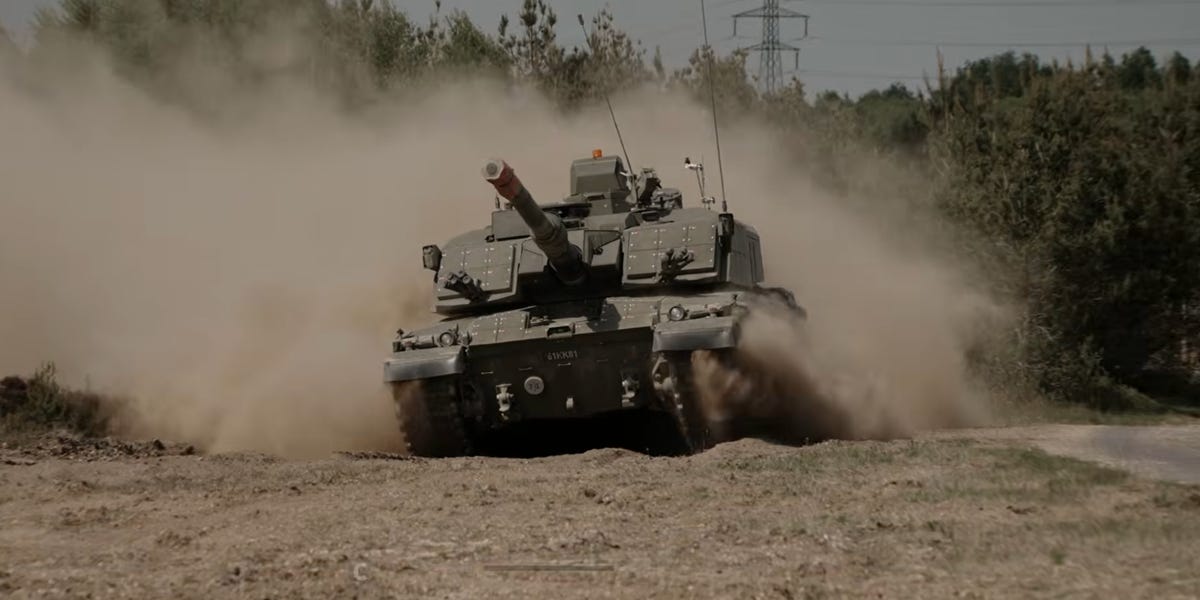
The British military is feeding a 'load of data' from the war in Ukraine into its next-gen Challenger 3 main battle tank The next-generation Challenger 3 tank is absorbing lessons from the war. Rheinmetall BAE Systems Land/Screengrab via YouTube As drones completely reshape how armored vehicles are used on the battlefield in Ukraine, the developers behind the British Army's next-generation tank are taking these lessons into account.Britain's Challenger 3 main battle tank is intended as a major upgrade over its predecessor, which is in service with both the British Army and the Ukrainian military. The new tank will feature a digital overhaul and new weaponry that make it more compatible with other NATO forces."We're taking a load of data from Ukraine" and feeding it into the Challenger 3 development, a UK defense ministry spokesperson told Business Insider at an exhibition near London last week.The tank has a smart targeting system built primarily for combating enemy armor, but it can be adapted to detect hostile drones, a major threat on the modern battlefield. For protection, the tank is equipped with explosive reactive armor.New features for the Challenger 3 are modular, meaning they can be swapped in and out, the spokesperson said, adding that Britain has options for drone-related equipment that can be installed as needed.British Army officers told Business Insider at the UK defense industry exhibition that the UK is learning lessons from Ukraine, not only for the development of the Challenger 3, but for armored vehicles in general, like how they can remain survivable on a modern battlefield.The officers emphasized that the version of the new Challenger 3 tank that exists today is not a finished product; the core platform will continue to be improved to keep pace with changes in modern warfare. The Challenger 3 is the successor to the decades-old Challenger 2. Rheinmetall BAE Systems Land/Screengrab via YouTube In 2021, the UK defense ministry awarded Rheinmetall BAE Systems Land a $1 billion contract to upgrade roughly 150 Challenger 2 tanks, which entered service with the British Army nearly three decades ago and have seen combat in the Middle East and Ukraine.The new upgraded tanks, designated as Challenger 3s, were designed as digital fighting vehicles with state-of-the-art targeting, fire-control, surveillance, and survivability systems. One of the biggest changes is the addition of a 120mm L55A1 smoothbore main gun that fires NATO-standard ammunition, replacing the Challenger 2's rifled gun that used ammunition unique to Britain. Other improvements include a redesigned turret, better thermal imaging, enhanced armor, and upgrades to the tank's engine, suspension, and other key systems.There are seven Challenger 3 prototypes, and an eighth is in production. The tanks have already completed their first crewed live-firing trials and are undergoing additional testing before expected delivery next year, which was pushed back from 2025.The Challenger 3 is at the center of what British Army officers and officials describe as the new "20-40-40" model, a layered approach to armor operations designed to protect high-value assets such as tanks and helicopters by relying more on cheaper drones and robots.The defense ministry spokesperson said this approach was taken directly from Ukraine, where cheap drones worth hundreds of dollars have been able to destroy armored vehicles that cost millions.The 20-40-40 model underscores that while the war in Ukraine has raised questions about the utility of tanks and other armored vehicles on modern battlefields, British military leaders still see them as a core part of their strategy. Read next Jake Epstein is a defense correspondent in London for Business Insider, covering the US military, NATO, and European security, as well as emerging tech in warfare.Jake has filed stories from conflict zones in Ukraine and the Middle East, where he embedded with a US aircraft carrier on a combat mission in the Red Sea. Jake has reported extensively on NATO operations and activities across Europe, including from aboard one of its AWACS surveillance aircraft along the Russian border, a British Voyager tanker refueling fighter jets over the Baltic Sea, and a Dutch helicopter flying to a warship in the Arctic. Ukraine
The British military is feeding a 'load of data' from the war in Ukraine into its next-gen Challenger 3 main battle tank
Full Article
Original Source
Read the full article at Businessinsider →KhanList aggregates and links to publicly available news content. We do not host full articles from third-party sources. Always verify important information with original sources.