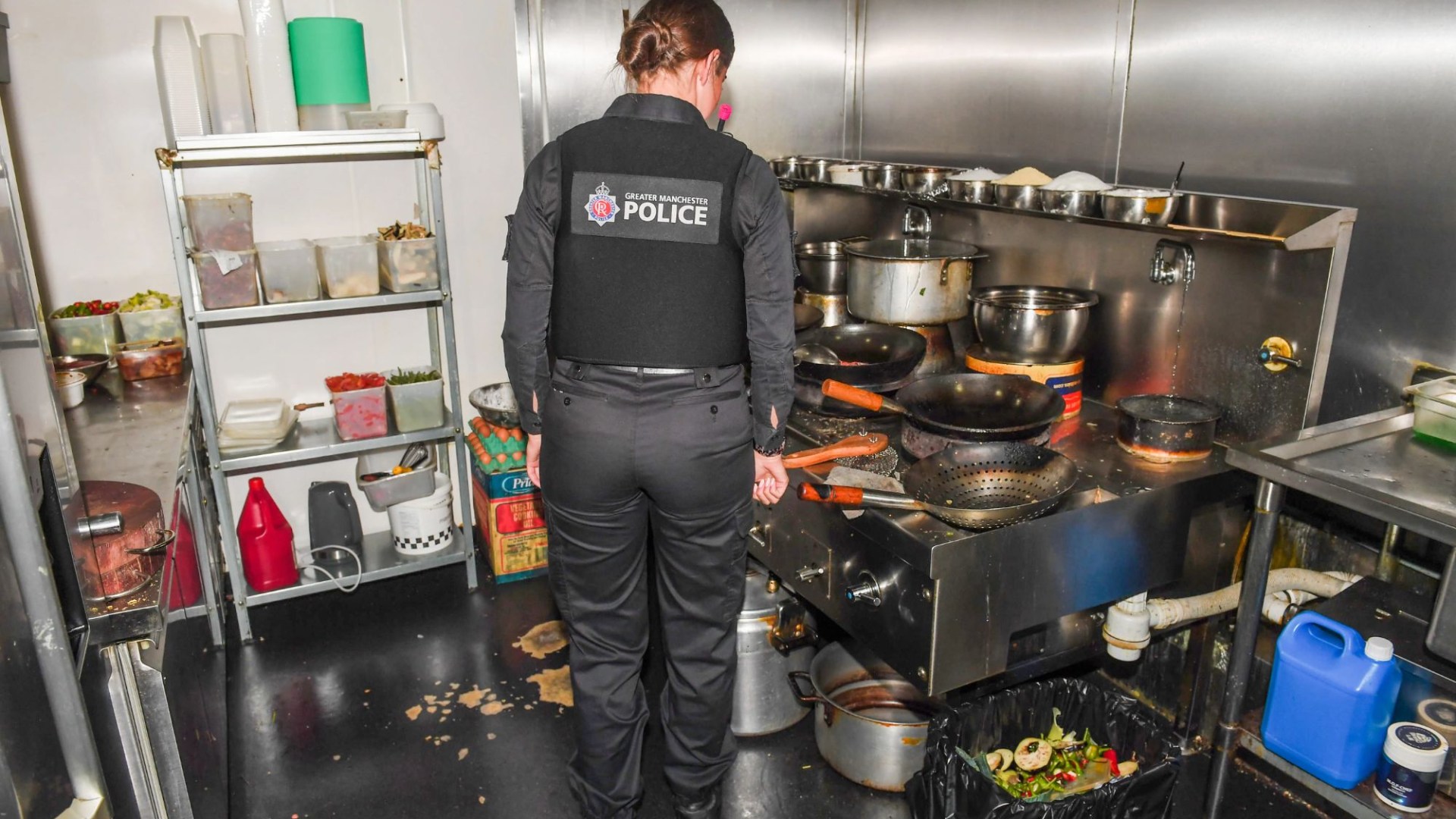
THE stench of rotting meat fills the air in a kitchen where blood-covered rags lie on top of dirty unit tops and swarms of flies buzz around bags of uncovered raw chicken. Staff, some of whom are believed to be working illegally, bustle through the hazardous kitchen, preparing food for delivery to customers who have no idea where, or under what conditions, their dinner is made. Greater Manchester Police inspect a dirty kitchen operation with food spillages Credit: Andy Kelvin / Kelvinmedia It is one of the growing number of “ghost kitchens” across the country that prepare food for unsuspecting customers via Deliveroo. Instead of being located in restaurants or High Street takeaways, they are based in faceless buildings, tucked away from sight within warehouses or office buildings. According to a study, one in seven major delivery app meals are prepared in ghost kitchens and even big-name chain restaurants have been known to sublet to them to slash costs and meet demand. Some ghost kitchens use exploited workers and others have never been given a hygiene rating from local authorities. Those that receive bad ratings can simply shut their doors and reopen under a different name. The Sun witnessed it first hand when we joined Greater Manchester Police to raid a Chinese food hub, called Fooduo in the Higher Ardwick area, following a tip-off that they were employing illegal workers. There, in a hot, windowless room, some staff were believed to be working without the correct visas. Although the owner, who has operated Fooduo Ltd for three years, claimed the staff were in fact just “friends,” the officers in charge did not believe him. After one chef was fingerprinted he said: “This man is my friend. He is not working, he’s just helping out.” PC Francesca Hooley, who led the raid, said: “We visited a ghost kitchen where we believed a man was working illegally. The man lacked the documentation necessary in the UK and was seen undertaking tasks in the kitchen area. “Meat was also left in bags in the hallway rather than being sealed and stored at the correct temperature in hygienic conditions. The man was referred to Immigration Enforcement officers and the establishment reported to health and safety officers.” Last year Fooduo was given the lowest hygiene rating of “1”, which means “major improvement is necessary,” but on Deliveroo the takeaway has a 4.7 rating from unaware customers, with one saying: “Amazing authentic Chinese food. Really tasty and big portions.” Another says: “Every time food from here is ten out of ten. I can’t get enough of it.” The police take fingerprints of a suspected illegal immigrant duringthe raid Credit: Andy Kelvin / Kelvinmedia Raw chicken was stored in hallway Credit: Andy Kelvin / Kelvinmedia Since the raid it has improved its hygiene rating, but Dr Babis Giousmpasoglou, a Hospitality Management expert at Bournemouth University, who has researched these operations, says many kitchens like this are “terrifying”. He said: “As a consumer you don’t know where your food is coming from. You might order from a restaurant because it has top ratings, but if it’s been subcontracted to a ghost kitchen, you have no way of knowing the standards. Many won’t have been inspected. “If you have someone who is more concerned with pushing costs down, they might ‘forget’ to comply with hygiene standards, or ‘forget’ to pay minimum wages. And because they are hidden from view, it’s easier to get away with it.” Fooduo operates alongside 32 other ghost kitchens in a building, which sits on a road full of packaging and furniture companies, delivery depots and MoT garages. These kitchens can cater for up to five different virtual restaurants and serve food ranging from Chinese and sushi to burgers and Cajun meals. Some have a hygiene rating of just one despite a 4.8 rating on Google Reviews. Others have a hygiene rating of two, which means they require improvement. Some have never been inspected, though many meet all required standards. This pattern spreads across the country, with similar hubs found in London, Leeds, Bradford and Bristol. A new landmark study by the University of Sheffield has now established a definition for these kitchens, which first started operating in 2019 and are also known as “dark”, “cloud” or “virtual” kitchens. In 2020 there were 750 ghost kitchens in the UK, according to market data company Statista, but experts believe there are many more today because so many fly under the radar. Dr Jordan Beaumont, a registered nutritionist at Sheffield Hallam University, who has also researched ghost kitchens, says the risk to allergy sufferers is high. He said: “If you’ve got a massive kitchen that has 30 different businesses running out of it, there are all sorts of problems that can arise. “They will be preparing different kinds of foods, and if they do have poor hygiene and they are not following requirements for allergens, that could cause serious problems.” Dr Jordan says many ghost kitchen owners will be doing their best to follow rules and regulations, but some rogue operators are not. In research by the University of Lancashire, one environmental health officer admits they cannot be certain how many kitchens are operating like this. Rats filmed outside a London ghost kitchen Credit: YouTube/@London Eats One in seven Deliveroo meals are made in ghost kitchens Credit: Getty But videos on social media, filmed by delivery drivers, show ghost kitchens in London with rats running around. One Deliveroo rider based in the capital told The Sun: “I’ve picked up from lots of ghost kitchens. “The number in use has sharply increased around London and major cities in recent years. “The big industrial ones are purpose-built, clean and professional. “Where it’s more dodgy is the one-off independent places, especially those doing sushi. You don’t need much for a sushi kitchen — just a fridge and a prep area — and several busy kitchens can run out of the basement of a corner shop. “Sushi does really well on these apps because it’s popular but also high margin, and it’s also zero per cent VAT. Delivery apps have done a bit of a job to try to clean this up but there are still lots out there” Modern slavery charity Unseen warns that ghost kitchens create ideal environments for human exploitation because of the way they operate. Their head of policy and research, Hilary Agg, said: “When it comes to ghost kitchens, they may be particularly appealing to exploiters because they allow victims to be even more invisible in the communities that they’re living in. Modern slavery is an economic crime – it’s all about making a larger profit. “Ghost kitchens are often operating out of semi-industrial sites, buildings with no footfall and few windows into the outside world, so they are essentially hidden from view. “Then inside it would be really easy for exploiters to subject their workers to physical and mental abuse. Few people are going to notice that staff, for example, are working around the clock, seven days a week with no breaks.” Deliveroo was approached for comment. The Sun understands it requires all providers on the platform to meet FSA standards and any business found to be in breach of modern slavery laws will be removed from their site.
The British ghost kitchens’ which could be making YOUR takeaways with illegal slave workers & piles of rotting meat
Full Article
Original Source
Read the full article at Thesun →KhanList aggregates and links to publicly available news content. We do not host full articles from third-party sources. Always verify important information with original sources.