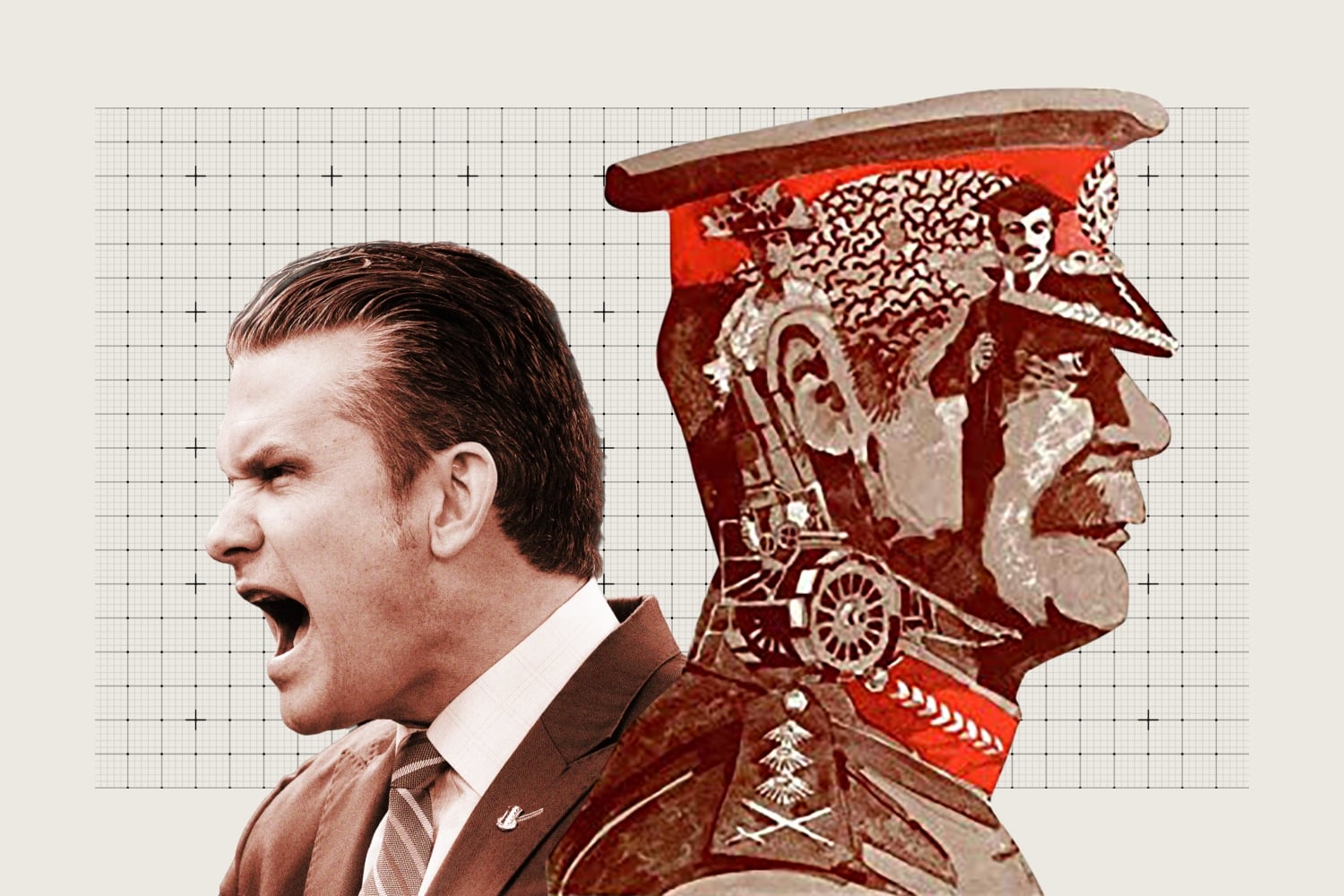
This year marks the 50th anniversary of the publication of a very British book seeking to make sense of what seemed at the time a very British problem. Half a century later, however, it turns out it was about Pete Hegseth all along. On the Psychology of Military Incompetence, by British psychologist Norman F. Dixon, has long been considered a must-read, even within U.S. military circles that relentlessly cull their own reading lists. Dixon sought to answer a question that had long bedeviled the British military, most especially in the wake of World War I: Why are lions always seemingly led by donkeys? Dixon had plenty of material to work with for his case studies, which make up the first part of the book. The series of military disasters that befell the British Army—and even occasionally the Royal Navy—began with a pair of catastrophic 19th century forays into Afghanistan, continued with a ham-fisted nightmare in the Crimean War, somehow got worse in an unequal battle with the Boers, and then culminated in the bloody mud flats of Passchendaele. World War II had its awful moments as well, especially at the beginning (the surrender of Singapore in early 1942 while heavily outnumbering the Japanese invasion forces remains Britain’s worst defeat) but also near the end, when the British Army attempted a paradrop push combined with an armored thrust into the Netherlands that proved to be a “bridge too far.” The front cover of a book titled "On the Psychology of Military Incompetence" by Norman F. Dixon. The cover illustration features a profile silhouette of a military officer wearing a red and black peaked cap, overlaid with intricate illustrations of soldiers, military vehicles, and historical figures. On the Psychology of Military Incompetence, Norman F. Dixon, Basic Books, 528 pp., $22.99, first ed. 1976 Dixon’s book reaches back to the middle of the 19th century and is thoroughly grounded in antiquated British military and civilian mores (Dixon places much of the blame on Victorian public school traumas and codes of behavior) and somewhat archaic psychology. There’s a lot on mommy issues and other Freudian cliches of the time. Yet, it is impossible to read the book today without thinking of the self-proclaimed U.S. “secretary of war” and his hapless efforts to root out “beardos,” do a pull-up, or subdue a third-rate country with history’s most awesome military at his disposal. Dixon rules out pure stupidity as a root cause for most of the explanation of the continued incompetence. Many of his case studies focus on general officers who were either academic high achievers, such as Douglas Haig, the commander of British forces for most of World War I, or at least reasonably free from intellectual defects. Instead, Dixon, who spent 10 years in the army, including service as a combat engineer in World War II, seeks an answer in deeper waters: a particular mindset attracted to institutions such as the military, which then exacerbate by design the very tendencies that will tend to undermine military competence. By and large, the (British) military shunned innovation; prized physical prowess and sporting achievements over book smarts (“lethal warrior” mentality); cherished tradition, spit-and-polish, regulations, and petty rules that all come under what Dixon defines as “bullshit.” Soldiers that had those traits to a great degree naturally advanced to higher ranks, eventually the highest, precisely to positions where those characteristics were either useless or catastrophic. Another characteristic Dixon found in decades of military dysfunction was an ingrained fear of “effeminacy,” producing a combination of homophobia and misogyny that translated into a crusade against anything feminine, especially women potentially doing military jobs previously done only by men. “Anti-effeminacy” even extended to battlefield behavior, Dixon suggests, including a previous disdain for taking cover, wearing protective gear, or even running protective convoys to shepherd merchant shipping during wartime. Other constant characteristics among incompetent senior military leaders were an inability to suffer criticism of any sort, and a predilection for picking subordinates whose loyalty far outweighed any particular competence. Most of Dixon’s book focuses on generals, with a few admirals and air marshals thrown in for leavening. There have been plenty of similar examples in the United States, such as the self-obsessed and pusillanimous George McClellan in the U.S. Civil War, or the disastrous disorganization of Lloyd Fredendall at Kasserine Pass in North Africa in World War II. Yet traditionally, U.S. failure has been marked more by chaotic arrogance than spit-and-polish obsessions. Pete Hegseth is not a general. He topped out as a major in the National Guard, after serving tours in Iraq and Afghanistan, but he has managed to carry his junior officer’s mindset into the office of the secretary of defense in a way that clearly echoes much of what Dixon lamented about wartime leadership in the British military. A man in a blue suit stands with his back to the camera, pulling open his jacket open to show his chest toward a group of about two dozen smiling military personnel in camouflage uniforms who are cheering with their hands raised. U.S. National Guard troops react as Secretary of War Pete Hegseth opens his suit jacket to show the U.S. flag lining following a reenlistment ceremony in Washington on Feb. 6. Chip Somodevilla/Getty Images Take Dixon’s euphemistic “bull,” the bane of button-polishing, parade-ground existence, even if it has a role in fostering discipline, uniformity, and an esprit de corps. “The phenomenon involves ritualistic observance of the dominance-submission relationships of the military hierarchy, extreme orderliness and a preoccupation with outward appearances,” Dixon notes. Hegseth summoned every single senior U.S. military commander from around the world to listen in person to a harangue on the evils of fat soldiers, long hair, and beards. He posts videos of himself attempting to do physical training, unusual for any secretary of defense, who presumably has broader strategic questions to worry about. But then—he was picked for the job by President Donald Trump because Hegseth was straight out of “central casting.” When it comes to prickly skin, Hegseth ticks all of Dixon’s boxes. Earlier in the ongoing war with Iran, Hegseth chided the press as “unpatriotic” for reporting objectively on the war. Likewise, in late July, Hegseth melted down when some lawmakers pointed out that the U.S. failure in the war was ultimately his responsibility. Like Dixon’s incompetents, who shunned publicity of any sort, Hegseth’s Pentagon not only purged the professional press corps and banished it from the building, but rewrites casualty totals on a whim and hasn’t held a press briefing during wartime for nearly three months. Dixon’s belief that fears about masculinity drive some senior leaders’ behavior finds expression both in “bull” and in personnel and force structure decisions. Dixon cites “[t]he importance attached to such outward signs of sex-role identification as hair-length,” and a “deeply rooted prejudice toward women who try to adopt traditionally male roles.” One doesn’t have to look far to find Hegseth mandating testosterone tests (and possible injections) for U.S. “warfighters,” or a systematic bias against the promotion of female officers or the expansion of female combat troops. Two female military service members in camouflage uniforms stand outdoors; one talks with her hand resting near her hair while the other holds a large firearm upright and looks off to the side with a serious expression. U.S. Army soldiers prepare to go on a mission during the Iraq War, seen in Ramadi, west of Baghdad, on Oct. 25, 2004.Patrick Baz/AFP via Getty Images Finally, there is an “authoritarian” mindset, in Dixon’s words, that necessarily defines much of the military hierarchy, but which finds unfortunate expression in a rigidity of thought. “Authoritarians will be less likely to understand enemy intentions,” Dixon wrote, as well as have a tendency to underestimate the enemy’s ability. He was thinking of the disastrous Allied battle plan in the spring of 1940, but today it reads as if he was writing about the Pentagon’s failure to prepare for Iran’s closure of the Strait of Hormuz, despite the scenario being war-gamed out for decades beforehand. Authoritarians are also less likely to embrace technical innovations. More than four years after the Ukraine war has shown the need to reconfigure combat forces for the drone era, the United States still lags behind a middling and war-beset European country by miles in terms of drone output. Part of that is due to Hegseth’s boss: Trump spurned Ukraine’s offer of drone assistance earlier this year during the initial phases of the Iran war. Trump is consistent in his disdain for technological advances in the military: For years he has begged for the return of old steam-powered catapults for U.S. aircraft carriers, and forced the Pentagon to allocate billions of dollars for the future construction of a Trump-class “battleship.” Dixon’s book is dated, both in its martial case studies and much of its science. Even the notion that Britain’s generals were “donkeys,” especially in World War I, has given way to more recent scholarship suggesting a nearly competent class of officers struggling with a whole new way of war. Yet it is still a fascinating glimpse at why the very things that make the military work most of the time tend to act against best performance at the most crucial of times. Creativity, openness to new ideas and dissent, overcoming petty conventions and regulations, promoting the best and brightest, and embracing the unconventional are among the traits Dixon identified in successful commanders. Those are qualities that the U.S. military has sometimes sought—but under Hegseth, it’s far more important to be white, male, and clean-shaven.
The Book That Predicted Pete Hegseth’s Failures
Full Article
Original Source
Read the full article at Foreignpolicy →KhanList aggregates and links to publicly available news content. We do not host full articles from third-party sources. Always verify important information with original sources.