
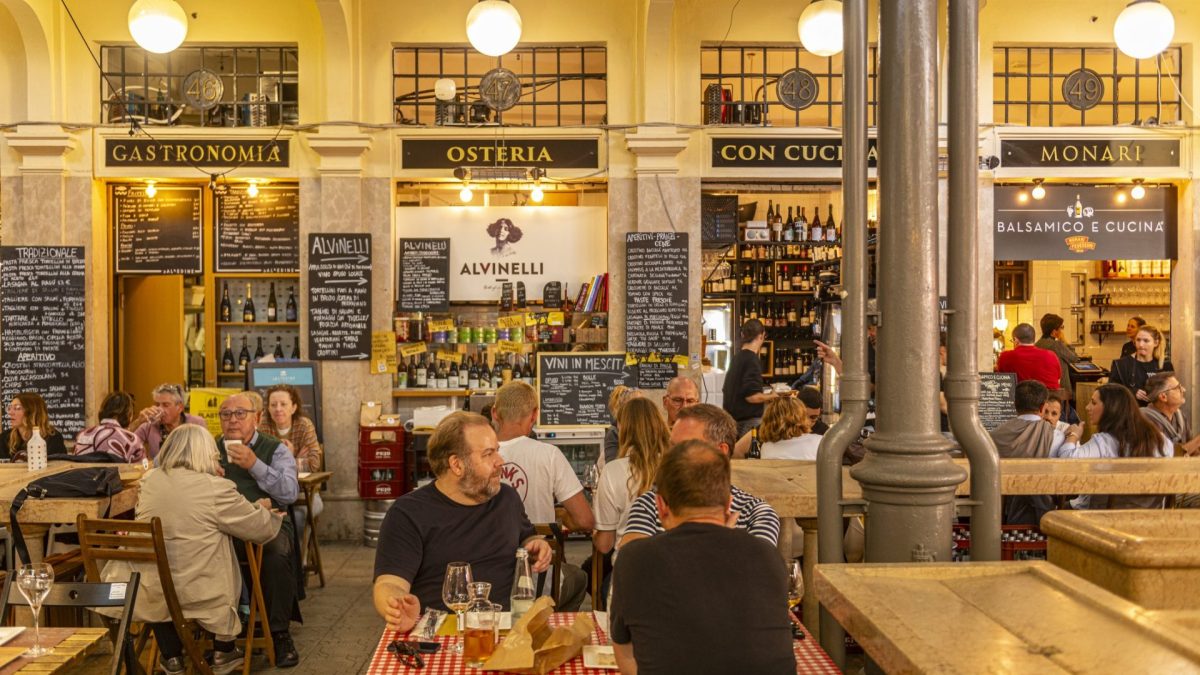
For international visitors, if Modena rings a bell, it tends to be for one reason: balsamic vinegar. The city is just 40 kilometres from Italy’s gastronomic capital, Bologna, but it has an enviable food scene of its own, and liquid “black gold” is its culinary calling card. Yet, the cuisine isn’t the only reason to bypass Bologna in favour of its neighbour to the northwest. You’ll find much smaller crowds in Modena, which, at about half the size of Bologna, attracted 403,070 tourists in 2025 – a modest figure compared to latter’s more than two million. And the tourist tax for a four-star hotel in the smaller city is €4 per person per night, compared with up to €7 in Bologna, where the rate varies according to the price of the room. What Modena lacks in size, it more than makes up for in heritage. Cutting diagonally across the city, Via Emilia is a Roman-era road lined with quaint boutiques and speciality food shops. Sprawling out from Via Emilia, the historic district is dotted with old buildings, painted in warm ochre and brick-red tones. A vibrant but unchaotic place, Modena is well cared for, with residents who appreciate visitors eager to learn more about their town. Shorts Joining the locals moving unhurriedly beneath elegant porticoes, I stroll over to Galleria Estense, which houses the art collection of one of the most prominent and longest-lived noble dynasties in the country: the Dukes of Este. One of Italy’s oldest and most significant galleries, Galleria Estense holds a remarkable collection of art, ceramics and musical instruments. The white walls are hung with paintings from the 14th to 18th centuries, including works by artists such as Correggio, Tintoretto and Velázquez. Unesco-listed Piazza Grande, with the cathedral on the left and Palazzo Comunale on the right (Photo: gionnixxx/Getty/iStock) In the heart of the city, a Unesco World Heritage Site encompasses four local landmarks. One is Piazza Grande, the city’s cobbled main square, whose eastern side is dominated by Palazzo Comunale. This 17th-century complex (also recognised by Unesco), formed by the unification of around 12 different medieval buildings, is defined by an elegant, arcaded facade. On the piazza’s north side is the Duomo di Modena, the cathedral, whose stone facade, like a book, depicts stories from Genesis for the benefit of illiterate worshippers. As I walk through the side entrance, my guide Elena points out the archivolt representing King Arthur – a feature that suggests pilgrims travelling from Canterbury may have brought myths and folklore with them. Torre Ghirlandina – the cathedral’s belltower – is the fourth element of the heritage site, and after climbing its 200 steps, I’m rewarded with views over the city. Inside the crypt interior of Modena’s Romanesque cathedral (Photo: Smartshots International/Getty/Moment RF) We leave Piazza Grande and head for Albinelli Market, passing the barbershop where Modena-born Enzo Ferrari was a regular, and a statue of fellow local legend Luciano Pavarotti, outside the city’s main opera house. Established in 1931, Albinelli Market is the oldest covered market in the city, showcasing produce from across the surrounding Emilia-Romagna region. Housed in an iron-and-glass Liberty-style (Italian art nouveau) building, it’s a feast for the eyes, with colourful displays of fresh ingredients and local dishes. It’s a place where personal connections thrive, and vendors not only advise customers on what to buy but on how to cook the produce once they get it home. “Massimo Bottura was spotted here, buying ingredients for his restaurant,” Elena tells me. The celebrated chef’s three-Michelin-starred Osteria Francescana is located in Modena’s historic centre. Albinelli market is laden with produce from across the Emilia-Romagna region (Photo: ivotheeditors/Getty/iStock) Deciding to take lunch in the market, I find myself spoiled for choice among the inviting stalls serving everything from fresh filled pasta and regional cheese to salumi and fish. I settle on a tasty pumpkin-filled tortelloni with butter, sage and amaretto at Monari-Federzoni, a small restaurant inside the market, which produces its own balsamic vinegar. Walking around nearby Piazza Mazzini afterwards, Gelateria Bloom catches my eye and I can’t resist trying custard gelato drizzled with DOP-protected “traditional balsamic vinegar”. Thick and syrupy, this is the variety known as the “black gold of Modena”, and it adds a sweet-sour contrast to the gelato. Beyond food, Emilia-Romagna is known as Italy’s Motor Valley, and Modena’s Enzo Ferrari Museum is dedicated to his life and work. Engines are exhibited as sculptural machines inside the house where Ferrari himself was born in 1898, while in the modern, yellow bonnet-shaped gallery, vehicles on modular pedestals resemble art pieces. Even for someone like me, who knows little about cars, the exhibition provides an interesting insight into vehicles I’ll never be able to afford. Later, I head to La Vacchetta Grassa, a historic artisan’s workshop filled with the scent of leather. Here, guided by an expert craftsman, I attempt to fold that leather into the shape of a tortellino, which, according to legend, was inspired by Venus’s navel. Eventually, I manage to create something I’m proud of, joining the ends of my creation, which is then tied to my keyring with strong twine. Now, when I see it hanging off my keys, it serves as a reminder both of Modena’s cuisine and the craftsmanship to be found there. How to get there Ryanair and British Airways fly from the UK to Bologna, a half-hour train ride from Modena. Where to stay Hotel Cervetta 5 is a three-star hotel in the city centre with doubles from €130 in summer.
The Bologna alternative with beautiful architecture, great food and no crowds
Full Article
Original Source
Read the full article at Inews →KhanList aggregates and links to publicly available news content. We do not host full articles from third-party sources. Always verify important information with original sources.