
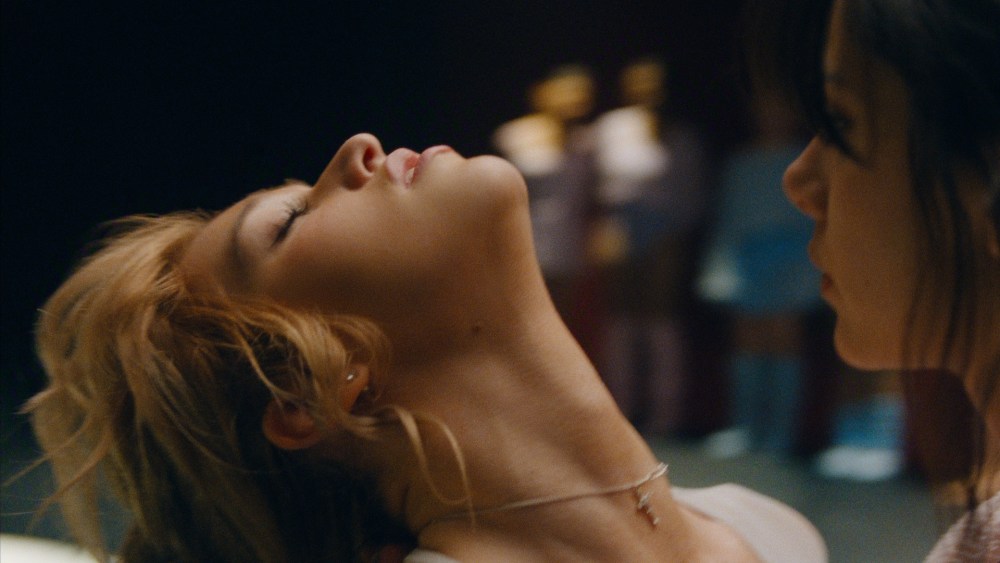
‘The Body’ Creator on the Dance Team’s Sexuality, What Happened to Grace and Whether God Is Real Courtesy of Netflix SPOILER ALERT: This story contains spoilers for “The Body,” now streaming on Netflix. If you’re looking for clear answers about whether or not God is real in the world of “The Body” — Netflix’s spooky new drama series about mass hysteria originating from a Catholic school dance team — you’re not going to find them. “If we ever fully defined it, it would break the rule of the show,” says creator Quinn Shephard. “The show is meant to mimic faith, so there’s people who believe, there’s people who don’t and there’s people in the middle, like me, who are like, ‘I don’t know.’” But regardless of whether it’s the big man upstairs or just some devious teenage girls pulling the strings, “The Body” has a lot to say about faith and its role in the lives of young and sometimes queer girls. Shephard is a proud lesbian who was raised in the church and has stepped away from it without fully rejecting it, and the show’s up-and-down relationship with God is a product of that. At the beginning of “The Body,” a devout Catholic named Grace (Sofia Wylie) is the clear standout at dance team tryouts, much to the chagrin of some of the team’s more senior members, who roll their eyes at her rule-following innocence. Thus, she’s put through a bit of hazing: At a Halloween party at an abandoned convent, she’s pressured to take Ecstasy by Elise (Sara Boustany), the team’s co-captain and resident badass, as everyone jokingly perform a ritual meant to sacrifice her soul to the devil. But the devil doesn’t seem to know that they’re joking. Anya (Kristina Bogic), who is Elise’s co-captain and the most popular girl in school, notices that Grace has wandered off alone. Alongside Lisbeth (Geena Meszaros), an awkward new girl who got rejected from the team in favor of Grace, she finds Grace on the ground, convulsing until she passes out. Anya and Lisbeth decide to take her to a hospital, but on the way, Grace appears to die. Because Anya supplied the Ecstasy, she’s terrified she’ll get in trouble. Lisbeth sees this as her way onto the dance team and into Anya’s good graces, and takes charge. They take Grace’s body back to her own house and tuck her into bed, then use Grace’s phone to text a friend that she got home safe, giving themselves plausible deniability. But at the end of the first episode, Grace takes a breath. She doesn’t wake all the way up, though, and spends the rest of the season in a coma as the dance team is wracked with guilt about the Ecstasy, which they don’t confess about. Needing support from the only other person who knows what happened, Anya brings Lisbeth onto the dance team to take Grace’s place, which intensifies the conflict between Anya and Elise. The two best friends are clearly in love with each other, and had been fooling around sexually at the party, but Anya insists that she’s straight and loyal to her boyfriend, Steven (Orlando Norman). Frustrated by Anya’s new closeness to Lisbeth, and with latent suspicion about Anya’s role in what happened to Grace, Elise fakes a spiritual experience, shrieking in front of the whole school that she’s having a vision of Grace. But everyone on the team — except Anya and Lisbeth, of course — buys into it. One by one, they begin faking their own visions. Soon, the whole town starts to believe that Grace is all-powerful, chosen by God to perform healing miracles from her apparent deathbed. People gather on her family’s lawn to worship her. Left to right: Kyra Pierce as Bailey, Sarah Abbot as Olivia, Michela Luci as Amy, Kristina Bogic as Anya, Shirley Chen as Maddie Courtesy of Netflix Lisbeth is delighted, using her relationship with Anya to increase her social standing at school and to protect her brother, Leo (Jackson Kelly), who at one point drew suspicion because of his crush on (and lewd drawings of) Grace. But eventually, Elise pieces together the truth, forcing Anya to confess to Father Franklin (Nnamdi Asomugha), the school principal and pastor. At that exact moment, though, Grace finally wakes up. Weakly, she whispers, “I’m God.” Shepherd spoke with Variety about Catholicism, lesbian camp and who-slash-what God is. Anya and Elise’s relationship feels lived-in and very unique — there’s not a lot of media set in the early aughts that depicts queer teens. How did you approach their hot-and-cold friendship and romance? Were you pulling from anything in particular? I definitely put so much of myself into those two characters, and also some of my close friends who let me use their stories. I do find the era really interesting, because it wasn’t like being gay was illegal, or like you’re guaranteed to get disowned, but it was definitely not good. And it felt like the biggest threat was to your femininity, and your social standing as normal or cool. I didn’t go to high school in 2004; I was in high school a little later than that. But pre-smartphones and pre-gay marriage being legalized, that was a very specific era. Being lesbian felt like a bit. I remember my friends and I doing so many bits where we’d “pretend” to be gay for each other. It’s not that it wasn’t being talked about; it’s that it wasn’t cool. I was like, “I can’t be gay.” This is going to sound so bad, but I think I thought I had to be butch. I didn’t want to, like, get a short haircut and start wearing rainbow knee socks. For Anya, that’s her worst fear. She’s not ready. She’s quite high femme, and on the top of the social hierarchy, and she’s like, “Oh my God. Not only am I going to threaten that, but I have to give up on all these ideas of what my life is going to be? Are people going to act differently around me in the locker room? Am I going to lose my girlhood? Am I going to lose my status?” And we talked a lot in the room about how much Catholicism plays into Anya’s fears — it is a fear that she’s going to go to hell, but it’s not the main fear. Certainly, a piece of her shame comes from Catholicism, but I think it’s more interesting and more relatable to more people that she’s equally afraid, if not more afraid, that she’s just gonna lose her identity. Because of that, even though she also has a lot of kindness to her, she does a lot of really fucked up things. I wanted to make a very unsanitized, messy first queer love story. I was seeing too many shows where the characters are gay and it’s totally fine and no one has a problem with it. Like, there’s the parent who’s a little homophobic, and then there’s one conversation where they’re like, “Actually, I love you, honey.” No. It’s messy as hell. And you do some crazy stuff that you look back on, like, “Why did I do that?” I really wanted to give that to Anya and Elise. Sara Boustany as Elise, Kristina Bogic as Anya Courtesy of Netflix Tell me about queerness as it exists — if it exists — elsewhere on the dance team. With Lisbeth, for example, it’s never totally clear whether she has any latent attraction to Anya. I like to joke that with the amount of queer women involved in making the show, the core ethos and tone is so inherently like lesbian camp and a lesbian sense of humor. That even applies to the fact that there’s a lot of really lovable men in the story. The men are kind of innocent, and that’s from a lot of the women working on the show being like, “With the men that I dated, it wasn’t their fault that I wasn’t into them. It was me and my journey, and God, what I put that guy through!” Everyone in the show is linked to that twisted sense of humor and trying to turn shame and trauma into comedy. But we’ve got stuff to play with in Season 2 in terms of queer characters. I actually really like that people have debates about Lisbeth. Because to make her relationship with Anya about sexuality would almost be too simple. I think it’s way bigger than that. Lisbeth’s character isn’t driven by sexuality, almost at all. She’s more driven by survival. She’s a child of trauma, and she’s got some slightly asexual and sociopathic tendencies coming out, but I don’t think that’s necessarily who she is forever. It’s more that that’s where we meet her, because she’s in survival mode. Like Anya, she does things that feel a bit evil, but she’s also really charming, and it’s clear how her past drove her to make these decisions. She always keeps calm because she has to, but what’s her internal monologue saying as she’s trying to control this secret she and Anya have about Grace? Is she secretly freaking out? I love Lisbeth. I don’t think she’s inherently bad. I just think she’s opportunistic in the first season, and too smart for her own good. It’s almost frustrating to her how ahead of other people her brain is. She’s definitely a bit on the spectrum. She struggles with social cues, but she’s brilliant, and she can’t help but see opportunities and strategies. For me, the lovable part of her is that she can strategize a takeover. She can play three-dimensional chess. She is starting mass hysteria to protect her brother and gain access to the dance team. But at the end of the day, she doesn’t know how to act like a normal high-school girl at a party. She can’t do it. She tries so hard, and she literally studies it like gospel, but she can’t get there, and I think that’s so human. Sometimes it feels like there’s a way to study something and get there, but you can’t because that’s not how life works. And she had such a profound relationship with religion when she was younger that she lost. It’s like she’s searching for something that profound again, and when she finds it, she’s literally not going to be stopped. She’s a dog with a bone. If she wants to be on that dance team, she’s getting on that dance team no matter what, even if she has to hide a body. She’s getting there. Geena Meszaros as Lisbeth Courtesy of Netflix Outside of the question of her sexuality, how does she feel about Anya? Is Anya just a pathway to popularity, or does she have any genuine love for her as a friend? I think it’s both. It changes. There are scenes where she’s like, “I’m so enamored with this girl. I wish I could be just like her. I don’t know if I want to be with her, be like her, be around her or be inside her skin. I don’t know. I’m just obsessed.” And then there’s other times where she’s like, “This girl is on my nerves.” It’s very hard for Lisbeth when Anya is like, “Why are you not freaking out?” And she’s like, “I am, but this is how I freak out.” She doesn’t understand Anya, but there are moments, like when she sees that Anya’s working on her dance team jacket, and Anya’s letting her into her closet, that’s like the happiest day of Lisbeth’s life. She’s like, “I finally have a friend, and I’m so happy.” Does she have some ulterior motives? Yeah. But there’s also a really wholesome motive in there too. She wants a friend. What went into the writing of Maddie (Shirley Chen)? For much of the season, she’s the only one being truthful about the fact that she isn’t seeing visions of Grace. When she does become a Grace worshiper at the end, has she genuinely convinced herself she sees her? Or is she lying too? Maddie’s quite an earnest character. I don’t feel like she’s ever purposefully deceiving. She really struggles with the lies that the girls are telling. One of the writers, Lily Houghton, told a story about how she lost both her parents. They were very beloved, and so many people came up to her, like, “Your dad came to me in a dream. I saw your mom yesterday, and she came with messages.” And she got to the point where she was like, “I don’t want to hear people’s stories about my parents visiting them, because if they’re going to visit someone, why would they not visit me?” And it was such a personal, vivid story. We were all so moved. It’s so human to still feel like a kid, like, “I feel like it would be me,” and also the bigger picture of people claiming someone else’s loss. So we baked a lot of that into Maddie’s desire to see Grace, and I would say she ends the show believing. And that gets validated, because she’s the one who says that when everyone confesses, that’s when Grace is going to wake up, and then that happens. She’s going to be telling anyone who will listen that she got a prophecy. I think she’s like,”My best friend is God, and it’s cool.” Shirley Chen as Maddie Courtesy of Netflix Can you answer whether the show believes in the supernatural? And does it believe in God? The rule that we have internally is that the show’s perspective on the supernatural needs to mimic a relationship with faith. So you can choose how you want to view the events that are presented. For every supernatural theory, there needs to be a countertheory, and the audience needs to be empowered to decide which show they’re watching and which character they align with. When people are like, “What is happening for you?” I’m like, “I don’t know! I don’t know what happens after we die. I don’t know the meaning of life. I don’t know exactly what God is.” The people making the show still have questions, so the show still has questions, and that’s the rule. So there’s a spiritual perspective, and a supernatural perspective, and it’s both/and instead of either/or. But would you say that, in the world of the show, there is absolutely something happening beyond human understanding? Or is there also a version of the show where every event has been orchestrated by the characters and is grounded in scientific reality? To me, that’s the same as being like, “On Earth, is there a God? Or is there not?” It is impossible for me to answer. And have a similar attitude with the show. The show exists in the unknown space. With the ending, there are clear supernatural and grounded, scientific theories that can explain that, and that’s the crux of the question we go into the next season with. It’s part of why I love and gravitate towards spiritual journalism — journalism that follows people’s unexplainable events. I like material without an agenda, that’s just like, “This has happened to this many people. We don’t know what it means.” People say that when you have a near-death experience, your brain fires your neurons and it gives you this crazy hallucination. And then there’s this camp of people who says you’re really seeing the afterlife. But, literally, we can’t know. Unless we die. So I don’t know! If we ever fully defined it, it would break the rule of the show. The show is meant to mimic faith, so there’s people who believe, there’s people who don’t and there’s people in the middle, like me, who are like, “I don’t know.” Sofia Wylie as Grace COURTESY OF NETFLIX Since you’re hopeful for a Season 2, what can you say about the ending and what you hope to cover in the future? Thematically, what’s going on in that moment where Grace wakes up and says that she’s God? We always knew the ending going into the first season, and I think that moment is so fun because it provokes exactly the conversation that we’ve been having in the writers’ room. We hear Michael say that people can hear things in comas sometimes, so there’s a part of you that goes, “Maybe she’s been hearing everyone talking about these theories, and she knows.” We also have heard countless stories in life about people in comas, or people who have died and come back, who have these crazy visions. Did she experience the afterlife? Has she changed? Did something happen to her soul? Is it supernatural? And also, since she’s waking up from a coma, is she going to remember what she says? People say and do crazy things when they’re waking up from comas they have no memory of. The fact that people are excited to discuss their theory on what that ending means is exactly what I want. Without saying too much, it’s a perfect encapsulation of what we’d like to do with the next season. This interview has been edited and condensed.
‘The Body’ Creator on the Dance Team’s Sexuality, What Happened to Grace and Whether God Is Real
Full Article
Original Source
Read the full article at Variety →KhanList aggregates and links to publicly available news content. We do not host full articles from third-party sources. Always verify important information with original sources.