
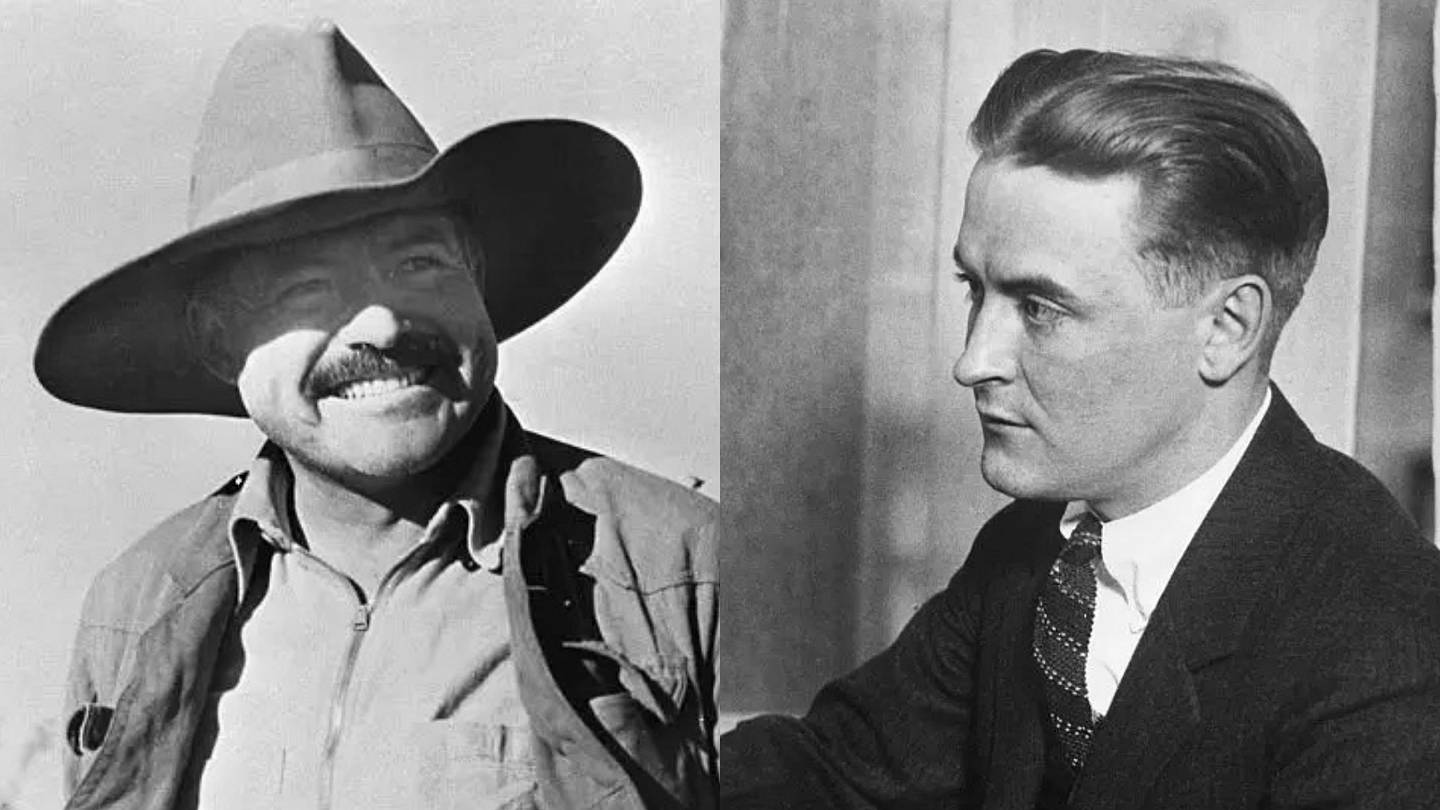
It can be easy to forget that the creators of some of the world's greatest works of art and literature were plagued by relentless self-doubt. Yet from Leonardo Da Vinci to Vincent van Gogh, some of the most legendary artists of all time have been crippled by a deep, near-inescapable feeling that they were failures. One member of this strange club is F. Scott Fitzgerald, now considered one of the giants of 20th-century literature. In 1934, just after publishing Tender Is the Night—his first book in nine years since The Great Gatsby—Fitzgerald reached out to his old friend Ernest Hemingway for feedback. It had been a difficult decade for Fitzgerald. His wife Zelda had been institutionalized in 1930, he was struggling financially, and his drinking had become excessive. Hemingway and Fitzgerald, meanwhile, shared a longtime friendship despite their differing beliefs and opposite personalities, and Hemingway responded to Fitzgerald’s inquiry with an uncompromisingly blunt missive. Hemingway’s Frank Advice to FitzgeraldErnest Hemingway Returing To The States | Bettmann/GettyImagesIn his letter, Hemingway initially explains that he “liked” Tender Is the Night and also “didn’t”—a contradictory phrase that undoubtedly would have appealed to Fitzgerald’s intellectual sensibilities. (Fitzgerald, after all, once wrote that “the test of a first-rate intelligence is the ability to hold two opposed ideas in the mind at the same time, and still retain the ability to function” in his essay The Crack-Up, which detailed some of the insecurities Hemingway would go on to denounce). Hemingway then gets into the weeds of his message. In essence, he commands Fitzgerald to leave behind his self-absorbed obsession with what others think and to simply do what he is best at.“For Christ sake write and don’t worry about what the boys will say nor whether it will be a masterpiece nor what,” Hemingway writes. “I write one page of masterpiece to ninety one pages of s**t. I try to put the s**t in the wastebasket.”He goes on to advise Fitzgerald to use his personal pain as fuel for creativity, but to not become overly attached to his own self-pity. “Forget your personal tragedy,” he continues. “We are all bit**ed from the start and you especially have to hurt like hell before you can write seriously. But when you get the damned hurt use it—don’t cheat with it. Be as faithful to it as a scientist—but don’t think anything is of any importance because it happens to you or anyone belonging to you.”In short, Hemingway seems to advise that the answer to creative self-doubt is to abandon the ego and return to the page and the craft, without being overly attached to where any of it will end up or how any of it will be perceived. “Scott, good writers always come back,” he continues. “Always. You are twice as good now as you were at the time you think you were so marvellous. You know I never thought so much of Gatsby at the time. You can write twice as well now as you ever could. All you need to do is write truly and not care about what the fate of it is. Go on and write.”Abandoning excessive egoism is a core message of Buddhism and many other ancient faiths. It also may be an antidote for our modern era of endless self-optimization and branding. Clearly, it was a message that Hemingway thought his friend needed to hear in 1934, albeit wrapped up in a series of rather harsh and uncompromising machismo characteristic of the author.Unfortunately, Tender Is the Night was the last novel Fitzgerald published during his lifetime. He died at just 44 in 1940 of a heart attack. Yet his work lives on, as does the evidence of his complicated relationship with another one of the 20th century’s great storytellers.Hemingway and Fitzgerald’s Complex FriendshipF Scott Fitzgerald, Zelda Fitzgerald | Hulton Archive/GettyImagesHemingway and Fitzgerald first met in a bar in Paris in April 1925, shortly after Fitzgerald published Gatsby. Hemingway was a journalist at the time and was still at the start of his literary career, and so admired Fitzgerald, who in turn apparently admired Hemingway’s hyper-masculine persona. They quickly formed a friendship based on their shared love of drinking—a lot of drinking—and writing. Yet their friendship was certainly not solely characterized by mutual encouragement. Instead, it was marked by a terse rivalry tinged with both collaboration and insecurity. The pair often sent each other strongly worded letters that mixed praise and criticism. In response to a draft of The Sun Also Rises, Fitzgerald penned a 10-page letter that called parts of the book “careless” and “ineffectual.” His advice led Hemingway to make significant changes to the manuscript.The pair were also extremely different; Fitzgerald struggled to handle his liquor, summered on the French Riviera, and often acted wealthier than he was. Meanwhile, Hemingway generally maintained control no matter how much he drank, enjoyed watching bullfights in Spain, and purposefully lived far below his means. These differences are easy to track in their writing, with Fitzgerald’s lavish, flowery prose presenting a stark contrast to Hemingway’s sparse and fastidious style. Meanwhile, Fitzgerald’s wife Zelda and Hemingway famously loathed each other; at one point, Zelda accused Hemingway and her husband of being lovers, while Hemingway often expressed his belief that Zelda was holding Fitzgerald’s writing back. By the end of the 1920s, their friendship had disintegrated as Hemingway grew exasperated with what he saw as Fitzgerald’s excess of self-pity and mishandling of his own potential, a frustration he expressed in the letter below. Fitzgerald would unfortunately continue down a path of tragedy. Unfortunately, Hemingway’s own demons eventually caught up to him, too; prone to alcoholism and depression, he committed suicide in 1961 at the age of 61. It’s not hard to imagine that, in part, Hemingway’s letter of advice may have been indirectly penned to a deeply buried part of himself.Read the entirety of Hemingway’s letter to Fitzgerald below.Hemingway’s Complete 1934 Letter to FitzgeraldHemingway writing on safari | Earl Theisen Collection/GettyImagesKey West28 May 1934Dear Scott:I liked it and I didn’t. It started off with that marvelous description of Sara and Gerald (goddamn it Dos took it with him so I can’t refer to it. So if I make any mistakes—). Then you started fooling with them, making them come from things they didn’t come from, changing them into other people and you can’t do that, Scott. If you take real people and write about them you cannot give them other parents than they have (they are made by their parents and what happens to them) you cannot make them do anything they would not do. You can take you or me or Zelda or Pauline or Hadley or Sara or Gerald but you have to keep them the same and you can only make them do what they would do. You can’t make one be another. Invention is the finest thing but you cannot invent anything that would not actually happen.That is what we are supposed to do when we are at our best—make it all up—but make it up so truly that later it will happen that way.Goddamn it you took liberties with peoples’ pasts and futures that produced not people but damned marvellously faked case histories. You, who can write better than anybody can, who are so lousy with talent that you have to—the hell with it. Scott for gods sake write and write truly no matter who or what it hurts but do not make these silly compromises. You could write a fine book about Gerald and Sara for instance if you knew enough about them and they would not have any feeling, except passing, if it were true.There were wonderful places and nobody else nor none of the boys can write a good one half as good reading as one that doesn’t come out by you, but you cheated too damned much in this one. And you don’t need to.In the first place I’ve always claimed that you can’t think. All right, we’ll admit you can think. But say you couldn’t think; then you ought to write, invent, out of what you know and keep the people’s antecedants straight. Second place, a long time ago you stopped listening except to the answers to your own questions. You had good stuff in too that it didn’t need. That’s what dries a writer up (we all dry up. That’s no insult to you in person) not listening. That is where it all comes from. Seeing, listening. You see well enough. But you stop listening.It’s a lot better than I say. But it’s not as good as you can do.You can study Clausewitz in the field and economics and psychology and nothing else will do you any bloody good once you are writing. We are like lousy damned acrobats but we make some mighty fine jumps, bo, and they have all these other acrobats that won’t jump.For Christ sake write and don’t worry about what the boys will say nor whether it will be a masterpiece nor what. I write one page of masterpiece to ninety one pages of s**t. I try to put the s**t in the wastebasket. You feel you have to publish crap to make money to live and let live. All write but if you write enough and as well as you can there will be the same amount of masterpiece material (as we say at Yale). You can’t think well enough to sit down and write a deliberate masterpiece and if you could get rid of Seldes and those guys that nearly ruined you and turn them out as well as you can and let the spectators yell when it is good and hoot when it is not you would be all right.Forget your personal tragedy. We are all bi***ed from the start and you especially have to hurt like hell before you can write seriously. But when you get the damned hurt use it—don’t cheat with it. Be as faithful to it as a scientist—but don’t think anything is of any importance because it happens to you or anyone belonging to you.About this time I wouldn’t blame you if you gave me a burst. Jesus it’s marvellous to tell other people how to write, live, die etc.I’d like to see you and talk about things with you sober. You were so damned stinking in N.Y. we didn’t get anywhere. You see, Bo, you’re not a tragic character. Neither am I. All we are is writers and what we should do is write. Of all people on earth you needed discipline in your work and instead you marry someone who is jealous of your work, wants to compete with you and ruins you. It’s not as simple as that and I thought Zelda was crazy the first time I met her and you complicated it even more by being in love with her and, of course you’re a rummy. But you’re no more of a rummy than Joyce is and most good writers are. But Scott, good writers always come back. Always. You are twice as good now as you were at the time you think you were so marvellous. You know I never thought so much of Gatsby at the time. You can write twice as well now as you ever could. All you need to do is write truly and not care about what the fate of it is.Go on and write.Anyway I’m damned fond of you and I’d like to have a chance to talk sometimes. We had good times talking. Remember that guy we went out to see dying in Neuilly? He was down here this winter. Damned nice guy Canby Chambers. Saw a lot of Dos. He’s in good shape now and he was plenty sick this time last year. How is Scotty and Zelda? Pauline sends her love. We’re all fine. She’s going up to Piggott for a couple of weeks with Patrick. Then bring Bumby back. We have a fine boat. Am going good on a very long story. Hard one to write.Always your friendErnest
The Blunt Letter Ernest Hemingway Wrote to F. Scott Fitzgerald About Self-Doubt
Full Article
Original Source
Read the full article at Mentalfloss →KhanList aggregates and links to publicly available news content. We do not host full articles from third-party sources. Always verify important information with original sources.