
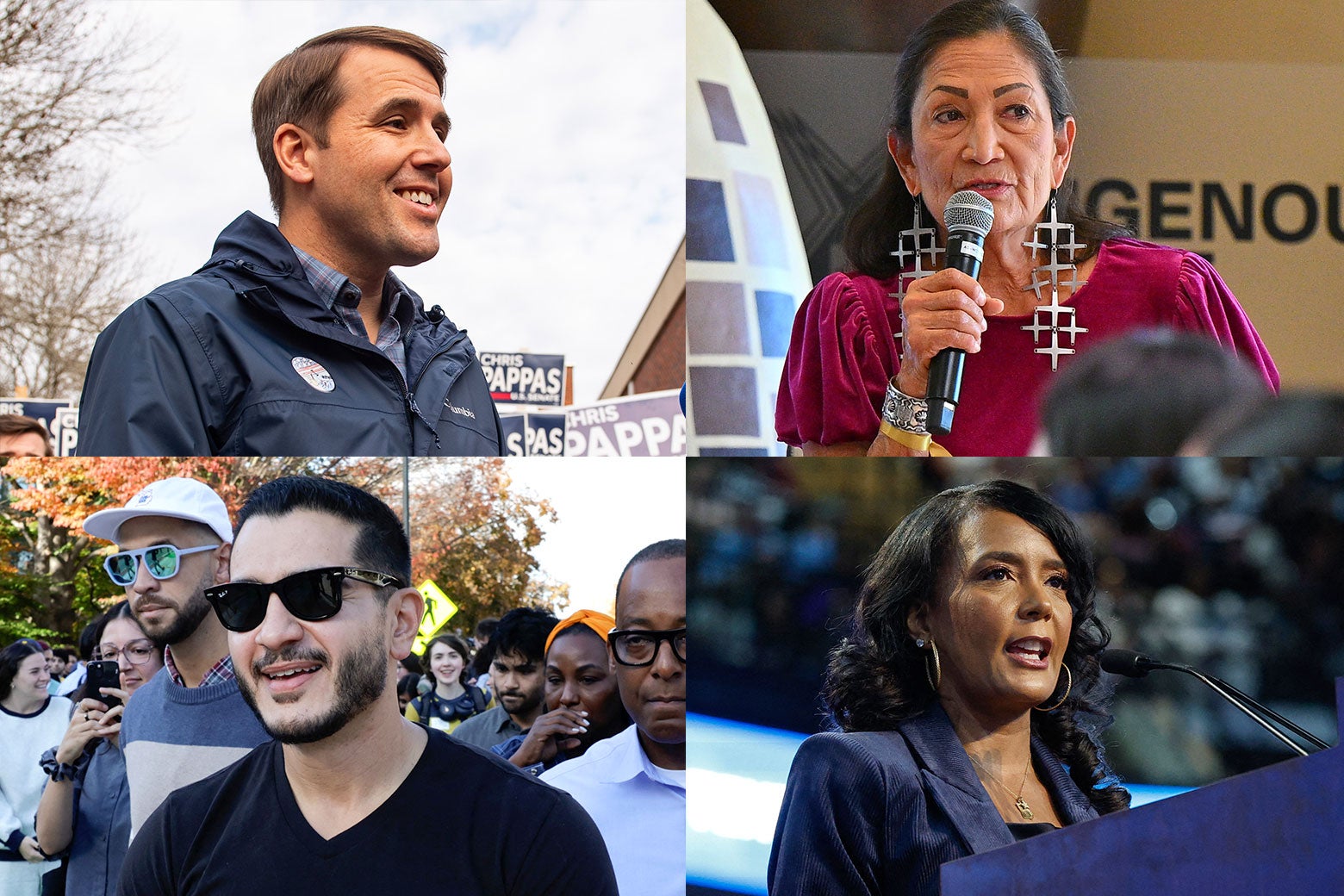
Politics By Enter your email to receive alerts for this author. Sign in or create an account to better manage your email preferences. Unsubscribe from email alerts Are you sure you want to unsubscribe from email alerts for Shirin Ali? Nov 04, 20262:14 AM History was made on Tuesday. Photo illustration by Slate. Photos by Erik S. Lesser/AFP via Getty Images, Sam Wasson/Getty Images for Indigenous House, Joseph Prezioso/Getty Images, and Jeff Kowalsky/AFP via Getty Images. Sign up for the Slatest to get the most insightful analysis, criticism, and advice out there, delivered to your inbox daily. The midterm elections have been all but wrapped up and not only did Democrats pull off a blue tsunami, there were plenty of historic firsts in districts and states across the country. Results are still rolling in, but we can safely say that the U.S. Senate will get its first openly gay senator, while a Black man is set to become the Speaker of the U.S. House for the first time ever, and this is just a taste of the new wave of leadership headed to Washington. Democrats wrangled control of the House and Senate from Republicans, decisively winning up and down the ballot in not just reliably blue states, but flipping solidly red ones too. Texas not only flipped one of its Senate seats to Democrat James Talarico, but also flipped the governorship to Democrat Gina Hinojosa, making her the first Mexican American governor of that state. South Carolina also flipped its Senate seat to Democrat Amy Andrews, who became the state’s first elected female senator. These historic Democratic flips come alongside other notable wins, like Xavier Becerra who will become the first Latino governor of California chosen by voters and Byron Donalds who will be Florida’s first ever Black governor. Tuesday night also saw firsts at the national level, almost entirely driven by Democrats. Here’s what we know so far: First Openly Gay Senator Democrat Chris Pappas won New Hampshire’s Senate race over former Republican Sen. John E. Sununu, which will make him the first openly gay man to serve in the U.S. Senate. Though not a fact about himself that Pappas mentioned much on the campaign trail—he didn’t even note the landmark moment in his victory speech, though he did thank his husband, Van—it’s significant given the Trump administration’s targeted attacks on the LGBTQ community. The 46-year-old will replace retiring Democratic Sen. Jeanne Shaheen after defeating New Hampshire political royalty Sunnunu by more than ten points. First Native American Female Senator Minnesota voters chose Democratic Lt. Gov. Peggy Flanagan to replace outgoing Sen. Tina Smith. She will become the first Native American woman to serve in the Senate, and could be joined by Democrat Mary Peltola of Alaska whose race has not yet been called. Flanagan is an enrolled member of the White Earth Band of Ojibwe. As MPR reported, Flanagan brought a number of Minnesota’s elected leaders deep into her campaign. “I could not run for the U.S. Senate without Native women. I could not exist in the way that I do without Native women,” Flanagan told MPR. Flanagan had served in Congress as one of the founding members of the House’s Native American Caucus and for the last four years as Minnesota’s Lieutenant Governor. “I think she is setting up a system for all of us to know that if we hope, if we work for things, we can achieve it, and that’s kind of our values too,” Melanie Benjamin, the longtime former chief of the Mille Lacs Band of Ojibwe tribe, told MPR. First Native American Female Governor New Mexico elected Deb Haaland to be its next governor, making her the first Native American woman to govern a U.S. state. Haaland is a member of the Laguna Pueblo tribe. She served as interior secretary under former president Joe Biden and before that, Haaland served in the House after being elected in the 2018 blue wave. She is one of over 300 Indigenous candidates who ran for office in local, state and federal elections across the country this year. As the New York Times reported: “She has racked up a series of firsts since the moment she entered politics: the first Native person to chair a major political party in New Mexico, one of the first two Native American women elected to Congress and the first Native American cabinet secretary, a position she took during the Biden administration.” First Black Woman Elected Governor Democrat Keisha Lance Bottoms won Georgia’s governor’s race, flipping control of the state’s highest office from Republican Brian Kemp. Bottoms is the former mayer of Atlanta and Biden administration official. She managed to overcome a massive spending disadvantage against Republican Rick Jackson, a healthcare executive who pumped over $100 million of his own money into this campaign. Bottom’s win is historic on multiple fronts: She becomes the first woman and first Black person to be elected governor of Georgia and the first Black female governor in the U.S—ever. First Paralympian Elected to Senate Democrat Josh Turek flipped an Iowa Senate seat and will become the first Paralympian to serve in the Senate. Turek was born with spina bifida, making him wheel-chair bound his entire life. However, he went on to become a two-time gold medalist in basketball at the Paralympics and eventually served in the Iowa statehouse. He’s now flipped one of the country’s most competitive Senate seats, replacing retiring Republican Sen. Joni Ernst. First Muslim Senator According to the DecisionDesk, Democrat Abdul El-Sayed won his Senate race against Republican Mike Rogers, becoming the first Muslim elected to the Senate. This victory was particularly dramatic considering the Democrat faced an onslaught of Islamophobic attacks during his campaign, including from President Donald Trump who called him a “jihadist.” As Senator-elect El-Sayed said in his victory speech, “rather than try to unite us to contend with the prices of gas and groceries, the opposition tried to divide us. At first they pointed to my name and my faith as if to say, ‘you know, he’s a little different.’ Then when it didn’t work they tried to guilt me by association. And when that didn’t work, they went all in on one of the ugliest campaigns we have seen in our lifetimes.” El-Sayed continued, explaining why he didn’t call out his opponents for being “racist or hateful” in his campaign: “I didn’t run for myself and in truth they weren’t targeting me. They weren’t just attacking me. They were targeting and attacking you. They were targeting and attacking the very idea of America. See, they hate the idea of an America big enough for anyone who looks a little different or prays a little different, or whose family comes from a different part of the world. That includes me, but it also includes anyone and everyone who doesn’t look like them, pray like them, love like them, or isn’t rich like them. So they turned this race into a simple choice. They want an America that is too small for some of us. We know that America is big enough for all of us.” Come January, the U.S. Senate will be big enough for Sen. El-Sayed. Democrats Politics 2026 Midterms
The Blue Tsunami Was Driven By These History-Making Candidates
Full Article
Original Source
Read the full article at Slate →KhanList aggregates and links to publicly available news content. We do not host full articles from third-party sources. Always verify important information with original sources.