
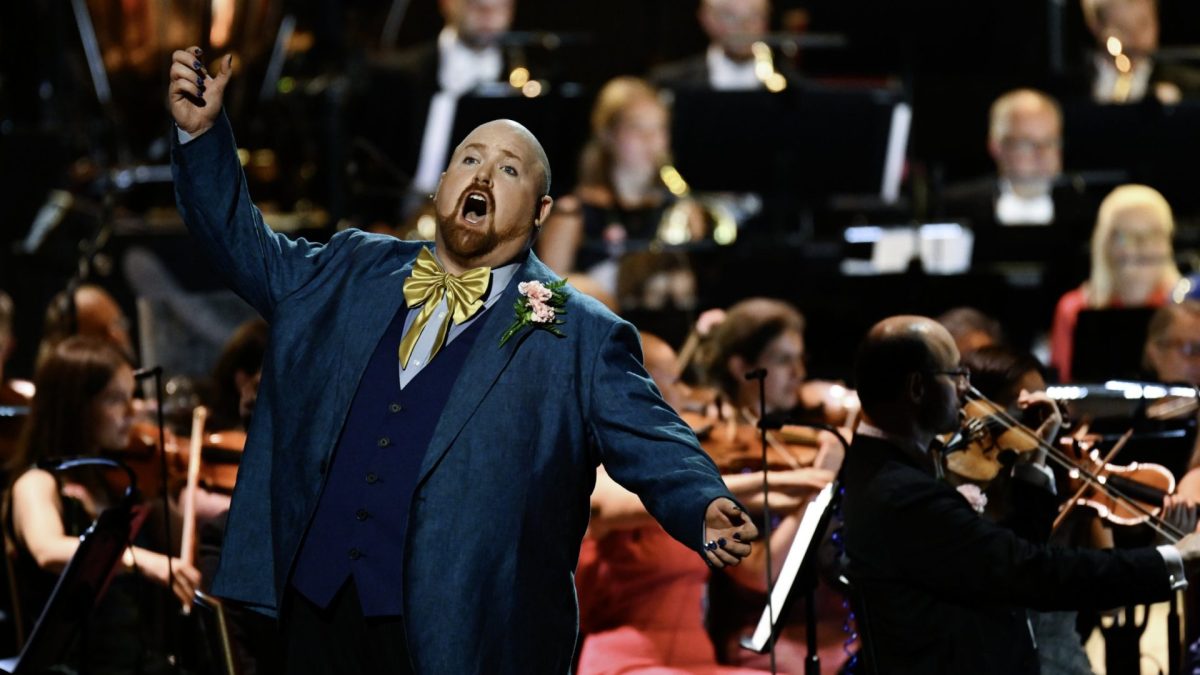
The Last Night of the Proms may be the last expression of old-fashioned, supposed “patriotism” in the internationalised world of classical music. Outraged articles usually appear beforehand, demanding that it be cancelled. This time, however, things have been oddly quiet. We could hazard a guess as to why. In 2025 a far-right march in London took place on the same day as Last Night of the Proms. This year, in Portsmouth, masked men in black intimidated asylum-seekers – and a youth cricket team visiting from Pakistan. Beside actual Blackshirts stalking British streets, a handful of music-lovers in Union Jack waistcoats bobbing up and down to a sea shanty looks mercifully daft. Love it or loathe it, the rituals of the Last Night have been going on since the 1950s, when conductor Sir Malcolm Sargent’s showmanship and new-fangled TV cameras turned the event into more than an end-of-term singalong. It’s one big party for everybody, as witness the plethora of different flags in the hall – Swiss, Finnish, American, German, Pride, a veritable sea of European blue and yellow. Nor is it without nuance. One couple wielding Union Flags were chattering in German. A guy near me bellowed the songs at buffalo volume while waving a European flag. Frankly, there are worse ways to mark the end of summer. But if anything threatens Last Night of the Proms, it’s the potential for it to buckle under its own weight. To misquote “Rule, Britannia”, longer and still longer have its bounds been set. By the time the megawatt Scottish tenor Nicky Spence strode on stage for that song wearing a Loch Ness Monster costume, we were so knackered that we just wanted to go home and get some kip. The continuity did not help: gaping holes between pieces sapped the energy, leaving the hall twiddling its thumbs, possibly for the sake of whatever extra happened to be on the TV broadcast. Tenor Nicky Spence (centre) performing on stage (Photo: Jennifer Hawthorn/BBC/PA Wire) It was Spence’s night nonetheless, his offerings ranging from a high-romantic extract from Dvorák’s Rusalka to a collection of folk songs arranged by Stuart Calvert, Scotch Snap, delivered with dancers, kilts and supreme silliness. Plus “Sit Down, You’re Rocking the Boat” from Guys and Dolls – fun for a jam-packed arena of promenaders who couldn’t sit down at all. There were plenty of other treats, too. First we heard the well-chosen razzledazzle of Bernstein’s “Candide” Overture. The second half began with a heartwarming tribute to Dolly Parton: a medley of “9 to 5”, “Jolene” and “I Will Always Love You”, wonderfully sung by Beverley Knight, Sheridan Smith and the country duo Ward Thomas, bathed in warm lighting and the waving of phone torches. Yuja Wang’s fire-eating pianism made light work of the Samuel Barber Piano Concerto, a spiky, Prokofiev-like piece once deemed virtually unplayable, never heard at the Proms before. Later, in Alexander Tsfasman’s irresistible Jazz Suite – think Rachmaninoff in Ronnie Scott’s – her touch was all silk, stardust and molten gold. What a glorious artist she is. Tenor Nicky Beverley Knight performing at the Proms (Photo: Chris Christodoulou/BBC/PA Wire) Two choral world premieres commissioned for the occasion nearly got lost. Samy Mousa’s imposing Dithyramb briefly transported us to ancient Greece with full-blown harmonic consonance and outdoorsy brass and drums. Anne Dudley’s Iris of Life, in contrast, was a small, perfectly wrought rainbow of sound, setting a poem by the Native American poet Zitkála-Šá, but its sensitive performance by the BBC Singers was mispositioned between Spence’s showstoppers. The BBC Symphony Orchestra deserved extra bubbly for uncompromising excellence throughout. This should have been the farewell Prom for its long-standing leader Stephen Bryant; sadly, he was off sick. Their other concertmaster, Igor Yuzefovich, took over and pulled out the stops in the famous Hornpipe solo in the Henry Wood Fantasia on British Sea-Songs. Their treasurable principal conductor, Sakari Oramo, brought gravitas, elegance and collegial sympathy to the proceedings, especially a sleek rendition of Smetana’s Vltava, but also embraced the party spirit. His speech calling for Authentic Integrity – “my type of A.I.!” – as a principle of being human was immensely welcome. This starry night crowned a brilliant season of Proms. The atmosphere has been buzzing, many concerts were sold out, and online consumption is up on last year by 32 per cent. Here’s hoping that despite financial threats, they will return in 2027 stronger than ever. All together now: stand by your Proms! The Last Night of the Proms is streaming on BBC iPlayer and BBC Sounds.
The biggest threat to the Last Night of the Proms is not the far-right
Full Article
Original Source
Read the full article at Inews →KhanList aggregates and links to publicly available news content. We do not host full articles from third-party sources. Always verify important information with original sources.