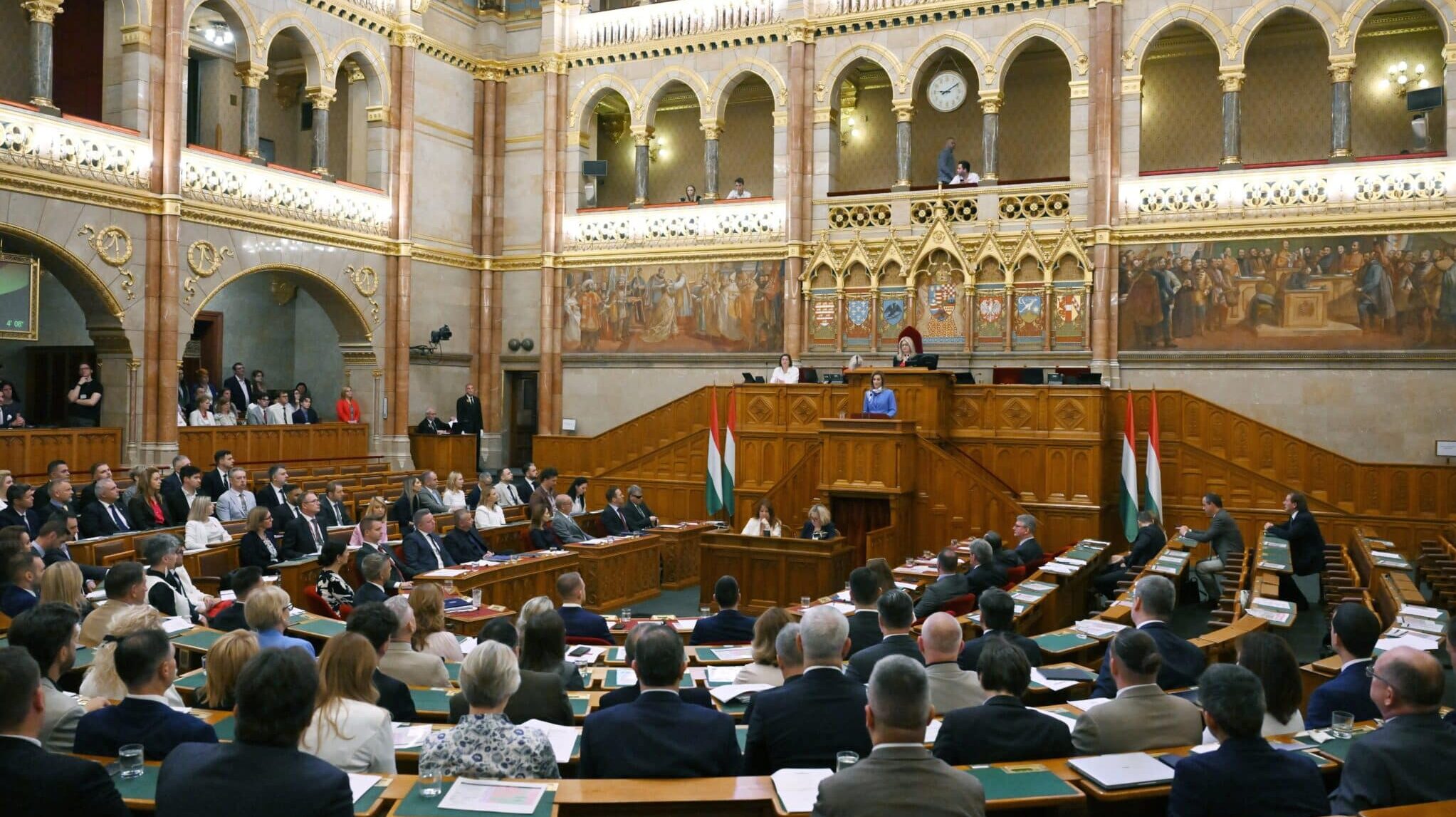
Hungary’s PM fired the president, fulfilling a campaign pledge to remove ‘Fidesz puppets’ from public office. A shambolic attempt to nominate a successor grabbed the headlines, but the focus should be on the government’s drafting of an entirely new constitution. “The rule of law means, above all, respect for the law – that is, the supremacy of law over arbitrary power, the supremacy of norms over individual decisions of public authority. If power politics overrides the constraints of law, it will have unforeseeable consequences for our country.” It was amusing to hear these words come out of Tamas Sulyok’s mouth on July 18, when the deadline for the president to sign and promulgate the constitutional amendment that removed him from office expired. Sulyok said he would sign the amendment and was explaining his decision in the dramatic video on Facebook. It was hard to watch it without laughing, because politics overriding the constraints of law is precisely what Sulyok allowed during his two years as state president during the Viktor Orban era, and before that as president of the Constitutional Court. It seems only now, when a new government is in power, that Sulyok suddenly discovered constitutional concerns. Throughout Fidesz’s 16 years in power with a two-thirds constitutional majority in parliament, when protests were banned and journalists and NGOs were threatened, it never once occurred to him to consult the Constitutional Court before signing a law or even raise constitutional concerns publicly. The rule of law and constitutionalism only became important to him when the new government wanted to fire him. Hungarian PM Peter Magyar holds an extraordinary press briefing following a voting on the 17th amendment to the Fundamental Law during a plenary session of parliament in Budapest, Hungary, 13 July 2026. EPA/TAMAS PURGER Making the presidency functional? The removal of Sulyok from the presidency was a symbolic issue and a key campaign pledge of the new prime minister, Peter Magyar, who won a landslide victory with his Tisza party at the April 12 general election, securing a record number of 141 seats (out of 199) in Hungary’s parliament. Possessing the magical two-thirds majority means practically unbridled power: this supermajority is required for constitution drafting and amending, adopting and changing so-called cardinal laws governing key constitutional matters (and not just that), and appointing the most important public officials. And for the first time, this power belongs not to Orbán’s Fidesz but to Magyar’s Tisza party. Absolute power always invites abuse, so many observers have raised concerns about Magyar’s removal of the president via a constitutional amendment, suggesting this amounts to the same kind of power politics dressed up as formally legal manoeuvres that Fidesz practiced over the past 16 years. Moreover, in the months since the election, Sulyok had shown readiness to cooperate with the new government, duly appointing ministers and signing laws on time – one could argue there was no need to get rid of him at all. Yet there are at least two reasons why Sulyok’s removal does not amount to an abuse of power. First, it was an explicit campaign promise – something Magyar received a two-thirds parliamentary mandate from the voters to carry out. Second, Sulyok has proven eminently unsuited to the president’s constitutional role of being the “guardian of the democratic functioning of the state organisation”. Under Hungary’s parliamentary system, the president is quite weak and his tools for performing this guardian role are rather limited. But Sulyok chose never to even use any of these limited competences. The very fact he servilely aligned himself with the Fidesz government, and then, after the April 12 election, sought to align himself with the Tisza government in every matter except his own removal, shows that he lacked the necessary autonomy – and thus could never act as such a guardian. Parliament now has now 30 days (counting from July 19) to elect a new president. Meanwhile, the presidential competences have been temporarily assumed by the speaker of parliament, Tisza’s Agnes Forsthoffer, as prescribed by the constitution. The choice of Hungary’s next president is already generating intense public interest, as the failed attempt to get Judit Polgar, the greatest ever female chess player, to accept the nomination showed. Obviously, electing another “puppet” as president would be politically risky for Tisza, as it would send the message that replacing the enemy’s puppet with its own is indeed an abuse of power. But if Tisza’s majority in parliament can elect someone clearly above party politics and has the necessary autonomy to make the presidential office functional, then the removal of Sulyok won’t be seen as an abuse of power but as a proper step in improving the rule of law and restoring checks and balances. The new president will anyway be elected for an interim period only, until a new constitution has been prepared, adopted and confirmed at a referendum. And that is where people’s attention should lie. Hungarian President Tamas Sulyok delivers a speech during the inaugural session of the new National Assembly in Budapest, Hungary, 09 May 2026. EPA/Tibor Illyes Sulyok signs democracy’s ‘death warrant’ – then mourns it theatrically When signing his own removal, Sulyok dramatically stated that with this constitutional amendment, “the democratic state under the rule of law, established at the time of the regime change, has ceased to exist.” It is hard to tell whether Sulyok seriously believes that it was his removal, here and now, that put an end to the democratic rule of law in Hungary – and not 16 years of Fidesz’s increasingly authoritarian rule that brought it to the brink. If he does believe it, then it is baffling why he signed the amendment instead of simply resigning. How is he going to look himself in the mirror with a clear conscience now his signature is on the very act that apparently abolished Hungary’s democratic rule of law? And finally, the outgoing president was mindful enough to hand ammunition to a now-in-opposition Fidesz party aghast at arbitrary power, declaring that his successor would in any case be illegitimate – since he himself was, as he put it, unlawfully removed. Fidesz politicians have accordingly begun echoing this narrative: whoever is appointed president by parliament will lack constitutional legitimacy because Sulyok’s removal was itself unconstitutional. This line of argument omits the fact it was precisely the previous Fidesz government that explicitly barred the Constitutional Court from substantively reviewing constitutional amendments. So, now there is simply no one left to declare that it would be constitutionally defective for a parliamentary two-thirds majority to sack the state president in the closing provisions of a constitutional amendment and vote someone else in his place. From this point on, the expert opinion of Fidesz politicians carries about as much weight as that of someone at the village pub. Legally speaking, at least. Politically, of course, some interesting situations could follow. If Fidesz really commits, consistently, to the position that Sulyok’s removal and the election by parliament of his successor – whoever that may be – are constitutionally defective, then it follows that it shouldn’t recognise as binding any of the laws signed and promulgated by the new president either. In fact, by that logic they may as well walk out of parliament altogether. After all, why keep clowning around in there if the resulting laws signed and promulgated by the president are going to be constitutionally defective anyway, right? Before anyone had time to seriously consider such rhetorical questions, Viktor Orban returned home from the FIFA World Cup in the US where he had spent these last turbulent days – and immediately made it clear how he and his party would resist. Fidesz party leader and former Hungarian PM Viktor Orban (L) and Fidesz parliamentary group leader Janos Boka hold a press conference in front of the party’s headquarters, in Budapest, Hungary, 22 July 2026. EPA/ROBERT HEGEDUS Orban’s shameless resistance – against what exactly? The former prime minister did not take up his parliamentary mandate after the election that his party so resoundingly lost, but he is still president of the Fidesz party. He declared on Wednesday that after the constitutional amendment removing Sulyok, the rule of law has ceased to exist in Hungary; from now on, there is only tyranny. After 16 years spent consolidating power and appointing loyal officials to every independent institution, Orban now contends that the actions of the new government are illegitimate because it is seeking to monopolise power. Therefore, Fidesz won’t participate in the election of officials in the place of those who were removed, because it considers the new officials also to be illegitimate. Beyond the state president, this will comprise four constitutional judge vacancies, because the constitutional amendment passed by Tisza also reintroduced the 70-year retirement age for constitutional court judges and four older than that will now have to retire on September 1. Orban recalled that, according to the constitution, everyone has the right to lawfully resist attempts to secure exclusive control of political power. He promised that Fidesz would support anyone engaged in such resistance. At this point it is worth reminding that at the time he was prime minister, those who expressed similar resistance were usually labelled traitors and foreign agents – but “the times they are a-changin’,” as Bob Dylan sang. It is likely that with its resistance agenda, Fidesz wants to undermine the new government’s constitution-drafting plans. Prime Minister Magyar has made it explicit that in a constitution-making process seen starting in September Hungarian society would be involved, which is in sharp contrast with the exclusively elite-driven constitution-drafting practices that Hungarians have so far experienced. By calling on its supporters to resist and depicting the new government’s rule as arbitrary, Fidesz probably also hopes to put people off participating in the constitution-drafting process so that it can label any new constitution illegitimate. Yet this could easily backfire, as the current Fundamental Law was practically written by two Fidesz politicians on a tablet, after a postal consultation with citizens full of biased questions and simplified answer options. This level of transparency and social involvement is not that difficult to surpass, even if Fidesz eventually ends up boycotting the process. Beyond its legitimacy, the key question about any new constitution is whether and how it will be able to prevent a similar concentration of power to what we witnessed over the past 16 years. This might entail various institutional solutions, depending on the outcome of the consultations in the constitution-making process. It would be worth considering the reintroduction of bicameralism where, if the right institutional balance is found, the upper chamber could function as a counterbalance to the government and its majority in the lower house. Referendums should also be made functional. Though they currently exist on paper, it is practically impossible to hold a legally binding referendum due to the high turnout threshold and the extensive list of prohibited subjects. Most important of all, the electoral rules and the constitutional provisions governing legislation and institutions must guarantee that no single party can amend the constitution or entrench its priorities in cardinal laws, and that no single party can pack independent institutions with loyalists, hollowing them out from within. Finding the right constitutional solutions to all these matters is far more important than which person will hold the presidency for an interim period of one or two years. Bea Bakó is an independent researcher, she holds a PhD in constitutional law and co-authors the Hungarian newsletter Gemišt. The opinions expressed are those of the author and do not necessarily reflect the views of BIRN.
The Biggest Question Is Not Hungary’s Next President but Its Next Constitution
Full Article
Original Source
Read the full article at Balkaninsight →KhanList aggregates and links to publicly available news content. We do not host full articles from third-party sources. Always verify important information with original sources.