
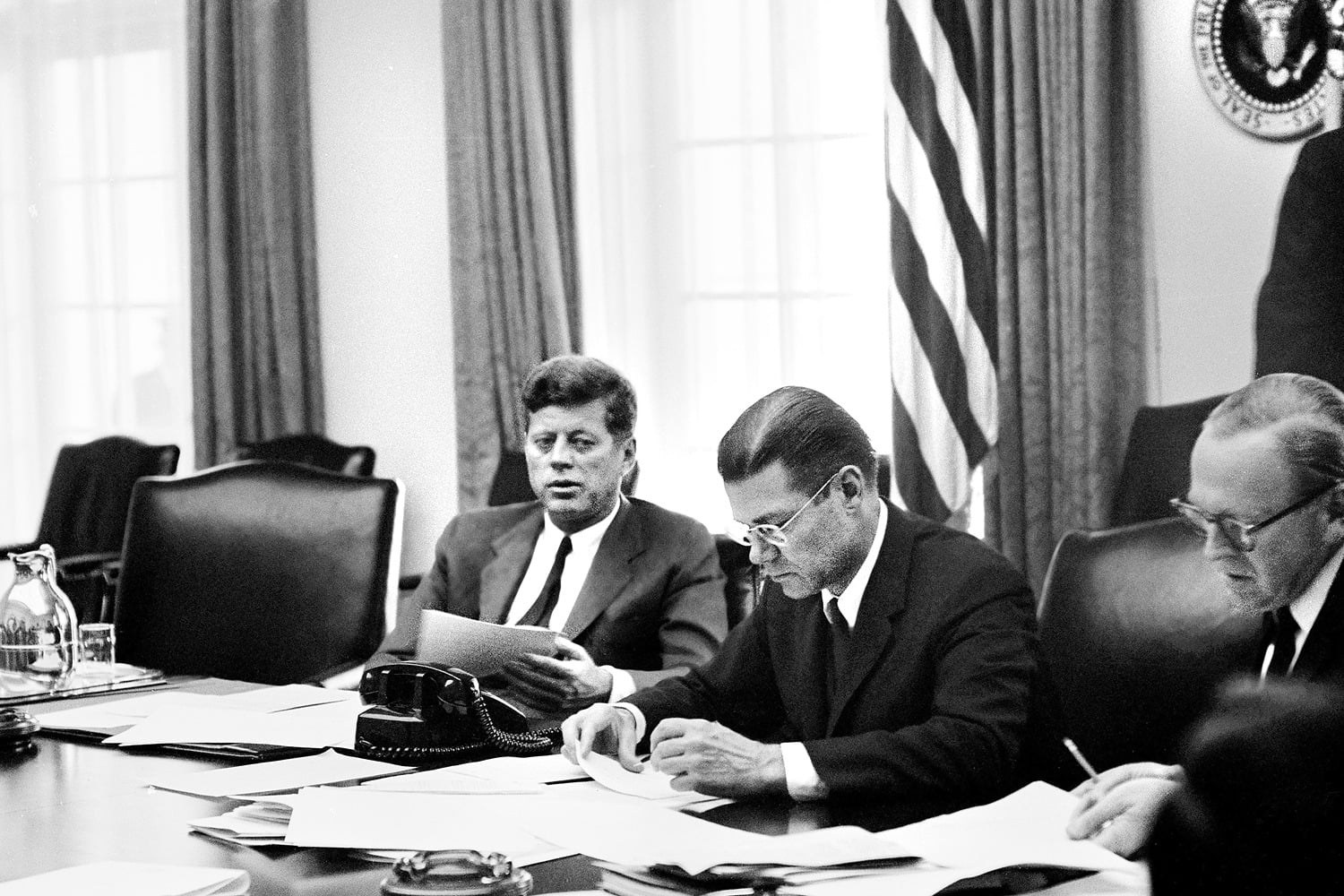
It is unclear whether anything that happened over the past month will go down in the history books as an “October surprise.” Most of the big events did not seem to move the needle relative to existing issues of affordability, war in Iran, mass deportations, and political chaos. Although President Donald Trump announced an oil deal with Russia and federal agents raided the home of Rep. Ilhan Omar, the underlying trends favoring Democrats seemed to hold. The one possible exception is a late-breaking New York Times story about staffers connected to Mary Peltola, the Democratic Senate candidate in Alaska poised to pull off a possible upset, who were part of a reported secret effort to recruit another Dan Sullivan to confuse voters and split the state’s Republican vote; Dan J. Sullivan now also appears on the ballot alongside the incumbent, Sen. Dan Sullivan. Alaska Gov. Mike Dunleavy ordered an investigation. Although there is nothing illegal about “stacking,” an old partisan tactic, the story will feed the Justice Department’s effort to block the state from certifying the election results if the Republican loses. Whether it will have any broader impact, however, remains unclear. The ambiguity over the October surprise should not itself be surprising. Since 1980, every election cycle has generated speculation about the possibility of one. The term refers to the emergence of earth-shattering news, whether generated by individuals associated with a campaign or by unfolding events, that could dramatically influence the electorate. It was popularized during the 1980 election, when William Casey, Ronald Reagan’s campaign manager, feared that President Jimmy Carter might announce a breakthrough agreement to free the 52 U.S. hostages being held in Iran before Election Day. No such deal materialized before voters cast ballots. Iran ultimately released the hostages minutes after Reagan was inaugurated in January 1981, a dramatic split-screen moment that has fueled longstanding allegations, never conclusively proven, that members of the Reagan campaign interfered with the negotiations by signaling that Tehran would receive more favorable terms under a Republican administration. Most anticipated October surprises never occur. As in 1980, the fears usually prove greater than the reality. Even when such surprises have emerged—such as the indictment of former Secretary of Defense Caspar Weinberger over the Iran-Contra affair days before the 1992 vote or the revelation of George W. Bush’s 1976 drunk driving arrest shortly before the 2000 election—other factors appear to have been more consequential in shaping the outcome. Sometimes, however, major developments, particularly foreign policy, have significantly altered the political environment in the final weeks of the campaign. One of the most dramatic took place in October 1962, when President John F. Kennedy confronted the Soviet Union over the placement of nuclear missiles in Cuba, about 90 miles from the shores of the United States. Since Kennedy’s inauguration in 1961, Republicans had attacked the young president as incapable of dealing with the threats posed by the Soviet Union. The spectacular failure of the Bay of Pigs invasion of Cuba in April intensified that criticism. In early June 1961, Kennedy met with Soviet Premier Nikita Khrushchev in Vienna, and Khrushchev treated the U.S. president with little respect and brazenly intimidated him. Of all the difficult foreign policy challenges that Kennedy confronted in his first two years of office, few were as explosive domestically as Cuba. Vice President Richard Nixon had been hurt in his 1960 presidential run by the fact that Cuba had fallen to communism on Republican President Dwight Eisenhower’s watch in 1959. Meanwhile, Kennedy had successfully positioned himself as more hawkish than Nixon, particularly through claims that a so-called missile gap had left the Soviet Union with a strategic advantage. Domestic tensions over Cuba escalated in the summer of 1962 as reports of a Soviet military buildup on the island hit U.S. politics. As the debate over Cuba heated up, Democrats anticipated the losses normally suffered by president’s party in midterms. With the exception of Democrats in 1934, such losses had been a constant in political life since the Civil War. The economy added to the party’s worries. The stock market had declined, with the steepest one-day drop since 1929 taking place on May 28, while the president clashed with steel industry executives over price increases. Violent struggles over civil rights were occurring in the Deep South. All of this occurred as much of the president’s domestic agenda, including Medicare, was stalled in Congress. Republicans hoped to reduce the size of the large majorities that Democrats enjoyed in the House and Senate. Republicans believed that Cuba was a winning issue. Evidence of Soviet activity in Cuba first emerged in August, when a U-2 reconnaissance flight captured images indicating the presence of Soviet military equipment, though the president told reporters that there was no indication of any Soviet combat troops. CIA Director John McCone warned Kennedy that Soviets were likely shipping some sort of missiles into Cuba, but many administration officials dismissed his claims as those of a hardline anticommunist Republican. Two Republicans, Sens. Kenneth Keating of New York and Homer Capehart of Indiana, spent much of August criticizing Kennedy for ignoring Soviet intervention in Cuba and placing the United States at risk. Keating, who was considering a presidential run at a time when liberal northeastern Republicans remained an influential force within the party, ridiculed the president’s claim that the Soviets were only sending defensive weapons that did not require a response. “Who is to say whether a weapon is offensive or defensive?” Keating asked. “It depends on the direction in which it is aimed.” Capehart was far more conservative than his counterpart, having opposed the liberal internationalism of Presidents Franklin Roosevelt and Harry Truman. In Cuba, however, he demanded force, once asking, “How long will the President examine the situation … until the hundreds of Russian troops grow into hundreds of thousands?” Worried about the political situation, Kennedy told Secretary of State Dean Rusk and National Security Advisor McGeorge Bundy that he wanted to remain in close contact with Republican leaders, the “key gasbags and others,” to calm the growing storm. On Sept. 7, he also tried to demonstrate his resolve by requesting from Congress stand-by authority to mobilize 150,000 men from the Ready Reserve. Arizona Sen. Barry Goldwater, a right-wing Republican who was preparing to run for president in 1964, was not satisfied. “The American people will not be satisfied with the President’s reiteration of a ‘do nothing’ policy toward Cuba,” he said. Keeping a close eye on Capitol Hill, Bundy reported to the president that “[t]he congressional head of steam on this is the most serious that we have had.” The crisis broke on Oct. 16, just three weeks before the midterms. U-2 reconnaissance flights, which Kennedy had stepped up earlier in the month, returned with photographs of Soviet missile sites being built in Cuba. Military officials understood that the Soviets could strike the U.S. within minutes. Before seeing the photographs, advisor Kenneth O’Donnell had assured the president that “voters won’t give a damn about Cuba.” After revealing the photographs to O’Donnell, Kennedy said, “You’d better believe it. We’ve just elected Capehart in Indiana and Ken Keating will probably be the next president of the United States.” After being briefed on the situation, Kennedy formed the Executive Committee of the National Security Council to deliberate over the available options. Its members debated everything from a full-scale military strike to an intensive diplomatic effort. Kennedy pushed back against the hawkish recommendations of military leaders, wary of how quickly the crisis could spin out of control. On Oct. 22, Kennedy addressed the nation on television to announce his middle ground solution. The U.S. Navy would impose a quarantine around Cuba to prevent additional military material from reaching the island. At the same time, he demanded that the Soviet Union remove the offensive weapons that had already been installed. From the moment Kennedy made his announcement until Oct. 28, the nation waited with bated breath to see what would happen, terrified that nuclear war might be imminent. After years of school children doing “duck-and-cover” drills in the classroom and suburban families building bomb shelters in case of war, an actual crisis was unfolding. Americans watched anxiously as Soviet ships approached the quarantine line. Those living in dense cities mapped out escape routes and made emergency plans in case of a nuclear attack. Years later, archival material revealed that Soviet commanders in Cuba had been granted authority to deploy certain weapons without direction from the Kremlin. The first political result of the crisis was to neutralize Cuba as a Republican campaign issue, producing a classic “rally-around-the-flag” effect. Although 8,000 conservative activists gathered at Madison Square Garden to criticize the president for his reluctance to use military force, most Republican leaders vowed to avoid stumping on the issue. At the same time, Kennedy had been on the campaign trail before his address, in part to hide the fact that a major crisis was unfolding. One day after Soviet forces shot down a U-2 reconnaissance plane over Cuba, killing its pilot, the crisis ended. Through an exchange of letters between Kennedy and Khrushchev, as well as secret talks between Attorney General Robert Kennedy and Soviet Ambassador Anatoly Dobrynin, the two sides reached an agreement: The Soviets would remove the missiles from Cuba, while the United States would pledge not to invade Cuba. In a secret side agreement, Kennedy vowed that the United States would remove its Jupiter missiles from Turkey. The second political effect of the crisis was to bolster the standing of Kennedy, and the Democratic Party. The president left the crisis perceived as a highly effective leader on foreign policy—a sharp contrast to the image after the Bay of Pigs—and Republicans had avoided one of the most fraught issues for weeks: The claim that Democrats were “soft on communism,” a staple of GOP rhetoric since the fall of China to communism in 1949, lost some of its force for the time being. Kennedy’s approval rating increased by 13 percentage points, reaching 74 percent. Democrats did well in the elections, avoiding the normal cycle of loss. They gained four seats in the Senate and only lost a few seats in the House. While Republicans scored some important victories, such as George Romney’s election as Michigan governor, Democrats generally thrived. A new generation of talented liberal senators, including Indiana’s Birch Bayh and South Dakota’s George McGovern, entered the upper chamber, where they would leave their mark over the decade. (Capehart, who was seeking reelection, lost to Bayh.) Although scholars debate the precise electoral impact of Kennedy’s handling of the missile crisis, one thing is sure: The confrontation dominated the news and boosted Kennedy’s standing in an area where he had been viewed as weak. “It must be assumed that the Democratic party gained rather than lost by its leader’s well-dramatized action,” concluded the chairman of the Republican Congressional Campaign Committee. The midterm also laid the foundation for even bigger gains in the 1964 election. The neutralization of national security as an effective partisan issue made it more difficult for Goldwater to attack Lyndon Johnson, who became president after Kennedy’s assassination, on this front. While October surprises have often failed to materialize, there have been moments when unexpected effects dramatically reshape the political playing field. This was the case in 1962. Today, a consequential October surprise is even less likely to alter the course of an election. Hyperpolarization has rendered much of the electorate resistant to change, even in the face of extraordinary events, such as a pandemic. The fragmentation of the media environment has made it harder for single issues—or even presidents—to command public attention for very long. Meanwhile, the spread of disinformation has made it more difficult for candidates to persuade voters of almost anything. High levels of political disengagement and distrust have also reduced the chances that disaffected citizens will vote. Finally, in both terms, Trump has gone so far to normalize the unpredictable that it is hard for anything to create shock and awe anymore. Still, history is full of surprises. In early October 1962, very few Americans imagined that the final weeks before the elections would be dominated by a crisis that brought the United States and the Soviet Union to the brink of nuclear war. Sometimes the unpredictable forces of history are the one factor strong enough to break through the political gridlock that constrains the possibility of major change.
The Biggest October Surprise of All
Full Article
Original Source
Read the full article at Foreignpolicy →KhanList aggregates and links to publicly available news content. We do not host full articles from third-party sources. Always verify important information with original sources.