
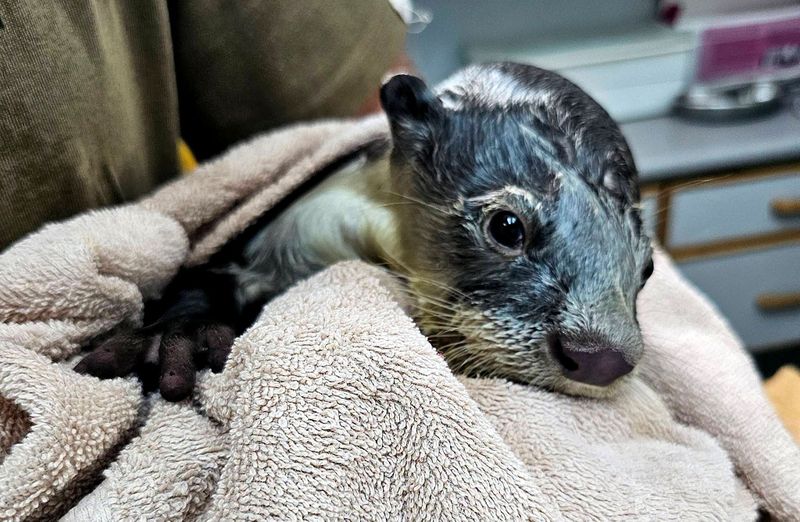
A young otter found struggling in a “sea of sewage” at Cape Recife has died, raising fresh concerns about the environmental consequences of Nelson Mandela Bay’s failing infrastructure.Bay wildlife expert and environmentalist Arnold Slabbert is considering laying criminal charges against the municipality and possibly individual officials for allegedly flouting environmental laws, following a visit to Cape Recife where sewage from a nearby wastewater treatment works is spewing into the ocean untreated.His visit to investigate the persistent discharge from the Cape Recife Wastewater Treatment Works comes after the young otter, rescued earlier in November, died. Leading African penguin researcher Professor Lorien Pichegru, who was in the area at the time, had alerted him to the young, fragile otter, which was found in what Slabbert described as a “sea of sewage”.Pichegru told Daily Maverick on Thursday that what she witnessed at Cape Recife was “more than heartbreaking”. The water was “light green… very, very artificial”, she said, while the smell was “very horrible”.The coastline at Cape Recife, where a stream of sewage is flowing into the ocean. (Photo: Deon Ferreira) Shortly after the otter died, an autopsy found that its “stomach was so scarred, it looked like he’d eaten acid”, Slabbert said.On Thursday, accompanied by police officials and Professor Nadine Strydom from the Department of Zoology at the Nelson Mandela University, Slabbert collected water samples from the affected area. The samples have been sent to an independent laboratory for testing.“The smell – when you arrive at the beach at Cape Recife where holidaymakers and tourists go, the stench at the beach where we took water samples is unreal. It’s like a powerful ammonia smell. Properly treated wastewater should never smell like that,” said Strydom.A heavy flow of murky water, suspected to be sewage, pours into the ocean at Cape Recife. Gqeberha environmentalist Arnold Slabbert says the discharge indicates that the Nelson Mandela Bay Municipality is unable to manage its wastewater treatment works. (Photo: Deon Ferreira)She raised concerns about the birdlife in the area, saying birds that had previously been present near the Roseate Tern Hiking Trail had disappeared.Slabbert said he was awaiting the laboratory results before forging ahead with bringing criminal charges against the municipality and possibly specific officials.“That sewage has not been treated. That water’s toxic, man. It’s absolutely rotten,” he said.Water samples were collected for testing following reports of sewage discharges into the ocean at Cape Recife. Slabbert says a criminal case against the municipality may be opened, depending on the outcome of the test results. (Photo: Deon Ferreira) He warned that the continued discharge of untreated sewage into the sea could have serious ramifications for marine life.“With that raw sewage, you’re developing a dead zone. If you go to all of these big rivers that are pushing all of their pollutants into the sea, you will get dead zones where there is no life. “So all of the toxins and effluent that’s getting pushed into the sea there is just killing all the sea life along the coast there. It's not even harming it, it’s just killing it,” Slabbert said.“This municipality has no capacity; in fact, most municipalities seem to lack the capacity and the desire to effectively manage their wastewater systems. Most of them, including in the Western Cape, are pushing their sewage straight into the sea. And the problem is, there is no enforcement,” he said.Prof Nadine Strydom, a zoologist at Nelson Mandela University, labels a specimen bag after she, with Arnold Slabbert, collected water samples on 19 November 2026. Slabbert, wearing the orange-coloured sunglasses, is an environmentalist from Gqeberha. (Photo: Deon Ferreira) History of sewage pollution, criminal investigationsSewage crises in Nelson Mandela Bay are not new. The Department of Forestry, Fisheries and the Environment (DFFE) earlier confirmed two criminal investigations involving the municipality.One relates to sewage spills affecting Kuyga between April 2024 and November 2025, while the other concerns sewage pollution in the Gqeberha harbour in 2022. The harbour case has been referred to the National Prosecuting Authority (NPA), which has yet to decide whether to prosecute.Sewage from the Cape Recife Wastewater Treatment Works in Gqeberha flows into the ocean. (Photo: Deon Ferreira) The sewage crisis at Cape Recife has also drawn the attention of the South African Human Rights Commission (SAHRC), which found evidence of widespread wastewater pollution, inadequate water-quality monitoring and failures to prevent contamination of rivers, estuaries and coastal areas. In its report, released in July 2026, the commission warned that the pollution threatened residents’ constitutional right to an environment that was not harmful to their health or wellbeing. It gave the municipality 30 days to submit a plan outlining how it intended to address the problems.A city-wide sewage problemAccording to Dr Gary Koekemoer, chairperson of the Eastern Cape branch of the Wildlife and Environment Society of South Africa (Wessa), the problems at the Cape Recife wastewater treatment works are not isolated, but part of a wider sanitation crisis affecting Nelson Mandela Bay.The consequences are also being felt by businesses operating in the metro, including oyster farms that regularly have to suspend production because sewage contamination affects water quality and causes them to fail international testing requirements, he said.The entrance to the Cape Recife Wastewater Treatment Works in Gqeberha on Thursday, 19 November 2026. Gqeberha environmentalist Arnold Slabbert says the persistent discharge of sewage from the facility is damaging the environment and poses a serious risk to both humans and animals. (Photo: Deon Ferreira) “But the problem is that systemically, our sanitation system is collapsing. And we work closely with the officials. So we know that they are doing work.“We know that they are trying. So people call it vandalism, but it’s not vandalism. It’s targeted stripping of the pump stations and infrastructure.“There’s an element of our society that we have to look in the mirror and go, our infrastructure should be sort of sacred,” Koekemoer said.‘If you fail to plan, you plan to fail’While vandalism and the stripping of municipal infrastructure are said to be contributing to the crisis, Strydom said the municipality’s failure to adequately maintain and upgrade its bulk wastewater infrastructure had left the system increasingly unable to cope with the city’s growing population.She said the problems had been building for years, with maintenance neglected and little meaningful investment in upgrading infrastructure to accommodate the metro’s expansion.“The city is haemorrhaging sewage. Maintenance has been neglected for literally years. We can even go into decades. Maintenance has been neglected, and number two, there’s been absolutely no upgrading of this metro’s sewage infrastructure, despite the fact that the population has grown astronomically.“Water infrastructure, sewage infrastructure, it’s been very poorly planned. Extremely poorly planned. And now, add lack of maintenance, and now we sit with one environmental disaster after the other,” Strydom said.‘Things are going backwards, not forwards’Koekemoer said addressing the crisis would require a more systemic approach from the municipality’s leadership, beginning with filling critical vacancies and restoring stability to the administration.He said the municipality’s latest Green Drop assessment – which sits at a dismal 36.3% – reflected the extent of the deterioration in its wastewater management.“It’s the lowest Green Drop report that it’s ever had. So it’s the lowest rating that it’s ever had. That says that things are going backwards, not forwards,” he said.Koekemoer said the instability in the municipality’s political leadership had also diverted attention from the city’s deteriorating infrastructure.The metro has had repeated changes in its mayoral leadership in recent years, while critical municipal positions remain vacant.“The municipality isn’t doing the job that it is mandated to do. That’s clear. I think that the problem is solved, firstly, by a permanent city manager,” he said.Slabbert, pictured here with Elizabeth van Staden, says there is little doubt that the water flowing into the ocean is untreated sewage, as he has spotted sanitary products and other sanitary waste in the water. (Photo: Deon Ferreira) Koekemoer said the focus on political leadership changes had come at the expense of addressing the city’s most pressing infrastructure problems.“But that’s not necessarily the officials’ issue. I think you have to ask the council, that has been deliberating about four or five different mayors over the last five years, whether their attention on the mayors is as valuable as the attention on our sewage system. And you can repeat that thing for electricity, for water, for all our infrastructure stuff.”The Nelson Mandela Bay Municipality acknowledged receipt of a request for comment on Thursday, 19 November 2026, but had not responded by the time of publication. If a response is received, it will be included. DM
THE BIG STINK: Young otter’s death highlights Nelson Mandela Bay’s ‘haemorrhaging sewage’ crisis
Full Article
Original Source
Read the full article at Dailymaverick →KhanList aggregates and links to publicly available news content. We do not host full articles from third-party sources. Always verify important information with original sources.