
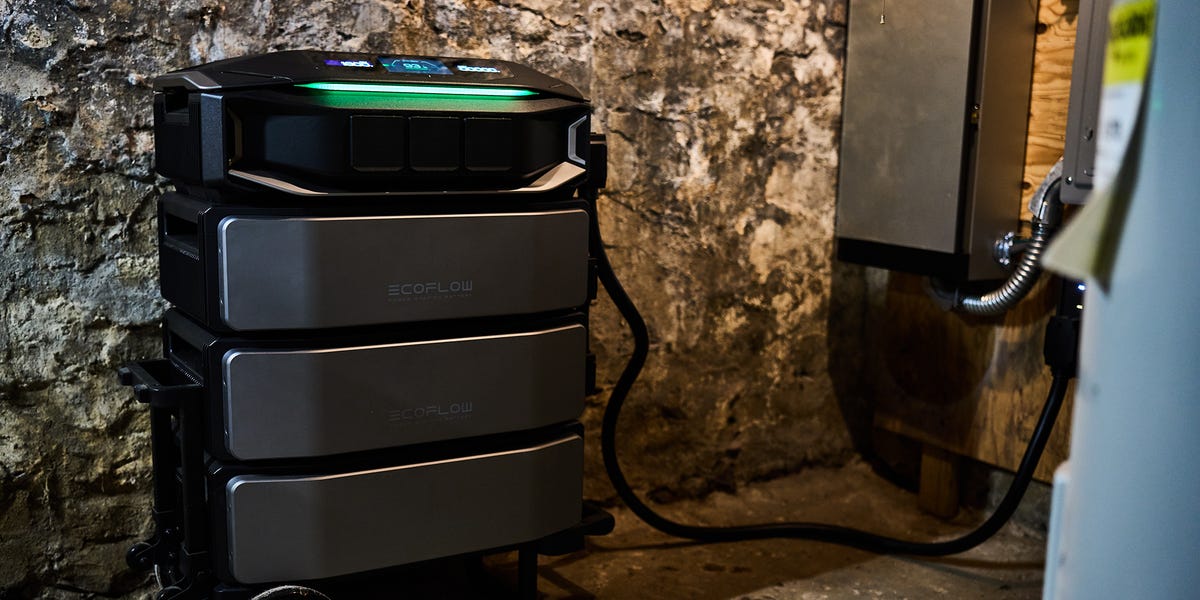
12 min readIf the power goes out, a battery-based backup system is attractive for many reasons. Sure, a fuel-based generator is great, but you need to run it outside because of the emissions, plus engine maintenance is messy, and they are very loud. The best whole-home power station systems can be set up indoors, have no emissions, and run nearly silently.Whole-home power station systems also feature several smart features you just can’t find on fuel-based generators. That includes automated time-of-use grid charging schedules, integration with larger home solar arrays, real-time monitoring of the electrical system, and notifications if problems occur, to name a few.These systems come at a high cost. Even entry-level configurations start at $3,000 or more, and that doesn’t include any costs that might be associated with installing and connecting the power stations to your home electrical system. But fuel-based standby generators are just as expensive, if not more, and aren’t nearly as configurable.Keep in mind that whole-home power station systems are not generators unto themselves. They are battery-based devices that store electricity for use on demand. When they need to be recharged, they require power from a public grid, a portable generator, or solar panels, a process that can take up to 12 hours or more. Despite that limitation, these systems are expandable using extra batteries to keep everything in your home running for a week or even longer.Best Whole-Home Power StationsBest Overall: EcoFlow Delta Pro Ultra X + Smart Panel Home 3Best Value: Jackery Explorer 5000 Plus and Smart Transfer SwitchBest for Solar Recharging: Anker Solix E10 + Power DockMost Modular: Bluetti Apex 300 Home Integration KitHow We Selected and TestedAll of the whole-home power systems we review below can be configured to meet different needs and budgets. To get you started, we chose the base model of each system. For whole-home backup, adding a power station (inverter/controller), batteries, and a transfer switch or panel replacement is required.It’s important to note that no system like the ones we chose is entirely plug-and-play. Additional wiring, electrical box upgrades, or other electrical equipment may be required for any installation of a battery-based system, so always consult a professional electrician before embarking on any project to ensure the installation is performed safely and correctly.Our team tested and reviewed the EcoFlow Delta Pro Ultra X and the Bluetti Apex 300. We’re recommending the Anker Solix E10 + Power Dock and the Bluetti Apex 300 Home Integration based on our experience and knowledge of brands that offer large whole-home battery-based backup systems.Full ReviewsProsFully automated whole-home backup will switch over instantly during a blackoutOnce installed, you can easily expand at any time with more batteriesStarter bundle offers double the power compared to other brandsConsIt’s expensive compared to some other brands (but comparable to some standby generators)Key SpecsCapacity12.28 kWh (expandable to 184.32 kWh)Max Ouput12 kW (expandable to 36 kW)Battery TypeLiFePO4EcoFlow’s Delta Pro Ultra X paired with its Smart Panel 3 is the brand’s most powerful and expandable power station platform to date. With 32 available circuits in the panel, not only can you back up your entire house, but you could also use it to replace the main electric service panel (though it can work as a subpanel, too).The bundle we reviewed comes with a 12-kilowatt inverter and controller—the most powerful on our list— two 6-kilowatt-hour batteries, and the Smart Panel 3. Gear Editor Bradley Ford previously reviewed EcoFlow’s Smart Panel 2 system, installing it himself, but allowed a local installer to perform the integration of the newer system, which took about 6.5 hours with an estimated cost of $3,200.During his test, two power outages occurred at his home, and he was impressed with the performance of the system, which automatically switched over from grid to backup power on its own seamlessly. The Emergency Power Supply (EPS) mode was also enabled and facilitated a 20-millisecond switch to backup power that was barely noticeable. He also took advantage of the Storm Guard feature that monitors severe weather. If predicted within a 12-hour window, that system automatically charges the batteries to 100 percent to prepare for possible outages.The Ultra X system can run effortlessly in the background, with little thought or concern on the part of the end user. If the power goes out, a notification will be sent to your phone, and the app will show exactly when it happened, what is being powered, and shut down unnecessary circuits to preserve power.Trevor RaabWith the EcoFlow app paired, you can view power usage down to the circuit, preset which circuits get backup power during outages, manually turn circuits on and off, and schedule automated tasks like charging and discharging. You also still receive notifications when the grid goes down and backup power takes over.Ford’s setup could reasonably power his home for one day if power went out for that amount of time, but a single Ultra X station can be expanded to support up to 10 batteries for a total of 61.4 kWh of capacity (potentially five days' worth of power). Additionally, you can also run up to three stations in parallel, so theoretically you could build a home backup system that offers a whopping 184.3 kWh of capacity and 36 kW of power output (though building such a system would cost well over $100,000). That’s over double the size of anything else we’ve seen, making EcoFlow the most expandable system out there.Full EcoFlow Delta Pro Ultra X + Smart Panel 3 ReviewProsMore affordable entry-level bundleAdd up to five batteries for a total of 30.24 kWh of capacityMain unit rolls on four wheelsConsMain unit is quite large, and you can’t stack extra batteries on or under itSmart transfer switch limited to 12 circuits (6 at 240 volts)Key SpecsCapacity5 kWh (expandable to 60.48 kWh)Max Output7.2 kW (expandable to 14.4 kW)Battery TypeLiFePO4Our experience with Jackery products has been that they deliver good performance for a bit less money than the competition. While we have not yet tested the Jackery Explorer 5000 Plus and Smart Transfer Switch, at just under $4,000, it comes in at a bit less than you would pay for a comparable system.As a stand-alone power station, the 5000 Plus is already a formidable backup solution, with 7,200 watts of total output (14,400 surge) and a base capacity of 5,040 watt-hours. It also has several outlets, including four standard AC outlets, four USB ports, a 12-volt port, a 30-amp 120-volt outlet, and a 30-amp 120/240-volt outlet.This station can be further expanded up to 30.24 kWh by adding up to five additional batteries, and you can run them in parallel to boost the total output power to 14,400 watts and the total capacity up to 60.48 kWh (bringing the total cost of such a system to over $32,000, not including any installation costs).Meanwhile, the smart transfer switch does several interesting things. Besides automatically switching to backup power when it senses the grid power has gone out while connected to the 5000 Plus, it doesn't lock you out of it completely. You can still use the additional ports on the power station while still feeding power into your home electrical system. Not all stations allow that.The smart transfer switch is limited to 12 circuits, so it’s unlikely to replace the main box the way an EcoFlow system can, but for someone looking to invest in a battery-based home backup system, Jackery is offering a decent option at a lower price point.ProsExpandable up to 22.8 kW of output and 90 kWh of capacityOutdoor-rated, so you can install it outside, even in weather as low as -4 degrees Fahrenheit Can connect to rooftop solar arrays without the need for a separate converterConsE10 doesn’t really work as a standalone power station without optional accessoriesKey SpecsCapacity6.1 kWh (expandable to 90 kWh)Max Output7.7 kW (expandable to 22.8 kW)Battery TypeLiFePO4Anker’s E10 is the basis for a whole-home backup system that, when paired with its Power Dock automatic transfer switch, can kick in automatically during a blackout and power up to 12 independent circuits in the home. The platform is expandable with additional batteries, and you can connect up to three separate E10 control units; each one can support up to five batteries. A fully realized system could provide up to 22.8 kilowatts of output and 90 kilowatt-hours of capacity (though it would cost nearly $50,000).The heart of this setup is the Power Dock, which acts as an automatic transfer switch with 12 circuits, supports up to 200 amps, and has inputs for up to three E10 controllers. In addition to automatically switching to backup power (as fast as 20 milliseconds) in the event of a power failure, the Power Dock can be controlled via Anker’s mobile app, which monitors each circuit's power draw and allows each circuit to be turned on or off individually. You can also prioritize certain circuits over others so that some will automatically turn off when battery capacity dips below 50 percent.The E10 system also offers robust solar recharging options, including inputs that support a connection to larger setups, like rigid, rooftop arrays. The E10 can accept 15-amp input at voltages between 30 and 450 VDC. That means you can input up to 4,500 watts of solar power, which is four to five times higher than most power stations.In cases where solar power is not going to cut it, Anker offers an optional fuel-based inverter generator, the Solix 5500, which we recently tested. This tri-fuel generator can be used to top off your batteries during emergencies and has a fast, direct DC power connection that can fast-charge the E10 when capacity runs low; there’s no other way to charge it quickly.ProsApex 300 station is very portable and stands alone as a capable power stationThere’s an option for connecting to high-input solarEasy-to-use app with access to a wide variety of advanced featuresConsBluetti does not offer a proprietary smart automatic transfer switchThe power output for the Apex is 300 is lower than competing models, so you’ll more likely need to run one in parallel to meet the demands of home backupKey SpecsCapacity2.7 kWh (expandable to 58 kWh)Max Output3.8 kW (expandable to 11.5 kW)BatterytypeLiFePO4The starting point for building a home backup system Apex 300a stand-alone power station that’s the most portable on our list. At 84 pounds, it’s not super lightweight, but it’s easy enough to pick up and pack in a car if you wanted to. But from there, you can expand it into a large system. You can add up to six additional batteries (either the BK3000 or BK5000) for battery capacity up to 19.4 kilowatt-hours. That can increase even more by running three Apex 300s in parallel using a Hub A1 Parallel box, which would bring your total system capacity to 58 kilowatt-hours and total power output potential to 11.5 kilowatts.When we tested the Apex 300 by itself, we were impressed with its overall performance. Using its UPS mode, we simulated a blackout, and the station switched on immediately with little interruption to the lights and refrigerator we had connected to it. And Bluetti’s companion mobile app is hands-down one of the best on the market. It’s easy to use and offers more advanced features, such as input-level customization or a grid-adaptation mode that protects the station from voltage spikes or unexpected drops in power.The one potential downside we see as it relates to whole-home backup is the power output. The Apex 300 can only output 2.7 kW (2,764.8 watts), more than half the amount of competing stations' entry-level packages. You’d need to run two or three of them in parallel to confidently run an HVAC system, lights, and appliances. Bluetti also does not make an automatic transfer switch of its own, so you would need to source one from a compatible third party. The package we feature here comes with a third-party manual transfer switch that Bluetti sells as part of a package that also includes an additional backup battery.The flip side of this problem is that the cost of entry is lower than others by comparison. The home integration kit is $4,099, which is the lowest price on our list. You could even just purchase the Apex 300 for $1,699 with the knowledge that you could easily build a full system later if you wanted to, but still get a great portable power station in the interim. If you’re nervous about investing a huge amount of money right now, Bluetti offers a lot of flexibility to start.How to Choose The Right Power Station SystemStart by figuring out the amount of energy your home uses on average per day (watt-hours or kilowatt-hours). The easiest way to determine this is to look at your past few electric bills. Most utilities list how many kilowatt-hours you use per month. From there, you can divide that number by 30 and get a rough estimate of how much power your home uses per day. That will help you decide how much capacity your system may need. For example, if you desire to power all of your home’s circuits during an outage and use a daily average of 18 kilowatt-hours, you’ll need to have enough battery capacity in your system to cover that (ideally a bit more, as factory numbers are only true in an ideal world) if you want 24 hours of backup coverage.You’ll also need to figure out how much output (watts) the system needs to provide power to all of your circuits. This starts with a little math. Ideally, you want to calculate this by adding up the wattage draw of all of your appliances, lights, and other electrical devices. Leave room to spare, because you’ll always wind up needing a bit more than you think you need (we recommend 20 percent more). Drawing too much can cause an overload that will trip the circuits or shut down the station.As you make your list, note what items are 120-volt and which ones are 240-volt appliances. Most items that you plug in—lighting, refrigerators, small appliances, and most electronics—are 12-volt. Meanwhile 240 volts devices—electric dryers, well pumps, and HVAC systems—will be either hardwired into your electrical system or have a dedicated 240-volt outlet.The amount of power you need may vary greatly depending on your needs. If you’re just powering a fridge, lights, and a few modest appliances during a short blackout, then 3,000 to 5,000 watts should do. But running heat, hot water, and several appliances at once will require more—at least 6,000 to 8,000 watts—and powering an entire home, everything included, will likely demand 10,000 watts or more.Energy load estimates for typical home appliances and recommended circuits for generators with a running capacity of up to 7kW, 17kW, and 48 kW.What to ConsiderCapacityCapacity, listed in watt-hours (Wh), is a measure of how much energy a power station can deliver over time. Generally, the larger the capacity, the longer the power station can run, but the length of time is dependent on how much power is being used. You can estimate how long a power station will last by dividing the total watt-hours by the watts drawn (Wh ÷ W = Hrs).For example, if you have a power station with 2,048 watt-hour capacity and are consistently drawing 400 watts of power: 2,048 ÷ 400 = 5.12 hours of runtime.One caveat is that you’ll typically get about 85 percent of the listed watt-hours due to power lost in connections and the electricity that the power station itself uses to power its inverter and display. So, a fully charged 2,000-watt-hour power station might only give you about 1,700 watt-hours of real-world power. Because of this, it’s always wise to buy around 20 percent more than you think you might actually need.InstallationConnecting a large whole-home power station system to your electrical system is similar to how you connect a generator to your home, and will require the installation of a transfer switch, whether that’s a manual version or a more advanced automatic model. Depending on the state of the wiring in your home and your main electrical box, there may be unforeseen upgrades required to make your home ready.It’s always wise to assume that the installation of any large system will cost more than the price tag of the basic equipment (sometimes thousands of dollars), so it’s a good idea to have your home evaluated by a professional before you buy the power station gear. You should also never attempt to install a system yourself if you do not have a lot of experience working with home electrical. Some power station companies offer installation services that connect you with a local professional who will be familiar with local electrical codes and can install your system properly and safely.Peak ShavingAdvanced power stations designed for home backup can perform “peak shaving” during non-emergency times in regions where utility rates vary between peak and off-peak. This process turns off the grid power during peak-rate hours and uses the power station to run home circuits, and then turns it back on during off-peak hours. It will also recharge the station during the lower-rate times. This can potentially save you money on your electric bills.The challenge of peak shaving is that you need a system large enough to handle all of your home's power needs if you want to keep things running normally, the cost of which could take many years to fully realize. It will take a bit of research to make sure you are choosing the right times of day and extra effort in programming your system.RechargingLike any battery-based system, once a power station is depleted, it has to recharge. All large systems can do this using AC power from the grid, solar panels, or power from a fuel-based generator. AC power is the easiest and fastest, and most stations are designed with weather alert tracking, which detects severe weather up to 12 hours prior and preemptively charges the station to 100 percent.A fuel generator can be as fast as power from the grid, and some power station companies like Anker and EcoFlow even have their own versions of fuel generators, designed with smart features that work with their power station systems. Because power stations are advanced electronic devices, inverter generators are the ideal choice in this situation because they deliver cleaner, more stable power.Solar energy is the most eco-friendly option, but also the slowest, taking many hours to recharge. How long depends on the size of your panels, the maximum solar input levels of your power station, and the total battery capacity of the system (the larger the capacity, the longer it will take). For example, a large system could take several days of perfectly sunny conditions to recharge fully from a simple portable array. Some systems can connect to larger rooftop arrays, however, which can significantly cut down on recharging time.David is a Reviews Editor for Hearst’s Enthusiast Group, contributing to Popular Mechanics, Runner’s World, Bicycling, Best Products, and Biography. He has over 25 years of experience writing about and reviewing consumer electronics, kitchen appliances, DIY products, outdoor gear, and more. He also spent years covering the ever-changing world of online retail. To relax, he loves experimenting with new recipes, tweaking his smart home setup, and spending time outdoors on his bike or camping. Rachel is the Deputy Editor of Reviews for Hearst's Enthusiast and Wellness Group where she supports Popular Mechanics, Runner's World, and Best Products. Her background is in service journalism and earlier in her career she worked as a daily newspaper reporter and book editor. She spent more than a decade as a staff editor and writer at TripAdvisor and Penguin Random House and her byline has appeared in Time Out New York, the New York Daily News, and New York Magazine. Outside of work, Rachel can be found planning her next trip, visiting museums and galleries, and walking her wirehaired dachshund in Central Park.
The Best Whole-Home Power Station Systems Deliver Clean Backup Power During a Blackout
Full Article
Original Source
Read the full article at Popularmechanics →KhanList aggregates and links to publicly available news content. We do not host full articles from third-party sources. Always verify important information with original sources.