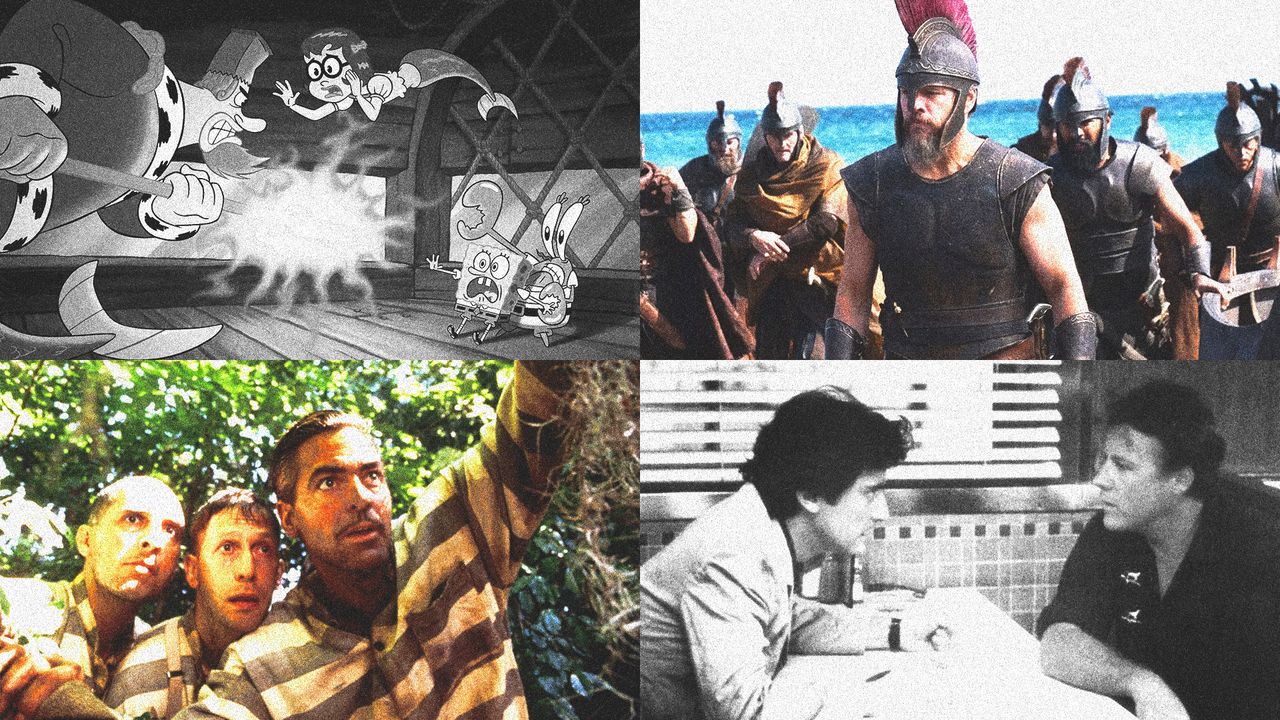
The Odyssey may not have invented the narrative concept of a journey home—but it sort of owns the idea. Turns out producing a massive piece of writing that becomes incredibly popular and lasts for thousands of years does actually function as a sort of artistic shotgun-call on the loose conceptual framework of the thing you’ve written. Fair enough, I guess.What this means is that, while there are of course your more direct adaptations of Homer’s original story, like that big film Christopher Nolan has just made, there have also been, in the quite-long-time since Homer’s OG, many many many pieces of storytelling that either explicitly or more subtly draw inspiration from The Odyssey and the concept (a long journey home) that it kind of sort of owns. Here are the best of them.5) The Simpsons, “Tales From the Public Domain” (2002)The audiobook of Homer's Odyssey (the original Homer, that is) runs about 14 hours, but this segment from season 13 of The Simpsons manages to trim the whole thing down to a tight seven minutes. The Odyssey stuff is just the first third of an episode that also features Simpsons-ized takes on Joan of Arc and Hamlet, but it manages to squeeze in Homer/Odysseus’s siege of Priam/Flanders’s Troy, the passage past the Sirens/Patty and Selma, a non-canonical attempt to destroy Homer/Odysseus with a lightning bolt by Dionysus/Barney, and Homer/Odysseus’s eventual return home to his son Telemachus/Bart and wife Penelope/Marge, who has resisted the advances of suitors Krusty the Klown, Groundskeeper Willie, Mr Burns and Sideshow Mel. Lesson for next time, (Original) Homer—cut the fat, yeah?4) The Spongebob Squarepants Movie (2004)Yes, really. Chances are the references to the source material sailed over the heads of this film’s target audience, but they’re in there—from the overall narrative structure (Spongebob and Patrick must make a long and treacherous journey home), to the interventions of sea god King Neptune and wind god The Bag of Winds (a literal bag that Spongebob and Patrick are gifted to guide them on their way home), and the siren-esque allure of an ice cream van which almost tempts our intrepid duo off course. Funny to imagine how Homer might feel upon being told his epic poem would one day be adapted for a children’s film about a burger-loving sponge and his starfish compatriot. Let’s say he would’ve loved it.3) O Brother, Where Art Thou? (2000)An immaculatelty-curated roots-music soundtrack featuring the likes of Alison Krauss, John Hartford, Emmylou Harris and Gillian Welch bounces through this merry tale about a trio of chain-gang escapees making their way across Great Depression-afflicted Mississippi. To make it back to the treasure he's stashed at home, George Clooney and crew face John Goodman's cyclops-esque crook Big Dan, sirens singing from the waters of a Mississippi mudhole, and the suitors angling to steal Clooney's beloved wife from him while he's away. The American South of the 1930s is a place that's pretty easy to imagine having an enormous density of absolute weirdos, and this lends itself extremely naturally to the sort of encounters that make a long and winding journey like this one so much more than just your standard “someone who wants something and has trouble getting it” hero's journey.2) After Hours (1985)It's a real tragedy that Griffin Dunne didn't become inordinately famous and successful as a result of this film, because he's absolutely fantastic in Martin Scorsese's often-overlooked '80s screwball comedy. He plays Paul Hackett, a man who journeys across Soho (the New York one) for an impromptu date and ends up taking an enormously convoluted journey home that’s populated by zany weirdos of the night. As with O Brother Where Art Thou, it's a setting that very comfortably populates the range of freaks you really need to bring this type of journey to life. Their confinement within a few square miles, in tandem with the semi-cyclical nature of the script, makes this film a strange testament to the density and range of human life that a city can offer— even in the middle of the worst night of some poor sod's life.1) Ulysses (1922)Odysseus's ten years of voyaging across the islands of the Aegean Sea become a single day in Dublin, and Homer's simple and repetitive style (designed to be easy to follow if you were sitting in an amphitheatre hearing someone recite it) makes way for Joyce's infamously elusive stream-of-consciousness prose. Ulysses is different, and difficult at times, but it's worth it. Not only will it allow you to lord your literary credentials over everyone you know who's heard of it and sort of wants to read it but hasn't, it's also, much more importantly, an absolute ton of fun. The style takes a minute to get used to, sure, but battle through chapter three (Proteus), and you'll fall into lockstep with it surprisingly quickly. Once that happens, you're in for an extremely enjoyable extended lesson on the infinite possibilities of language, and how the act of depicting a day, or an hour, can provide an opportunity for invention that imbues life with the magic of imagination.This story originally appeared in British GQ.
The Best ‘The Odyssey’ Adaptations that aren't ‘The Odyssey,’ Definitively Ranked
Full Article
Original Source
Read the full article at Gq →KhanList aggregates and links to publicly available news content. We do not host full articles from third-party sources. Always verify important information with original sources.