
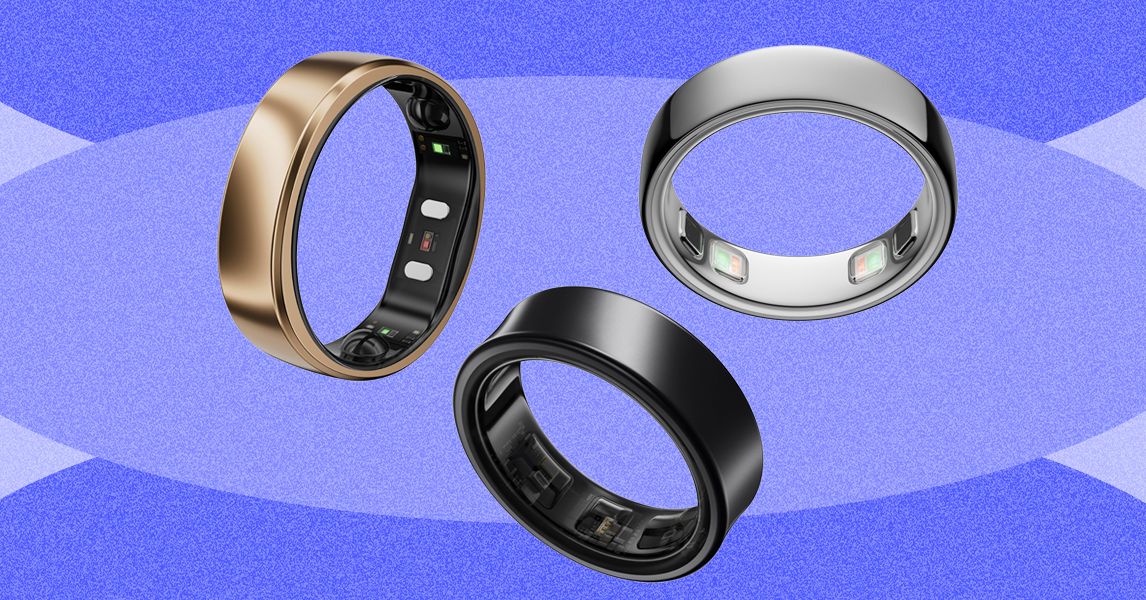
The best smart ring does a lot without asking much of you, passively tracking your activity, health, and sleep. Some models go even further, with meal logging, AI coaching, and cycle tracking. No distracting screens. No bulky smartwatch banging you in the face while you're deep in REM sleep.Once the preserve of wealthy wellness buffs, top-of-the-line smart rings are becoming increasingly affordable and available. Although our top pick is still Finnish pioneer Oura's Ring 5 (from $399), the company is no longer the only fish in the smart-ring sea, thanks to upstarts like Ultrahuman and RingConn, established fitness-tracking brands like Amazfit, and even tech giants like Samsung. I expect to see more entrants in the coming months, but for now, these are the best smart rings we’ve tried.For more wearable recommendations, check out WIRED's guides to the Best Smartwatches, the Best Fitness Trackers, and the Best Fitbits.Featured in This GuideBest Smart Ring OverallOura Ring 5Jump to reviewBest Subscription-Free Smart RingRingConn Gen 2 AirJump to reviewBest for Samsung UsersSamsung Galaxy RingJump to reviewHow I Test Smart RingsWhat Am I Testing Next?More Smart Rings We TestedAvoid These Smart RingsFAQsWIRED has been testing smart rings since the NFC Ring and the first-ever Oura Ring. I wear each smart ring 24/7, for at least a month, to assess how it performs in everyday life. Every ring is worn during activities like commuting, exercising, and sleeping to see how comfortable it feels over extended use and whether the design causes irritation, scratches easily, or gets in the way of everyday tasks.Sleep tracking: Sleep tracking is one of the biggest reasons people buy smart rings, so I wear each device overnight for several weeks and compare data trends against other trackers I regularly use, including wearables and sleep-tracking mats. I also evaluate whether the personalized insights (readiness metrics, sleep apnea detection, and coaching recommendations) are useful.Fitness tracking: I wear each ring during a range of workouts—including walks, runs, and high-intensity training—to evaluate how accurately it tracks movement, heart rate variability (HRV), and other exertion metrics. I compare data trends against other fitness trackers I regularly use.Durability: I expose all smart rings to daily handwashing, temperature fluctuations, and bumps. I check for scratches, coating wear, and water resistance performance.Companion app: Since most smart rings lack screens, companion apps need to be user-friendly. I evaluate how easy the apps are to navigate, how clearly they present health data, and whether paywalled subscriptions lock away essential features.Battery life: Battery life claims are tested. I track how long each ring lasts with all available features, such as continuous heart-rate monitoring, workout recognition, and sleep tracking. I also look at how quickly each ring charges and whether its charging accessories are practical to use.Sizing: Because fit is critical for accurate readings and usability, I take note of sizing ranges and kits. I test multiple finger placements when possible and track performance to determine how dependable the readings are.Value: Some smart rings cost as much as a premium smartwatch, and many also require monthly subscriptions. To determine whether a ring is worth buying, I consider its build quality, the accuracy of its features, the app experience, and any ongoing fees.Love WIRED? Add us as a preferred source on Google to see more of us.Best Smart Ring OverallPhotograph: Boutayna ChokraneWIREDMuch smaller, more comfortable designImproved fitness features, including Live Activity, heart-rate monitor support, and more reliable automatic workout detectionThoughtful privacy additionsSeamless multi-ring supportTIREDSymptom Radar still isn’t as predictive as Oura claimsSubscription still feels mandatoryThe original Oura Ring unilaterally created the health smart ring category. This stylish, unobtrusive ring, popularized by biohacking billionaires, soon brought miniaturized fitness tracking to the masses.Why WIRED recommends: The latest Oura Ring 5 is 40 percent smaller than its predecessor, making it one of the comfiest wearables to keep on all day and night. The titanium exterior has a new coating applied with physical vapor deposition (PVD) to improve scratch resistance, and the ring itself features redesigned sensors, stronger signal detection, and consequently, better accuracy. It also has improved battery life, lasting up to nine days of use.The biggest upgrade is Oura's push toward AI-powered health guidance. Similar to Google Health Coach, the Oura Advisor can answer wellness questions, provide personalized recommendations, and help identify patterns across your long-term data. New health features, including blood pressure signals and nighttime breathing insights, expand Oura's focus beyond basic fitness tracking.The trade-offs: While it now supports live activity tracking through the app and can work with compatible heart rate monitors, the Ring 5 isn't the best choice for athletes who need live workout stats or a built-in GPS. If you already own a Ring 4, I'd probably wait another generation, considering that most software additions are coming to older hardware anyway. Finally, you'll need an Oura membership ($6 per month or $70 annually) to unlock most of its insights. (Without it, you can only view your Readiness, Activity, and Sleep Scores.)Is There a Class-Action Lawsuit Against Oura?Last August, San Francisco’s Clarkson Law Firm filed a class-action lawsuit alleging that Oura rings cannot measure one’s sleep stages and rely on the company’s AI models to do the guesswork. The complaint argues that sleep is “defined by brain electrical activity, eye movements, muscle tone, and other signals measured through electrodes placed on the scalp, leads on the eyes, and sensors on the chin. [Oura] doesn’t measure any of these parameters.”In an email statement to WIRED responding to the lawsuit, an Oura spokesperson wrote, “Like other consumer sleep wearables, Oura Ring estimates sleep stages using multiple physiological signals, including heart rate, heart rate variability, movement, breathing patterns, and temperature.”According to Oura, its sleep-staging algorithm is informed by research based on more than 1,200 nights of collected data. “We published a peer-reviewed paper that describes how the sleep-staging algorithm was developed and how it uses the signals collected by the ring,” wrote the spokesperson. “Multiple third-party, independent studies support our claims of accuracy, and we have transparently reported on the mechanisms and measures that inform Oura’s sleep staging.”As of November 2, the court has yet to rule on Oura’s response to the complaint. I’ll continue to monitor the lawsuit and report back on any significant developments. For now, though, nothing has surfaced that changes my judgment of Oura as my top pick.TL;DR: Though still subscription-based, the Oura Ring 5 is the best sleep tracker, one of the best fitness trackers, and the best smart ring for most folks. Read my full review.Best Subscription-Free Smart RingWIREDNo subscription requiredRelatively affordableLighter and more comfortable than the Oura Ring 4TIREDLimited workout trackingSlow app syncingLess accurate than its competitorsI'm currently testing the RingConn Gen 3, but the Gen 2 Air remains one of our budget picks thanks to its affordable price and subscription-free model.Why WIRED recommends: The RingConn Gen 2 Air is slimmer, lighter, and much more comfortable than previous models. It tracks your steps, calories burned, heart rate, blood oxygen, and sleep. It can prompt you to get up when you’ve been sedentary for too long and nudge you to take a breather if your stress levels spike. It's also compatible with colored ring protectors to swap out with your outfits if you're someone who likes to color-coordinate.RingConn added an AI assistant to the app that generates a plan for you, adjusting your targets weekly based on your activity and feedback. This feature is fine. You can ask questions and get tips, but it doesn't dramatically change the overall user experience or make me more motivated to use the ring.The trade-offs: Compared to the Gen 2, it's made from cheaper steel, has a slightly shorter battery life (still up to 10 days), can’t detect sleep apnea, and comes with a basic charger instead of a nifty charging case. Workout tracking is limited and does not work well when your heart rate is elevated. It also consistently overestimated reviewer Simon Hill's sleep and underestimated his steps and activity compared to the Oura and Apple Watch.TL;DR: The RingConn Gen 2 Air is worth considering given that it's comparatively affordable and subscription-free.Best for Samsung UsersWIREDLighter than the Oura Ring 4Works seamlessly with the Galaxy WatchFull suite of health features, including cycle trackingTIREDNot worth buying if you don’t have a Samsung phoneDoesn’t have a gyroscope or GPSAI-enabled suggestions are poorThe Samsung Galaxy Ring works seamlessly with the Galaxy Watch8 series and Galaxy Watch Ultra, extending each device's battery life by trading tasks and keeping tabs on your activity while the other is charging.Why WIRED recommends: Former WIRED editor Adrienne So found this ring's accuracy similar to the Apple Watch Ultra. It accurately auto-detected workouts—even pool workouts—and the heart rate tracking is also reliable. Its cycle-tracking feature, powered by the fertility-tracking app Natural Cycles, uses skin-temperature sensing to track when your period will come—and it works.It comes in an attractive, clear charging case with an LED that shows you how much battery life you have left.The trade-offs: While you can use the Galaxy Ring with most Android phones, it costs about as much as the Oura Ring 5 upfront and doesn’t require a subscription. The most useful features, like your daily Energy Score and wellness tips (what the company calls Booster Cards), also rely on Galaxy AI, which means you'll only be able to see them if you are using the ring with an Android phone and the Samsung Health app. Lastly, Adrienne found the Galaxy Ring to be a bit too generous with its sleep tracking, which makes sense since it lacks a gyroscope.TL;DR: If you have a Samsung phone and Galaxy Watch, the Samsung Galaxy Ring has an Apple-like seamlessness and interoperability to it. Read Adrienne So's full review here.More Smart Rings We’ve TestedOver the years, the WIRED Reviews team has tested several other entrants in this category. Here are some more smart rings to consider.Oura Ring 4 for $349: While the Ring 5 is the smallest smart ring on the market, the Ring 4 is still slimmer and lighter than its predecessor. There's also a ceramic version. Reviewer Simon Hill had issues with dwindling battery life and some scuffing with his silver Ring 4, but he hasn't encountered those issues with the ceramic version.Photograph: Simon HillLeep Ring for $199: A British smart ring that's affordable and subscription-free, and offers simplified stats on your activity, sleep, and stress. Unfortunately, sleep is woefully inaccurate and tends to report that I’ve been asleep for my entire time in bed, even if I was watching TV or reading. One night, it suggested I slept 8 hours and 43 minutes (Oura said 6 hours and 52 minutes). The app could also use some polish. For example, it doesn’t take into account that it’s only a couple of hours into the day before telling me my movement for today is “Bad.” I also lost data on the first night it ran out of battery, and there was no warning notification to tell me to recharge. A fully charged ring is meant to last up to eight days, but I’ve been getting closer to five. —Simon HillRingConn Gen 2 for $299: Despite being $100 more than the Gen 2 Air, this is still a relatively affordable, subscription-free smart ring. The main differences here are that the Gen 2 offers sleep apnea monitoring and it's a titanium build; the Gen 2 Air is made of stainless steel.Avoid These Smart RingsAmazfit Helio Ring: Amazfit is a purveyor of affordable fitness trackers like the Active 2, so I expected its smart ring to be competitive, but the Helio falls short in several areas. I like the textured bronze finish, but it is the only color you get. Sizes are limited to 8, 10, or 12 for now (sizes 7 to 13 are coming). Also, the Helio was often inaccurate, with heart rate measurements wildly out of step with other wearable tech. It lacks automatic workout tracking, battery life averaged three days for me, and it frequently disconnected from the busy and confusing Zepp app. There's no monthly subscription fee, but there is Aura AI ($70/year) for sleep insights and content or Fitness ($30/year), which includes an AI coach. They are expensive and confusing. (Why have two separate subscriptions?) The Helio works much better in conjunction with a smartwatch (I tried it with the Amazfit Cheetah Pro), as it can merge the data, but as a stand-alone device, it is impossible to recommend. —Adrienne SoMovano Evie Ring: When the subscription-free Movano Evie Ring first came out, it was touted as the fitness tracker for women’s health. However, its menstrual health features are pretty underbaked compared to those offered by its competitors. Now that the Oura and the Galaxy Ring can track cycles accurately, this ring's time may have passed. It's also currently sold out.FAQsHow Do I Choose the Right Smart Ring Size?Some smart rings come in standard sizes, but there is variation, and half sizes are rare, so it's worth taking some time to ensure you get the best possible fit. Most manufacturers will send you a free sizing kit, enabling you to wear a dummy ring for at least 24 hours. Your smart ring should be snug to enable the sensors to measure accurately, but you don't want it so tight that it restricts blood flow. Bear in mind that your fingers swell and shrink throughout the day.Note: You may have to buy the ring directly from the manufacturer to get the sizing kit for free.Which Finger Should I Wear My Smart Ring On?You can wear your smart ring on any finger, but most manufacturers recommend wearing these gadgets on your index finger for the best accuracy, though the middle or ring finger can also work. These three fingers all have large blood vessels for more accurate pulse monitoring. What’s really important is that the ring fits tightly and securely around the base of your chosen finger, so if you have a big knuckle and a narrower finger base (more common with the middle or ring finger), this can be tricky. I recommend wearing it on the index finger of your less dominant hand, because I found wearing it on my right index finger, as a right-handed person, led to more damage on the ring and scrapes.How Do I Care for My Smart Ring?Regular cleaning can help maintain accurate tracking and prevent skin irritation. Use mild soap and water to remove buildup and oils. Wipe the inner sensors with a soft cloth. Always dry the ring and your finger completely after handwashing.Most smart rings are built to handle everyday wear, but if you want to avoid damage, it's best to remove them when working with tools, lifting heavy weights, or playing contact sports. I'd also remove mine during chores like washing dishes or cooking, especially when abrasive products are involved.How Often Do I Need to Charge My Smart Ring?Most models need to be charged every five to eight days. I tested the smart rings above with all the functionalities turned on, so my battery life estimates are typically lower than the manufacturer's claims.Smart rings come with a charging cable (and sometimes a charging case), but you will generally have to provide your own wall adapter. From dead, they take anywhere from an hour and a half to three hours to fully charge, but you should avoid letting the battery run down completely, or you run the risk of losing health data. Oura recommends charging your ring in short bursts and during moments of low activity, such as cooking or showering. The company also suggests charging your smart ring to at least 30 percent before bed to ensure uninterrupted sleep monitoring.What Smart Ring Features Should I Look For?Choosing the best smart ring for you comes down to a few key considerations:Biometric tracking: At a minimum, it's worth looking for essentials like continuous heart rate monitoring, sleep tracking accuracy, and daily activity tracking, all of which are pretty common across most modern models. For users who want deeper wellness insights, some devices offer more advanced features. These can include readiness or recovery scores that help you decide when to rest or push harder, body temperature sensing that can detect changes linked to stress or illness, and blood oxygen (SpO2) monitoring that may help flag potential breathing disturbances during sleep. Some smart rings also offer cycle tracking, which can help women monitor menstrual cycles, predict fertility windows, and better understand patterns related to hormonal changes.Materials and build: Materials like titanium and ceramic are popular choices because they're durable, lightweight, and often better suited for sensitive skin, thanks to their hypoallergenic properties.Water resistance: A rating of at least 5 ATM (or 5 atmospheres) is ideal, as it offers protection for swimming and showering.Companion app: Since smart rings don't have screens, the companion app becomes the only way you view and interact with your health data. A well-designed app makes all the difference, so make sure to choose one that feels intuitive, easy to navigate, and engaging to use daily. Compatibility matters too. Depending on your device ecosystem, you may want a ring that syncs with platforms like Apple Health, Google Health Connect, or Samsung Health.Battery life: Most smart rings last around five to eight days on a single charge, depending on usage and the specific model. Choose one that fits your lifestyle, especially if you plan to wear it overnight for sleep tracking. Some newer models also include a portable charging case, which can be useful if you travel often or tend to forget to charge your devices.Price and subscription costs: The upfront cost of a smart ring is important, but some brands also lock advanced insights behind a monthly membership. Before buying, consider whether the total long-term cost fits your budget. Otherwise, you may end up paying for a device without access to the features that make it most useful.Are Smart Rings Better Than Smartwatches?Neither is better per se. Smartwatches are designed to do more than just track health data, offering broader functionality and interactive features that allow users to check notifications, reply to messages, and even make calls right from their wrist. They're built to combine fitness tracking with everyday convenience, making them a versatile option for people who want multiple functions in one device. Smart rings take a more understated approach. Designed to be low-maintenance and discreet, they specialize in tracking health and wellness metrics in the background without the need for a display screen or interaction.That said, here are a few reasons why you might consider a smart ring over a traditional fitness tracker or smartwatch:Better battery life. Smart rings are smaller and less power-hungry, which often translates to longer battery life. Most current models can run for about five to eight days on a single charge, though this varies depending on usage and brand. Smartwatches tend to require more frequent charging. Battery life varies widely, but many last around one to three days before needing a recharge. Some fitness-focused trackers—like Whoop and Fitbit—tend to last longer, offering battery life of up to two weeks.Reliable sleep tracking. When it comes to tracking sleep and resting heart rate, smart rings often have the edge. Because they fit securely on the finger, they maintain skin contact throughout the night, which ensures more consistent readings. Because of their longer battery life, you're more likely to keep a ring on overnight without needing to recharge it, whereas many smartwatches require overnight charging. Plus, smart rings are generally more comfortable to wear to bed than bulkier wrist-based devices.Looks like jewelry. Smart rings are compact and often available in a range of finishes that give them the look of everyday jewelry. Their discreet design makes them suitable to wear in almost any setting, including formal occasions where a smartwatch might look out of place. For users who prefer something low-profile, smart rings offer a more discreet option for health and fitness tracking.Power up with unlimited access to WIRED. Get best-in-class reporting and exclusive subscriber content that's too important to ignore. Subscribe Today.
The Best Smart Ring for Discreet Fitness Tracking in 2026
Full Article
Original Source
Read the full article at Wired →KhanList aggregates and links to publicly available news content. We do not host full articles from third-party sources. Always verify important information with original sources.