
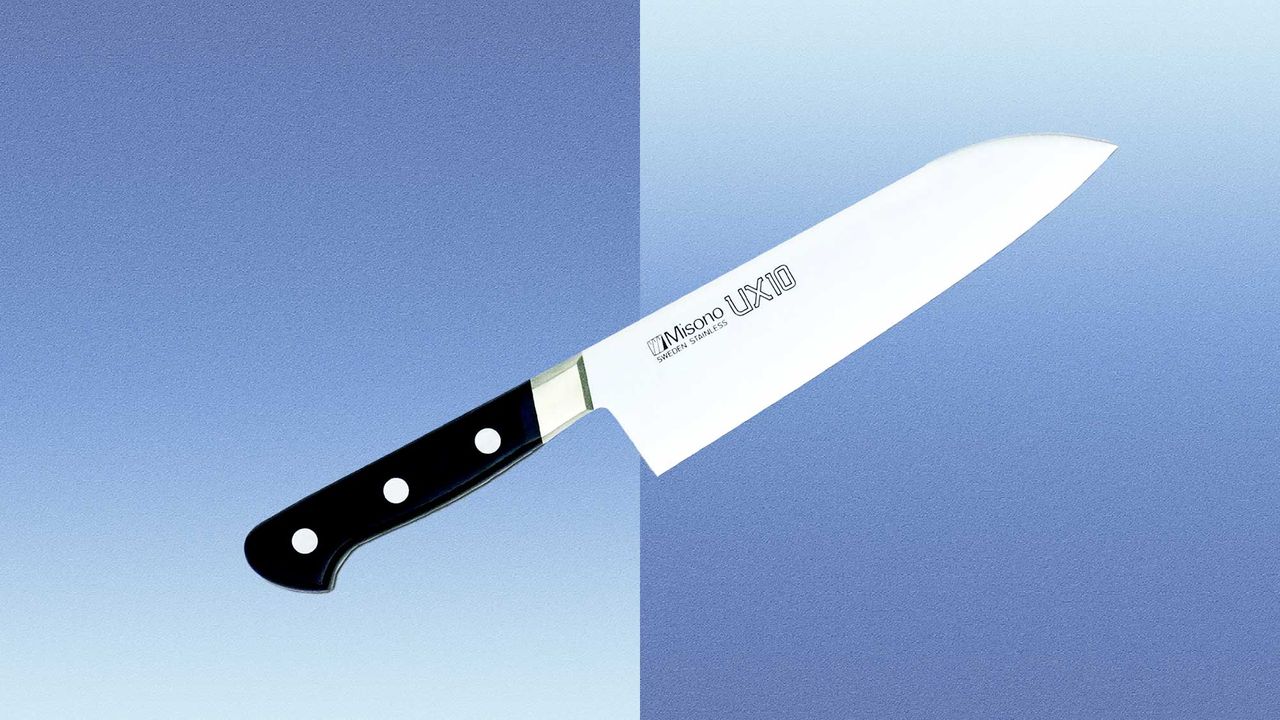
Most professional kitchens are dominated by chefs’ knives—long, sharp, and versatile. A good chef’s knife transforms raw ingredients through perfect cuts and detail-oriented knife work. Most home cooks, however, don’t require absolute precision for every cutting task. And when it comes to daily use utility knives, the santoku reigns supreme.Originating in Japan around the 1940s or 1950s, santoku translates to “three uses” or “three virtues,” which might refer to meat, fish, and vegetables or to chopping, slicing, and dicing, depending on who you talk to. Santoku knives are often shorter than a chef’s knife with a relatively flat edge and a pronounced sheep’s foot point. Their overall shape lands somewhere between the nakiri, gyuto, and the deba knife—a sturdy, single-edge fish cleaver. In a modern kitchen, however, the size and shape of a santoku knife makes them easy to grab for whatever task is at hand.While there was a bit of a santoku craze in the early 2000s when the knife shape first took off in the U.S., these days, a good santoku knife is a great utility addition to your kitchen. The best santoku knives allow you to dice vegetables, break down chickens, mince herbs, and slice onions with ease—and might just replace your current chef’s knife as your go-to blade. To help you find the best santoku for your kitchen, we tested over 30 santoku knives to find the best options at a variety of price points.Our top picks• Best santoku knife: Kazan Ginsan Nahiji Santoku• Best Western-style handle santoku knife: MAC Professional Series Santoku• A santoku knife upgrade: Misono UX10 Santoku• A worthy santoku splurge: Kazan Arare by Shibata Santoku• The best budget santoku knife: Mac Knife Superior Santoku Knife• Another affordable santoku knife: Misono Molybdenum Stainless Steel SantokuBest santoku knife: Kazan Ginsan Nashiji SantokuUntitled / Melissa Knific / 13 October 2026 at 15:12Kazan Ginsan Nahiji SantokuProsRazor sharpNimble yet sturdyBeautiful hand-finished detailsConsPriceyAfter testing a wide swath of santoku knives, we fell in love with models featuring the traditional Japanese wa-style handle for its versatility and light weight. This santoku from Kazan is handmade in Japan and features beautiful details worthy of a knife twice the price.What we love: A great santoku knife should feel sturdy, yet nimble, and Kazan’s Ginsan Nashiji Santoku was everything we wanted in a santoku knife. It was razor-sharp out of the box and lightweight enough to slice through paper effortlessly while still retaining the cleaver-style qualities that let it power through fibrous sweet potatoes with ease. We also loved the gorgeous pear-skin style hammer marks on the spine that help with food release, along with the wavy patterns that show how the steel was tempered. It’s quickly become a go-to for any everyday task—slicing cheese, cubing potatoes, cutting a sandwich, etc. The wa-style handle shifts the weight of the knife slightly toward the blade, but also opens up a lot of grip options: it was easy to choke up for more leverage when breaking down sweet potatoes or shift to a more delicate pinch when dicing an onion. It was also the lightest knife we tested by far, adding to its numble versatility while still being supported by a sturdy spine. All in all, we loved that this knife tackled everything we threw at it while looking absolutely gorgeous.What we'd leave: The biggest issue? Price. It’s a gorgeous handmade knife, and it is expensive. At the same time, we think this knife is absolutely worth it, and performs like a knife twice its price. The other thing to consider is that it’s made from ginsan stainless steel—a high-carbon stainless steel that’s great for edge retention but can develop discoloration from water spots if it isn’t dried completely after use. If you’re the type of person who likes to chop and go, you may want to consider our alternative picks.Weight: 4.5 oz.Blade length: 6.7"Handle length: 5"Best Western-style santoku knife: MAC Professional Series SantokuMacMAC Professional Series SantokuProsSharpWell-madeGood valueConsSlightly clunky handleA true workhorse and daily driver, this santoku knife will keep chopping in your kitchen for years to come.What we love: When it comes to performance and value, MAC’s knives are hard to beat. Our previous top pick for santoku knives was MAC’s Superior Series; on retesting, we think it’s probably worth spending a bit more for their Professional Series. The upgrade gives you a better fit and finish, along with an integrated bolster for better weight balance and hollow ground divots to help prevent food from sticking. It’s extremely sharp out of the box and easily slices through tough sweet potatoes and onions. It was comfortable to hold, and the “sub-zero tempered steel” did feel like it held its edge better than many of the knives we tested. For most people, a santoku knife is part of their daily cooking routine—if that’s the case, and a good knife can last you ten years, we feel like the upgrade to the Professional Series MAC santoku knife is absolutely worth it.What we'd leave: While we liked the handle, we found that, compared to Japanese wa-style handles, it felt a little clunky. Because the blade goes directly into the bolster, there’s less freedom to adjust to a variety of different grip styles. That said, once we settled into the right grip for this knife, it felt like an easy extension of our hands.Weight: 6.1 oz.Blade length: 6.5"Handle length: 5"A santoku knife upgrade: Misono UX10 SantokuProsVery thin, agile, and sharp bladeStainless steel is not prone to discolorationComfortable tapered handle; high-end feelConsExpensiveAsymmetrical bevel makes it difficult to sharpen at homeIf you’re serious about santokus and looking for a high-quality upgrade pick, the Misono UX10 is well-loved for its 70/30 bevel and incredible slicing ability.What we love: We’re big fans of this family-run Japanese brand’s knives across the board for their superior agility, precision, and edge retention (their chef’s knife is also one of our top picks). The UX10 santoku has an ultra-thin blade that not only offers an insanely sharp edge out of the box, but also retains that sharpness even after prolonged use. And because it’s made of stain-resistant Swedish steel, it’s not as prone to discoloration as the high-carbon steel blade of the Mac. We also love that its handle tapers as it gets towards the blade, which makes it very comfortable to hold—no hand cramps here.What we'd leave: Besides the price (around $220 at the time of writing), the one major thing to note about the Misono is that its 70/30 asymmetrical bevel. That doesn’t make it a lesser knife, but it does make it more difficult to sharpen at home. It also means you’ll need to change the orientation of the bevels after purchasing it if you’re left-handed. That’s because the two sides of the blade are sharpened to different angles, one shallower and one more acute.Weight: 5.6 oz.Blade length: 7”Blade height: 5”The best santoku knife splurge: Kazan Arare by Shibata SantokuKazanKazan Arare by Shibata SantokuProsUnbelievably sharpGorgeous hand-hammered detailsLightweightConsPriceSteel is prone to discolorationIf you want an unbelievably sharp, nimble, and beautiful santoku knife, this santoku checks every box we could possibly imagine.What we love: When we tested Japanese knives, there was a clear winner we fell in love with. The Kazan Arare by Shibata line also offers a santoku knife, and we were just as in love with it as its gyuto sibling. To start, it features a hand-hammered spine that removes weight and keeps food from sticking while looking incredible. It also has a near-perfect santoku shape: a mostly straight edge with a tall heel and a severe sheep’s foot tip for precision cuts. It rivaled the Misono UX10 for sharpness by gliding effortlessly through paper and slicing through onion layers with zero resistance, and it’s edge geometry is so thin that even tough sweet potatoes were easy to slice without much effort. We love that it has an easy-to-maintain 50/50 bevel on its edge, and the ebony handle with a decorative ring felt exquisite in our hand.What we'd leave: The biggest knock against this knife is the price—it’s our most expensive top pick, though we feel like a knife of this quality would usually be priced in the $300-$400 range. The other thing to take note of is that it’s made from SG2 steel, which is great for edge retention but can show water spots more than other high-carbon stainless steels.Weight: 5.5 oz.Blade length: 6.5"Handle length: 5.5"The best budget santoku knife: Mac Knife Superior Santoku KnifeMacMac Knife Superior Santoku KnifeProsExcellent valueSharp and durableComfortable handleConsBlade is prone to discolorationA classic santoku that’s been made by MAC since the 1940s and one of the earliest examples of the knife’s design.What we love: Like the other knives in the brand’s lineup, Mac’s santoku strikes the right balance between performance and price. At $80 at the time of writing, it really can’t be beat. It’s razor-sharp out of the box and has a lightweight, well-balanced feel that makes it easy to maneuver.In our testing, the high-carbon-steel blade was equally adept at slicing through hardy sweet potatoes as it was delicate herbs. In long-term testing, it’s held up as a regular go-to knife for our testers. When it does come time to sharpen, the Mac’s blade easily comes back to life after several passes on a whetstone (or through a high-quality electric knife sharpener).What we'd leave: In our latest round of testing, the Professional Series MAC handle beat out this model for comfort and durability. But if you’re curious about picking up a santoku knife and don’t think it’s going to be a daily driver, this is a perfect option.Weight: 5.5 oz.Blade length: 6.5"Handle length: 5"Another affordable santoku knife: Misono Molybdenum Stainless Steel SantokuMisonoMisono Molybdenum Stainless Steel SantokuProsSharpVersatile blade shapeWell-pricedConsCheaper steelHarder to maintain 70/30 edgeMisono’s Molybdenum Stainless Steel Santoku offers nearly the same sharpness as the UX10 model at a more affordable price point.What we love: Misono’s UX10 line is legendary amongst chefs for its precision slicing—their Molybdenum line is a more affordable version that offers just as sharp an edge (though it lacks the same edge retention of the higher-end model). We loved how sharp and versatile this knife was, and at around $100 at the time of testing, it almost won out as a top pick overall for its performance to value ratio. Its tall heel gives you plenty of knuckle clearance while giving you enough steel for a variety of pinch grips, and it’s pronounced tip was perfect for precise cuts when dicing an onion.What we'd leave: Part of this knife’s cutting ability comes from its 70/30 edge bevel, making it harder to maintain at home with practice sharpening. It’s also made from a less hard steel, meaning it won’t hold it’s edge as well as the UX10 option.Weight: 5.2 oz.Blade length: 7"Handle length: 4.75"How we chose the best santoku knivesWe tested santoku knives similarly to how we tested chef’s knives: That is, by cutting up a lot of produce. We put them to work on sweet potatoes, raw onions, and herbs to see how they fared with both tough and delicate ingredients. We also spent time examining each knife for build quality and overall design, and took note of how each one felt to hold and use for long periods of time. We evaluated each knife according to the following criteria:How does the knife feel to hold and use? How heavy is it, how comfortable is the handle, and how responsive is the blade?Santokus are meant to be agile and versatile, so we were looking for a lightweight knife that was comfortable to hold, but still felt study enough to handle tougher tasks. We also paid attention to the knives’ responsiveness, which refers to how much you feel the blade react in your hand. The more responsive the knife, the more control you’ll feel over it.How is the finish quality?We looked at how well-made each knife was, paying close attention to the finishes, the transition between the blade and handle, and any unique design features.How sharp is the knife? How does it fare in our tests?We looked for blades that were razor sharp out of the box, able to cut through anything we threw at them with ease and precision. Given that santokus are designed for versatility, we wanted a knife that could cleanly cube sweet potatoes, cut onions into even, thin slices, and produce a pile of finely chopped (not crushed) herbs.Other santokus we likedSakai Takayuki SantokuSakai TakayukiSakai Takayuki SantokuThis was a truly beautiful santoku with a comfortable handle, gorgeous hand-hammered details, and a beautiful Damascus pattern. We just preferred the general blade shape and height of the other knives we tested. A perfectly great example of a santoku, however, and we think most people would be happy with its performance and style at this price point.Shun Classic 7" Santoku KnifeShun Classic 7 Inch Santoku KnifeThe Shun knife is another solid option for those drawn to the look of Damascus steel blades. Like most Classic Shun knives we’ve tested, it had an incredible edge out of the box. Our big issue was with the overall size of the knife and its handle—both are a bit large for a daily-use utility knife.Shun Hollow Ground 7” Classic SantokuShun Classic 7" Hollow Ground SantokuAlmost identical to the knife listed above, this version has channels cut into the blade to prevent food from sticking and reduce weight. Our evaluation remains the same, however—sharp, beautiful, but a little unwieldy compared to our top picks.Wüsthof Classic 7" Hollow Edge SantokuWüsthof Classic 7-Inch Hollow Edge SantokuWe liked this well-made knife from the German brand Wüsthof for its super-sharp, high-carbon-steel blade, full-tang construction, triple-riveted handle, and excellent performance across all our tests. It’s a solid choice if you want a santoku knife with better stain resistance and slightly softer steel that won’t chip as easily.Global Classic 7" SantokuGlobalGlobal Classic 7" SantokuLots of people love Global knives for their middle-of-the-road price and balanced, lightweight feel. They’ve historically fared well in our tests, and the 7" santoku was no exception. Our testers found the handle’s slim, ergonomic shape and seamless transition into the blade comfortable to grip, but users with larger hands may prefer a handle with a bit more bulk. If you’re a Global stan, we’re confident you’ll love this knife, but at nearly $150 at the time of writing, we feel like it’s just a little pricey compared to our other top picks.Miyabi Birchwood SG2 SantokuMiyabiMiyabi Birchwood SG2 SantokuMiyabi makes truly beautiful Damascus-patterned blades with elaborate handles, but we find their price tag is just a big higher than we’d like on average. This Birchwood SG2 santoku was light, nimble, sharp, and truly beautiful to behold. The only issue? We didn’t feel like it was as comfortable as our splurge picks, and it costs over $100 more than our most expensive pick. Most people will love using this knife, but its value is more tied to appearance and materials than cutting ability.Miyabi Artisan Santoku KnifeMiyabi Artisan Santoku KnifeThe Miyabi Artisan is a beautiful knife, with a rosewood pakkawood handle and shiny hammered steel blade. It was very sharp and comfortable to hold, but we didn’t feel it was worth the $225 price tag, considering it performed similarly to the Mac. That said, if you’re drawn to it for aesthetic reasons and willing to splurge, you can trust it will serve you well.Miyabi Kaizen II Santoku KnifeMiyabi Kaizen II Santoku KnifeThis is another stunning Miyabi knife that features a Damascus steel blade and a black pakkawood handle. It performed well in testing and is reasonably priced for its Damascus pattern. We just preferred other knives for performance and handle comfort at this price point.Victorinox Swiss Classic Santoku KnifeVictorinox Swiss Classic Santoku KnifeThe Victorinox Swiss Classic was our previous budget pick. It’s incredibly lightweight at just 4.6 ounces, very sharp out of the box, has a granton edge (those are the divots you see on lots of santokus) meant to discourage food from sticking to the blade, and impressed us throughout all of our testing. Its plastic handle makes it feel quite cheap, which we didn’t mind when it was under $40. Still, it is the cheapest knife we recommend, so if you’re on a tight budget this is a decent option.Santoku knives we don't recommendTojiro’s knives are sharp and well-made, but often lack the polished details of competitors like MAC and Misono. Now that Tojiro’s prices have gone up, we’re recommending them less and less. It’s still a sharp and versatile santoku knife, we just think you’re better off spending just a bit more for a higher level of fit and finish.This budget-friendly knife will get the job done if you’re in the market for a knife around $40, but it was too heavy and uncomfortable to grip for us to recommend it.This knife from Misen was far too heavy to grant us the agility and precision we were looking for in a santoku.This knife has an odd shape for a santoku, mostly because it’s a kiritsuke knife—not a santoku. The curved edge was very effective for chopping herbs, but we preferred a flatter edge for other tasks like slicing through sweet potatoes and onions.We thought the balance between the handle and the blade felt off, and that the handle was too bulky. We also wish it were sharper.Our initial paper-slicing test had us impressed with the sharpness of Miyabi’s Hisho santoku, but it met too much resistance when cutting sweet potatoes for this price point.This knife was too small to be truly useful in the kitchen. For a knife this size, we recommend looking at a petty knife instead.While beautiful, the extra knife material needed to achieve its Damascus pattern made it heavy and unwieldy. We also didn’t like the handle shape, and it was expensive.We were surprised at how dull this knife felt out of the box, given how impressed we were with Shun’s standard Classic line. Again, this knife’s dual core added weight and bulk to a knife shape that should be more agile, and it’s priced too high.We loved the look and handle feel of Shun’s Premier Santoku, but it lacked sharpness. For this price, you can get a sharper knife made by hand in a small studio.Too large, bulky, and heavy for a santoku knife—it also struggled to cut as cleanly as we’d like, and is one of the most expensive knives we tested.We’re a little torn on this one—we like the shape and the gorgeous Damascus-patterned steel, and it cut fairly well in our tests. Overall, we just think the price is a little high compared to our top picks and wouldn’t recommend this knife over any of them.FAQWhat’s the difference between a santoku knife and a chef’s knife?Santoku knives are designed to be all-around utility knives—they often have the same height as a chef’s knife, but a shorter, straighter edge and a very pronounced sheep’s foot tip. While chefs’ knives are designed for pull-through slicing and rock chopping on a cutting board, santoku knives are mostly designed for push cuts and fine point work.What makes a great santoku knife?Santoku knives combine the best aspects of nakiris, gyutos, and petty knives—they’re designed to be a middle-of-the-road utility knife that can chop and cut while being nimble enough for fine tasks. A great santoku knife is lightweight, but has a big enough blade to tackle everyday cutting tasks.Do I really need a santoku knife?Santoku knives are great all-around utility knives for any home cook at any skill level. Some economical kitchens can even make do with just a santoku knife. However, if you already have a chef’s knife, paring knife, utility knife, etc., adding a santoku knife might feel a bit like overkill.More on knives• I've tested 42 chef's knives to find the best 7 options• A sharp knife is a happy knife• How to build a knife set
The Best Santoku Knife for Agile Slicing and Dicing (2025)
Full Article
Original Source
Read the full article at Bonappetit →KhanList aggregates and links to publicly available news content. We do not host full articles from third-party sources. Always verify important information with original sources.