
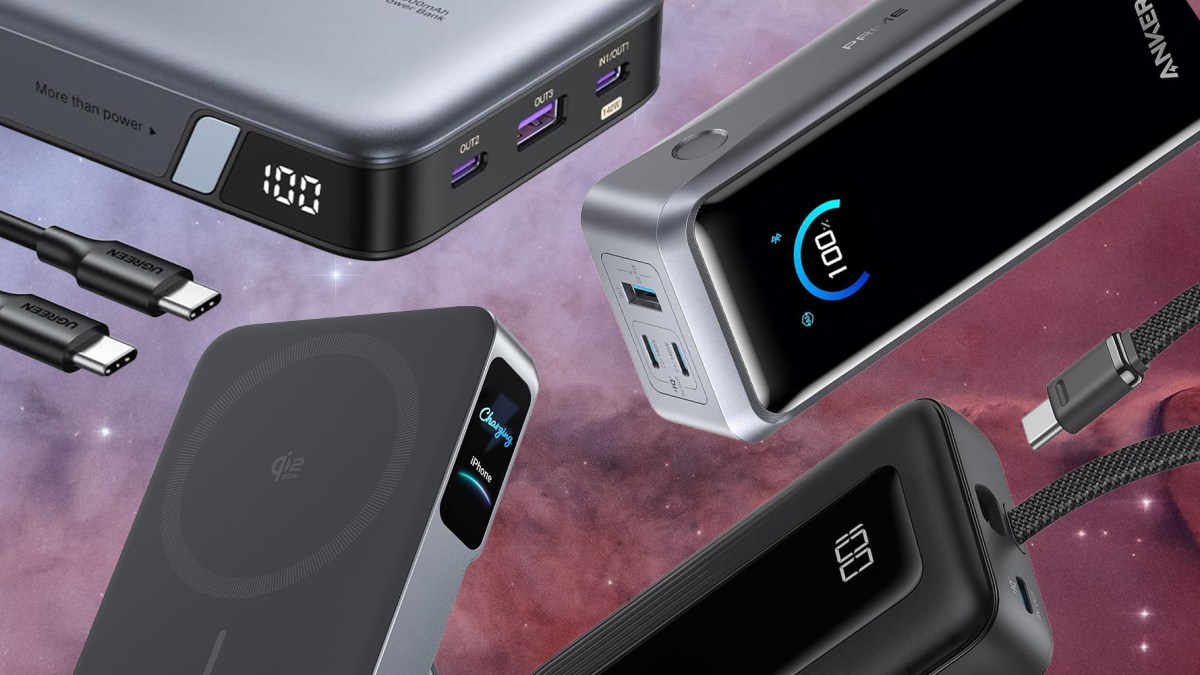
We may earn revenue from the products available on this page and participate in affiliate programs. Learn more › The best portable charger is the Anker Prime Power Bank (26K, 300W) ($229.99 at Anker as of October 2026), because it can fast-charge two laptops and a phone at once, gets back to 80 percent in 40 minutes by Anker’s rating, and stays just under the 100Wh airline limit. If you carry an iPhone, the Anker MagGo Power Bank 2 Pro ($109.99 at Anker) snaps on magnetically and charges at up to 25W with no cable, and if you want a laptop-capable bank for less, the UGREEN Nexode 20,000mAh 130W costs $59.99. Plenty has changed since our last update: our previous budget pick appears to be a model INIU recalled in December 2025, Anker recalled several of its own banks in 2025, Qi2.2 magnetic banks raised wireless charging speeds from 15W to 25W, and airlines tightened power bank rules this spring. This guide is for anyone who wants to keep a phone, tablet, or laptop running away from an outlet; if you need to power appliances or camp for a week, our guide to the best portable power stations fits better. Best overall: Anker Prime Power Bank (26K, 300W) Best for travel: UGREEN Nexode Power Bank 20,000mAh 130W Best MagSafe: Anker MagGo Power Bank 2 Pro Best multipurpose: Anker Power Bank (10K, Fusion, Built-In Cable) Best for laptops: UGREEN Nexode Power Bank 25,000mAh 145W Best with AC outlet: Goal Zero Sherpa 100AC Best for hiking: Nitecore NB10000 Gen 4 Best budget: Anker Zolo Power Bank (10K, 30W) How we chose the best portable chargers We’ve used power banks for years to keep phones, cameras, and laptops alive while covering events, traveling, and working away from a desk, and our own testing covered the UGREEN 145W bank here and the predecessor of our travel pick. For this update, we also read the 2026 power bank reviews and roundups from outlets including Macworld, Digital Camera World, Expert Reviews, Engadget, Tom’s Guide, and CleverHiker, logged which products independent testers kept landing on, and noted where testers disagreed with each other or with the maker’s numbers. Then we checked every finalist against its maker’s current product page and a live retail listing on October 21, 2026. We also checked each brand’s recall history with the Consumer Product Safety Commission, which changed two of our picks. The other seven picks are researched rather than tested by us, and each section says which is which. We have a MagGo 2 Pro on the way for review and will update this guide as our own results come in. The best portable chargers: Recommendations The picks below run from a $30 pocket battery to a $250 bank with a wall outlet built in. Before you buy, know the two numbers that matter most: how much your devices draw when they charge, and whether you plan to fly with the battery. Output figures in the table are the makers’ ratings. Prices were checked on October 21, 2026 at the retailer named in each pick’s section, and power banks go on sale often, so check before you buy. PickCapacityMax outputPriceAnker Prime 26K26,250mAh300W$229.99UGREEN Nexode 20K20,000mAh130W$59.99Anker MagGo 2 Pro10,000mAh45W (25W wireless)$109.99Anker 10K Fusion10,000mAh30W$52.99UGREEN Nexode 25K25,000mAh145W$79.99Goal Zero Sherpa 100AC25,600mAh100W AC$249.95Nitecore NB10000 Gen 410,000mAh22.5W$83.95Anker Zolo 10K10,000mAh30W$29.99 Best overall: Anker Prime Power Bank (26K, 300W) See It Pros 300W total output, with up to 140W from each of two USB-C ports, per Anker 26,250mAh, just under the 100Wh carry-on limit Anker rates it at 80 percent recharged in 40 minutes Display shows battery level and what each port is doing Cons $229.99 is a lot for a power bank 1.32 pounds, per Anker, so it lives in a bag, not a pocket Don’t confuse it with the older Prime 27,650mAh 250W model Specs Model: A110A Capacity: 26,250mAh (99.75Wh) Ports: Two USB-C, one USB-A Max output: 300W total; 140W per USB-C port, 22.5W USB-A (Anker’s rating) Weight: 1.32 pounds (600 grams, Anker’s spec) Price: $229.99 at Anker as of October 26, 2026 (on sale) Anker’s Prime Power Bank (26K, 300W), model A110A, is the one power bank we’d buy if we could only own one. It’s expensive, at $229.99 at Anker as of October 26, 2026 (a sale price; Anker shows $30.01 off), and Macworld found it for $199.98 at Amazon in July. What you get for that is a battery with no real ceiling for everyday gear. Anker rates each of its two USB-C ports at 140W and the bank at 300W total, so it can fast-charge a 16-inch MacBook Pro and a second laptop at the same time and still run a phone off the 22.5W USB-A port. Most banks make you wait as long to refill them as they took to drain. Anker rates the Prime at 50 percent in 13 minutes and 80 percent in 40 minutes, Anker’s page doesn’t say which setup those figures assume, but its fastest refill uses both USB-C ports at once with two 140W chargers, so expect slower results from a single charger. A built-in display shows the remaining charge and what each port is drawing, and the capacity is tuned for flying. At 26,250mAh, it comes in at 99.75Wh, just under the 100Wh line airlines use for carry-on batteries that don’t need approval. Expert Reviews, Engadget, and Macworld all ranked it at or near the top of their 2026 power bank roundups. The trade is size. At 1.32 pounds, per Anker, it’s a bag battery, and if you only ever charge a phone, the UGREEN 20,000mAh bank below does that job for a quarter of the price. Check the model number before you buy, too. Anker also sold an older Prime 27,650mAh 250W bank (model A1340), which shows as sold out on Anker’s site, and the A110A is also sold in a bundle with a charging base. This recommendation covers the A110A power bank on its own. Best for travel: UGREEN Nexode Power Bank 20,000mAh 130W UGREEN Pros 130W total output, per UGREEN, enough to fast-charge most laptops Color display shows remaining charge, voltage, and current 20,000mAh works out to roughly 74Wh by our arithmetic, well under the 100Wh carry-on line Its predecessor held up well in our own testing Cons About 480 grams (16.9 ounces), per UGREEN, so it’s a bag battery, not a pocket one No built-in cable $59.99 is a sale price; UGREEN lists it at $89.99 Specs Model: PB721 Capacity: 20,000mAh Ports: Two USB-C (UGREEN’s US page) Max output: 130W total (UGREEN’s rating) Weight: 480 grams (UGREEN’s spec) Price: $59.99 at UGREEN as of October 21, 2026 (regular $89.99) A 20,000mAh battery is the size that covers the most situations without becoming a burden. It’s enough to recharge most phones more than once, top off a tablet, or buy a laptop a couple more hours, and it still slides into a backpack’s laptop sleeve. UGREEN’s Nexode Power Bank 20,000mAh 130W (model PB721) is the one we’d buy at that size. It costs $59.99 at UGREEN as of October 21, 2026, a sale price against a $89.99 list price, and UGREEN rates it for 130W of total output across two USB-C ports. This is the successor to the 20,000mAh, 100W UGREEN bank that earned our travel award last time, and the predecessor’s results are why it’s back in that slot. In our testing, that model took an iPhone 16 Pro Max from empty to 55 percent in 30 minutes and to full in about an hour and a half, with 66 percent of the bank’s own charge left afterward. It also fully recharged a 2024 iPad Pro in two hours with 36 percent to spare. We haven’t run the same tests on the 130W version yet, so treat those as results from the previous model, not this one. The feature we’d miss most on any other bank is the screen. It shows the remaining charge plus the voltage and current going to each device, so you can tell at a glance whether your laptop is actually fast charging or trickling along on a bad cable. The bank weighs about 480 grams, per UGREEN, and there’s no built-in cable, so pack a USB-C cable rated for 100W if you plan to charge a laptop with it. UGREEN’s US page names two USB-C ports; some international listings add a USB-A port, so check the listing if you still need one. Best MagSafe: Anker MagGo Power Bank 2 Pro See It Pros Up to 25W Qi2.2 wireless charging on iPhone 16 and newer Built-in fan with Cool and Silent modes, per Anker 45W USB-C in and out; Anker rates it at 80 percent recharged in 52 minutes Adjustable kickstand and a status display Cons Older iPhones are limited to 15W wirelessly Reviewers found the fan audible on a quiet desk No built-in cable, and pricey for 10,000mAh Specs Model: A110R Capacity: 10,000mAh Wireless output: Up to 25W Qi2.2 (Anker’s rating) Wired output: 45W USB-C (Anker’s rating) Weight: 7.7 ounces (Anker’s spec) Price: $109.99 at Anker as of October 21, 2026 A magnetic battery snaps onto the back of an iPhone and charges it with no cable at all, which is why it’s the kind of power bank people actually carry every day. Anker’s MagGo Power Bank 2 Pro (model A110R) is the one to get right now. It costs $109.99 at Anker as of October 21, 2026, and it was $87.99 at Amazon during October’s Prime Big Deal Days. It’s built on Qi2.2, a newer version of the magnetic wireless standard that grew out of Apple’s MagSafe, and Anker rates it at up to 25W wirelessly and 45W through its USB-C port. That 25W figure only applies to the iPhone 16 lineup and newer. Per Macworld, the iPhone 15 and older, plus the iPhone 17e, charge at 15W and the iPhone Air at 20W, and Anker excludes the iPhone 16e, which lacks MagSafe magnets. Macworld’s reviewer charged an iPhone 16 Pro to 50 percent in 30 minutes with the fan running. Faster wireless charging means more heat, and Anker’s answer is a small built-in fan with Cool and Silent modes. Reviewers at Macworld and Digital Camera World both found it audible up close, and Digital Camera World’s tester noticed the phone still got warm. If it bothers you on a nightstand, Silent mode turns the fan off. The rest of the package earns the price. A fold-out kickstand props the phone up for video calls or watching something on a flight, the display shows battery level, temperature, and battery health, and 45W input means the bank itself refills quickly. Anker says it’s designed for Apple devices, so Android owners should look elsewhere, even though one reviewer did get a Pixel to charge on it. If you’d rather have a built-in cable than a kickstand, Ugreen’s MagFlow Pro is the rival Macworld compared it against. We have a MagGo 2 Pro on the way for a full review and will update this section with our own results. Best multipurpose: Anker Power Bank (10K, Fusion, Built-In Cable) Anker Pros Folding wall prongs make it a wall charger too Built-in USB-C cable plus a second USB-C port Up to 30W output, per Anker Replaces two things in a travel bag Cons Heavier than a standard wall charger, so it can sag out of loose outlets 30W is fine for phones and tablets but slow for laptops The built-in cable is short Specs Model: A1637 Capacity: 10,000mAh Ports: Built-in USB-C cable (0.82 feet, per Anker), one USB-C port, folding AC plug Max output: 30W (Anker’s rating) Price: $52.99 at Anker as of October 21, 2026 (on sale) Our previous multipurpose pick was the Anker PowerCore Fusion 10000. Anker’s current US lineup leads with a newer version, and the idea is unchanged. The Anker Power Bank (10K, Fusion, Built-In Cable), model A1637, is a 10,000mAh battery with folding wall prongs, so it works as a wall charger when you’re near an outlet and a power bank when you aren’t. The new version adds a built-in USB-C cable, which fixes a familiar power bank problem: having the battery but not the cord. There’s also a second USB-C port for charging two devices at once, and Anker rates the output at up to 30W. That’s plenty for a phone, earbuds, or a tablet, but slow for a laptop. It costs $52.99 at Anker as of October 21, 2026, on sale, and B&H listed it for $44.99 the same day. Like the model it replaces, it’s heavier than a normal wall charger, and in a loose hotel outlet, the weight can pull it partway out. If that happens, plug it into a power strip instead. For anyone who travels light, losing a separate charger from the bag is worth the trade. Best for laptops: UGREEN Nexode Power Bank 25,000mAh 145W See It Pros About 90Wh, per UGREEN, while staying under the 100Wh carry-on line Charges a laptop and a phone at the same time Side display shows remaining charge Held up through months of our testing Cons Runs warm with a laptop plugged in for long stretches UGREEN’s own listing is inconsistent about the total output No AC outlet for laptops that need their own power brick Specs Capacity: 25,000mAh (about 90Wh, per UGREEN) Ports: Three Max output: 145W total in the product name; UGREEN’s images list 140W, 65W, and 22.5W by port Price: $79.99 at UGREEN as of October 21, 2026 If you work from coffee shops, libraries, or airport gates, the power bank that matters is the one that keeps your laptop alive until an outlet frees up. UGREEN’s Nexode 25,000mAh 145W Power Bank has been our pick for that since we tested it, and it’s still on sale at $79.99 at UGREEN as of October 21, 2026. UGREEN rates the battery at about 90Wh, which leaves it comfortably under the 100Wh limit for carry-on bags. After using it regularly for months, it never let us down. It extended a 16-inch MacBook Pro by a few hours and fully recharged an iPhone 15 Pro Max and a Nintendo Switch OLED. It did run warm when a laptop drew power from it for long stretches, though never hot enough to worry us. A side display shows the remaining charge, so you know whether to plug it in before you leave. One thing to know about the numbers: UGREEN’s product name says 145W, while its own product images list 140W, 65W, and 22.5W for the three ports. Either way, the main USB-C port has enough power to fast-charge most laptops, and the other two cover a phone and earbuds at the same time. The one thing it can’t do is run a laptop that only charges from its own AC adapter. For that, see the Goal Zero below. Best with AC outlet: Goal Zero Sherpa 100AC See It Pros 100W AC outlet for gear that only runs off its own wall adapter Two USB-C ports at 60W and 100W, plus 15W wireless charging 94.7Wh, under the 100Wh carry-on line Cons Expensive at $249.95 The AC outlet is modified sine wave, which some electronics dislike Some owners report port and display failures Specs Model: 22200 (4th generation) Capacity: 25,600mAh (94.7Wh) Ports: AC outlet, two USB-C, two USB-A, Qi wireless pad Max output: 100W AC; 100W USB-C (Goal Zero’s rating) Weight: 2.1 pounds Price: $249.95 at Goal Zero and B&H as of October 21, 2026 Some gear still only charges from its own power brick: older laptops, camera battery chargers, a drone charger. The Goal Zero Sherpa 100AC gives you a real AC outlet, rated at 100W, in a bank that stays under the 100Wh carry-on limit. It costs $249.95 at Goal Zero and B&H as of October 21, 2026. Goal Zero shows that as a discount from $274.85. The current model is the fourth-generation Sherpa 100AC, part number 22200. Beyond the outlet, it has two USB-C ports rated at 60W and 100W, two USB-A ports, and a 15W wireless pad on top. Goal Zero has sold several Sherpa generations under nearly the same name, and the previous one, model 22050, had a much weaker 5W wireless pad. Make sure the listing says 4th generation or 22200. Know a couple of things before you buy. The AC outlet is modified sine wave rather than pure sine, which is fine for most chargers but can make some motors and audio gear hum or run poorly. Owner ratings are also mixed: REI showed a 3.9-star average across 63 reviews in October 2026, with some owners describing port and display failures. Goal Zero is now owned by BioLite, which bought the brand in April 2025 and has kept its products on sale. If you need more than about 100W of AC power, a portable power station is the better tool. Best for hiking: Nitecore NB10000 Gen 4 Nitecore Pros About 5 ounces (143 grams), per Nitecore’s retailers IPX7 waterproof rating Two USB-C ports with pass-through charging Carbon fiber composite shell Cons 22.5W maximum, slow for anything bigger than a phone No built-in flashlight Expensive for 10,000mAh Specs Capacity: 10,000mAh (39Wh) Ports: Two USB-C Max output: 22.5W (Nitecore’s rating) Water resistance: IPX7 Weight: 143 grams (5 ounces) Price: $83.95 at Garage Grown Gear as of October 21, 2026 Our previous outdoor pick, Goal Zero’s Venture 75, was sold out at Goal Zero and Backcountry when we checked in October 2026, with no successor announced. For hiking and backpacking, we’d now carry the Nitecore NB10000 Gen 4. It’s a 10,000mAh battery that weighs about 5 ounces and carries an IPX7 rating, meaning it’s built to survive brief submersion, so rain, a creek crossing, or a soggy tent won’t kill it. It costs $83.95 at Garage Grown Gear as of October 21, 2026. Weight is the whole point here. Most of the other 10,000mAh banks in CleverHiker’s 2026 testing weighed between 6.6 and 8.5 ounces, and on a multi-day trip, those extra ounces add up. Nitecore gets the weight down with a carbon fiber composite shell and silicon-carbon cells, and the bank has two USB-C ports with pass-through charging, so you can recharge it and your phone from one wall plug at a trailhead motel. It was the top backpacking pick in CleverHiker’s power bank testing this year. It’s not a fast charger. Nitecore rates it at 22.5W, which is fine for a phone, a headlamp, or a GPS messenger but slow for a tablet. Like every power bank, it also delivers less than its label suggests, because energy is lost converting the cells’ voltage up to USB levels. If you’d rather recharge from the sun on longer trips, see our guide to the best solar power banks. Best budget: Anker Zolo Power Bank (10K, 30W) See It Pros $29.99 list, and often less on sale Built-in 5.4-inch USB-C cable plus a second USB-C port 30W output, per Anker, quick enough for most phones Not one of the Anker models in the 2025 recalls Cons The built-in cable is short Anker’s FAQ caps pass-through charging at 5V/3A Fewer ports than our larger picks Specs Model: A1688 Capacity: 10,000mAh Ports: Built-in USB-C cable, one USB-C port Max output: 30W (Anker’s rating) Price: $29.99 at Anker as of October 21, 2026 Sometimes you just want a cheap battery that won’t let you down. The Anker Zolo Power Bank (10K, 30W), model A1688, costs $29.99 at Anker as of October 21, 2026, and Amazon has sold it for about $22 in sales this summer. It has a 5.4-inch USB-C cable built in, a second USB-C port for another device, and enough capacity to get most people through a long day of heavy phone use. We replaced our previous budget pick, a 10,000mAh INIU bank with a paw-print light, because it appears to match the INIU BI-B41 that the Consumer Product Safety Commission recalled in December 2025 after reports of overheating and fires. Only certain serial numbers were affected, but we’d rather not recommend a model with a recall on its record. If you already own one, check the serial number printed on the bank against INIU’s recall page. Anker had recalls of its own in 2025, and the model number matters with this brand. The 10K Zolo we recommend here, the A1688, isn’t on either recall list. The Zolo 20K with built-in cables (models A1681 and A1689) was recalled in September 2025, so don’t assume the bigger Zolo is the same product. Check the model number printed on the back of any Anker bank you already own. Picks we retired, and why Every pick from our previous version of this guide either changed or left. Here’s what happened to each. OtterBox Performance Fast Charge 20,000mAh (former best overall): In October 2026, we only found it at business and overseas resellers, and its 18W output is slow next to current banks. Anker PowerCore Fusion 10000 (former best multipurpose): Anker’s US store now leads with the 10K Fusion with a built-in cable, our new multipurpose pick. UGREEN Nexode 20,000mAh 100W (former best for travel): UGREEN’s US store now lists the 130W version in its place, and it keeps the travel award. Goal Zero Venture 75 (former best with flashlight): Sold out at Goal Zero and Backcountry in October 2026, with no successor announced. Mophie Charge Stream (former best with wireless charging): No longer in Mophie’s lineup, and its 10W wireless pad is slow next to today’s Qi2.2 magnetic banks. INIU 10,000mAh (former best budget): Appears to match the INIU BI-B41 recalled in December 2025. More in the budget section above. What to consider when buying a portable charger A power bank is a battery plus the electronics that turn its power into something your devices can use. These are the specs that separate a good one from a disappointing one. Capacity: mAh, watt-hours, and why you get less than the label Capacity is listed in milliamp-hours (mAh), measured at the cells’ own voltage, about 3.7 volts for most lithium-ion banks. Your phone charges at 5 volts or more, and converting between the two loses energy as heat. That’s why a 10,000mAh bank won’t charge a phone with a 5,000mAh battery twice. In Macworld’s 2026 capacity tests, 10,000mAh banks averaged 174 percent of a phone battery, not 200 percent. Watt-hours (Wh) are the more useful number, because they don’t depend on voltage and they’re what airlines use. Multiply mAh by the cell voltage and divide by 1,000: a 20,000mAh bank at 3.7 volts is about 74Wh. As a rough guide, 10,000mAh covers a day of phone use, 20,000mAh covers a weekend or a tablet, and 25,000mAh or more is for laptops. Output: match the watts to your devices Output, in watts, decides how fast a bank charges your devices. Most current phones fast charge at 20W to 45W, tablets want 30W or so, and laptops need 45W to 140W depending on the model. Look for USB Power Delivery (USB PD) on the USB-C ports, since that’s the standard laptops and iPhones use, and check whether the advertised maximum comes from one port or is split across several. A bank rated for 100W total might only give 60W to each of two laptops. Wireless and magnetic charging Wireless power banks use the Qi standard. Qi2 added MagSafe-style magnets that line the phone up with the charging coil, and Qi2.2 raised the speed to 25W. Every iPhone since the iPhone 12 (except the 16e) has the magnets; Android support is spotty, and some phones need a magnetic case. Wireless charging is convenient but less efficient than a cable, so it gets more heat and fewer total charges out of the same battery. Our explainer on wired vs. wireless charging goes deeper, and our MagSafe accessories guide covers the cases, mounts, and wallets that use the same magnets. Flying with a power bank in 2026 Power banks have to go in your carry-on, never checked luggage. The FAA allows any number of batteries up to 100Wh, and up to two between 101Wh and 160Wh with airline approval. Airlines added rules of their own this year. Southwest allows one power bank per passenger as of April 2026, American and Delta cap passengers at two banks of 100Wh or less as of May 2026, and several airlines now bar power banks from overhead bins. International aviation rules adopted in March 2026 also limit passengers to two and ban recharging a power bank in flight. Rules are still changing, so check your airline’s page before you fly. Every pick in this guide is under 100Wh. Recalls and safety Power bank recalls have become common enough that checking is worth a minute. In 2025, Anker recalled more than 1.1 million PowerCore 10000 banks (model A1263) in June and about 481,000 more banks across five models in September. INIU recalled about 210,000 BI-B41 banks in December 2025. Recalls usually cover specific model and serial numbers, which are printed on the bank itself. Search the Consumer Product Safety Commission’s recall site for your brand. Whatever you own, stop using a bank that’s swollen, cracked, or too hot to hold, and don’t charge one on a bed or couch where heat can’t escape. Buy from brands that sell under their own name and have a working support page, since they’re the ones that issue recalls and replacements when something goes wrong. FAQs Q: What’s the best portable charger in 2026?The Anker Prime Power Bank (26K, 300W). It costs $229.99 at Anker as of October 2026, can fast-charge two laptops at once, and stays just under the 100Wh carry-on limit. For less money, the UGREEN Nexode 20,000mAh 130W ($59.99) still charges a laptop, and iPhone owners who want a magnetic battery should get the Anker MagGo Power Bank 2 Pro. Q: How much does a portable charger cost?As of October 2026, a good 10,000mAh bank from a known brand costs $25 to $60. Magnetic wireless banks cost $60 to $150. High-output laptop banks run $80 to $230, and banks with a built-in AC outlet cost $200 or more. Q: Can I bring a power bank on a plane?Yes, in your carry-on only. The FAA allows batteries up to 100Wh without approval, and some airlines, including Southwest, American, and Delta, now limit how many you can bring and where you can stow them. Check your airline’s rules before you fly. Q: How do I know if my power bank was recalled?Find the model number and serial number printed on the bank, then search the Consumer Product Safety Commission’s recall site and the maker’s support page. Recent recalls include Anker models A1263, A1257, A1647, A1652, A1681, and A1689 and the INIU BI-B41, though some recalls cover only certain serial numbers. Q: What’s the difference between MagSafe and Qi2.2?MagSafe is Apple’s magnetic charging system for iPhones. Qi2 is the open standard built on it, and Qi2.2 raised its top speed to 25W. A Qi2.2 power bank like the Anker MagGo 2 Pro charges an iPhone 16 or newer at up to 25W and most older iPhones at 15W. Q: Will a portable charger damage my phone?No. Your phone controls how much power it accepts, and a power bank from a reputable brand only supplies what the phone asks for. If a bank delivers power badly or develops a fault, recent phones will slow down or stop charging and warn you. Q: Should a portable charger get hot?Warm is normal, because some energy is lost as heat while charging, especially wirelessly. Hot is not. If a bank or your phone gets too hot to hold comfortably, unplug everything, move the bank away from anything flammable, and stop using it if it happens again. Q: How long does a portable charger last?Most power banks keep useful capacity for a few years of regular use, and many makers rate their cells for several hundred full cycles. Storing a bank about half charged in a cool place helps it age more slowly. Replace one that swells, no longer holds a charge, or gets unusually hot. Final thoughts on the best portable chargers Best overall: Anker Prime Power Bank (26K, 300W), 300W and a fast refill, for nearly everything you carry Best for travel: UGREEN Nexode Power Bank 20,000mAh 130W, a 20,000mAh bank with a display, at a quarter of the Prime’s price Best MagSafe: Anker MagGo Power Bank 2 Pro, 25W magnetic charging for the iPhone 16 and newer, with a kickstand Best multipurpose: Anker Power Bank (10K, Fusion, Built-In Cable), a wall charger and battery in one, with a built-in cable Best for laptops: UGREEN Nexode Power Bank 25,000mAh 145W, our long-term tested pick for keeping a laptop running Best with AC outlet: Goal Zero Sherpa 100AC, a real AC outlet in a bank you can still fly with Best for hiking: Nitecore NB10000 Gen 4, 5 ounces and waterproof, for the trail Best budget: Anker Zolo Power Bank (10K, 30W), a $30 bank from a brand you know A dead phone at the wrong moment is more than an inconvenience. It can leave you unable to call for help, find your way home, or pull up a boarding pass. Pick a bank sized for what you actually carry, check its model number against recent recalls, and charge it before you need it. Then stop worrying about the battery icon. 2026 Popular Science Home of the Future Awards 39 products that will improve your everyday life.
The best portable chargers
Full Article
Original Source
Read the full article at Popsci →KhanList aggregates and links to publicly available news content. We do not host full articles from third-party sources. Always verify important information with original sources.