
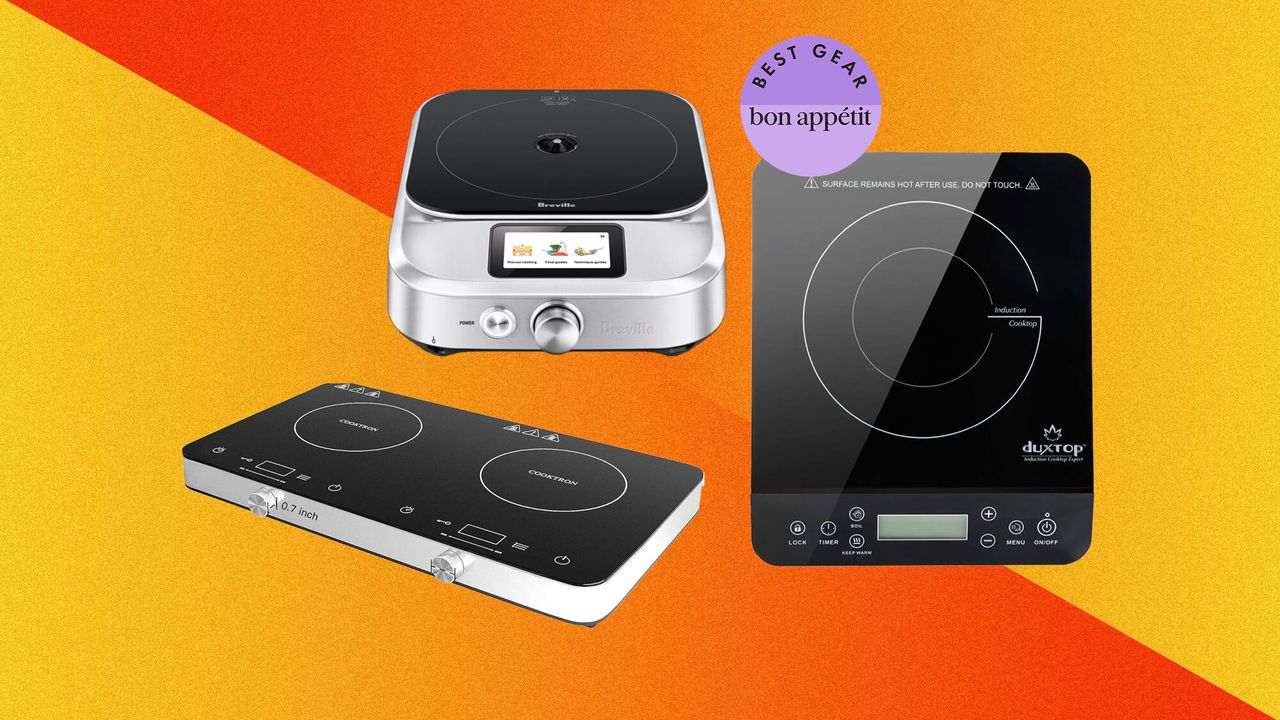
My interest in induction cooking was piqued after hearing culinary geniuses/mad scientists Alton Brown and Harold McGee discuss the technology's benefits at Thermoworks headquarters. Brown said he had converted his entire kitchen from gas to induction for a variety of reasons, including environmental concerns, but mostly for its performance: Induction heats cookware directly via a magnetic field rather than through a coil or a flame. That means water will boil faster, you'll have tighter temperature control, and the burner surface stays cool to the touch. Induction cooktops used to be something only fancy chefs like Brown and McGee had access to, but the market has exploded, and the spectrum of pricing and performance is vast.The best induction burner is actually a bit of a misnomer though. Unlike those terrifying old school hot plates, the surface of a portable induction cooktop doesn't get hot because the electromagnetic current goes directly to your pots and pans. It’s a fast and energy efficient technology that was once on the cutting edge of cooking tech, but is now easily (and affordably) accessible to anyone in the form of a portable induction cooktop.The best portable induction burners:The best induction burner: Duxtop Portable Induction CooktopA splurge-worthy upgrade: Breville Control Freak HomeThe best double induction burner: Nuwave Double Induction CooktopA budget-friendly double-induction burner: Cooktron Double Induction CooktopWe've tested 15 machines across two rounds, and our winners, the Duxtop Portable Induction Burner and the Breville Control Freak Home, are still holding fast. This round, I put our winners up against some top contenders with new tests to evaluate how well they could bring water to a boil, hold a steady simmer, handle a hard sear, and how easy they were to use. Whether you need a backup burner for a small kitchen, a setup for a dorm or an RV, or a serious upgrade for precision cooking at home, we found the right induction burner for you.New in this update: We retested previous winners against new cooktops of the pricey (Smeg) and more budget (Amazon Basics) varieties, as well as using additional cookware materials on our favorites to see how they performed.More on our top picksHow we tested portable induction cooktopsWhat to look for in a portable induction cooktopOther induction burners we likedInduction burners we don't recommendThe induction questions you should be askingThe best induction burner for most home cooks: Duxtop Portable Induction CooktopDuxtop Portable Induction CooktopPros:PowerfulAffordable20 temperature + 20 power settingsCompact and lightweightFairly easy to useEasy to cleanBuilt-in safety featuresCons:Small learning curve to figuring out power vs. temp settingsCan only adjust temperature in increments of 20ºF (no Celsius)Power: 1,800 wattsSize: 11.4" x 14" x 2.5"Weight: 5 lbs.Weight limit: 25 lbs.Settings: 20 power and temperature, adjusted in 20° increments from 100°F-460°FControl type: Touch controlWarranty: 2-year manufacturer’s limited warrantyWhat we love: The Duxtop brought water to a rolling boil in about 3 minutes and snapped back from an ice-cube shock in just about 1.5 minutes, a solid, dependable performance that held up against burners costing significantly more. Browning was where it really stood out, as it self-regulated heat even without a probe and produced the most even color of any cooktop in this round of testing on my boneless pork chops, with none of the scorch marks or hot spots we saw on the others.Part of what makes this burner easy to live with day-to-day is how it splits control into two separate modes. You can set the temperature to lock onto a target between 100°F and 460°F in 20°F steps, with a built-in sensor keeping it steady. Then there's power mode, on the other hand, which lets you directly control wattage across 20 numbered levels, with the lowest setting at 100 watts. The top level is the full 1800 watts. It's a slightly unusual way to think about heat if you use a simple low-medium-high dial, but once it clicks, it gives you a level of control and precision that those vague settings don’t.There is also a dedicated boil button that switches the unit to its highest power and temperature settings simultaneously. During our testing, it got water moving as fast as some of the pricier commercial-style units. The control panel itself is refreshingly uncomplicated. Its bright, easy-to-read display has clearly labeled buttons, a built-in timer, a child safety lock, and a keep-warm function that holds food at serving temperature without having to babysit it. Combine that with the surface that wipes clean and a price under $50, and it's easy to see why this has been our go-to recommendation for most home cooks across multiple rounds of testing.What we’d leave: Frying was a surprising and genuine weak spot. The Duxtop struggled to maintain its temperature once the food went into the oil, leaving it oil-logged. If deep frying is a top priority, you may want to consider a different machine. Also, the 20° jumps between settings can feel a little coarse if you're trying to dial in something finicky, like a delicate simmer.A splurge-worthy induction burner: Breville Control Freak HomeBreville Control Freak HomePros:PowerfulCan be adjusted in single-degree increments from 77°F-482°FHelpful presets sorted by ingredient and techniqueEasy-to-use knob and touchscreen control panelOptional temperature probe for sous vide cooking, candy makingCons:ExpensiveBulkyCan hold less weight than DuxtopPower: 1,800 wattsSize: 12.2" x 16.9" x 4.1”Weight: 15.37 lbsWeight limit: 13 lbs.Settings: Variable single-degree increments from 77°F-482°FControl type: Touchscreen and knobWarranty: 2-year consumer limited product warrantyWhat we love: The Breville was the fastest burner across the board. It took only 2 minutes to come to a rolling boil with clean, even bubbles, and just one minute to recover after an ice shock while running noticeably quieter than everything else in the lineup. Frying was just as impressive as it held its target temperature with almost no lag, producing consistently good chips rather than the greasy results we saw from other burners under similar conditions. The temperature range runs from a gentle 77 degrees Fahrenheit to a searing 482 degrees Fahrenheit, and instead of stepping through preset increments, a single control knob lets you dial in the exact degree you want, in either Fahrenheit or Celsius.The display doesn't just show your target; it also shows the pan's real-time temperature, so you always know exactly where you stand. Pair it with the included probe, and the Control Freak will read the temperature of whatever's in the pan and adjust itself to keep it steady. It's a genuinely useful feature for deep frying, tempering chocolate, and it turns the control freak into a sous vide cooker. For cooks who would rather not think about the exact temperature at all, the touch screen offers a shortcut: you can select an ingredient or a cooking technique from the menu, and the Breville automatically sets and holds the appropriate heat for you. Given the depth of control on offer, this is a burner that makes the strongest case for itself of anything we tested — provided you're willing to pay for it.What we’d leave: It's the bulkiest and heaviest single burner we tested, and at nearly 13(!) times the price of the Duxtop, that's a real ask. If you're not cooking frequently or precisely enough to take full advantage of everything this machine offers, the price is hard to justify.The best double induction burner: Nuwave Double Induction CooktopNuwave Double Induction CooktopPros:PowerfulTemperature range 100ºF to 575ºFAdjustable in 5-degree incrementsNumerical touchpad for quickly setting a temperature50 multi-step presets for specific recipes (recipe book included)150 additional programmable multistep presets100-hour timer for sous vide and slow cookingPower switchCons:Safety lock takes getting used toMay be too techy for some home cooksPower: 1,800 wattsSize: 14.1"D x 23.6"W x 2.6"HWeight: 15.7 lbsWeight limit: 25 lbs. per sideSettings: 250+ including presetsControl type: Touch controlsWarranty: 1 yearWhat we love: The Nuwave Double Induction Cooktop, sometimes also called the Nuwave PIC (precision induction cooktop), is a two-burner induction cooktop that has more settings than any comparably-priced single or double-burner induction cooktops. The Nuwave’s temperature can be set in 5-degree increments anywhere from 100ºF to 575ºF. That’s 94 different heat settings per heating element, and a separate numerical touchpad for each burner makes it easy to set your desired temperature. The touchpad is also handy for selecting a preset. There are 50 recipe-specific presets already pre-programmed, and each corresponds to a recipe in the included recipe booklet. You can also program an additional 150 multi-step presets for your own recipes. For less precise cooking tasks, there are six quick temperature settings similar to what you’d find on a standard range cooktop (low, low-medium, medium, medium-high, high, max/sear). On the highest setting, the Nuwave Double Induction Cooktop brought four cups of water to a rolling boil in just over four minutes and regulated temperature changes quicker than any other double-burner model I tested.What we’d leave: Though the control panel is user friendly (the same can't be said for the less intuitive child safety lock), the settings and presets may be overkill for some people. And though this boiled water quickly, it did take longer than other models to get a big Dutch oven full of oil to the target temperature in the deep-fry test. It’s also important to note that the 1,800-watt output is for the entire unit so if you’re using 1,600 watts on one burner you’ll only have 200 left to use on the other. That’s a limitation for every two-burner induction cooktop tested though.A budget-friendly double-induction burner: Cooktron Double Induction CooktopCooktron Double Induction CooktopPros:PowerfulVery easy to useVery to cleanSleek lookSafety lock buttonTimer (up to 240 minutes)Cons:Can’t dial in specific temperatures beyond 10 settingsHard to tell when it’s on or offNo presetsVery short warrantyPower: 1,800 wattsSize: 22.05 in. x 12.20 in. x 1.90 in.Weight: 11 lbsWeight limit: None listedSettings: 9 power, 10 temperatureControl type: Touch control + knobsWarranty: 30 daysWhat we love: We were drawn to this two-burner induction cooktop because of its sleek look and knobs that replicated the control on a full-size range. Contributor Emily Farris has used it as the main cooktop in her apartment (instead of the cheap electric range) for almost two years. Each heating element has 10 temperature settings between 140ºF–464ºF, so while this is far from a precision cooktop, it’s more than suitable for everyday cooking. It heated quickly, regulated temperature well, and the safety lock is easy to find and engage. All of the touch controls are embedded under the ceramic-glass cooking surface too, so it’s very easy to wipe clean.What we’d leave: Because of the limited settings, this cooktop adjusts in 200-watt increments, so you can’t dial in specific temperatures beyond the preset temps.Back to the topHow we tested portable induction cooktopsWe boiled a four cups of tap-cold water in the same stainless steel saucepan (ensuring the pan was back to room temperature between each test) and timed how quickly the water reached a rolling boil on each cooktop using either a boil preset, or the highest temp/power setting available. With our top picks, the difference was a matter of seconds.To gauge temperature recovery and responsiveness, we added five ice cubes to the boiling water and noted how long each cooktop took to get the water back to a rolling boil. Some devices really struggled here but our top picks all returned to a rolling boil within seconds of each other.Browning tofu and pork chopsWe also looked at how well each cooktop distributed heat by searing tofu for three minutes in a nonstick pan (again, letting it return to room temp between tests) with a teaspoon of vegetable oil. Admittedly, this wasn’t a perfectly-controlled test because we couldn’t set each burner to exactly 340°F, but it was no surprise that the Breville Control Freak produced a uniform sear on the tofu.For the pork chops we seasoned them simply with salt and pepper, then let them sit at room temperature for even cooking. We heated a stainless steel All-Clad pan with a little canola oil, then cooked the pork chops in sets of two to evaluate browning and evenness of cooking. We also looked for scorch marks to evaluate temperature regulation.To test each unit’s temperature-regulation capabilities, we deep fried many batches of potato chips, aiming to maintain a steady 340°F—which we monitored with a candy/deep frying thermometer. Some models lagged in the reheat after adding, resulting in more oil-logged chips. Temperature regulation is very important when frying because slow temperature recovery can lead to greasy chips, but overshooting the target temp can lead to burnt ones, which no one wants.What to look for in a portable induction cooktopAll 1,800-watt induction cooktops are certainly not created equally but the best induction burners will boil a pot of water quickly on a boil or maximum temperature setting. When shopping for a double-burner induction cooktop, it’s important to note whether one burner is capable of utilizing all 1,800 watts—if not, the cooktop probably isn’t very powerful.Precision is one of induction cooking’s big selling points, and the more temperature settings a cooktop has, the better.Induction burners have built-in sensors and a well-calibrated induction cooktop should automatically compensate for drops in temperature caused by adding cold ingredients, as well as cool down when the pan and its contents get too hot.Even heat distribution is another selling point of induction cooking, so food should brown evenly when cooked on a good portable induction cooktop.Stovetop cooking shouldn’t be complicated, so look for a cooktop with user-friendly control panels and easy-to-read temperature displays.Induction cooktops have a smooth glass-ceramic top, so they’re very easy to clean. Raised buttons or other features that aren’t fully embedded provide places for food and grease to get stuck, so we looked for very easy-to-clean surfaces.If you plan to travel with your portable induction cooktop, consider the size and weight in relation to its capacity and function.Back to the topOther induction burners we likedAmazon Basics Portable Electric Induction BurnerAmazon BasicsInduction BurnerThe Amazon Basics machine is very...basic. However, that doesn't mean it can't perform. I did find it wasn't as well constructed as other models like the SMEG and the Breville. It's still an excellent budget burner with great features. Many burners at this price only offer power settings in levels rather than temperature, but this is controllable by degrees. It actually did a better job during our tortilla chip test than more expensive models. If you're someone who will only occasionally use one of these, the Amazon is a perfectly adequate machine.The Breville Control Freak is the precursor to the Breville Control Freak Home and it's part of the Breville Commercial line (formerly called Polyscience). Until Breville released the Home model, this was our splurge pick. Both models have a range of 77º–482ºF and both can be adjusted in single-temperature increments, but the commercial model has a few more features that will appeal to professional cooks—including a carrying case and the ability to save and set names for frequently-used presets. This one also offers a bit more protection from kitchen elements, but it's bigger and heavier than the Home model, and unless you're planning to use it in a commercial kitchen, it's probably a bit more than what you need.SMEG Portable Induction CookerSmegPortable Induction CooktopThis is a beautiful induction burner for SMEG lovers. It fits very well into the brand's overall design aesthetic, and its performance is top-notch. It was one of the fastest and most responsive induction burners. However, it is much larger and heavier than the others in the test, and I don't like that you can't control it with temperature. For me, that was a really big miss and one of the reasons it didn’t score a superlative. Being able to select a specific temperature was very important.Hamilton Beach Portable Single Induction CooktopHamilton Beach Portable Single Induction CooktopThe Hamilton Beach Portable Single Induction Cooktop is a powerful induction burner that allows you to toggle between Fahrenheit and Celsius (something you can't do with our top pick, the Duxtop). It only has 12 temperature settings though, and overall doesn't have as many features as the Duxtop, but if you want to try induction cooking and don't want to spend more than $100, this is a good option.Isiler Portable Induction CooktopIsiler Portable Induction CooktopWe liked the sleek look of the Isiler Induction Cooktop and overall, it performed well in our testing. But it only has 9 temperature settings (compared to 20 on our top pick, the Duxtop 9600LS) and after we added cold ingredients in our deep fry test, it struggled a bit to get the oil back to the target temperature.The Duxtop 9100 MC is not to be confused with our top pick, the Duxtop 9600LS—but for the record, I absolutely confused them when I first took over reviewing induction burners. (Don't worry, I realized the error of my ways before I published any updates!) It’s actually quite easy to confuse the two models since they look a lot alike, but this less-expensive model only has 15 temperature settings, compared to the 20 on the pricier model. This one didn't regulate temperature quite as well either.Nuwave Flex Precision Induction CooktopNuwave Flex Precision Induction CooktopThe Nuwave PIC Flex is the smallest induction cooktop we tested and while the size is nice for portability, the control panel felt unnecessarily complicated for something so small. It has a nice temperature range, going from 100ºF to 500ºF and you can dial into a fairly precise temperature since the 45 settings can be adjusted in 10-degree increments. However, it was one of the slowest burners to stabilize the temperature in our deep-fry test.Induction burners we don’t recommendThe Duxtop 2-Burner Portable Induction Cooktop (9720LCBI) is the rare portable induction cooktop that is also indicated as a drop-in unit or hob—meaning you can install it in a countertop cutout in addition to setting it on top of one. I was surprised at how much I disliked this two-burner model, especially considering the fact that Duxtop’s single-burner cooktop has been our top pick for years. But there’s a lot to dislike. For starters, when you hit the “boil” button the timer defaults to just 10 minutes (annoying if you’re trying to bring a stock pot full of water to a rolling boil). The two heating elements also have different power outputs, which isn’t indicated anywhere on the unit but if you hit the boil button on the left burner, the most power it will put out is 1,000 watts—and because it will shut off after 10 minutes, your water may never reach a boil!The Cooktron 2-Burner Portable Induction Cooktop with Cast-Iron Griddle Pan is the smallest double-burner induction cooktop I’ve tested and the included full-length cast-iron griddle pan and matching lid make it versatile portable use. It’s a good option if you want something for occasional cooking in a cabin or RV, but I wouldn’t recommend it for regular use at home. Though it’s listed as an 1800-watt unit, it’s not as powerful as my budget pick above, and it only has five temperature settings ranging from 248ºF–410ºF.Cuisinart’s countertop appliances are a mixed bag and the Cuisinart Double Induction Cooktop (ICT-60) gets a hard pass from me. Though it’s an 1,800-watt unit, it’s nowhere near as powerful as the other single- or double-burner units I tested because neither heating element can operate at the full 1,800 watts. The left side has a range of 200W–1,200W (settings 1-8) and the right one only has a 200W–600W (settings 1-5) There’s no way to tell how those settings translate to actual temperatures. There’s not even a conversion chart in the manual.The Hestan Cue SmartChef Induction Cooktop is a single-burner induction cooktop that was designed to work with Hestan's smart cookware and a recently-retired companion app. While this induction burner will technically work with any induction-compatible cookware, there's no real control panel or display (just a slider) so you can’t tell what temperature or wattage you're setting—just where it falls on a range of lowest to highest. Given the comparably hefty price tag, this is not something we'd recommend for use with anything but Hestan's smart cookware. And even then, it feels a little gimmicky.I thought the NuWave induction burner would give the Duxtop a run for its money, given its similar price and slim design. However, it was damaged after just two tests, and its white writing was stained from burned frying oil and couldn’t be cleaned off. I also found it frustrating that it couldn't regain the temperature quickly enough during our frying test. And one thing I did note with this glass burner is that lighter pans tend to move on their own due to the electromagnetic field. I also noticed this on the Duxtop, but it was less pronounced. It's definitely a safety consideration.Back to the topThe induction questions you should be askingHow does induction cooking work?Gas stoves and electric cooktops rely on thermal energy, which in its simplest terms, is a process that moves heat through one thing and onto the next (so, in this case, heat source, to stovetop, to cooking vessel, to whatever’s inside). It’s not super efficient because so much of that heat/energy is wasted as it dissipates into the air (lots of it ends up heating your kitchen, not your cookware).Induction technology is much more energy efficient because it bypasses the cooktop completely and transfers an electromagnetic current directly from the induction element to the pan. Basically, it teleports energy from a copper induction coil directly to quickly heat up your cookware without ever heating the glass top. Some heat from the hot pot or pan does get thermally transferred back to the cooking surface, but it’s nothing compared to the heat radiating from a glass electric stove or the flames shooting from a gas range.You also can’t accidentally leave an empty induction stovetop turned on because the electromagnetic current needs somewhere to go. So if there’s no induction compatible cookware on the cooktop, it simply won’t work—though it may annoyingly beep or chirp an error message at you.Which is better: induction or gas?Induction is much faster and more responsive than gas because it heats the pan directly via electromagnetic energy rather than heating the surrounding air. Water boils faster, and temperature changes register almost instantly. Gas, by contrast, has a noticeable lag. Turn the dial down and the flame responds right away but the pan itself takes a minute to catch up. Inductio, however, does not work during power outages, while gas does. So that is a consideration as well. There's also a case to be made for induction on environmental grounds, since it doesn't burn fossil fuels or release combustion byproducts into your kitchen the way a gas flame does. It's not a perfect solution because the electricity still has to come from somewhere, but experts like Alton Brown have pointed to induction as the better option overall.Are there safety concerns with induction cookingIn general, there are fewer concerns than there are with gas cooking (leaks, open flames, etc). However, if you or someone in your household has a pacemaker or an insulin pump, talk to your doctor before using an induction burner. The electromagnetic field these units generate can interfere with how devices function. It's also worth handling the glass cooktop with a bit more care than you would a standard stovetop. It's durable enough for daily cooking, but it can crack or shatter if you drop a heavy pot on it from a height or set something down too forcefully. Treat it more like your favorite stoneware and less like a cast iron griddle.How much power does a portable induction cooktop use?Something that tripped me up during testing was that most portable induction burners draw up to 1800 watts of power, which puts them right on the edge of what standard 15-amp household circuits can handle. You might trip a breaker if you are running other appliances at the same time. I did so multiple times during testing when I had two plugged in. So, plan accordingly with which appliances are plugged in and in use while you're using your induction burner?Do I need special induction cookware?Good news: If you’ve been taking our recommendations and buying stainless-steel, high-quality nonstick, cast-iron (enameled or not), or carbon steel cookware, you already have induction-compatible cookware. If you’re unsure if your current cookware is induction read, grab a magnet from your fridge. If it sticks, it’s induction compatible. If it doesn’t, consider investing in a small set of stainless steel cookware. The only other caveat here, is that the induction coil can only heat what it comes in contact with. So woks, for example, don’t work well with induction, because most of the cooking surface, even on a flat bottomed wok, won’t come in contact with the copper coil.You might already own some of it, but here are our favorite induction-compatible pots and pans for home cooks.Do I need a portable induction burner if I already have an induction range?That depends on your interpretation of the word “need.” Even when I had a fancy Italian induction range in my kitchen, I used my portable induction cooktop to do my deep frying and other smelly, high-heat cooking outdoors. It’s also handy to have an extra “burner” for holidays or dinner parties—and an induction cooktop is perfect to use as a food warmer since you can set and maintain low temperatures for long periods of time.Back to the topSome other easy kitchen upgradesThese countertop ovens and air fryers can take the place of your regular oven.Personal blenders are affordable difference makers.Get yourself the good ice.
The Best Induction Burner for Precise, Efficient Cooking Just About Anywhere (2026)
Full Article
Original Source
Read the full article at Bonappetit →KhanList aggregates and links to publicly available news content. We do not host full articles from third-party sources. Always verify important information with original sources.