
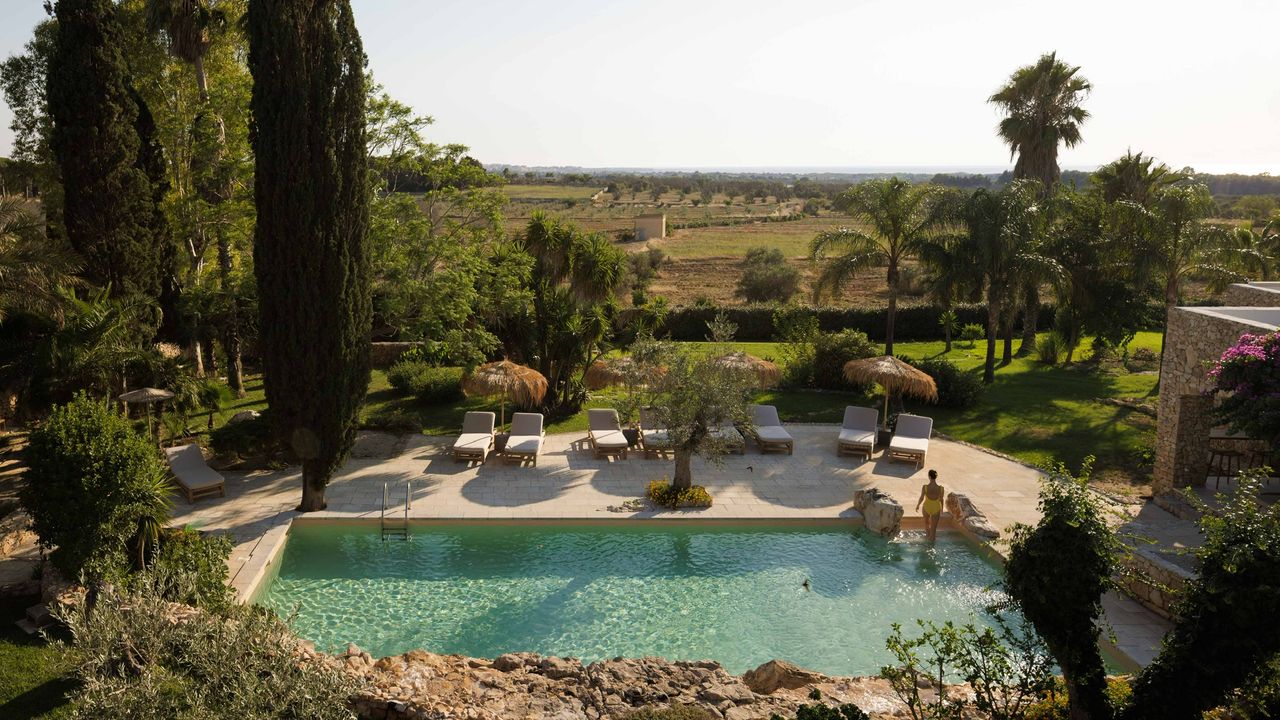
Whether you come for the food, the scenery, or the sheer romance of it all, Puglia has a way of getting under your skin.Vigo Janson/Tenuta NegroamaroMention rural Italy, and the eyes of those who have stayed in some of the best hotels in Puglia begin to sparkle. It’s a region that easily makes you fall in love with a slow-paced lifestyle, historic trulli, and the scent of lemons, rosemary, and sun-ripened figs. Here, the untamed Mediterranean scrub stretches down towards the three seas that embrace the area, and its distinctive shape forms the heel of Italy’s boot, where sandy beaches, jagged cliffs, and rocky bays alternate with vast olive groves and whitewashed villages perched on sun-drenched hilltops.Heritage and design collide in the most seductive way in Puglia, and the hotel scene is all the better for it. Masserie, once humble farmsteads, have been reimagined as chic retreats, and centuries-old palazzi now house boutique hotels with breezy courtyards and hand-painted tile floors. Whether you come for the restaurants, the scenery, or the sheer romance of it all, Puglia has a way of getting under your skin—once you’ve been, you’ll find yourself longing to return. Ready to book a trip to see for yourself? These are the best hotels in Puglia.Dawn at Masseria Montenapoleone Wine tasting at Masseria Montenapoleone Our top picksMore editor-recommended hotels in PugliaFrequently asked questionsMore Italy recommendationsOur top picks:Best for a beach getaway: La Peschiera, MonopoliBest for couples: Borgo San Marco, FasanoBest for families: Borgo Egnazia, SavelletriVista Ostuni, OstuniIt might be in Puglia, but Vista Ostuni is no typical masseria. This is a next-generation grand hotel set within a five-story historic palazzo at the foot of the “White City,” which Ostuni is known as, thanks to its tide of whitewashed houses and sweeping views. The old town sits at its doorstep, and, beyond, a sea of ancient olive trees fades into the azure horizon of the Adriatic. A vista indeed, with every window, terrace, and nook opening onto the vast, striking beauty of the Apulian landscape. No two rooms are alike: bathrooms are clad in marble and local soft-hued Trani stone, and bespoke furnishings mix wood, rattan, and Dedar fabrics in shades of ochre, teal, and terra-cotta. Unique touches include tapestries, Grottaglie ceramics, handcrafted amphorae, and rugs whose patterns shift with the sunlight. The classic Bambola armchairs on the rooftop are the spot from which to order a drink and soak in the views over the giant-wedding-cake whiteness of hilly Ostuni. —Sara MagroRead Full ReviewCastello di Ugento, UgentoAt the highest point of the small town of Ugento, 15 miles from Puglia's southernmost point, one gleaming monument stands out from its sun-faded neighbors. It took 18 months to sandblast Castello di Ugento's dilapidated pietra leccese walls back to their original honey hue, part of a nearly $16,000,000 renovation that breathed new life into the once-majestic palazzo. Three state-of-the-art kitchens were built within the property for Culinary Institute of America students to learn authentic Italian methods.Pugliese produce is championed elsewhere in the castle too, with embroidered fabrics, handmade ceramics, and organic olive oil soaps and shampoos. Design-savvy guests will appreciate the furniture, from Ceccotti loveseats to reupholstered vintage Poltrona Frau armchairs. The nine bedrooms combine original architectural features with contemporary cosseting: sleep under a star-vaulted ceiling or shower in a rediscovered vault. The marriage of ancient and avant-garde continues in the museum wing, where 17th-century frescoes provide a backdrop to modern art exhibitions. In the restaurant, the glass floor reveals a Norman tower that was excavated during the renovations. —Sarah Royce-GreensillRead Full ReviewBorgo Egnazia, di SavelletriThere is nothing in Puglia quite like this: Borgo Egnazia is a vast, hotel-village with a riad feel that sprawls luxuriously over three areas. Head to the center, and you'll find a gorgeous 63-room masseria hotel. Families tend to opt for the more relaxed apartments, which give on to the lanes and piazzas of a tasteful faux-rural hamlet. For larger groups, there are 29 individual villas with private pools. Borgo Egnazia can absorb well over 300 people in high season, yet it's remarkably easy to carve out a private corner. There are four pools, as many restaurants (in varying venues, from cellars to the beach), and a glam spa with a cinema. Local advisors sort tours or activities and indulge guests' whims: there's even a dedicated in-house bicycle rental guy. —Issy von SimsonRead Full ReviewLa Peschiera, MonopoliSettled on the water's edge, La Peschiera is the perfect example of a meticulous restoration—it went from an ancient fishing reserve to one of the most exclusive, refined hotels in Puglia. Located along the Monopoli coastline, the dreamy beachside property features a simple color palette of whites and beiges that perfectly complements the hypnotic deep-blue sea it overlooks. Here you live and breathe the Adriatic, waking up and falling asleep to the gentle rustle of the waves, and even dining above it on a suspended terrace where seafood is undoubtedly the star ingredient of chef Vincenzo Montanaro’s tasting menus. On the other side is a small, private beach where you can experience the leisurely rhythm of the Mediterranean.Read Full ReviewMasseria Borgo RitellaMasseria Borgo Ritella, FasanoThe exterior of Masseria Borgo Ritella is exactly what you’d expect from any Apulian masseria: a blindingly white façade, framed by vibrant pink bougainvillaea in summer, and an azure swimming pool set under the shade of centuries-old olive trees. Located in the wild landscapes of Fasano, in the heart of the Itria Valley, this family-led property is one of the region’s few remaining masserie still run with deep-rooted tradition. After years of teaching in Rome, Paola returned to her homeland and, alongside renowned interior designer Pino Brescia, lovingly restored her grandfather’s masseria. At Masseria Borgo Ritella, refined yet relaxed contemporary design meets a relaxed approach to hospitality. The true luxury lies in the untouched nature, idyllic mornings filled with birdsong, and a warm, authentic welcome. Each of the 17 rooms and suites follows a neutral, earthy color palette, enriched with high-quality, luxurious materials that capture the essence of Puglia. The cashmere bed throws are irresistibly cozy, but the draped canopy fabric makes you want to linger in bed all day. As for the cuisine, expect Apulian classics such as friselle, panzerotti, focaccia, and those dishes that capture the heart of a traditional Puglian home. When you’re not exploring the surroundings or splashing around in the pool, retreat to the spa for a deliciously relaxing massage or some well-deserved you-time over herbal tea.Borgo Valle RitaBorgo Valle Rita, GinosaOn the border between Puglia and Basilicata, only a couple of miles away from the Ionian Sea, lies Borgo Valle Rita, a sprawling 255-acre family-owned agricultural estate. Acquired in 1972 by Pasquale Lunati, the estate is now overseen by his grandson, Carlo, and his wife, Antonella, who have given it a dynamic new life. Adjacent to the Rita stream, which lends its name to the property, lies an ancient palm grove leading to a rustic 14th-century manor restored by the Milan-based architect Anna Mazzucchelli. With a commitment to preserving its historical significance, local materials like the "tufo Pugliese" stone were used and matched with simple furnishings sourced from local artisans. There are 15 rooms, apartments, and villas here, each with its own unique design. At the restaurant, housed beneath an elegant barrel-vaulted ceiling, you can savor a farm-to-table menu curated by the chefs, who celebrate Apulian heritage through a seasonal menu blending traditional recipes with contemporary culinary techniques. Additionally, guests can enjoy a swimming pool offering breathtaking valley views, a tennis court, and three scenic hiking or mountain biking trails, with complimentary classic and electric bikes available for use throughout their stay.Vigo Janson/Tenuta NegroamaroTenuta Negroamaro, GallipoliTenuta Negroamaro, named after the local grape and fantastic red wine, is embedded within the rustic Gallipoli countryside, an hour’s drive from Brindisi Airport. Enclosed within olive groves, prickly pears, and almond trees, the estate operates as a secluded sanctuary for those seeking to connect to nature, while still being within easy reach of quaint villages, beautiful bays, and the turquoise waters of Salento. Designed by Olga Ashby Interiors, the 10-room property is a playful tribute to the surroundings, with a mix and match of earthy colors, natural materials, and textures that harmonize with the traditional interiors from the region. Within the rooms are soft linen bedsheets, Aztec-style cushions, and jute rugs that recall the laid-back nature of the property. Some feature private plunge pools, others have a private patio equipped with a cozy sofa and outdoor shower. Mediterranean flavors are served from breakfast through to dinner, with homegrown fruits and vegetables paired with locally caught seafood and country delights. Make sure to stop for a drink at The Cactus Bar, with its lovely hand-painted mural, for a prickly pear–infused cocktail.Yulia Longo/Masseria MontelauroMasseria Montelauro, OtrantoIt was a love story—not between two individuals, but three. It took one look at Masseria Montelauro for Elisabetta Massaro and her daughters, Caterina and Mercedes, to embark on a new venture and transform the run-down farmhouse into a warm, detail-oriented bolthole in southern Puglia. The female touch is certainly present: sky-blue painted shutters contrast with the whitewashed façade of the masseria, large wooden cabinets are adorned with pastel-colored ceramics, and fresh flowers are ever-present throughout. The 29 rooms are simple yet respectful of tradition, with vaulted ceilings and “chianca” stone tiled floors, intricate wrought-iron bed frames, and lamps handcrafted by local artisans. The wooden wardrobes and cabinets, acquired from ancient dwellings, have been repurposed to their former glory. Outside, a swimming pool sits alongside an immaculately trimmed lawn, along with a fruit orchard and vegetable and herb garden that serves the on-site Fimmine Restaurant. The cuisine relies heavily on either homegrown or locally sourced produce and reflects the biodiversity of the region, focusing on seasonal ingredients and flavor-filled recipes for breakfasts, lunches, and dinners.CritabiancaCritabianca, CutrofianoCritabianca is situated in the countryside of Cutrofiano, a small town in southern Puglia known for its tradition of pottery-making. Crita, in fact, translates to “clay,” the very clay that makes up the surrounding landscapes and has been a primary ingredient for making the world-diffused Apulian ceramic homeware for centuries. This country house has lived many lives, formerly a summer residence for affluent middle-class families in the Bourbon period; later, in the 19th century, it transitioned into a tobacco-producing farmstead. Today, it belongs to the Ghione family, who transformed the ancient farmhouse into a six-room hotel surrounded by prickly pear, almond, and olive trees. During restorations, they stayed faithful to the original structure, retaining, where possible, ancient stone vaulted ceilings and traces of 19th-century frescoes. It's a place to enjoy all year round, truly embracing the quietude of the countryside. Breakfast is enjoyed under the shade of the orange orchard, and days are spent either poolside, soaking up the Mediterranean sun, or exploring the surroundings in which each village has a story to tell. Visit during November to experience the saffron harvest.Monastero Santa TeresaRelais Monastero Santa Teresa, NardòThe Nardò-based Relais Monastero Santa Teresa is a Baronial palace dating back to the 14th century, which was later donated to the Vatican, who converted it into a monastery. Under the Napoleonic influence of the 18th century, it was confiscated and fell into the hands of numerous noble families until it was finally acquired by the current owner, Antonello Rizzetto, who, alongside the Italian architect Luigi Ripa, took the palace back to its former splendor and opened its doors as an “Albergo Diffuso.” The property is comprised of four grand palazzi, with a total of 30 contemporary-designed rooms treasured among frescoed walls, grand 39-foot-high vaulted ceilings, and sumptuous ornaments that walk you through centuries of architectural styles—the most notable being the original intricate Baroque rose window and sculpted portico. Two of the four palazzos boast large swimming pools. Nardò in itself is a great base for discovering the treasures of the south, as well as simply strolling through its cobblestone streets, admiring the ornate balconies and glamorous arches that represent centuries worth of history.Courtesy Borgo San MarcoBorgo San Marco, FasanoA whitewashed limestone façade represents years of history that date back to the 12th century, enclosing fragments of the past preserved as treasures in the cave church. But this heritage has experienced a contemporary dimension since 2002, when Alessandro and Virginia Amati acquired and restored the property. Today, Borgo San Marco has 19 suites with rustic design, four-poster beds, and romantic drapes that gently dance in the morning breeze. The views here stretch across the horizon, over layers of centenary olive trees and ancient carobs, and sprawl out to the Adriatic Sea. (This is the side to catch the best sunrise.) At the hotel’s restaurant, home-cooked local cuisine is served to hotel guests and visitors. Order the Fave e Cicoria (fava bean purée with chicory) and drizzle with Borgo San Marco’s own extra-virgin olive oil made on-site—it’s also just as lovely on bread with a sprinkle of salt.Salva Lopez/Courtesy Masseria MorosetaMasseria Moroseta, OstuniCarlo Lanzini set out to create a contemporary structure that acknowledged and respected tradition, and integrated harmoniously into the surroundings. The outcome is a very linear, refined structure with whitewashed tufo walls, vaulted ceilings, and original stone floors designed by Andrew Trotter. Outside, the beautifully minimalist location offers both sociable and convivial spaces, plus intimate nooks for moments of simple solitude. With Giorgia Eugeniagoggi at the head of the kitchen table, the philosophy behind the cuisine is simple yet refined: farm-to-table ingredients, locally sourced products, research, and dedication.©Rei Moon/Moon Ray Studio/Courtesy Castle ElviraCastle Elvira, TrepuzziA 15-minute drive from Lecce takes you to a 20th-century castle left in its original state, with merlons and turrets set amidst 37 acres of gardens and orchards sprawling out towards the Adriatic Sea. Legend has it that the castle was abandoned for a century until current owner Steve Riseley acquired the property and—working closely with architects and specialist artisans—carefully restored it whilst discreetly integrating contemporary, eclectic designer furnishings and works of art. There are four suites within the castle, plus a two-roomed Garden Suite in the Cottage, and four more suites across the tower and ancient masseria. The property also has a 230-foot swimming pool, hot tub, rooftop terrace, and restaurant in which chef Fabiana Taurino prepares dishes deeply rooted in southern Apulian traditions.Courtesy Masseria MontenapoleoneMasseria Montenapoleone, Pezze di GrecoA long, narrow road with alternating rosemary and oleander bushes leads to an enchanted garden suspended between the countryside and the sea. Set out in the tiny hamlet of Pezze di Greco—eight minutes away from Torre Canne beach—Masseria Montenapoleone transports you to a dimension in which time is unimportant. Giuliano and Alessandra Monteneve created this artistic haven from an ancient cave settlement and live here today alongside their guests with their daughter, Marcellina. They have paid particular attention to furnishings, in which upcycled objects and vintage finds from antique markets have been given a second life. The setting is a natural wonderland, composed of a variety of vegetation from fruit trees to flowers and herb gardens that leave a fragrant trail as you walk around the narrow stone-carved paths. In the mornings, you’ll find chef Domenico Consoli picking fresh fruits and vegetables to cook at La Falegnameria restaurant. At Herbarium, the holistic spa, herbs are also used to create massage and aromatherapy oils that change on a seasonal basis. In the evening, book an aperitivo among the vineyards and watch the sun set as you enjoy a cocktail from the botanical bar or a glass of Primi Passi wine made from the native Susumaniello grape from the vineyards.Stefano Scatà/Courtesy Masseria Le TorriMasseria le Torri, Polignano a MareWhen you think of Polignano a Mare, you probably envision the large spurs of rocks that look over Cala Porto, that small, picturesque sandy beach. But there’s another side to the scenic town: rolling green hills with dense olive groves surrounding Masseria le Torri. Here, Mimmo and Silvana welcome you to their home through small and kind gestures that truly make you appreciate family-run hotels. Now and again, you’ll see Silvana walk around with a little apron and a huge smile, often on her way to the kitchen to bake something delicious.The breakfast is a memorable spread of home-baked cakes (vegan and gluten-free, too) and your traditional savory delicacies such as ricotta, primo sale, focaccia, and capocollo. But the rooms within this masseria also leave their mark—a simple and delicate palette of white with only essential furnishings that recall farmhouses of the past. You’ll find charming little details like an olive branch in place of a wardrobe, reflecting the farmer’s habit of hanging his jacket on a tree before starting work in the fields. At night, a spray of lavender oil awaits you on your pillow.Colella Nicola/Courtesy Galeta MasseriaMasseria Galeta, NardòFor a visit to Nardò—an authentic Italian gem with its splendid baroque façades, grand piazzas, and few tourists—Masseria Galeta is an ideal base just a 20-minute drive away from the action. The masseria has a wonderful country vibe and operates as a guesthouse as well as a farm, breeding cattle and goats. There are only three rooms between the 16th-century watchtower and the farmhouse, where simple, antique furnishings enhance the atmosphere of an authentic, historical masseria. Meant to be savored around a large, long table, breakfast is a moment of conviviality, where guests can come together over homemade delights.Courtesy Palazzo DanielePalazzo Daniele, SalentoSalento, at the tip of Italy’s heel, is both a land’s-end peninsula and a crossroads of cultures—some locals still speak an ancient Greek dialect. Gabriele Salini of GS Collection decided to partner with art curator Francesco Petrucci after Petrucci inherited his family’s 19th-century townhouse in lively Gagliano del Capo. Salini worked closely with architects to take things back to essentials while exaggerating the grandeur of the place. Within this six-bedroom property, there are stripped-back walls, industrial lamps, monastically simple bedrooms that highlight the ceiling frescoes, mirrored salons, and a courtyard that calls for wild The Leopard–like soirées. Some of the region’s best beaches are a short drive away, but a cool, dark slick of swimming pool and lemon-filled orchard are persuasive reasons to stay put.More hotels nearby$$ | Italy, Puglia, Strada Comunale EgnaziaThe dreamily beautiful Borgo Egnazia is one of the loveliest places to stay in all of Italy.$$$ | Italy, Via Giosuè Pinto 60 AA former convent has been transformed into a spiritually serene grand hotel combining classic service with nostalgic Italian design and culinary touches $$ | Italy, Ugento, Via CastelloA former CEO of Pepsi has transformed his family's castle in Puglia's Salento Coast into a luxury retreat, complete with boutique hotel, highly rated cooking school and restaurant, and museum. This is the southern Italian getaway of your dreams.
The Best Hotels in Puglia, Italy's Rustic Heel
Full Article
Original Source
Read the full article at Cntraveler →KhanList aggregates and links to publicly available news content. We do not host full articles from third-party sources. Always verify important information with original sources.