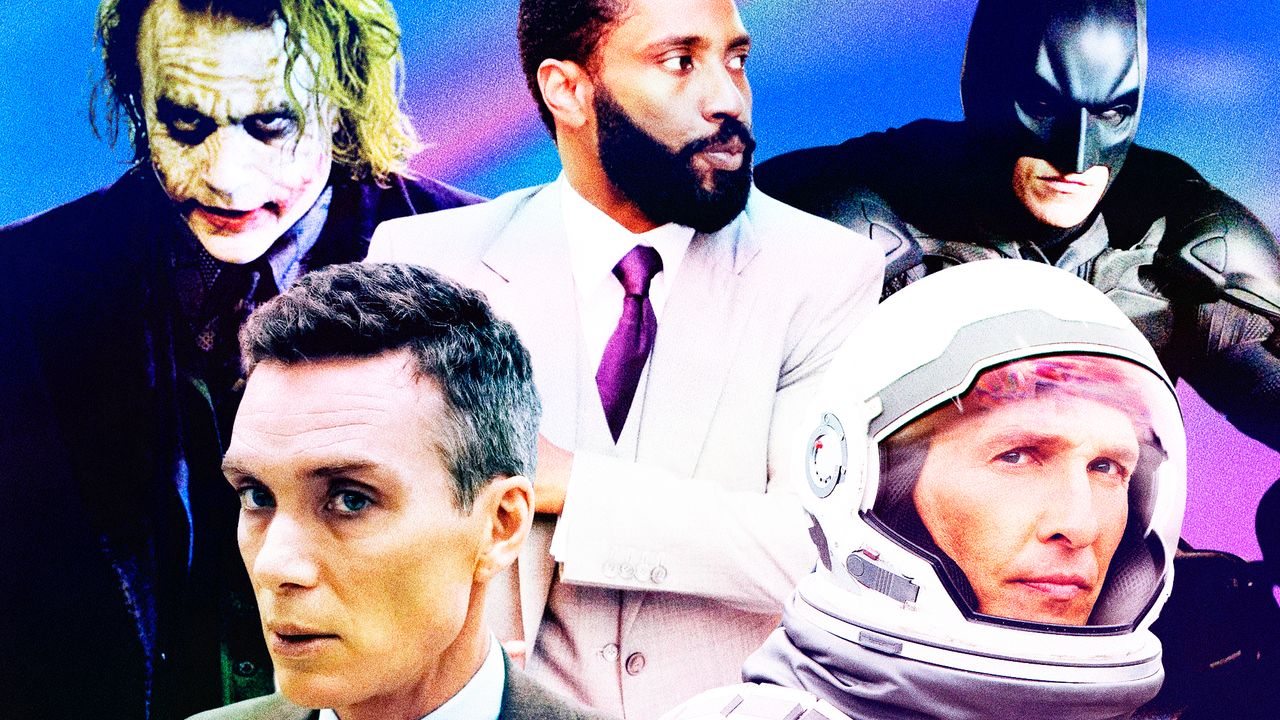
The Best Christopher Nolan Movies, Definitively RankedAuteur cred, blockbuster clout, rakish scarves—nobody hits the trifecta quite like Christopher Nolan. As his latest and hugest project The Odyssey hits theaters, we've ranked every movie in his epic filmography.Photographs: Everett Collection; Collage: Gabe ConteChristopher Nolan is the biggest brand-name movie director since the days of Steven Spielberg or George Lucas, which puts him in the running for biggest brand-name movie director of all time, at least in the realm of English-language cinema. (Although: His movies are overseas sensations, too. Tenet didn’t make $350 million worldwide off of a blockbuster U.S. release.) The strange thing about this is that Spielberg at his commercial peak was considered a populist, a director whose name became synonymous with big, mass-appeal hits and his ability to make them. Especially post-Batman, Nolan seems uniquely well-positioned to engineer those hits from his name, maintaining a perception that he’s an artsy auteur even as he makes billion-dollar smashes. He’s a fusion, then, of Spielberg-level monocultural ubiquity and dorm-room-poster quasi-alternative cool—which is to say, for hardcore film people, he’s probably come to seem more than a little square, a basic-bro cliché refreshed for the geek generation. (The James Cameron of Stanley Kubricks?)That’s more about perception of his movies than their vivid alternate realities, however. Despite his nerdy British rep, the increasing size and scale of Nolan’s work—including this week's The Odyssey, the first feature ever to be shot entirely on IMAX cameras—is best expressed by the smooth insinuation of Eames, Tom Hardy’s character in Inception: “You mustn’t be afraid to dream a little bigger, darling.” His work calls back to noir and war pictures while looking ahead with sci-fi headiness; the further into his career he gets, the more distinctive and inimitable his style becomes, interestingly dependent on editing, score, and tempo as much as a purely visual signature. It’s a fascinating evolution for a filmmaker whose work so often hinges on men who struggle for some greater, perhaps impossible control over their environment. The best Christopher Nolan movies make big-budget blockbusters feel like canvas for art, rather than endless monetization machinery. There’s not a bad film in the bunch, so let’s rank them all.13. Following (1998)Zeitgeist Films/Everett CollectionIsn’t it kind of nice to have a designated last-place dweller on this list that likely won’t bother anybody? Surely there are some Following partisans, and there’s plenty to like about Christopher Nolan’s debut; before you even get to the hooky budget-noir premise – an aspiring novelist starts following people at random and meets a criminal, becoming ensnared in his world of deception in the process – there’s the fact that it’s a 70-minute movie shot on black-and-white 16mm film, essentially a scrappy student film with the chops to score a limited indie release. But this is also a filmmaker who has excelled in the studio space, with the top-notch actors, practical effects, and bigger canvases those jobs have afforded him, so this one can’t help but look a bit slim by comparison. (In a clear case of “take what you can get,” this is the only Nolan movie in the Criterion Collection.) That said, it would be a kick to see Nolan pick up any of those limitations again, presumably still at a cost greater than the six grand or so this one supposedly cost; imagine the Nolan of 2025 turning in a movie under 90 minutes! Imagine the grain if he blew up a 16mm print to those IMAX screens! Following is still very much worth seeing, and there’s no shame in its placement here. Who among us wouldn’t hope to place work we did in our twenties below what we worked up to afterwards?12. Dunkirk (2017)Warner Bros. Pictures/Everett CollectionAlmost all of Nolan’s movies bend time, whether through non-chronological editing, actual time-travel devices, or the occasional “Wait, how much time just passed?” elision. Though it creates zero temporal pincer movements, Dunkirk is one of his headiest time-trips, following a World War II troop evacuation from three cross-cut perspectives: characters in land, sea, and air. The unusual trick is that these three stories, though afforded similar amounts of screen time, cover different spans of action. The land evacuation takes place over one week, the sea material takes place over one day, and the air mission happens in a single hour. It’s like Inception’s dream-layered climax recreated in real life. On a purely practical level, the movie can be a little hard to follow, because it features a bunch of pasty, largely uniformed English guys running, sailing, and flying around in great numbers, depending on action far more than dialogue or characterization. Even more so than many of Nolan’s visually spectacular films, Dunkirk is best seen in a format that’s vanishingly difficult to actually attain: full 70mm film IMAX, which is available at all of about 20 U.S. locations. That’s why, terrifically visceral as it is, the movie doesn’t rate higher here; its full immersive effect (still occasionally imitated in films as diverse in style as 1917 and Warfare) can't be reproduced in your living room, no matter how big your TV is.11. Insomnia (2002)First Run Features/Everett CollectionOn the other hand, Nolan’s most comfortably rentable at-home movie might be this remake of a 1997 Norwegian film that most buffs agree is the superior take on the material. But there’s something deeply appealing about a Nolan movie that now feels like an entry from an alternate universe where he became the best Warner Bros. auteur of TNT-ready programmers. Al Pacino plays a guilt-ridden cop sent to a night-free town in Alaska to investigate a serial killer—played by Robin Williams, in the more overtly evil but also less showy of his two against-type bad-guy roles of 2002. (The other is the more histrionic if still chilling One Hour Photo.) Pacino v. Williams makes for a surprisingly effective and satisfying mid-movie face-off; it may not be Heat-level, but this is a rock-solid noir with capable support from Hilary Swank, Nicky Katt, and Maura Tierney. Like Following, Insomnia almost makes you wish there were a couple more of these in Nolan’s filmography before he gets to the big leagues (not that directing one of the best Pacino movies of the 2000s is exactly small potatoes).10. Tenet (2020)Warner Bros./Everett CollectionBoy, it would be perfect if the story of Tenet, obviously conceived well before its 2020 release date, had a stronger allegorical connection to COVID, because it feels like the movie’s reputation was very much forged and then re-forged in that particular crucible. Nolan notoriously agitated for Warner Bros. to make this erstwhile summer event movie the world’s big return-to-cinema marker in September 2020, before anyone had vaccines, to muted and uncomfortable overall reaction, exacerbated by the obtuse nature of the movie’s sci-fi plotting. (The not-even-subtext of the reactions included a bit of: All of that, for this?) Then, when it did hit streaming, it was gradually embraced as the kind of opulent Pure Cinema studios have largely refused to make in recent years, especially as many people tried to forget about the pandemic, whether to escape for a couple of hours to put the trauma out of mind. To that end, maybe there’s something to be said for the movie’s villain (Kenneth Branagh) essentially deciding that the world might as well end for everyone else if it’s going to end for him; there’s a glimmer of both pandemic-era selfishness and doominess to that monstrous yet weirdly relatable instinct. Or maybe the movie works as a testament to the much-needed power of human connection, because while the time-in-reverse mechanics are often baffling in the moment, the movie works in large part because of the bittersweet camaraderie forged in the midst of all this, between the unnamed Protagonist (John David Washington) and his guide through the twilight world (Robert Pattinson, appropriately). Regardless: Despite its hinkiness feeling like it belongs in some as-yet-unreached Nolan Late Period, Tenet rocks, and may IMAX rep screenings play it back forever.9. Batman Begins (2005)Warner Bros./Everett CollectionAt the time of its release, Batman Begins was the second-best Batman movie in a walk, so it’s wild that it lands as far down as number eight in Nolan’s canon, behind two additional Batman movies, among others. It’s easy to underrate Begins because it’s a bit more modest, a bit more of a pulpy origin story, than the more ornately ambitious sequels (one of which is quite underrated in its own way). It’s also easy to overrate it for being the first blush of Nolan’s crime-saga take on the Caped Crusader; the relief this represented after the overblown, smirky garishness of Batman & Robin is difficult to convey to those who weren’t waiting with bated breath for a Bat-movie corrective for eight years following that Clooney-led debacle. (By contrast, it only took Warners four years to re-introduce a live-action Batman after Nolan’s mega-successful Dark Knight trilogy ended.) In the end, it’s also easy to rate Batman Begins exactly right: As a perfect introduction of Christian Bale into the Bruce Wayne/Batman role and one of the most rigorously satisfying superhero origin stories ever made.8. The Odyssey (2026)Universal/Everett CollectionNolan’s most Classic Hollywood production—a sword-and-sandal epic with the starriest cast this side of a 1950s Bible or circus picture—mitigates any perceived old-fashioned conservatism by following the thread of Oppenheimer, of all things: It’s a spectacle-heavy adventure story with a heavy dose of how-did-we-get-here despair. If that sounds like an internal compatibility error, well, maybe you haven’t thought this through as clearly as Nolan has; once again, he turns elements of his filmography that should feel old hat (the scrambled chronology; the fantasy elements rendered quasi-realistically; Anne Hathaway as the embodiment of love) into genuine grace notes. Also, isn’t it great to see a filmmaker who practiced for adapting classic literature by adapting superhero comics, rather than the other way around?7. Interstellar (2014)Paramount/Everett CollectionThe movie that should have banished a lot of empty comparisons between Stanley Kubrick and Christopher Nolan instead locked us in for another decade of them, simply because Nolan used a lot of practical effects to shoot a relatively grounded-looking (if still probably scientifically wack) movie set partially on spaceships. Interstellar is a vastly more sentimental movie than anything Kubrick ever made, especially 2001, and what it lacks as a visionary trip, it tries to make up in Nolan’s most blatant tearjerking, as in the scene where Cooper (Matthew McConaughey) returns from a time-dilated mission on a far-off planet, seeking a new settlement for the people on Earth, and watches a series of video messages where his children age decades and give him up for dead. It’s especially moving coming from a filmmaker so fixated on the flexibilities of time—an acknowledgment of how some things are immutable, whether it's time’s passage or (as Anne Hathaway’s character argues) the enduring nature of love. It’s corny and beautiful! And while Nolan has been accused of humorlessness, this movie also has a sassy talking robot; truly, something for everyone.6. Oppenheimer (2023)OPPENHEIMER, Cillian Murphy as J. Robert Oppenheimer, 2023. ph: Melinda Sue Gordon / © Universal Pictures / Courtesy Everett Collection©Universal/Courtesy Everett CollectionI know the movie that won Christopher Nolan some much-deserved Best Picture and Best Director Oscars should probably rate higher; the degree of difficulty involved in making nearly a billion dollars off of a three-hour historical drama about the creation of the atom bomb (and, more impressively, the personal fallout of that creation) is insanely high, and Oppenheimer is a hell of an achievement: in getting a bunch of IMAX theaters to play a movie with a bunch of black-and-white scenes; in exposing a bunch of dads to elliptical and non-linear editing with a stunning lack of exposition; in Nolan ensemble-marshaling in general and briefly reminding Robert Downey Jr. that he’s a real actor in particular; in becoming one of the first movies to kinda feel like a doomscroll but, somehow, not really in a bad way?It’s also a neat companion piece to something like First Man, as it chronicles those crucial first steps toward a possible end of the Earth. (See what I mean about the doomscroll?) The only thing that places this excellent movie out of the top five is the nagging sense that sometimes Nolan’s most serious-minded projects also tend to be his most workmanlike. He’s a sci-fi guy at heart—which is also what gives the movie’s build toward the bomb a hurtling, chilling grandeur.5. The Dark Knight Rises (2012)Warner Bros./Everett CollectionNolan may have been launched to the next level by big-budget franchise filmmaking, but he knows his way around an ending, and even his middle-of-the-trilogy movie finds a perfect non-cliffhanging stopping point—to such an extent that Nolan actively wondered if he could or should follow up The Dark Knight at all. He eventually did, with perhaps his most undervalued movie, one that patiently awaits the reclamation so many of his “disappointing” blockbusters enjoy a few years later; the sheer size and scope of this thing is a wonder to behold, especially in a subgenre that so often rushes to world-in-the-balance stakes in stories that nonetheless look and feel pixelated and rinky-dink. The Dark Knight Rises, following Bruce Wayne’s return to the Batman cowl for one last ride eight years after the events of The Dark Knight, is an intensely physical movie, befitting a trilogy-capper where Wayne has to strap on a semi-magical leg brace just to continue his Batman antics. He’s joined by an idealistic orphan cop (Joseph Gordon-Levitt) and some kind of Cat Woman (Anne Hathaway); is there a more swoonworthy moment in the Nolan canon than Bruce and Selina fighting henchmen together on the Gotham rooftops? (Probably, but not for me!) Basically, everything in The Dark Knight Rises that has incited mass eyerolls – Tom Hardy’s voice-mask combo as bad guy Bane (heavily reconfigured from the comics); the fact that Batman escapes a pit of eternal despair in an undisclosed location and rolls back into Gotham with absolutely no intervening scenes explaining how he got back there; “Robin” – is actually pretty awesome, especially in service of a rare degree of actual superhero-story closure. I know this probably “shouldn’t” be ahead of Oppenheimer, but which one would I be up for rewatching, like, right now?4. Memento (2001)Newmarket Releasing/Everett Collection“OK, so what am I doing? Oh, I’m chasing this guy. No, he’s chasing me.” It’s probably the biggest laugh in the Nolan filmography, and it doubles as a high-concept synopsis of Memento, the reverse-chronological story of Leonard (Guy Pearce), a guy with a hell of a short-term memory problem trying, with a doggedness that seems admirable at first, to solve the mystery of his wife’s death. Informational tattoos, helpful-hint Polaroids, Carrie-Anne Moss as a possible femme fatale, Pearce looking befuddled, Joe Pantoliano going “Lenny!”… the imagery, touchstones, and performances of Memento may be smaller-scale than much of what followed in Nolan’s career, but they’re just as indelible, a necessary reminder that the best Christopher Nolan movies need not cost $200 million to stun us. If anything, his breakout indie hit looks even smarter in (a ha!) retrospect, especially in terms of what it didn’t portend about his future movies. Specifically, it was probably wise of Nolan to mostly abandon the big-twist mechanism that finishes this particular movie with such elan, lest he become M. Night Shyamalan (which would ultimately be fine from an artistic point of view, but it's got to be annoying to constantly hear your endings described as “twists”). Instead, the movie’s finale lingers less for the audacity of its rug-pull than its chilling rumination on memories and how we mold them to our use.3. The Prestige (2006)Touchstone Pictures/Everett CollectionTwo magicians tussle dishonorably for authentic wonder in this Nolan Brothers adaptation of the Christopher Priest novel (Jonathan Nolan makes his first credited return to Christopher’s films since co-writing Memento). I know I just got through praising Nolan for not over-relying on twists, and The Prestige happens to have a doozy of one up its sleeve. But this film—perhaps the definitive feature-length attending of that Arthur C. Clarke quote about sufficiently advanced technology being indistinguishable from magic—is precisely about methods of sleight-of-hand, whether old-fashioned commitment or futuristic breakthroughs. It also features one of Hugh Jackman’s very best performances, playing a guy who will do anything to become the greatest showman—a far more interesting precursor, then, to his edgeless, cuddly P.T. Barnum from the hit musical a decade later. We expect to see Christian Bale characters behaving obsessively (and his character here feels like a darkly funny comment on nutty actorly discipline), but there’s something particularly eerie about finding the darkness in Jackman’s top-hatted soul. On top of all that, there’s terrific cinematography, production design, Rebecca Hall and Scarlett Johansson, and David Bowie playing Nikola Tesla. Plenty of other filmmakers would go to outlandish lengths to make a movie this good.2. The Dark Knight (2008)Warner Bros./Everett CollectionIt’s a classic for a reason, merging Empire Strikes Back shit-gets-real portent with Return of the Jedi-style cross-cut momentum. Not to always tell it to you in Star Wars, but The Dark Knight also finds further kinship with the future entry The Last Jedi; both movies obviously connect to and deepen their predecessors while working remarkably well as stand-alone stories. (Hence Nolan’s aforementioned reluctance to even make a third Batman movie, though I’m glad he ultimately didn’t pass, or Rise of Skywalker it.) We’ve all read endless run-downs of how great The Dark Knight is, and we’ve all seen multiple Joker performances that still live entirely in the shadow of the work Heath Ledger does here, while never managing to be as funny, scary, or original. It’s not just Joker, though. What’s especially funny and strange is that this movie helped kick off an age of Batman saturation we’re still living in; the eight-year gap between Joel Schumacher's Batman & Robin and Nolan's Batman Begins now seems unthinkable, and in fact it’s far more likely that there will be multiple ongoing movie Batmen at once than none at all. Yet no matter what you think of the individual variations, it’s hard to shake the feeling that this one will be impossible to top. In his own thrilling and slightly self-serious way, did Nolan help gradually kill off the illusion of a healthy long-term superhero cinema?!1. Inception (2010)Warner Bros./Everett CollectionThe obligatory complicated movie that’s at least partially about the complications of moviemaking, Inception has ample opportunities to disappear up its own ass. (If ever there was perfect timing to produce a boondoggle, it would be following the billion-dollar success of The Dark Knight.) Yet this dream-heist sci-fi action-drama, where thieves plug into deeper and deeper levels of subconscious to implant and/or steal valuable ideas, somehow maintains a light touch amidst all of the usual straight-faced menace. Yes, the Nolan narrative and stylistic tropes are all here: the obsessive protagonist; the dead wife; the attempt to impose control; the pacing and cutting that sometimes feels like an endless rising montage. Don’t they have to be, working in concert, to play out so well? The stock criticisms of Inception are, unsurprisingly, actually describing secret strengths: The torrents of exposition offered to Ariadne (Elliot Page) don't just give the audience the opportunity to catch up on the movie’s heady rules; they’re actively fun and playful, as crucial to drawing us into the mission as scenes where the leader lays out the blueprint for an impending heist. The lack of blatant surrealism in the dreamscapes, meanwhile, reflects the control that mastermind Dom (Leonardo DiCaprio) must attempt to exert in order to manipulate his subjects (and, not unimportantly, is also true to a lot of actual dreams)—and, of course, the recognizable reality that so many big-screen dreams try to stay rooted in, at least on some level. “Always imagine new places,” Dom cautions Ariadne, not to let imagination run wild but for the safety of distinguishing dream from reality. That tension between drilling further into familiar-but-different imaginary spaces—living in that slow-motion shot of the vehicle hurtling off the bridge— and coming back up for real-world air makes the movie more than its rollercoaster of indulgences. It’s a certain kind of magic-trick experience that you can’t stop watching, in hopes of spotting that little wobble of reality. Put in a less convoluted way: Movies like Inception are why I love movies.Jesse Hassenger is a contributing writer for GQ covering movies, television, and popular culture. His other work as a critic currently appears at Paste Magazine, where he is the associate film editor, as well as the A.V. Club, Decider, The Daily Beast, The Guardian, and Vulture, among others. Past publications ... Read More
The Best Christopher Nolan Movies
Full Article
Original Source
Read the full article at Gq →KhanList aggregates and links to publicly available news content. We do not host full articles from third-party sources. Always verify important information with original sources.