
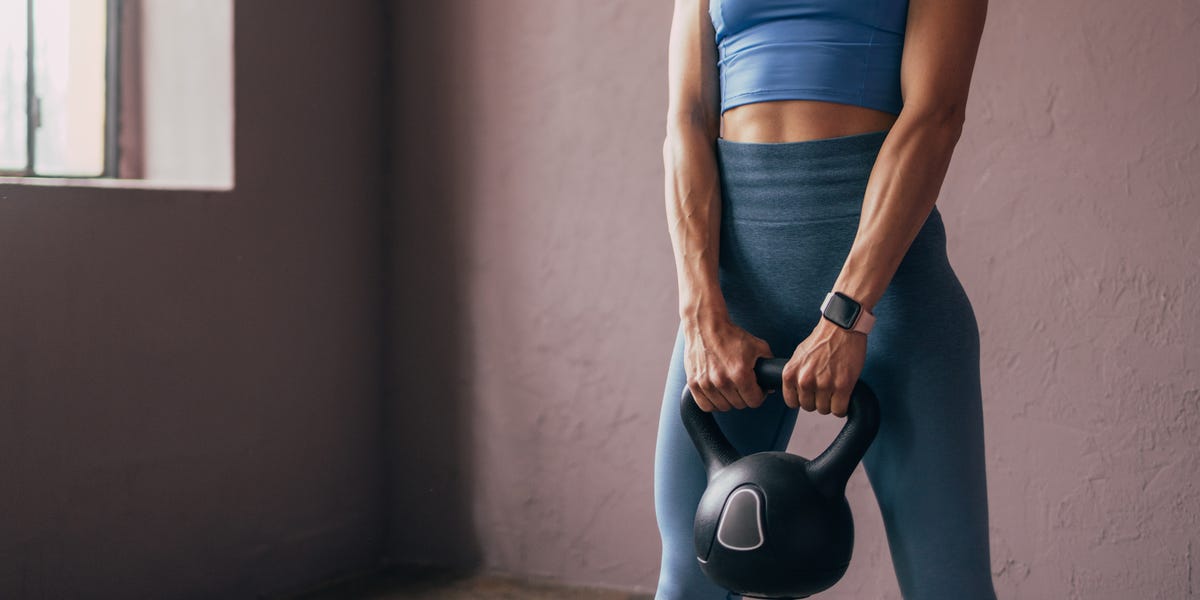
12 min readIf you’re anything like me, then you’re a regular at the dumbbell rack and know exactly how to bicep curl, lunge, and squat your way through a workout with them. Buuut you tend to avoid direct eye contact with your gym’s kettlebell section. Rest assured, bells aren’t as intimidating as they look—and trust me, you’ll want to get familiar with this often-underrated weight.This piece of equipment is a jack of all trades. “Kettlebells allow you to increase your strength, power output, muscular endurance, muscle size, and bone density,” says Jacqueline Kasen, CPT, a Miami-based coach, master trainer, and creator of the Kasen Method with the StrongFirst Kettlebell certification.Meet the experts: Jacqueline Kasen, CPT, is a Miami-based coach, master trainer, and creator of the Kasen Method with the StrongFirst Kettlebell certification. Taylor Beebe, CPT, is an RKC-certified personal trainer and member of the WH Strength In Diversity initiative in California.Due to the way that kettlebells are shaped—with their center of mass falling at the bottom of the handle—they’re also great for doing explosive power movements that can improve athleticism and bone health.Plus, you don’t need a ton of equipment or space to train with kettlebells. “If you're someone who maybe doesn't have access to a gym or you're just looking to start investing in equipment, you get the most bang for your buck when you are able to utilize kettlebells,” says Taylor Beebe, CPT, an RKC-certified personal trainer and member of the WH Strength In Diversity initiative in California.Transform your body composition with our 4-week kettlebell burn planThat said, because of the way they’re shaped, kettlebells come with a bit more of a learning curve. That’s where this complete guide to kettlebell training comes in. It includes the best moves for beginners, how to get started, and the benefits you can expect to reap.12 Best Kettlebell Moves for BeginnersTime: 20 minutes | Good for: full-body | Equipment: looped resistance band, dumbbellsInstructions: Choose 5 to 6 exercises from the list below. Perform 8 to 12 reps of each exercise (or 30 to 45 seconds for carries), moving from one exercise to the next with minimal rest. After completing all exercises, rest for 60 to 90 seconds, then repeat the circuit. To get the most benefits, Kasen (who designed the workout) recommends completing the full circuit two to three times total:1. Kettlebell DeadliftHow to: Stand with your feet hip-width apart and the kettlebell centered between your heels. Hinge at your hips by pushing them back while maintaining a neutral spine. Keep your chest open with your eyes looking six to eight feet in front of you. Grip the handle with both hands, drive through your feet, and stand tall, extending hips. Lower the kettlebell back to the floor in between the heels with control. That’s 1 rep.Why it works: This move builds posterior chain strength while teaching the foundational hip hinge pattern used in many kettlebell exercises.2. Goblet SquatHow to: Stand with feet slightly wider than hip-width apart, holding the kettlebell close to your chest by the horns (the sides of the handle) with elbows pointing down in line with your wrists. Sit your hips back and down until your thighs are parallel to the floor (or as low as comfortable) while keeping your chest up and eyes gazing forward.Drive through your feet to return to standing. That’s 1 rep.Why it works: Goblet squats strengthen the legs and glutes and stabilize the core while reinforcing proper squat mechanics.3. Two-Hand Kettlebell SwingHow to: Stand with your feet directly behind the kettlebell so your big toes are lightly touching it, then take a casual step back until your feet are about hip-width apart. Hinge at your hips, grip the top of the handle with both hands, and keep your chest lifted, lats and core engaged, and your eyes focused about six feet in front of you. You should feel tension in your hamstrings and glutes.Hike the kettlebell back between your legs, aiming your thumbs toward your glutes while keeping the bell close to your body. Then explosively drive your hips forward into full hip extension, allowing the kettlebell to float to shoulder height. (Keep your arms relaxed—your lower body should generate the power.)Allow the kettlebell to naturally fall back between your legs, staying patient on the descent and keeping it close to your body to maintain proper alignment. That’s 1 rep.When you’ve completed your final repetition, hike the kettlebell back one last time, then guide it forward and place it gently on the floor slightly in front of where it started.Why it works: It improves power, endurance, and cardiovascular fitness while working the glutes, hamstrings, and core.4. Single-Arm Kettlebell SwingHow to:Stand with your feet directly behind the kettlebell so your big toes are lightly touching it, then take a casual step back until your feet are about hip-width apart. Hinge at your hips, grip the top of the handle with one hand, lift your chest, and engage your lats and core. Keep your eyes focused about six feet in front of you. You should feel tension in your hamstrings and glutes.Aggressively hike the kettlebell back between your legs, aiming your thumbs toward your glutes while keeping the bell close to your body. Then explosively drive your hips forward into full hip extension, allowing the kettlebell to float to shoulder height. (Keep your arms relaxed—your lower body should generate the power.)Allow the kettlebell to naturally fall back between your legs, staying patient on the descent and keeping it close to your body to maintain proper alignment. That’s 1 rep.When you’ve completed your final repetition, hike the kettlebell back one last time, then guide it forward and place it gently on the floor slightly in front of where it started.Complete all reps, then repeat on the other side.Why it works: It challenges your unilateral strength (on one side of the body), grip abilities, coordination, and core stability, all while building power.5. Single-Arm Dead CleanHow to: Start with the kettlebell on the floor just inside the heel of your working side. Hinge at the hips, grip the handle with your palm facing down, and engage your lats and core while keeping your chest lifted. Keep your shoulders and hips square to the floor, with your knees and feet aligned.Drive forcefully through your feet and extend your hips to smoothly bring the kettlebell into the front rack position (with your hand directly in front of your shoulder and the weight of the bell resting on your wrist). Avoid letting the kettlebell swing or cast away from your body. Lower the kettlebell back down to the starting position, allowing gravity to guide it down while maintaining control. That’s 1 rep.Why it works: It builds coordination, power, and total-body strength.6. Single-Arm CleanHow to: Begin with the kettlebell between your legs. Hinge, then explosively extend your hips and guide the kettlebell into the front rack position, allowing it to rotate smoothly around your wrist rather than flipping over.Lower the kettlebell back down to the starting position, allowing gravity to guide it down while maintaining control. That’s 1 rep.Why it works: It improves your explosive power, coordination, and upper-body stability.7. Two-Hand CleanHow to:Begin with the kettlebell between your legs. Using both hands on the kettlebell, hinge at the hips and drive upward explosively, bringing the kettlebell into a controlled front rack position. Lower the kettlebell back to the starting position, allowing gravity to guide it down while maintaining control. That’s 1 rep. Why it works: It develops full-body power and reinforces proper hip drive.8. Clean to Overhead PressHow to: Begin with the kettlebell between your legs. Hinge, then explosively extend your hips and guide the kettlebell into the front rack position, allowing it to rotate smoothly around your wrist rather than flipping over it.Press the kettlebell overhead until your arm is fully extended. Lower back to the rack position, then down to the starting position, allowing gravity to guide it down while maintaining control. That’s 1 rep.Why it works: It combines lower- and upper-body strength into one efficient full-body movement.9. Push PressHow to: Begin with the kettlebell between your legs. Hinge, then explosively extend your hips and guide the kettlebell into the front rack position, allowing it to rotate smoothly around your wrist rather than flipping over.Perform a slight knee bend, then drive through your legs to help press the kettlebell overhead. Lower to your shoulder with control. That’s 1 rep.Lower the kettlebell back to the starting position, allowing gravity to guide it down while maintaining control.Why it works: It generates power while allowing you to move slightly heavier loads than other press variations.10. Single-Arm Bent-Over RowHow to: Begin in a staggered stance with your left foot forward and your right leg back. Step your right leg far enough behind you that it remains straight with your weight loaded through the ball of your back foot. Your left knee should be bent, with your knee stacked over your foot.Rest your left forearm across your left thigh for support and stability, and place the kettlebell just inside your left ankle. With your chest open, lats engaged, hips and shoulders square to the floor, and your eyes focused slightly in front of you, reach across and grab the kettlebell with your right hand using a neutral grip.Pull the kettlebell toward your hip, driving your elbow back, while keeping your torso completely still. Pause briefly at the top, then slowly lower the kettlebell until it lightly touches the floor inside your ankle, allowing your lat to fully lengthen before beginning the next repetition. That’s 1 rep.Perform all reps, then repeat on the other side.Why it works: It strengthens the upper back, lats, and arms while improving posture.11. Lateral LungeHow to: Hold the handle of the kettlebell in one hand with a neutral grip and stand tall with your feet together. Step out to lunge to the right, keeping your toes pointing forward and your knee aligned with your foot. Sit your hips back into the lunging leg while keeping your opposite leg straight and your chest lifted. Press through the mid-foot of your working leg to return to the starting position. Keep your core engaged throughout the movement and avoid side bending as you stand back up, maintaining a tall, stable torso from start to finish. That’s 1 rep.Perform all reps, then repeat on the other side.Why it works: Lateral lunges work the glutes and legs while improving lateral movement, balance, and hip mobility.12. Unilateral Farmer’s CarryHow to: Hold the kettlebell in your right hand, resting at your side as you stand tall with your shoulders level and core engaged.Walk forward slowly and under control for 30 to 45 seconds. That’s 1 set.Repeat on the other side.Why it works: It improves grip strength, posture, core stability, and overall functional strength.Getting Started With a KettlebellTo get the most out of your kettlebell workout, be sure to follow these key tips:Take your shoes off. “You need to be one with the floor,” during all strength work, but particularly when using kettlebells, says Kasen. If you’re wearing sneakers during a kettlebell swing, for instance, it’s easy for your toes or heels to pop off the floor because they’re not grounded. But without shoes, “you're starting to actually use your feet and you'll be more stable,” she adds. That way, you can throw the bell around with control.Get comfortable holding the bell. When holding a kettlebell, especially in the rack position, keep your wrist neutral with your “knuckles stacked right above your wrist and not cocked to the side,” says Beebe.In the front rack position, the kettlebell may bruise your forearm a bit in the beginning because the tissue isn’t used to that weight. But “the more often you use it, the more comfortable it gets and it won't be as sore over a period of time,” says Kasen.Place the kettlebell strategically. For vertical movements, or when the bell is moving directly up—like cleans, overhead presses, or thrusters—the kettlebell should be placed between the heels when you go to pick it up, Kasen says. When the bell is moving horizontally (out from you), like during a kettlebell swing, it should be hiked out a bit in front of you.Engage your entire body. After picking up a bell, “your total body turns on,” says Kasen. If the bell is front racked, squeeze your elbows in and engage your core and lats. Think of the core circumferentially like a can of soup and distribute “force around the perimeter,” says Beebe. For instance, if you’re at the top of a kettlebell swing, you’re essentially in a vertical plank. “I shouldn't be able to move you at the top of your kettlebell swing, you should be really, really stable,” with that stability coming from the core, she adds.Distribute your weight into your mid-foot. “You're not going to be on the toes of your feet, you're not going to be on your heels,” Kasen says. “If you're doing a deadlift, a clean, a jerk, a snatch, a row, anything, you have to think, ‘Feet push through the ground,’ and that's where the power's going to come from.” In this position, you should feel your quads, hamstrings, glutes, abs, shoulders, and chest working. Your feet should be especially grounded during horizontal movements, because the propulsion of the kettlebell is moving away from you, Beebe says.Start small. “Everybody sees the fun, explosive, hard” kettlebell movements online and gets excited, like single-arm swings, snatches, and jerks, Kasen says. But don’t jump into those movements just yet—instead, start balancing on one leg with the kettlebell in a front rack position and your other leg in tabletop position for 30 seconds. “Build a strong foundation,” she says, then when you get to those harder moves, “you're going to feel really strong and powerful, and it's going to be a lot safer.”Be patient.“People want to be so perfect right out the gate,” Kasen says. “You're going to make mistakes. Form is not going to be perfect. Don't give up, don't quit too early.” It’ll take a couple of reps before you really feel comfortable. But the more you practice, the better your form will become and you’ll feel that sense of accomplishment from conquering a new-to-you piece of equipment.“Enter this type of training with an open mindset and an understanding that it's going to take some time to develop that skill," says Beebe. “But it's going to be really rewarding if you stick with it.”Get a kettlebell coach. Your best bet to learn form and technique is to work with a coach who’s either certified through Strong First or the Russian Kettlebell Challenge (RKC). They’ll understand how to teach explosive power movements, which are way more technical than traditional dumbbell movements, Kasen says.They can also give you feedback on your form that might highlight other issues you have, like a mobility problem. “Having that extra set of eyes can be really, really helpful,” Beebe adds.Which Kettlebell Weight to Pick“Beginners should ideally have access to three kettlebells: a light bell for overhead pressing and skill development; a medium bell for foundational movements, such as squats and rows; and a heavier bell for lower body exercises like swings, deadlifts, and loaded carries,” says Kasen. “This allows for appropriate loading across different movement patterns when you're promoting safe and effective progressions.”Shop Our Favorite KettlebellsAmazon Basics Cast Iron KettlebellYes4All Vinyl Coated KettlebellNow 11% OffBeebe recommends getting a starter pack of 12-, 16-, and 24-kilogram kettlebells. But if you can only invest in one, go with a 16-kg bell. “You can do two-handed swings at least initially with that, but also a single-arm swing,” she adds.Both experts say they commonly see people using kettlebells that are too light. Here are some signs that you should use heavier weight, according to Kasen and Beebe:- Your wrists are flopping around or you feel your arms (instead of your hips) working during kettlebell swings.- You can overhead press the kettlebell weight that you’re using for your lower body.Why Using Kettlebells Is a Smart Way to TrainIt can increase athletic performance and power. Because the center of mass falls at the bottom of the kettlebell, the moves that you do with it are naturally more power-based than strength-based, says Kasen. (See: swings and cleans.) It may improve strength and build muscle. Kettlebells are “a more versatile tool” than dumbbells, says Kasen, so you can also use them to strength train. “You can press it, row it, curl it, extend it, squat it, deadlift it.” Strength training is important for growing muscle mass and strength, which can also help you move independently as you age and complete daily tasks, according to the National Institutes of Health (NIH).It might support your bone health and longevity. While kettlebells can benefit everyone who picks them up, they’re especially impactful for women in midlife. “As women age, we have to worry about bone loss or osteoporosis and osteopenia, where bones are becoming more brittle because we're not lifting as heavy as we should,” Kasen says. But resistance training (which can be done with kettlebells) helps the bones take on force to make them work harder, combating bone loss, according to the NIH. It can enhance endurance. Since a kettlebell handle allows you to swing it during exercises, it can help get your heart rate up and improve your endurance more than traditional dumbbells, according to a 2024 review of articles on kettlebell training in Cureus.Above all else, though, when you pick up kettlebell training, you’re investing time in yourself and learning something new (which is linked to better brain health!). “Something that is very undervalued in the fitness world is being a beginner at something,” says Beebe. So, take a chance on yourself and approach the kettlebell section of your gym—you’ll never know how much you love it if you never try.Find the Perfect Women’s Health Training Program for YouJustin SteeleRona Ahdout//Hearst Owned Addison Aloian is the associate health & fitness editor at Women’s Health, where she writes and edits across the health, weight loss, and fitness verticals. She’s also a certified personal trainer through the National Academy of Sports Medicine (NASM). In her free time, you can find her lifting weights at the gym, running on the West Side Highway in New York City—she recently completed her first marathon, the 2025 New York City Marathon—and watching (and critiquing!) the latest movies that have garnered Oscars buzz. In addition to Women's Health, she’s made an appearance on the Oprah Podcast and her work has also appeared in Allure, StyleCaster, L'Officiel USA, V Magazine, VMAN, and more.
The Beginner’s Guide to Kettlebell Training, According to Experts
Full Article
Original Source
Read the full article at Womenshealthmag →KhanList aggregates and links to publicly available news content. We do not host full articles from third-party sources. Always verify important information with original sources.