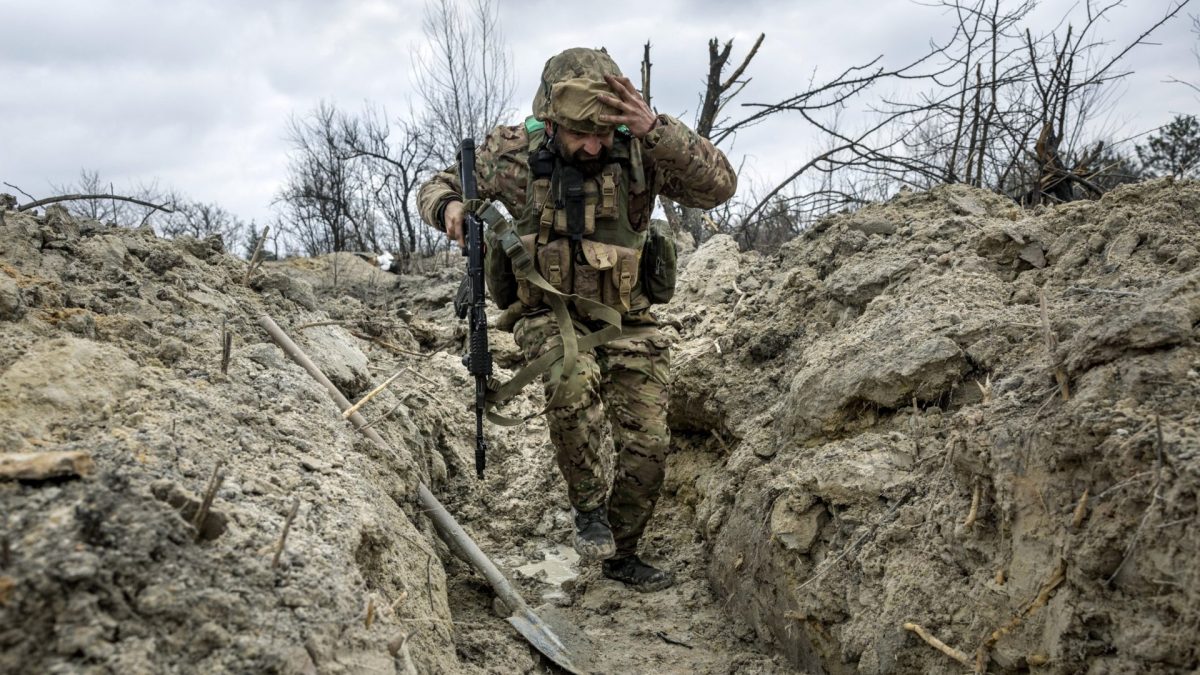
PUTTEN, NETHERLANDS – Think of war and you’re likely to picture trenches. From the Battle of the Somme to the invasion of Ukraine, trenches have become synonymous with land warfare. Trench warfare began on a massive scale in the First World War, used to hide troops, push forward, deliver supplies and evacuate casualties. Today, it remains a staple of the curriculum for infantry training, officers at Sandhurst and the University Officer Training Corps, which The i Paper joined on an exercise in the Netherlands. But as the invasion of Ukraine changes the face of warfare, trenches are being abandoned as militaries pursue other tactics. Shorts During the First World War, the main trench system spread approximately 475 miles from the English Channel to the Swiss Alps, containing command posts, first-aid stations, kitchens and latrines, as well as emplacements for machine guns. Building at this scale was only possible because of enormous manpower; around six million men were mobilised to fight for the UK alone. Soldiers were rotated in and out of the trenches, spending around 10 days a month in the system. As new weapons like the fully automatic machine gun came onto the battlefield, and armies ballooned to millions in size, “the only way you can protect your soldiers is to get them dug into the ground,” says Alan Wakefield, head of First World War at the Imperial War Museum. “The reason that the Western Front becomes one continuous line is because each army is trying to find a way round the other’s flank to surround the enemy,” he told The i Paper. “Every time it fails, another chunk of trenches is added to the system.” British University officer cadets learn trench warfare on an exercise in the Netherlands (Photo: Mark Owens/ British Army) Both sides raced to develop and mass-produce technologies that could break the trenches – and the morale of the men within. Tanks were invented in part to respond to the problem, and were first used by Britain in the Battle of Flers-Courcelette in September 1916. Howitzers, large-scale field guns, were also used to bombard the enemy trench for hours or days. During the Battle of the Somme in 1916, the British bombardment of German trenches lasted for more than a week. Trench warfare also persisted into the Second World War, though on a much smaller scale, as evolving technologies opened up new approaches. During the Gulf War, in which the UK deployed more than 50,000 soldiers, Iraq built elaborate trench systems and they were also used by the Taliban in Afghanistan. However, it is arguably drones that have finally made trenches obsolete. In Ukraine, expansive trench networks are being left behind, according to Nick Reynolds, a research fellow for Land Warfare at the Royal United Services Institute think-tank. “If you speak to Ukrainians, some will say: ‘Nobody digs trenches anymore’. There is an element of truth in that. In some areas, we’re not seeing trenches at all on the battlefield.” Reynolds attributes this to the “drone-ification of warfare“. With drones constantly patrolling the skies, spending hours digging in the open has become increasingly dangerous. Much of the battlefield in Ukraine also has very little tree cover, making it easier to be spotted and harder to cover trench networks effectively. A soldier from Ukraine’s 72nd Mechanised Brigade carrying out assault training in a trench (Photo: Viktor Fridshon/Getty) Drones can also help with trench creation, with heavy-duty attack and cargo-carrying drones blasting munitions to break up hard soil or bringing in digging equipment. The lack of trenches is also linked to Ukraine’s unwillingness to put large numbers of troops in harm’s way. Whereas the First World War trenches were used to funnel soldiers to the front, Ukraine prefers to limit the number of troops in forward positions and hold much of its force, including drone pilots, back in safer areas. “Instead of creating a mass that would create a challenge for an attacker to break through [as in the First World War], that would simply create a target on the modern battlefield,” Reynolds said. “You would get a lot of people killed.” Ukrainian soldiers are still digging down for protection, but more commonly in isolated dugouts rather than connected systems. “I’m not saying that trenches won’t come back, but I don’t think we’ll ever see continuous trench lines again,” Reynolds told The i Paper. He said that smaller trench networks, used to anchor defensive lines, or dugouts connected by communications trenches, aren’t “going to go away”. But as drones rapidly reshape modern warfare, it’s clear that future battlefields could be unrecognisable from the ones we’ve known.
The battlefield tactic from the First World War that’s being killed off by Ukraine
Full Article
Original Source
Read the full article at Inews →KhanList aggregates and links to publicly available news content. We do not host full articles from third-party sources. Always verify important information with original sources.