
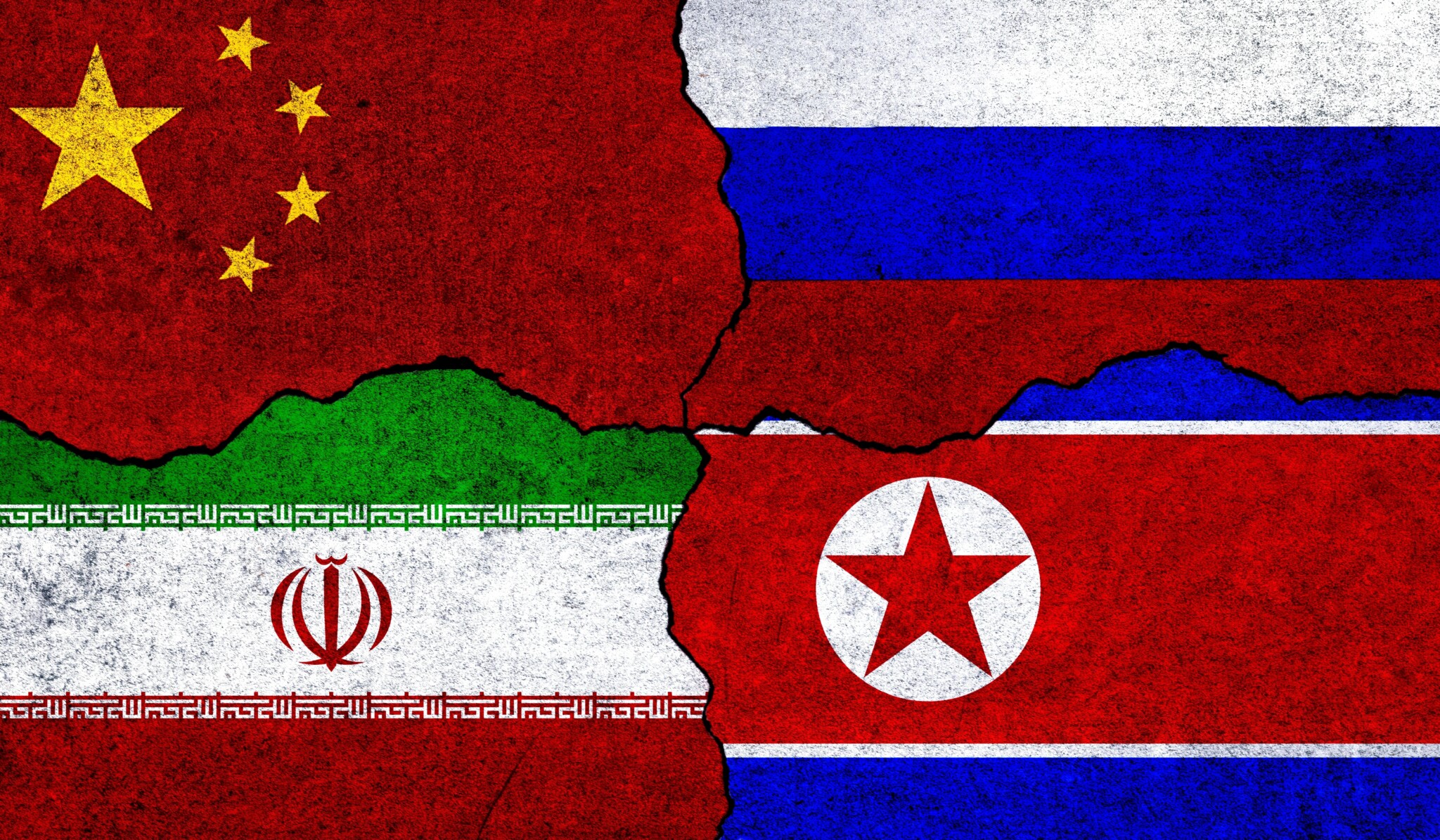
America has grown addicted to the phrase “wars of choice,” often using it to vilify the U.S. government for campaigns deemed unnecessary. Wholesale skepticism of military power, however, undermines Washington’s ability to defend the homeland against surprise attacks like Pearl Harbor and 9/11. America might not choose war, but war will likely choose America, at home and around the world.In “Axis of Aggressors,” my Foundation for Defense of Democracies colleagues Brad Bowman, Elaine Dezenski, and Mark Montgomery examine how China, Russia, Iran, and North Korea cooperate across multiple domains. These regimes supplement each other’s military production while building parallel financial networks to bypass Western economic tools. Together, their economic weight approaches a quarter of global GDP. Western policymakers long managed these nations as isolated regional challenges. As detailed in national security assessments, however, these four authoritarian regimes have systematically set aside ideological differences. This Axis utilizes alternative financial platforms, illicit trade networks, and shared military technologies to blunt international pressure and challenge the rules-based order. A primary engine of this collaboration is a shadow economic system engineered to evade sanctions. Jurisdictions such as Malaysia and Turkey play structurally distinct but mutually reinforcing roles in sustaining Axis trade. In global energy markets, Malaysia has emerged as a key relabeling hub for Iranian oil, with Chinese customs data showing imports from Malaysia far exceeding the country’s production. China reported importing 1.3 million barrels per day of “Malaysian” oil in 2025, more than twice Malaysia’s total daily production of 535,000 barrels in 2024, as “Axis of Aggressors” notes. The book points to additional examples of sanctions evasion. “Turkey has become a top buyer of Russian oil products and a major conduit for parallel imports, while Hong Kong has evolved into a high-risk transshipment and financing center for restricted technologies bound for Russia,” according to “Axis of Aggressors.” “Central Asian states serve both as Russia’s backdoor for battlefield goods and as a logistics corridor for China’s long-term sanctions resilience,” it adds. To break their reliance on the U.S. dollar, China and Russia are developing parallel financial messaging systems. While these alternative networks remain fragile compared to the U.S.-based Clearing House Interbank Payments System, which settles approximately $1.8 trillion daily, China’s Cross-Border Interbank Payment System “processed roughly $24.5 trillion in transactions in 2024 — a 24 percent increase in volume and a 43 percent increase in value from the prior year — and now connects more than 5,000 financial institutions across 190 countries.” Meanwhile, Russia’s System for Transfer of Financial Messages connects “177 financial institutions from 24 countries,” and its integration with Iran’s financial system has created a “sanctions-resistant payment corridor between two of the world’s most heavily sanctioned economies.” This economic defiance funds aggressive efforts to undermine the U.S. domestic front through information warfare. Axis adversaries conduct sustained influence operations seeking to “divide and distract Americans and deceive them into believing the United States has no interests in the outcomes in Taiwan, Ukraine, and Israel.” Compounding this challenge, U.S. government efforts to counter foreign malign influence have been dismantled, leaving them hamstrung. The book notes how key government agencies have been weakened, including the FBI’s Foreign Malign Influence Task Force, the State Department’s Global Engagement Center, and the Office of the Director of National Intelligence’s Foreign Malign Influence Center. This domestic vulnerability coincides with a shifting global military balance. “The Pentagon estimates that China possesses approximately 600 warheads and is on track to have more than 1,000 warheads by 2030,” the book notes. With Russia continuing to “modernize and diversify” the largest nuclear arsenal in the world, the U.S. faces “the prospect of deterring two nuclear-armed peer adversaries at the same time.” Despite these threats, U.S. defense spending has fallen to near post-World War II lows as a percentage of GDP. Bipartisan commissions warn that insufficient budgets have crippled the defense industrial base, leaving the nation unprepared for a major war. To reverse this decline, Washington must shift both resource allocation and strategic posture. Rebuilding deterrence requires a historic increase in defense spending, bringing core military spending to 3.5 percent of GDP. In the Indo-Pacific, where U.S. advantages have severely eroded, “Axis of Aggressors” argues that a strategy of denial along the First Island Chain, stretching from Japan southward through Taiwan and Indonesia, is urgently needed. This posture must be “more mobile, networked, dispersed, survivable, and lethal,” strengthening the U.S. presence in Japan and the Philippines while securing a larger inventory of “air and missile defense interceptors as well as advanced air-, sea-, and ground-launched long-range precision munitions.” Washington can no longer afford to view global flashpoints in isolation. The burgeoning Axis of China, Russia, Iran, and North Korea has proved that economic insulation, information warfare, and military expansion are part of a singular, synchronized campaign to dethrone Western leadership. Preserving the international rules-based order demands that American leaders move past partisan divisions and old bureaucratic inertia to make necessary, long-term investments in America’s military-industrial base. The inability to refill depleted air defense interceptors, whether in Ukraine, Israel, or Kuwait, offers ample evidence that the U.S. and its allies are unprepared. As the world heats up, Washington should do all it can to abandon its unjustifiably relaxed posture. If the U.S. wants peace, the saying goes, it must prepare for war. Hussain Abdul-Hussain is a research fellow at the Foundation for the Defense of Democracies and a columnist focusing on Lebanon and broader Arab affairs.
The Axis of Aggressors Is Getting Ready for War. Is America?
Full Article
Original Source
Read the full article at Fdd →KhanList aggregates and links to publicly available news content. We do not host full articles from third-party sources. Always verify important information with original sources.