
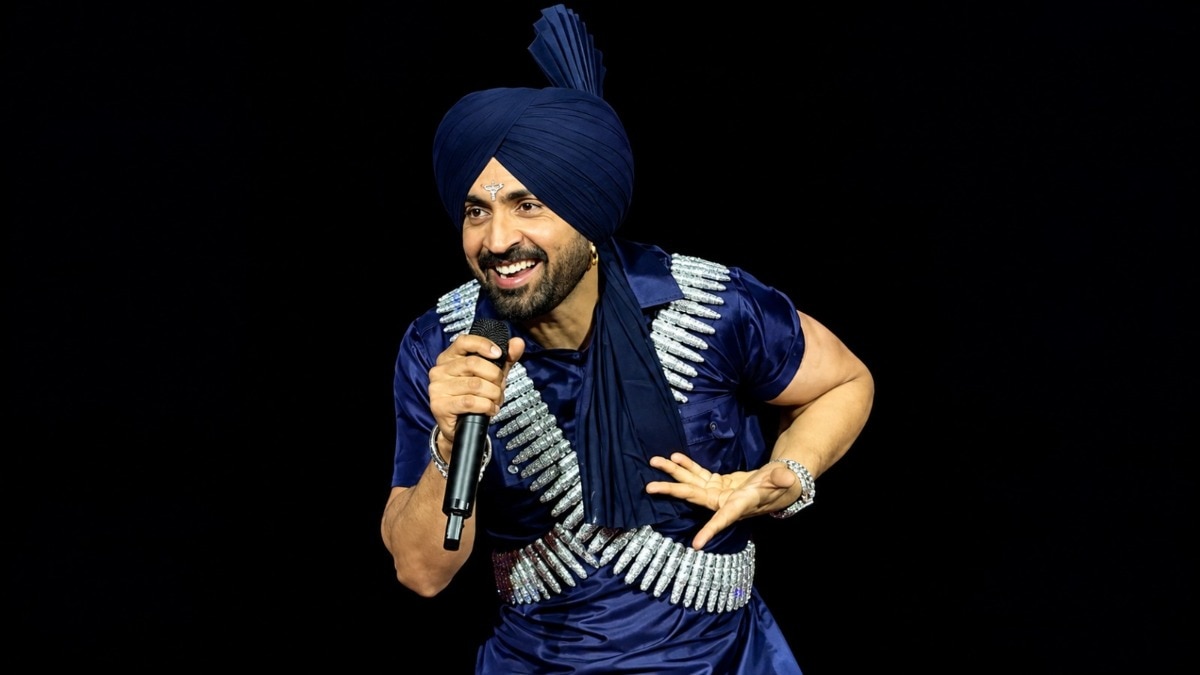
Being told what to say, how to behave and when to act is essentially like being asked to stay within four walls while still being expected to think outside the box. Now imagine being told what you can sing at your own concert, having bomb threats hanging over your show and still walking on stage as if nobody's going to tell you when to stop. That's pretty much been Diljit Dosanjh's AURA India Tour so far. And that's just two shows till now. The crowds have come for the music, the dancing and the madness that comes with a Diljit concert. But the singer has had a few other things to deal with. And instead of keeping them backstage, he's been bringing them right into the spotlight.What's interesting here is the way Diljit has handled it all. No preachy speeches or turning concerts into lecture halls. He's made his point in his own language: by showing up, cracking a sarcastic remark, wearing a rather telling accessory and, in Indore, borrowing a few lines from late legendary poet, Rahat Indori.If anyone thought the tour would be just another musical spectacle, they've probably had to rethink that by now. Here's how it all happened.It started on a rainy day in Delhi on October 30. The opening concert at Jawaharlal Nehru Stadium was caught in a security clearance tussle after Delhi Police initially denied permission, citing festive-season crowds and threat-related inputs. Additional security arrangements had to be worked out before the show got the go-ahead. So, even before Diljit could sing his first song, there was enough drama to fill an entire set-list. And he did turn up – fearless, unapologetic and powerful. Diljit's Delhi show was a full-blown slap on the faces of those who dared to add hiccups in the name of culture. Not just the concert, he also went on Instagram Live to talk about those hurdles. He said there had been several impediments before the show, but he had still managed to pull it off. There was no grand speech about victory. Just Diljit reminding everyone that when he commits to showing up, he means it. Quite a way to kick off a tour, isn't it?Indore, on November 15, was another story altogether. Bomb-threat emails had been sent to several institutions ahead of the concert, and police permission came only hours before the show. Then came the restrictions on four of his songs. The Department of Women and Child Development flagged Patiala Peg, 5 Taara, Case and Jatt Uthe Fire Karda, citing concerns about their possible impact on children in the audience. In other words, some of Diljit's own hits were suddenly off the menu. Now, here's where things became interesting. Rather than quietly accept the restrictions and pretend nothing had happened, Diljit walked on stage wearing a bandolier, a bullet belt strapped across his chest. Considering that songs referencing weapons and fire had been flagged, the choice of accessory was hard to miss. He also took a dig at the restrictions, telling the audience, "Ye nahin gaana, wo nahin gaana, ye nahin kar sakte, wo nahin kar sakte (Don't sing this, don't sing that, you can't do this, you can't do that)." You could almost hear the sarcasm.As if this wasn't enough. He quoted lyricist and poet Rahat Indori. In the city that the late poet called home, Diljit recited one of his best-known couplets: "Sabhi ka khoon hai shamil yahan ki mitti mein, kisi ke baap ka Hindustan thodi hai." The lines weren't picked at random. They speak of a country that belongs to everyone, not one person or group. Coming from an artist who had just been told which songs he couldn't perform, the timing gave the words another layer. It was a powerful moment, and the crowd knew it.The Cockroach Janta Party (CJP) row had already put Diljit in a position where people wanted him to explain his choices. His response then was that he was an artist who supported people, but nobody needed to teach Punjabis how to fight.He wasn't interested in being pushed into a role someone else had written for him. And that's been a recurring thread throughout this tour, too. He'll speak when he wants to, stand by what he believes and leave the rest to the people making noise.Of course, people buy tickets to a Diljit concert to hear him sing, not to watch a debate unfold. But it's hard to ignore what's happening around the music. Delhi tested whether he'd show up. Indore tested what he'd do when told what he couldn't sing. On both occasions, he found his way to the stage. And perhaps that's the real story of the 'AURA' he carries. Diljit is still giving fans the songs they came for. He's just making it clear that the microphone, the set-list and the right to stand on that stage aren't things he's willing to hand over so easily.- Ends
The AURA rebellion by Diljit Dosanjh. One concert at a time
Full Article
Original Source
Read the full article at Indiatoday →KhanList aggregates and links to publicly available news content. We do not host full articles from third-party sources. Always verify important information with original sources.