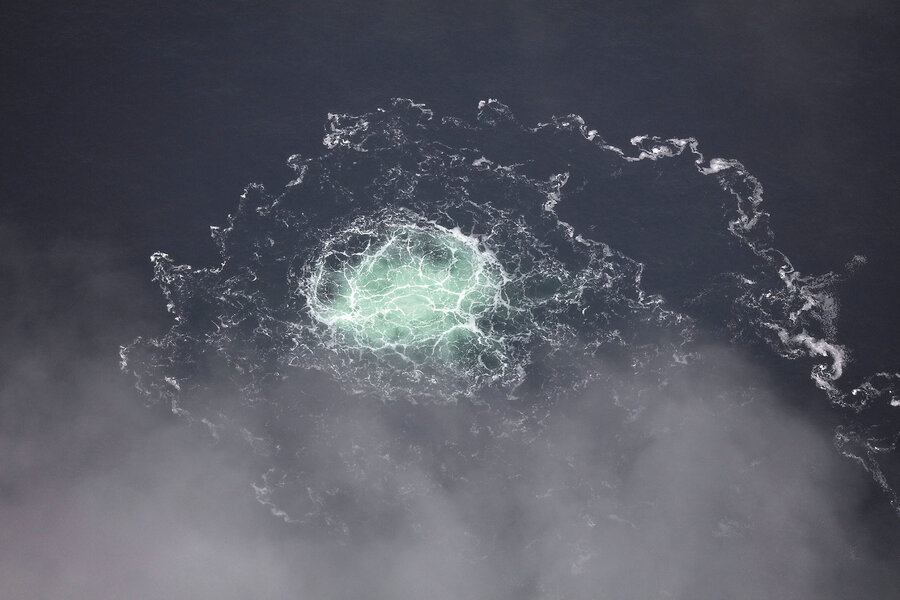
In September 2022, seven months after Russia’s full-scale invasion of Ukraine, a series of explosions in the Baltic Sea alarmed seismologists across Europe. The blasts destroyed Nord Stream 1 and 2, the world’s largest offshore pipeline system, which transported gas from Russia to Germany. Great geysers almost a kilometer (0.6 miles) in diameter erupted, unleashing methane. The cost of the leaked gas amounted to almost $2 billion dollars. Experts determined that the damage was not caused by an underwater earthquake. NATO then declared that the pipelines had been deliberately targeted. So began a blame game, with Russian leader Vladimir Putin accusing the CIA of terrorism and Western intelligence officials branding Russia the culprit. Who was responsible for one of the biggest and most audacious acts of sabotage in modern history? "The Nord Stream Conspiracy: The Inside Story of the Explosions That Shook the World," by Bojan Pancevski, Henry Holt and Co., 336 pp. Bojan Pancevski, the chief European political correspondent of The Wall Street Journal, embarked on a mission to unravel the mystery. His book, “The Nord Stream Conspiracy,” is a compelling account of his detective work. Drawing on years of interviews with a range of individuals, Pancevski tells an in-depth, multistranded story about a daring operation that rocked lives, destabilized economies, and shook the world order. Why We Wrote This Shadowy figures, deep-sea sabotage, and geopolitical skulduggery come together in a fascinating exposé by Wall Street Journal reporter Bojan Pancevski. His depiction of both the preparation of the mission and its execution keeps readers hooked. The book opens with the German response to the pipeline attack. Aware that this could be the biggest case of his career, Dieter Romann, head of the Germany’s Federal Police, puts his best man on the job. An officer referred to only as The Chief Investigator assembles a team. Two theories emerge: First, that the pipelines were destroyed by a minisubmarine or drone; the second, more fanciful, hypothesis was that a small team of professional divers was involved. As the investigators probe further, they discover that some countries – supposedly Germany’s allies – are proving secretive and obstructive.From here, Pancevski turns his focus on Ukraine and introduces a different set of protagonists. We meet a man called The Colonel, whose career as a law enforcement, intelligence, and military officer has involved everything from fighting corruption and organized crime to battling pro-Russian warlords. We also encounter his compatriot and brother-in-arms, The General, “another mastermind of crazy clandestine operations,” including a notorious plot that infiltrated Russia’s security apparatus. Shortly before Russia invaded Ukraine in 2022, the two men formed an elite combat group they named The Startup. “You could say we became a tiny little deep state,” The General tells Pancevski. When Russian forces finally invaded in 2022, The Startup offered effective resistance. But trading blow for blow wasn’t enough: To protect their homeland, the men knew they needed to hit the aggressor where it hurt the most, and that meant attacking the economy. A plan was devised and a target decided upon. “Nord Stream was Putin’s perfidious tentacle,” The Colonel says, “and it was wrapped around Europe’s neck.” Destroying the pipeline network would force the extrication of Europe from Putin’s stranglehold and, in the process, eliminate a critical source of Russia’s revenue. But Operation Diameter, as it was called, would be dangerous. It would involve a team of divers working with explosives under time constraints and high stress, in total darkness and freezing temperatures. Fulfilling their objective was one thing; doing so without getting caught or killed was another.It has become something of a cliché to say that a gripping work of nonfiction reads like a fictional thriller. However, that is indeed the case with “The Nord Stream Conspiracy.” Pancevski keeps us hooked. His depiction of both the preparation of the mission and its execution is wholly absorbing. We learn how eight civilian divers were selected, including one woman who, though less experienced, showed remarkable courage. After undergoing rigorous training, they endured first a delay to obtain fake IDs and then a fraught wait in a safe house. A day before departure, one diver tested positive for COVID-19. While at sea, storms created 7-foot waves, and their boat was tossed around “like a walnut shell.” It was no safer overboard: Diving to the seabed was like descending into a sandstorm.The book is just as riveting when Pancevski traces geopolitical tension and skulduggery. It continues to enthrall as the cast of shadowy operatives expands. As with The General and The Colonel, Pancevski has withheld the names of key figures, “for revealing their identities could put their lives at risk.” Joining The Captain, The Soldier, and The Skipper are more intriguingly named characters: The Iceman, The Smiley, and The Walking Lawsuit. Pancevski ensures his narrative loses none of its momentum in his last section devoted to the German investigation. Here, as the detectives home in on their quarry, we find out mistakes the conspirators made, from minor organizational errors to strategic blunders. It should be said that Ukrainian President Volodymyr Zelenskyy continues to deny official Ukrainian involvement in the Nord Stream explosion. Some parts of the book could have been dropped, such as pages on the history of Nord Stream and the perils of deep-sea diving. Otherwise, it is hard to fault this immersive and propulsive study, a fascinating exposé that illuminates murky, treacherous deeds not only at the bottom of the sea but also on dry land.
The audacious plot to blow up the Nord Stream pipelines
Full Article
Original Source
Read the full article at Csmonitor →KhanList aggregates and links to publicly available news content. We do not host full articles from third-party sources. Always verify important information with original sources.