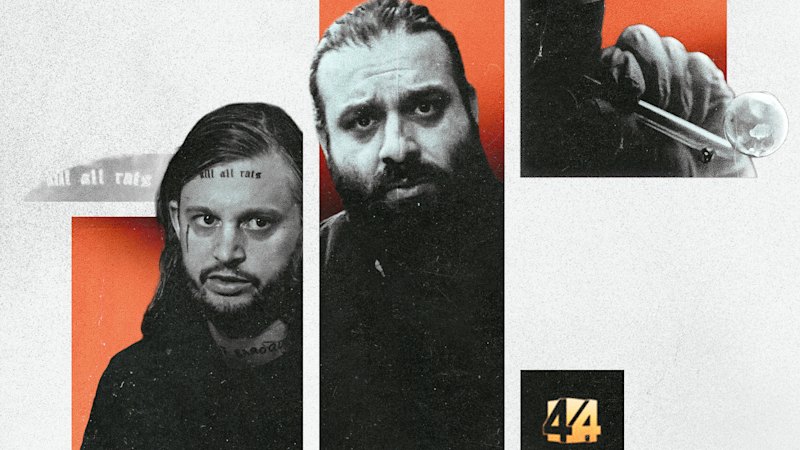
In March this year, former bikie, occasional winemaker and then-suspended Four Corners reporter Mahmood Fazal fronted a panel on “who speaks for culture” at an art school in Sydney. At the time, a small detail escaped attention: the branding for the event had been done by Benjamin Aitken, a five-time Archibald Prize finalist turned convicted drug dealer.It was just a subtle hint of the connections between the two. Connections that, on July 24, surged into view after the national broadcaster took the near-unprecedented step of pulling down two episodes of Four Corners. They both, staff had alleged internally in correspondence relayed to this masthead, featured Aitken in different guises. In one, he appeared under his own name as a recovering drug addict and dealer with a distinctive facial tattoo. In the other, he allegedly appeared in disguise as “Brendan”, an active methamphetamine cook.Artist Benjamin Aitken (left) was suspected by ABC staff of appearing as a meth cook (right) in a broadcast fronted by Mahmood Fazal (centre).Aresna VillanuevaLate on Friday, the ABC announced it had retracted another piece of journalism related to Fazal, a Background Briefing program entitled “Remy was 12 when she became a drug dealer”.The ABC’s decision to dump the episodes since triggered an internal conflict among the upper echelons of the national broadcaster. Managers with decades of service overseeing major investigations are battling to avoid blame for a saga that has tainted the reputation of the jewel in the broadcaster’s crown. Larger conversations about bureaucracy, journalistic ethics and race at the ABC have returned.Fazal, in a statement to this masthead, said the broadcaster’s treatment of him had gone “beyond legitimate editorial scrutiny”.“I’ve been left with the impression that there has been a concerted effort to retrospectively undermine my work and reputation,” he said. “I don’t comment publicly on confidential sources or editorial decisions concerning anonymity. Normalising the outing of sources when they’ve been given assurances is a threat to journalism.”That was just the most recent in a string of controversies that dogged Fazal’s tenure at the broadcaster, including allegedly relaying threats from an organised crime gang to a YouTuber and starting an unsanctioned podcast with an underworld media figure that took money from an unlicensed gambling site.Meanwhile, nearly every senior editorial decision-maker responsible for approving his work has left the ABC. Jo Puccini, the broadcaster’s head of investigations and current affairs, is soon to be the last remaining staffer at the ABC who was in the reporting line of the two removed Four Corners episodes.If Fazal’s tenure at the ABC ended in a blizzard of bureaucracy and blame, then it was a rare appetite for risk which led him to one of the most prestigious jobs in Australian journalism. The child of Afghan refugees, Fazal’s much-publicised journey, from a one-time sergeant-at-arms in the Mongols and Finks outlaw motorcycle gangs to Four Corners reporter, began with a series of bylines in the then-buzzy youth outlet Vice during the 2010s.Fazal’s writing, which probed topics such as the sex lives of inmates, his experiences facing gunfire, and trying prison-made homebrew, demonstrated his access to a criminal underworld understood by few Australians: drug dealers, petty crooks, wannabe gangsters.But even then, those relationships often strayed toward outright sympathy. In a 2016 first-person piece titled “Why Being a Mongol Biker Is Worth All the Arrests and Nanny State Bullshit”, Fazal wrote that membership of the gang had “shown me Australia’s potential as an open and inviting country”.Having departed the Mongols in 2016, Fazal had cultivated an image as a warrior poet and gourmand, mixing in the top tiers of Melbourne’s cultural sphere. He created his own wine label, Semiautomatic Wine, which released a $60 shiraz, and wrote for high-end Schwartz Media publications The Monthly and The Saturday Paper.Mahmood Fazal cultivated an image as a gritty investigative reporter and gourmand, drawing on his bikie past.Michael HowardIn 2021, Alice Brennan, the boss of the ABC’s premier investigative audio program, Background Briefing, brought Fazal to her show. A year later, he co-reported a Four Corners story called Postcode Wars on the gang conflicts in western Sydney. He had access to members of the Alameddine crime organisation and helped set up an interview between reporter Grace Tobin and rapper Ay Huncho, an alleged member of the gang.Fazal’s introduction to Four Corners came during a period of flux for Australia’s most famous television current affairs program. Sally Neighbour had just stood down as executive producer after seven years in what is described by staff as a brutally intense role. In 2021, Four Corners failed to win a Walkley Award for the first time in nearly a decade, and its annual report showed ratings had fallen by nine per cent.Sydney rapper Ali “Ay Huncho” Younes.InstagramAfter his work on Postcode Wars, Fazal returned to Four Corners and delivered his first solo story, which was broadcast in 2023 under the title Cocaine Nation. It was a ratings hit, the show’s most viewed episode that year and a Walkley finalist. Fazal won a permanent position with Four Corners. Brennan too had moved to the television program, where she was effectively second-in-command. Fazal, like many Four Corners reporters before him, had the makings of a star at the ABC with a long career ahead of him. Brennan declined to comment.But the tension between Fazal’s gangland past and high-profile present burst into public in 2024, when this masthead revealed allegations he had passed on threats from the Alameddine crime organisation to YouTuber Jordan Shanks and his producer Kristo Langker, who had been taking a hard look at alleged criminal links in the NSW property sector.The ABC backed Fazal to the hilt. He denied wrongdoing and claimed he was being ethnically stereotyped. The Four Corners team even issued a statement backing their colleague as an “award-winning, ethical and fact-based reporter”.Jordan Shanks’ YouTube broadcasts on his FriendlyJordies channel allegedly attracted threats from the Alameddine crime network, relayed by Mahmood Fazal.Sally RawsthorneWhile Four Corners was outwardly supporting Fazal, some media colleagues were growing sceptical of his methods. “It’s just not my experience that criminals will voluntarily admit to committing crimes – unsolved and uncharged,” says one veteran crime reporter at another media outlet. “The idea that someone would admit to trafficking drugs or being personally responsible for committing acts of violence – even anonymously – is a whole other level of risk that I haven’t seen criminal sources directly do.”There was a sense from staff that the show and the wider ABC leadership were to an extent blinded by the excellent ratings Fazal’s programs were pulling in and didn’t delve deep into his methods. The stories were also reaching new audiences on YouTube previously untapped by the national broadcaster, ABC executives boasted internally.But management was forced to act when, late last year, Fazal began working on an unauthorised podcast on underworld crime with self-styled “media cowboy” Ryan Naumenko. Naumenko was an unusual co-host: he reportedly served 15 days in prison in 2015 for trafficking cannabis, and has several other convictions.Ryan Naumenko, pictured on his short-lived podcast with Mahmood Fazal, has previous criminal convictions.YouTubeFazal had initially gone to his bosses asking to be interviewed on an external podcast. Fazal received initial endorsement from his boss, Four Corners’ executive producer Matthew Carney, but still needed written approval up the chain. People familiar with the saga suggest Fazal did not provide details about who the podcast was with, that he would be a co-host (not interviewee), would be paid for his part, and that payment was facilitated through sponsorship by an illegal crypto casino.The first episode was posted on YouTube in September 2025. Screenshots of a message sent from Fazal, later posted on social media by Naumenko, showed him claiming he had “final go ahead from my boss fkn yesss” on September 26, three days after the first episode had already been posted.They both agreed “we don’t do any work unless we’re paid”, according to screenshots posted online by Naumenko. But despite this, the external work application was never fully approved.When ABC executives saw the first episode was published containing ads for Vegastars, they were shocked. To make matters worse, Four Corners’ next episode, Losing Streak, was an investigation into dodgy online bookmakers.Even before the second episode of the podcast was recorded, relations between Fazal and Naumenko broke down. Naumenko said he showed up to the recording of the second episode six hours late. According to a video he later posted online, he arrived to find Fazal and his friend Aitken, the acclaimed Melbourne artist with a criminal record, demanding payment for the first two episodes.“Brendan” was presented as a meth dealer in the 2024 Four Corners episode Meth Highway, but staff believed he had appeared before.ABCThis masthead does not suggest Naumenko’s version of events is correct, only that the allegations were aired publicly and widely reported. “Ryan Naumenko has a criminal history, a history of harassment, and a documented record of dishonesty,” Fazal said at the time.Despite denying Naumenko’s allegation that he was paid, and enlisting the support of defamation solicitor Rebekah Giles to address coverage of the incident, Fazal was suspended by the ABC in October 2025. The broadcaster began an investigation.One question which still baffles many of his former colleagues is why Fazal would risk his career for a podcast with such an obviously inappropriate sponsor, co-hosted with such an unreliable figure. “You had the best job in Australian journalism!” says one bewildered colleague, on condition of anonymity.But after Naumenko published pictures of Fazal’s friend Aitken, bafflement turned to shock. Some ABC staff recalled they had seen the artist’s face before. He had appeared in Cocaine Nation two years prior under his own name. In that program, he was presented as a reformed one-time cocaine pusher with a glamorous moniker: “The Art Dealer”.In June 2022, Aitken had been convicted of a raft of serious crimes. During a raid of Aitken’s house, police found 90 grams of methamphetamine, a sawn-off shotgun, cocaine and ketamine. He told Fazal in the program that he had justified the path he had gone down as being a sort of “ethical drug dealer”. “Morally, dealing drugs is wrong,” Aitken told Fazal during the episode. It was not the most forthright repudiation of drug culture.Benjamin Aitken leaves court in 2022, when he was convicted of a raft of offences. He did not yet have his distinctive facial tattoo.Eddie JimA year later, Fazal’s second program for Four Corners, Meth Highway, featured a local meth cook in Melbourne dubbed “Brendan”, who hid his face behind glasses, bandages, and a mask while he cut up and smoked methamphetamine on camera. Fazal told viewers it had taken “a lot for us to convince him” to speak to Four Corners and tell his side of the story.Now, according to correspondence, the substance of which was relayed to this masthead, Four Corners staff who had seen raw footage of the broadcast identified the disguised man known as “Brendan” as Aitken. He is also alleged to have featured as a bug sweeper for another crime figure during Cocaine Nation, Four Corners staff said in the internal correspondence.That raised multiple red flags for staff. Had Fazal correctly portrayed Aitken as reformed in the first broadcast? Was he genuinely a meth cook as he appeared in the second episode? And had it really been so hard for Fazal to convince Aitken to talk?Aitken did not respond to a request for comment.The pair had history. In late 2022, six months before the broadcast of Cocaine Nation, Fazal opened Aitken’s first art show following his 18-month corrections order. The pair were both members of Melbourne’s Kelvin Club, the “most progressive” private members’ club in the city. Fazal then conducted Aitken’s first interview following his release, in which the latter said he wanted to straighten out the media image that had been constructed of him. And Naumenko had claimed Aitken designed the initial logo for his podcast with Fazal.Four Corners staff put their concerns about the two Fazal programs in writing, sending the explosive and detailed email to Carney in October 2025.Then, nothing appeared to happen. Fazal was already under investigation by the ABC over the podcast, but that process had been held up as he took extended leave.(He was ultimately sacked in May 2026, and is appealing to the Fair Work Commission.)In November 2025, Carney retired. A new boss, Joel Tozer, took over Four Corners. Tozer ran the contents of the email up the chain when he was made aware of them in May, but it was not until Friday 24 July, helped along by questions in anticipation of a deeply-reported piece by former Four Corners boss Neighbour in The Monthly, that the two episodes were removed. Clearly, behind the scenes, some form of investigation – whether a branch of the one examining the podcasts, or a separate probe – had been under way.Catharine Lumby, a former journalist turned media professor at the University of Sydney, said that if Fazal had used the same source in different ways, then he had breached his ethical duties.“I think it’s a form of conspiring to deceive the audience,” she said. “It’s lazy journalism. I think it’s unethical. I think we have to be very careful in journalism to explain why we are using an anonymous source, and to use someone in three different ways – it just doesn’t pass the bullshit test.”In his several statements over the past week, Fazal has insisted all of his work went through the rigorous fact-checking and verification processes that any other Four Corners production is subject to.“I’ve never refused to disclose the identity of a confidential source to my editorial supervisors where that was required as part of the editorial process,” he told this masthead in a long statement that responded to some questions, but not others. “Protecting a source’s identity from public disclosure does not mean there was no editorial and legal oversight.”Questions remain unanswered as to why the details of the Four Corners staff email were not escalated until more than six months later. When was the division’s boss, Puccini, made aware of the allegations within it? And why were they not acted upon until May? Internally, there are competing versions of events.“I was shocked by the contents of the confidential email and I did my own inquiries,” Carney said. “I will leave any further details about this matter to the ABC ombudsman inquiry,” he said, referring to an inquiry by the organisation’s external watchdog that began after the two episodes were pulled.“I was not aware of the reporter’s personal relationship with Ben Aitken,” Carney previously told this masthead. The rest of what he knows has been referred to the ABC’s ombudsman, he said.At the ABC, major investigations go through a traffic light system. If a story was determined to be “green”, it was deemed low-risk and the executive producer, in this instance Carney, would have final sign-off. Amber would require a “mandatory upward referral” and final responsibility for the episode shifts to the executive producer’s superior, in this case Puccini. Red, of course, would mean the story posed serious legal risks and would be assessed accordingly.Both now-removed stories were determined to be “amber”, ABC sources with knowledge of the process say, which meant both required sign-off by Puccini. This is not uncommon, with Puccini having to sign off on a significant number of Four Corners stories over the past four years. But, given that concerns among staff were only raised later, this does not mean she was informed of any sourcing issues at the time. And with a large division under her, Puccini would have had to trust her subordinates.When a series of questions were put to Puccini this week, she responded via defamation lawyer Monica Allen, best known for representing disgraced soldier Ben Roberts-Smith in his unsuccessful litigation against this masthead. Puccini did not provide an on-record response.“In keeping with the ABC’s editorial guidelines, I would’ve expected an appropriately senior person to have satisfied themselves with those anonymous sources before it went to air,” said Alan Sunderland, a former ABC editorial director. “If that didn’t happen, then somebody didn’t do their job properly.”Fazal said he had not been contacted by the ABC Ombudsman regarding any of his reporting, and that the broadcaster has not told him why his work was removed.“My reporting has always been subject to editorial oversight, fact-checking and legal review in accordance with the ABC’s editorial processes and based on the information available at the time of publication,” he said.And in a video on Instagram this week, Fazal cast the removal of his reporting and criticism of his work as a symptom of a broader disease affecting the ABC.“We all know that the problem in the joint is how they’ve been able to slowly replace ambition with bureaucracy. Instead of asking ‘is this the best journalism we can produce?’, they’re asking ‘is it legally safe? Will it generate complaints? Will it protect the organisation?’ Those questions do matter, but if they become the only questions, something important disappears.”Fazal also claimed that he “became a target” for new ABC bosses based on his identity.“Now that they got rid of me, I’m reduced to a f---ing diversity hire,” he said. “Or is it really about people like me having no place in telling the public different sides of the story?”The Fazal bombshell has landed during a fraught period for the ABC on issues around cultural diversity. Last year, Federal Court Justice Darryl Rangiah ordered the broadcaster to pay Antoinette Lattouf $70,000 after it sacked her from a radio gig “to appease … pro-Israel lobbyists” over her views on the war in Gaza. Stan Grant, the ABC’s most prominent Indigenous presenter, resigned in 2023 citing a lack of support from management when faced with racist abuse.In that context, Fazal’s claims have resonated among several journalists from diverse backgrounds at the ABC. Some suggested that while the allegations against Fazal deserved serious scrutiny, there was a sense that he had been hung out to dry by the broadcaster.Sami Shah, a former ABC radio presenter turned University of Melbourne journalism academic, said that the institution had traditionally failed to acknowledge the different life experiences of diverse journalists.“I think the ABC needs to understand that diverse staff come from diverse backgrounds,” he said. “It needs to have the institutional patience to understand that and to support and nurture them, rather than their current approach of shock and horror and running away screaming.”Lumby, who was commissioned by Google and Media Diversity Australia to write two reports into diversity in Australian journalism, said there was no evidence the ABC is structurally racist. “To simply say it was ‘this is just a case of racism’ is to deny the evidence of the basis on which the decision was taken,” she said of the Fazal saga.The affair has also lifted the lid on furious internal politicking at the ABC’s highest levels, as top staff seek to cauterise any damage. “It’s an incredible high-level battle of point scoring over who will take the fall,” says one veteran ABC journalist.Many in the chain of command from Fazal’s time have already left. Chair Ita Buttrose was replaced by Kim Williams part way through his tenure, news director Justin Stevens was forced out this year, Carney retired, and Brennan is now serving out the last days of a redundancy. Puccini remains in her role.Carney’s successor Tozer made clear in June that, in his view, standards at the program were not high enough and he had identified “some gaps” in key areas. He did not mention Fazal.With news chief Stevens gone, the newsroom is preparing for a reset. His replacement, Simon Robinson, arrives from global newswire Reuters in six weeks. If there ever was a time for cleansing in the ABC’s news division, it is now.By then, the ABC’s Ombudsman will have delivered its report. The findings are likely to inflict further damage onto the ABC, staff say. Managing Director Hugh Marks will want any lingering issues put to bed by then. The ABC’s own internal investigation, which led to the removal of the episodes, also continues.As one senior staffer said: “The new guy will be reading this all thinking: ‘Organised crime? Bikies? What the hell have I signed up for?’”The Business Briefing newsletter delivers major stories, exclusive coverage and expert opinion. Sign up to get it every weekday morning.
The artist, the ex-bikie and a scandal at the ABC that won’t end
Full Article
Original Source
Read the full article at Smh →KhanList aggregates and links to publicly available news content. We do not host full articles from third-party sources. Always verify important information with original sources.